
Navigating the AI Index: A New SEO Playbook for Verifying Content Retrieval Without Search Console
LONDON — In the rapidly evolving landscape of search engine optimization (SEO), traditional mainstays are undergoing a radical transformation. For decades, digital marketers and site owners relied on simple diagnostic commands like the "site:" operator in Google or Bing—or the time-tested method of dropping a unique text snippet into quote marks—to instantly verify whether a newly published page had made it into a search index.
These rudimentary checks were invaluable, especially when working on client sites without direct access to Google Search Console (GSC) or Bing Webmaster Tools (BWT). They were fast, effective, and free.
However, as generative AI search engines, conversational chatbots, and Answer Engine Optimization (AEO) reshape how users discover information, these old-school tricks are falling short. In the AI-search era, proprietary retrieval-augmented generation (RAG) models operate behind closed doors, often leaving SEO professionals in the dark regarding how—or even if—their content is being ingested, indexed, and surfaced.
Addressing this modern indexing blind spot, SEO practitioner Chris Green has introduced a clever workaround: leveraging conversational AI prompts and custom browser tooling to manually test whether large language models (LLMs) can retrieve specific web pages.
Main Facts: The Death of Traditional Index Checks and the Rise of AI Retrieval
The core challenge facing modern SEOs is transparency. Traditional search engines crawl the web, build an inverted index, and display URLs in a structured results page (SERP) that can be easily audited. Conversely, AI-powered search layers and chatbots retrieve data dynamically, synthesizing answers rather than merely listing blue links.
Without direct server log file analysis or verified platform dashboards like GSC, determining whether an LLM’s search infrastructure knows a page exists has become an opaque guessing game.
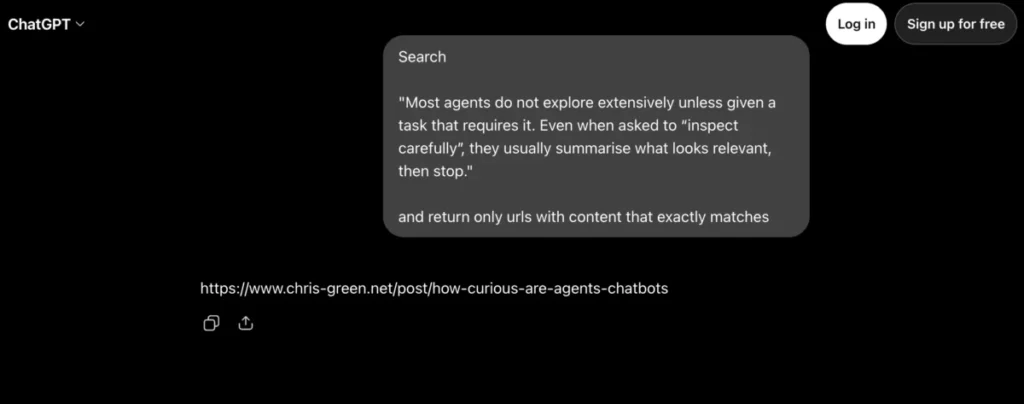
Green’s solution bypasses traditional search parameters by treating the AI chatbot itself as an auditing tool. By providing a chatbot with a precise, unique snippet of text from a target webpage and deploying a strict prompt constraint, marketers can establish whether a specific URL exists within an AI model’s active retrieval index.
The standard prompt template looks like this:
“Search for ‘[paste your unique snippet here]’ and return any results which contain that exact text only.”
Initial testing across various platforms shows that when signed-out instances of ChatGPT (equipped with web-browsing capabilities) successfully pull and cite the precise text, it offers definitive, empirical proof of two critical milestones:
- Discovery: The search-enabled AI has successfully crawled or discovered the URL.
- Retrieval: The underlying retrieval mechanism deems the content accessible and worthy of inclusion in its search index.
Chronology: How the SEO Industry Shifted from SERPs to LLM Retrieval
The transition from classic web search auditing to AI retrieval verification has evolved rapidly over the past several years:
- The Pre-AI Era: SEOs relied heavily on the
site:domain.com/page-pathoperator and exact-string searches in traditional search engines to confirm page indexing status within seconds. - The Rise of Generative Engines: As search engines integrated conversational AI features and standalone chatbots gained mainstream adoption, traditional indexing signals became fragmented. Marketers noticed that pages ranking well in traditional SERPs were not automatically being cited or pulled into conversational AI answers.
- The Visibility Gap: Webmasters managing complex migrations, large enterprise catalogs, or niche sites without direct dashboard access found themselves unable to diagnose why their content was missing from AI answers.
- The Prompt-Based Workaround: Industry specialists began experimenting with direct prompt instructions to force AI models to reveal their source indices, paving the way for structured manual testing and community-built automation scripts.
Supporting Data and Technical Implications
While this manual prompting technique offers a practical workaround, SEOs must interpret the data with caution. AI models do not operate like deterministic database queries; they draw from a shifting matrix of diverse data sources, APIs, and cached indexes.

What to Do If Your Page Fails the AI Retrieval Test
If a targeted snippet test yields no results or fails to return the correct URL, site owners are advised to systematically troubleshoot standard technical barriers:
- Crawling Blocks: Check
robots.txtfiles to ensure AI user-agents (such as GPTBot, OAI-SearchBot, or ClaudeBot) are not explicitly blocked from accessing the site. - Rendering Issues: Verify whether the content requires heavy JavaScript execution that the AI’s scraper failed to render correctly.
- Canonicalization and Meta Directives: Ensure no accidental
noindextags or conflicting canonical tags are confusing automated scrapers. - Discovery Latency: Remember that indexing takes time. A newly published page may simply be sitting in a discovery queue awaiting its turn to be crawled.
Dealing with False Negatives
Because different AI instances or localized API calls may pull from different regional or weighted data caches, a single negative test is not definitive. Green recommends running the exact-match snippet test four to five times, potentially altering the text snippet slightly if initial results remain ambiguous.
Implications for the Future of AEO (Answer Engine Optimization)
The emergence of AI retrieval testing highlights a broader evolution within the digital marketing industry. We are moving away from optimizing solely for keywords and meta tags, and moving toward optimizing for machine readability and retrieval mechanics.
Furthermore, industry experts draw a sharp distinction between retrieval and ranking. Successfully passing the AI snippet retrieval test only proves that a chatbot can see and fetch your content. It does not guarantee that the model will prioritize, rank, or cite your page in response to broad user prompts.
If a page successfully passes the retrieval check but still fails to generate referral traffic or citations within AI answers, the problem shifts from technical SEO to content authority and competitive differentiation. In the AI-search ecosystem, generic content will easily be bypassed in favor of sources demonstrating deep topical authority, unique data insights, and unmatched utility.
Streamlining the Workflow: Enter "Exactly Matchy"
Recognizing that copy-pasting text snippets and crafting restrictive prompts manually is tedious for large-scale site audits, open-source developers have begun building custom solutions.
To bridge this gap, Chris Green has released an experimental, open-source browser extension called "Exactly Matchy" (available via GitHub). Designed as a "vibe-extension," the tool aims to streamline the process of testing exact-match retrieval directly inside a browser workflow without manual prompt engineering.
How the Extension Operates:
- Users highlight a specific block of text on any live webpage.
- Triggering the extension automatically packages the snippet into a pre-formatted retrieval prompt.
- The tool interfaces with the active AI chat window to execute the query, returning a streamlined pass/fail indication based on whether the AI successfully retrieves the exact URL.
Note on Security: Because community-built extensions require manual installation via developer mode (forking the GitHub repository and loading it locally into Chrome), users are strongly advised to review the source code independently. As Green notes, installing unverified browser extensions is the digital equivalent of accepting candy from a stranger; caution and due diligence are paramount.
Conclusion: Balancing AI Workarounds with Sound Technical SEO
The inability to query AI search indices through traditional interfaces like Google Search Console is a frustrating reality for modern SEO professionals. While prompt-based retrieval testing and custom browser tools like Exactly Matchy provide an ingenious workaround, they should be viewed as diagnostic aids rather than absolute truths.
AI chatbot responses are probabilistic, not deterministic. Therefore, digital marketers must pair these AI-specific workarounds with foundational technical SEO best practices—ensuring clean log files, robust crawlability, proper rendering, and clear internal linking structures.
By mastering both technical fundamentals and modern AI retrieval checks, SEOs can better navigate the shifting sands of search and ensure their content remains visible in an increasingly automated digital ecosystem.
