
Navigating the 2026 Horizon: Jon Miller’s Strategic Forecast for B2B Go-To-Market
As we move into 2026, the B2B marketing landscape is undergoing a metamorphosis that transcends mere technological adoption. Jon Miller, the industry visionary and co-founder of Marketo, has released his fourth annual set of predictions, offering a roadmap for an era where AI is no longer a peripheral tool but a central participant in the buying journey.
Miller’s analysis suggests that 2026 will be the year the "vision of AI-powered marketing comes into focus." However, he provides a sobering caveat: while the technology is maturing, enterprise adoption will be incremental. The gap between theoretical capability and practical reality remains substantial, setting the stage for a year of "hybrid experimentation" rather than a wholesale replacement of traditional frameworks.
The Core Shift: Marketing to Agents, Not Just Humans
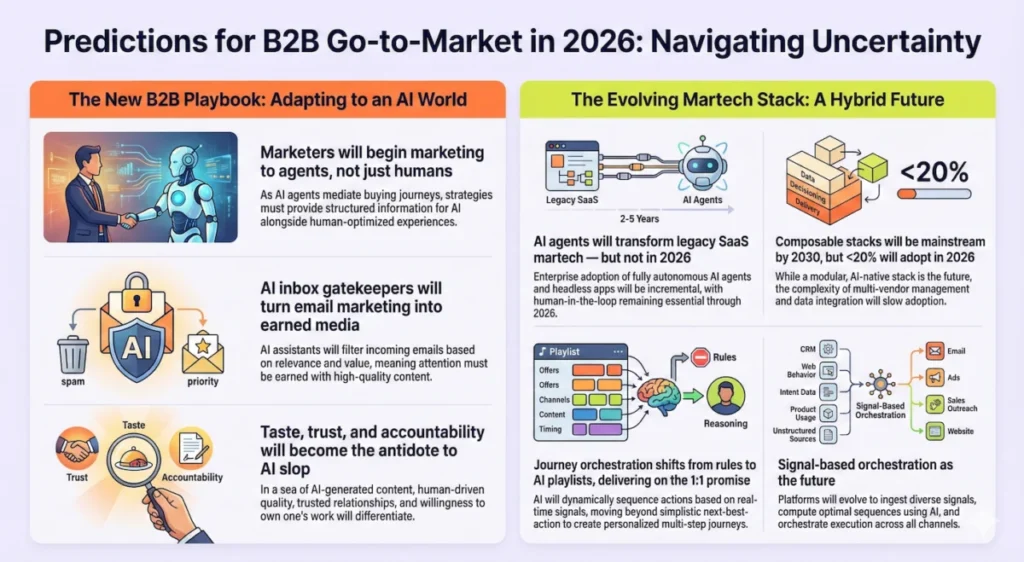
The most fundamental change outlined by Miller is the emergence of AI agents as key stakeholders in the B2B buying process.
The Rise of Agentic Buying Committees
B2B buying journeys are increasingly mediated by artificial intelligence. Agents are now researching, evaluating, and narrowing down vendor lists alongside human stakeholders. This shift requires marketers to transition from traditional SEO to "Answer Engine Optimization" (AEO).
- Key Fact: 90% of B2B buyers utilized AI tools for research in 2025, and 72% encountered AI Overviews during their evaluation phase.
- Strategic Pivot: Companies must now prioritize "headless" content architecture. While human buyers continue to demand emotionally engaging, branded experiences, AI agents require structured, API-accessible data—such as dynamic pricing models and technical knowledge bases—to perform their evaluations.
Chronology of Transformation: From Rules to Reasoning
The evolution of martech is not happening in a vacuum. Miller categorizes the shift as a move from rigid, rules-based automation to adaptive, reasoning-based AI.
- 2023–2024 (The Foundation): The industry focused on basic LLM integration and the initial excitement surrounding generative content.
- 2025 (The AEO Era): Marketers focused on optimizing for AI summaries and search engine chatbots, treating AI as a search-adjacent tool.
- 2026 (The Hybrid Year): Organizations are moving toward "agentic" workflows. We are witnessing the birth of "composable" stacks, where modular, AI-native components replace monolithic legacy platforms.
- 2027–2030 (The Maturity Phase): Full-scale composable architecture is expected to reach mainstream adoption, shifting the market toward signal-based orchestration.
Supporting Data and Market Realities
The transition to a composable martech stack is a central theme of Miller’s 2026 outlook. However, the data reveals a slower pace of change than many "techno-optimist" influencers suggest.
- Stack Composition: While custom, composable platforms grew from 2% to 10% of the market in 2025, the majority of mid-market firms still rely on integrated platforms like HubSpot or Marketo. Miller predicts that less than 20% of B2B teams will achieve a fully composable architecture by the end of 2026.
- Automation Gaps: Currently, 81% of AI usage is "assist-only," with less than 10% of implementations allowing agents to act autonomously.
- The "Silent Freeze": Data from Pave and Stanford Digital Economy Lab indicates a significant contraction in entry-level hiring. SDR positions, for example, dropped from 1.98% of the workforce in early 2023 to 1.45% by mid-2025. This creates a "barbell economy" where junior talent is increasingly excluded from the on-ramp, potentially harming long-term industry expertise.
Official Industry Perspectives and Implications
Miller’s predictions echo sentiments from other industry leaders, including Scott Brinker and analysts at Gartner and Forrester. The overarching consensus is that the "SaaS is dead" narrative is premature. Instead, we are entering a period where SaaS platforms must either evolve into AI-native, API-driven engines or risk obsolescence.
Implications for the Modern CMO:
- Context Engineering as a Discipline: As AI takes on more operational tasks, the quality of output will depend entirely on "context engineering." This involves formally capturing the tribal knowledge—naming conventions, Salesforce schema logic, and campaign strategy—that currently lives in Slack threads and human heads.
- The Death of "Batch-and-Blast": Email marketing is shifting from "owned" to "earned" media. With AI gatekeepers like Outlook Copilot and Apple Mail filtering inboxes, relevance and trust are the only currencies that matter.
- Taste and Accountability: In an age of "AI slop," content that lacks human insight will be ignored. The most successful marketers will be those who stake their professional reputation on the output, acting as the final curator and validator of AI-generated work.
- Signal-Based Orchestration: The ultimate goal is to move beyond "next-best-action" toward "playlists." By sequencing multiple actions rather than relying on a single touchpoint, marketers can finally deliver on the decades-old promise of 1:1 personalization.
Preparing for Uncertainty: The "Human" Imperative
Perhaps the most poignant aspect of Miller’s report is his assessment of global uncertainty. The "World Uncertainty Index" is at an all-time high, driven by geopolitical instability, economic volatility, and the rapid pace of technological change.
How to Navigate the Storm
Miller advises against "freezing" in the face of this disruption. Instead, he outlines four pillars for navigating 2026:
- Build Efficiency: Organizations must operate lean to create a cushion. Efficiency is not just about cost-cutting; it is about creating the agility needed to pivot when market conditions shift.
- Enable, Don’t Replace: Focus on teaching teams to use AI to challenge their own assumptions. AI should be a partner in brainstorming and strategy, not a replacement for human judgment.
- Upskilling through AI: Utilize AI as a personalized coach for your existing staff. The technology is uniquely capable of providing on-demand skill development that traditional training programs cannot match.
- Redesign for Adaptability: Move away from hyper-specialized, siloed roles. The future belongs to the "generalist strategist" who can fluidly manage data, content, and agentic workflows across a unified stack.
Conclusion
As Miller concludes, "2026 won’t be predicted as much as navigated." The era of deterministic rules-based marketing is ending, replaced by a dynamic, reasoning-based future. While the transition brings significant risks—particularly regarding job displacement and the erosion of entry-level career paths—it also offers a path toward a more meaningful, efficient, and personalized marketing future.
For B2B leaders, the task is clear: invest in the signal foundation, document the operational logic that makes your business unique, and maintain the human-in-the-loop accountability that will define the winners in this new, AI-mediated landscape.
