
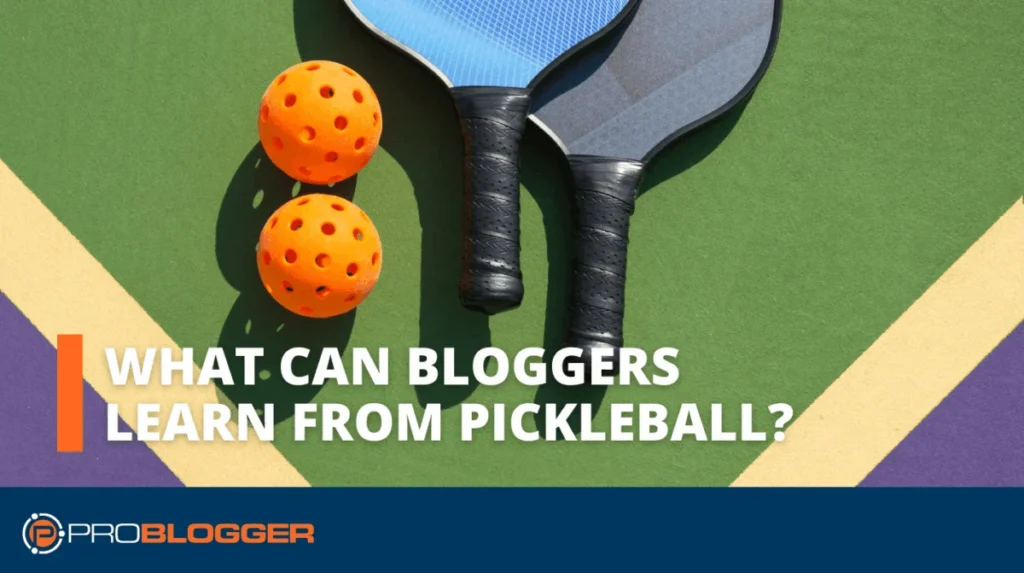
From the Court to the Content Hub: 10 Strategic Lessons Bloggers Can Learn from the Pickleball Phenomenon
In the ever-evolving landscape of digital content creation, bloggers are constantly seeking fresh metaphors to explain the complex, high-stakes game of audience building and SEO. Occasionally, inspiration strikes from the most unexpected of places—in this case, the brightly colored, noisy, and fast-paced world of pickleball.
As the fastest-growing sport in the United States, pickleball has transcended its status as a "quirky" pastime to become a full-scale cultural movement. Beyond the satisfying pop-pop of paddles against plastic, the sport offers a surprisingly robust masterclass in strategy, community management, and sustainable growth. For the modern blogger, looking at the court through the lens of a content strategist reveals that the principles of winning a match are nearly identical to those required to win over an online audience.
The Genesis: A Chronology of Growth
To understand why pickleball serves as such a potent model for success, one must look at its history. The sport was born in 1965 on Bainbridge Island, Washington, when Joel Pritchard and Bill Bell returned from golf to find their families bored. With limited equipment, they improvised—lowering a badminton net, using ping-pong paddles, and utilizing a perforated plastic ball.
What began as a backyard experiment for bored families has transformed into a global industry. By 2023, the Sports & Fitness Industry Association reported over 13.6 million players in the United States alone. The trajectory from a makeshift court to professional leagues and prime-time broadcasting mirrors the ideal lifecycle of a blog: a small, scrappy experiment that solves a specific problem (in this case, "boredom") and scales into a massive, dedicated community.
1. Start Small, Think Big
Pickleball did not begin with multi-million dollar stadium contracts; it began with a need to fill an afternoon. Bloggers often suffer from "analysis paralysis," waiting for the perfect design or the perfect strategy before publishing their first post.
The lesson here is simple: launch with what you have. A thriving content hub is merely a collection of individual posts that have stood the test of time. Your "backyard game" might be a niche hobby blog, but if the foundation is sound and the rules are clear, the potential for expansion is limitless.
2. Rally Your Community
In pickleball, a rally is the lifeblood of the game. It is the back-and-forth tension that keeps players engaged and spectators watching. In the world of blogging, a "rally" is the conversation you have with your readers.
When you respond to comments, you are keeping the ball in play. When you host Q&A sessions or invite guest posters, you are expanding the court. A blog that operates as a monologue will eventually stagnate; a blog that treats its comment section like a rally will cultivate a loyal, returning audience that feels invested in the "game."
3. The Art of ‘Dinking’: Mastering Simplicity
Perhaps the most distinct element of pickleball is the "dink"—a soft, intentional shot hit into the opponent’s "kitchen." It is not about brute force or power; it is about precision and patience.
Bloggers often make the mistake of trying to "power-hit" their readers with overly dense, jargon-heavy, or complex content. Sometimes, the most effective strategy is a "dink":
- Simplify: Break down complex concepts into digestible bullet points.
- Clean Layouts: Use whitespace to give your readers’ eyes a break.
- Clarity: Prioritize the message over the fluff.
By slowing the pace and focusing on precision, you force your reader to pay attention to your value proposition, much like a well-placed dink forces an opponent to stay sharp.
4. Finding the Sweet Spot: Engagement Balance
The "kitchen" (the non-volley zone) is the most critical area of the court. It is a place of restriction, but also a place of maximum control. For a blogger, your "kitchen" is the balance between providing free value and monetizing your content.

If you are too far back, you are distant and unreachable. If you "volley" too aggressively—shoving products and affiliate links at your readers before they’ve even had a chance to get to know you—you’ll be penalized. Find the sweet spot where you are close enough to your audience to provide high-level engagement without overstepping the boundaries of trust.
5. Learning from the ‘Whiffs’
Every player, from a novice to a professional, misses the ball. In pickleball, this is called a "whiff." In blogging, a "whiff" is a post that flops—no engagement, no shares, and no traffic.
The difference between a failing blogger and a successful one is not the absence of mistakes; it is the speed of the recovery. When a post fails, don’t take it personally. Analyze the data:
- Was the headline weak?
- Was the timing off?
- Did it not address a real pain point?
Adjust your grip, change your stance, and get ready for the next serve.
6. Adaptability: The Digital Landscape
The rules of pickleball have evolved as the game has become more professional, and players have had to adapt their techniques to stay competitive. Similarly, the digital landscape is in a constant state of flux. Google algorithm updates, the rise of AI-generated content, and the shifting preferences of social media platforms mean that what worked for you in 2020 may not work in 2024.
Successful bloggers are those who treat their content strategy as a living, breathing document. Be prepared to pivot your SEO approach or experiment with new content formats as the "court" changes.
7. Keep Your Eye on the Ball
It is a cliché for a reason. In the heat of a fast-paced rally, it is easy to get distracted by the competition or the environment. In blogging, it is easy to get distracted by vanity metrics like follower counts or what your competitors are doing.

Stay focused on your primary objective: your audience’s needs. If your content remains laser-focused on providing genuine value, the rest of the game becomes much easier to manage.
8. Serve Strong, Serve Smart
A serve is the only part of a pickleball match that you have total control over. It sets the pace for the entire point. Your blog post’s introduction is your serve. If it’s weak or uninspired, you lose the advantage immediately.
Invest time in your headlines and opening paragraphs. A strong hook grabs the reader by the collar and pulls them into your content, ensuring that they are invested in the point before they even reach the middle of the text.
9. Strategic Positioning
In pickleball, positioning is the difference between an easy return and a lost point. Players must constantly anticipate where the ball is going. For bloggers, this means understanding your niche. Are you positioning yourself as an authoritative expert? A relatable peer? A source of breaking news?
By understanding your unique position in the market, you can anticipate your audience’s questions before they even ask them. Strategic positioning allows you to own your "side of the court" rather than constantly chasing the ball.
10. Embrace the Fun
The most important lesson pickleball offers is that it is, fundamentally, a game. The reason it has become a global phenomenon is not just because of the strategy, but because it is inherently enjoyable to play.

If you view your blog as a tedious chore, your readers will feel that exhaustion in your writing. If you approach your content with genuine enthusiasm and passion, that energy is contagious. When you enjoy the process, the "hard work" of blogging transforms into a creative outlet, making it easier to sustain your efforts over the long haul.
Implications for the Future of Content
The intersection of sports psychology and digital content strategy is becoming increasingly relevant. As audiences become more fragmented, the ability to build a community through consistent, strategic, and human-centric engagement—much like a local pickleball club—is becoming the most sustainable path to growth.
By applying these ten lessons, you aren’t just writing blog posts; you are building an ecosystem. You are learning to control the pace of the conversation, adapt to the shifting needs of your readers, and maintain the stamina required for the long-term game.
So, pick up your keyboard, step onto the court, and start playing. Your next "big hit" might be just one serve away.
