
Fourthwall vs. Gelato: The Ultimate Print-on-Demand Showdown for Creators and E-Commerce Entrepreneurs
Introduction
The print-on-demand (POD) landscape has evolved dramatically over the last decade. Gone are the days when launching an online merchandise line required sinking thousands of dollars into bulk inventory, renting garage storage space, and manually tracking international shipping slips. Today, advanced API integrations, localized global production hubs, and all-in-one storefront platforms have democratized digital entrepreneurship.
Among the leading solutions in this space are Gelato and Fourthwall. While both cater to creators, artists, and e-commerce entrepreneurs looking to sell custom-branded merchandise without holding inventory, their foundational philosophies couldn’t be more different. Gelato operates primarily as a global logistics and production powerhouse that integrates into your existing store, whereas Fourthwall functions as an all-in-one brand-building ecosystem complete with its own customizable website builder and multi-stream monetization features.
This comprehensive guide analyzes the core facts, chronological development, supporting data, platform dynamics, and broader industry implications of choosing between Gelato and Fourthwall for your next e-commerce venture.
Main Facts: Understanding the Core Platforms
To make an informed decision between Gelato and Fourthwall, it is essential to first understand what each platform is designed to achieve.
- Gelato: Positioned fundamentally as a print-on-demand production and fulfillment partner, Gelato connects seamlessly to your existing storefronts—whether that is Shopify, Etsy, Wix, Squarespace, or TikTok Shop. Gelato does not provide a standalone storefront; instead, it relies on a massive, decentralized global network spanning over 140 production hubs. Its primary value proposition is local production (roughly 90% of orders are produced locally), which radically slashes transit times and minimizes carbon footprints.
- Fourthwall: Positioned as an all-in-one e-commerce and brand-building platform, Fourthwall provides users with a custom website, a dedicated domain, and built-in print-on-demand infrastructure. Beyond custom apparel and accessories, Fourthwall expands a creator’s catalog to include self-sourced physical goods, digital downloads, memberships, and direct donations. Furthermore, Fourthwall acts as the Merchant of Record (MoR), handling complex sales tax obligations and managing customer support inquiries for its native catalog items.
High-Level Comparison Matrix
| Comparison Factor | Fourthwall | Gelato |
|---|---|---|
| Core Architecture | Brand-building platform with built-in POD & website builder | Global print-on-demand production and fulfillment partner |
| What You Can Sell | POD, self-sourced physical items, digital downloads, memberships | Custom POD products (apparel, wall art, stationery, home goods) |
| Starting Cost | Free to sign up (5% fee on digital/memberships on free plan) | Free to sign up (Paid plans available for advanced features) |
| Administrative Support | Acts as Merchant of Record; handles catalog-item customer support | Fulfillment and back-end fulfillment support only |
| Sustainability Focus | Eco-friendly products available; secondary focus | Core pillar utilizing local production and non-toxic inks |
| Integrations | Social channels (TikTok, YouTube), email marketing, Etsy | Major e-commerce platforms (Shopify, Wix, WooCommerce, Etsy) |
| Fulfillment Network | Worldwide shipping partners | 140+ localized production hubs across the globe |
Chronology: How Both Platforms Reached Market Dominance
The trajectories of Gelato and Fourthwall reflect the shifting demands of the creator economy over the past several years.
The Rise of Gelato: From Global Logistics to Local POD
Founded with a vision to eliminate waste in the printing industry, Gelato initially built its reputation on software-driven print workflows for traditional publishing and commercial printing. As the creator economy exploded, Gelato pivoted heavily into the print-on-demand sector, leveraging its preexisting global network of printing partners.
Instead of centralizing production in a single mega-warehouse—the traditional model used by many early US-based POD companies—Gelato engineered a localized, decentralized network. Over the years, this has expanded to over 140 production facilities worldwide. Recent milestones include the launch of the Personalization Studio (allowing end-consumers to customize products directly on storefronts), advanced AI mockup tools via GelatoCreate, and enhanced pricing navigation engines designed to protect creator profit margins amidst fluctuating global supply chain costs.
The Evolution of Fourthwall: Beyond Merchandise to Creator Commerce
Fourthwall emerged to solve a very specific pain point for content creators, streamers, and independent brands: the friction of piecing together disparate tools. Historically, creators had to stitch together Shopify for a website, Printful or Printify for merchandise, Patreon for memberships, and separate apps for digital downloads.
Recognizing this administrative burden, Fourthwall integrated all these revenue streams into a single unified dashboard. Over successive iterations, the platform expanded its capabilities to include social commerce links (such as YouTube Shopping and TikTok Shop), a designer marketplace to help creators find artists, and sophisticated AI integrations like the Eli AI assistant. By 2026, Fourthwall further broadened its marketplace footprint by adding native integrations with platforms like Etsy, cementing its status as an end-to-end commerce solution.
Supporting Data & Financial Breakdown: Which Costs Less in Practice?
When analyzing e-commerce tools, upfront subscription costs only tell half the story. True platform economics involve factoring in transaction fees, associated software stack costs, and operational overhead.
Gelato Pricing Strategy
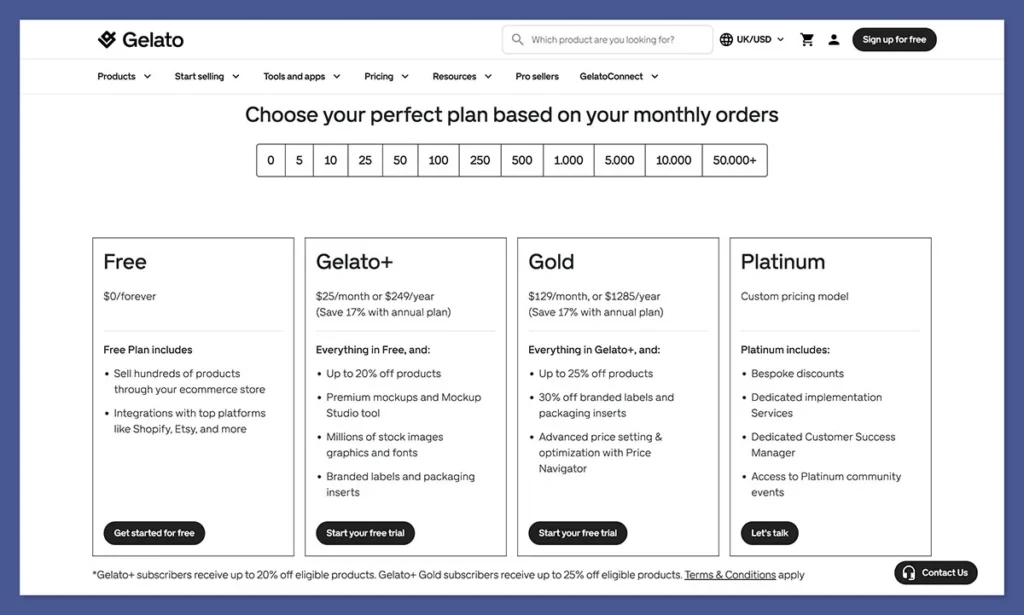
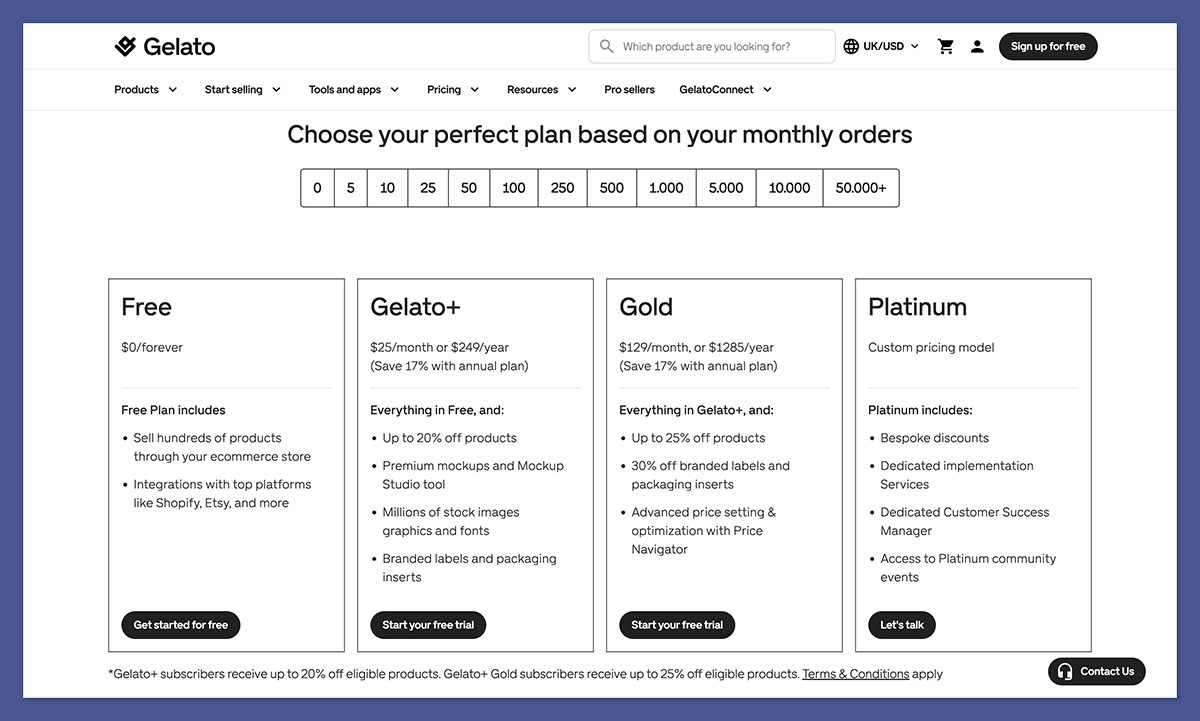
Gelato offers a robust Free Plan that grants users access to its entire print-on-demand catalog, free mockups, basic design tools, and integrations with nearly any e-commerce channel.
As businesses scale, many merchants opt for the Gelato+ Plan, priced at $29.99 per month. While this monthly fee represents an upfront expense, it unlocks critical profit-boosting features:
- Product discounts of up to 33% on base manufacturing costs.
- Access to the Personalization Studio and Magic Mockups.
- Automated product migration tools and price navigators.
The Hidden Cost of Gelato: Because Gelato is purely a fulfillment backend, users must factor in the cost of their primary e-commerce platform (such as Shopify at $39+/month or paid tiers of Wix/Squarespace) alongside email marketing software and other operational plugins.
Fourthwall Pricing Strategy
Fourthwall’s pricing architecture is structured to minimize upfront overhead for new creators:
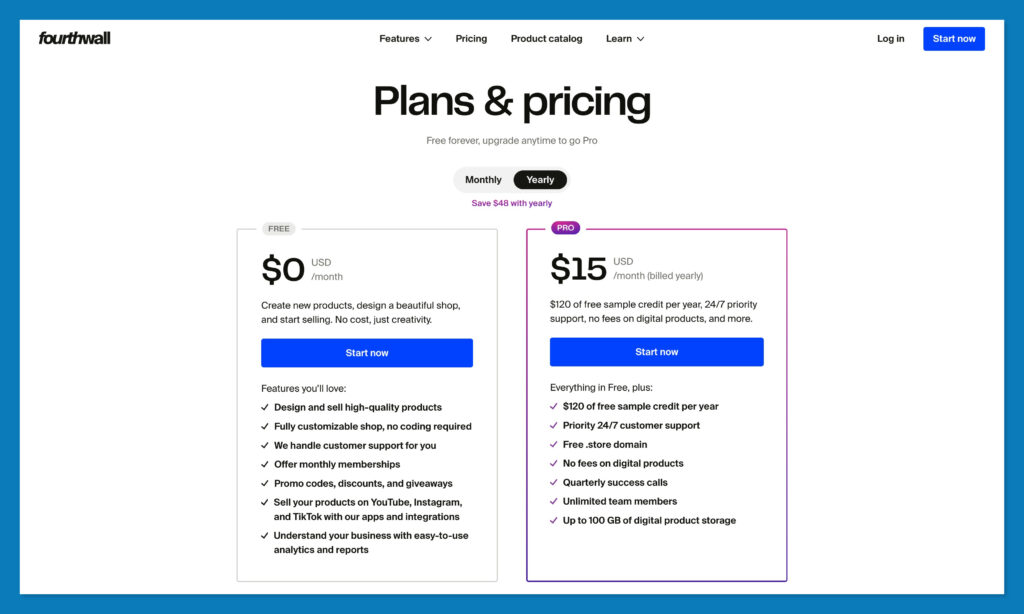
- Free Plan: Completely free to launch a fully customized storefront, domain connection, and POD catalog. It includes zero platform fees on physical merchandise, though a 5% transaction fee applies to digital downloads and memberships.
- Pro Plan ($19 per month): Eliminates the digital download fee, introduces unlimited team members, advanced analytics, priority customer support, and $10 in monthly sample credits to test out new products.
The Economic Verdict: If you are launching a brand from scratch and do not already maintain an active Shopify or Etsy store, Fourthwall is significantly cheaper. It eliminates the need for standalone website hosting subscriptions, bundled app fees, and external checkout providers. Conversely, if you are an established merchant already generating steady revenue on Shopify, Gelato integrates cleanly into your existing operational framework without forcing a platform migration.
Product Range, Quality, and Monetization Opportunities
Product Quality and Catalog Breadth
Both platforms excel in output quality, though their catalog philosophies differ:
- Gelato: Offers a comprehensive, high-grade catalog spanning apparel, drinkware, bags, and stationery. Crucially, Gelato’s wall art and paper products consistently rank above industry averages, making it the premier choice for digital artists, photographers, and illustrators. The design tools are intuitive, and the Personalization Studio allows buyers to input custom names, dates, or imagery directly into the layout.
- Fourthwall: Focuses heavily on retail-grade, premium apparel and lifestyle goods. While its raw catalog count may not match massive legacy POD aggregators item-for-item, the baseline quality is exceptionally high. Fourthwall also enables advanced print placements—such as printing directly onto apparel sleeves—that are often restricted by competing providers. Furthermore, its hybrid model allows you to mix POD items with self-sourced inventory (e.g., custom vinyl records or plush toys shipped to Fourthwall’s warehouse for fulfillment).
International Shipping, Logistics, and Sustainability
Global reach is non-negotiable for modern creators with international audiences. Both platforms offer worldwide shipping, but their methodologies diverge sharply.
- Gelato’s Eco-Centric Localization: Gelato treats sustainability as a core brand pillar. By routing orders to the production facility nearest the end customer, approximately 90% of all orders are produced locally. This drastically reduces transit times (with roughly 90% arriving within five days) and significantly cuts carbon emissions associated with long-haul air and freight shipping. Gelato utilizes non-toxic inks and eco-conscious collections extensively.
- Fourthwall’s Global Network: Fourthwall utilizes a reliable fulfillment network spanning the US, UK, EU, Canada, Mexico, Japan, and Australia. Standard delivery typically ranges between 5 to 8 days depending on regional stock availability. While Fourthwall offers sustainable product lines, its corporate positioning leans more heavily toward creator empowerment and brand monetization than Gelato’s explicit environmental crusade.
Administrative Support, Compliance, and Risk Management
Operating an e-commerce brand involves navigating complex legal, tax, and customer service hurdles. This is arguably the starkest point of divergence between the two contenders.
Gelato: Operational Independence
When utilizing Gelato, you remain entirely responsible for the front-facing administration of your business. This means you must personally configure sales tax automation, manage state and international tax compliance, handle refund requests, and correspond directly with customers when packages face carrier delays or manufacturing defects. While integration apps on Shopify can automate some of these tasks, the ultimate legal and customer-service burden rests on your shoulders.
Fourthwall: The Merchant of Record Advantage
Fourthwall dramatically reduces administrative friction by acting as the Merchant of Record (MoR) for transactions conducted on its platform.

- Tax Compliance: Fourthwall assumes responsibility for calculating, collecting, and remitting global sales taxes and VAT, shielding independent creators from complex regulatory tax audits.
- Customer Support for Catalog Items: If a customer orders a Fourthwall POD item and encounters a print defect, sizing issue, or transit damage, Fourthwall’s internal support team steps in to manage and resolve the ticket directly, removing the support burden from the creator.
Official Responses and Platform Innovations
Leadership teams across both companies have doubled down on technological modernization to capture the evolving creator economy.
Gelato’s executive roadmap emphasizes hyper-localized manufacturing efficiencies and AI-driven design assistance. By continually expanding its network of local printers, Gelato aims to insulate creators from international tariff volatility and shipping bottlenecks. Their recent rollout of automated mockup generators and creator analytics widgets reflects a concerted push to provide enterprise-grade data insights to solo entrepreneurs.
Fourthwall’s development strategy centers on holistic brand ecosystems. The integration of advanced AI assistants like Eli allows merchants to execute complex store modifications—such as launching flash sales, altering product descriptions, or analyzing conversion drop-off points—via conversational prompts. Additionally, the inclusion of podcast hosting integrations (via RSS.com) and a dedicated designer marketplace highlights Fourthwall’s aggressive positioning as an operating system built specifically for creators, podcasters, and digital influencers rather than traditional retail dropshippers.
Implications: Which Platform Should You Choose?
Selecting between Gelato and Fourthwall ultimately depends on your current business infrastructure and long-term strategic ambitions.
When to Choose Gelato
- You already operate an established store: If you have an optimized, high-converting storefront on Shopify, Etsy, Wix, or Squarespace, uprooting your site makes little sense. Gelato plugs directly into your existing infrastructure.
- You prioritize sustainability and local transit: If your brand identity is built around eco-friendly practices, non-toxic materials, and minimizing carbon footprints via localized manufacturing (140+ hubs), Gelato is unmatched.
- You sell heavy wall art or paper goods: Gelato’s framing, poster, and stationery quality outperforms most competitors in the print-on-demand space.
When to Choose Fourthwall
- You are starting from scratch: If you do not yet have a website and want to spin up a professional, custom-branded storefront without paying separate monthly fees for hosting and ecommerce software, Fourthwall is the clear winner.
- You want to diversify monetization streams: If your business model relies on selling a mix of merchandise, digital downloads, gated memberships, and direct community donations under one roof, Fourthwall handles it natively.
- You want to minimize administrative overhead: Acting as the Merchant of Record and taking over customer support for catalog defects makes Fourthwall an ideal choice for creators who want to focus purely on content creation and marketing rather than backend logistics and tax compliance.
Final Verdict
Both Gelato and Fourthwall represent the gold standard of modern print-on-demand fulfillment, but they solve different problems. Use Gelato if your primary need is flawless, localized global production and robust fulfillment integration for an existing store. Use Fourthwall if you want to build an expansive, multi-revenue-stream creator brand from the ground up with minimal administrative headaches.
