
Building the Modern Social Media Engine: Your 2026 Hiring Blueprint
In the rapidly evolving digital landscape of 2026, the definition of a "social media team" has fundamentally shifted. Gone are the days when a single intern could manage a brand’s presence as an afterthought. Today, a successful social media unit functions as a high-velocity engine that blends human creativity and strategic intuition with the surgical precision of AI-powered efficiency. Whether you are a lean startup leveraging a single, AI-augmented manager or an enterprise scaling a dozen specialists across global regions, your hiring strategy must be as dynamic as the algorithms themselves.

The Evolution of the Social Media Team
In 2026, the social media team is no longer an isolated silo; it is the heartbeat of modern customer experience. Effective teams now exist at the intersection of content marketing, customer care, growth marketing, and brand strategy.

As a rough benchmark for organizational scaling, team composition generally follows three maturity stages:
- Early Stage (1–2 people): Typically a generalist Social Media Manager, often supported by freelance creative talent for high-impact visual assets.
- Mid-Market/Scale-up (3–5 people): A team lead overseeing specialized roles in content creation, paid advertising, and community engagement.
- Enterprise (6–12+ people): A senior leader owning global strategy, with distinct sub-teams focused on regional nuances, platform-specific content, paid media, and data analytics, frequently supplemented by agency partners.
Strategic Hiring: Recognizing the Need for Growth
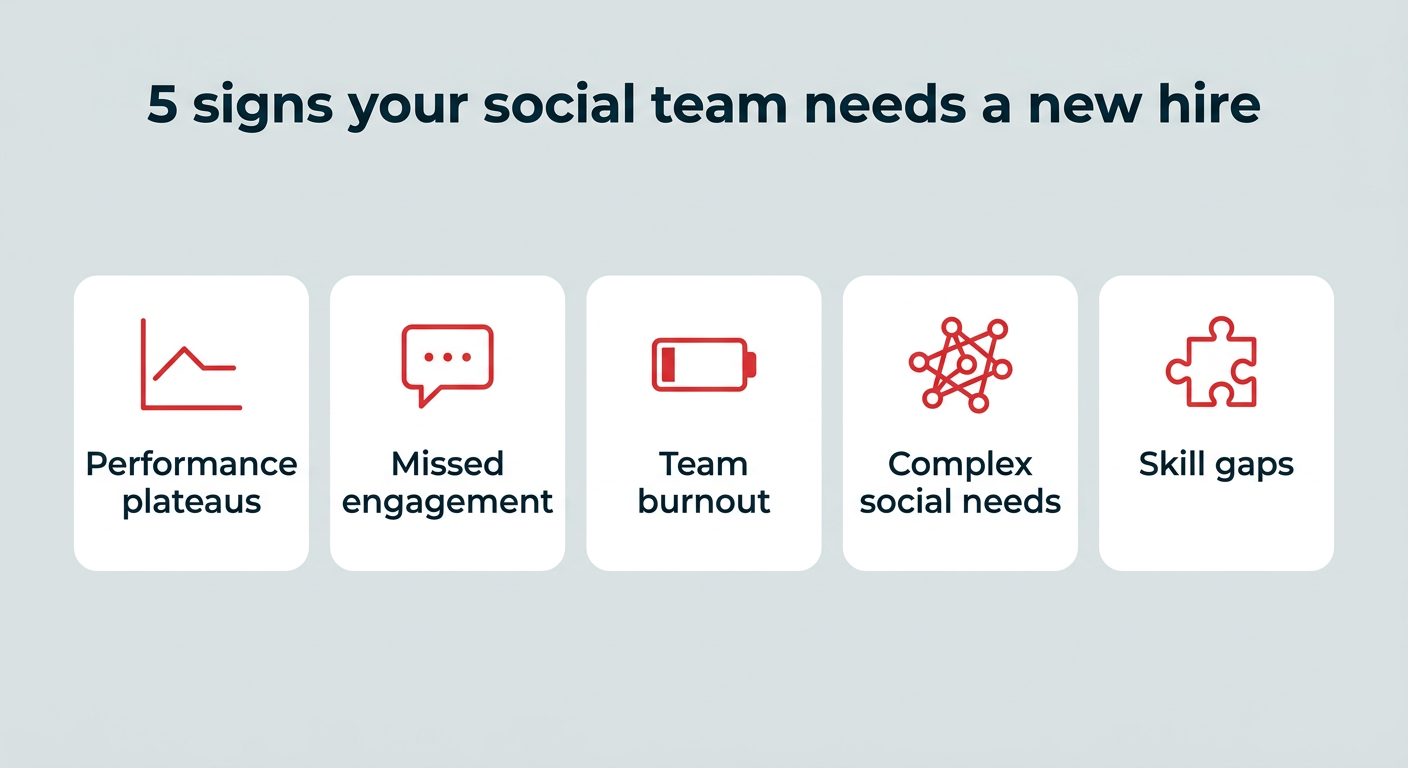
The decision to expand your social team should not be based on vanity metrics or arbitrary company growth milestones. Instead, it should be a response to operational pressure. The most reliable indicator that you have outgrown your current capacity is a performance plateau: the work volume continues to increase, but your engagement, conversion rates, and brand sentiment remain stagnant.

"When the volume of conversations we need to participate in exceeds our capacity, that is when we decide to hire," says a representative from a leading digital agency. "Beyond simple volume, we hire when we identify a competency gap—areas like sophisticated social listening or advanced paid-media attribution—that our current team isn’t equipped to handle."

Mapping Roles to Business Objectives
Before drafting a job description, hiring managers must audit their current bottlenecks. If your primary goal is lead generation, a Paid Social Specialist should be your priority. If your brand is suffering from poor sentiment or high churn, a Community Manager is your most valuable asset.
Core Roles and Responsibilities
- Social Media Manager: The foundational hire. They own the strategy, day-to-day execution, and scheduling.
- Social Media Strategist: Focused on big-picture planning, data-driven audience targeting, and aligning social goals with the broader business funnel.
- Content Creator/Video Producer: The creative engine responsible for brand voice, short-form video, and visual storytelling.
- Community Manager: The "face" of the brand in the comments section. They manage social listening and foster trust in groups and forums.
- Paid Social Specialist: Responsible for the technical side of ad spend, targeting parameters, and ROI tracking.
- Social Analytics Lead: A high-level role that translates raw social data into actionable business intelligence.
Salary Benchmarks and Market Realities
In 2026, compensation transparency is not just a best practice—it is a competitive necessity. According to recent market data, the median annual wage for marketing management roles, which often encompass senior social leadership, sits near $165,000. For individual contributors, expectations vary significantly by region and industry.

- Social Media Manager: ~$91,000 (Range: $54k–$95k)
- Social Media Strategist: ~$93,000 (Range: $55k–$101k)
- Community Manager: ~$66,000 (Range: $49k–$77k)
- Paid Social Specialist: ~$65,000 (Range: $44k–$71k)
Note: These figures are based on self-reported averages and reflect total compensation. Employers should adjust for cost-of-living differences in major metropolitan hubs versus remote-first organizations.

In-House vs. Agency: Choosing Your Model
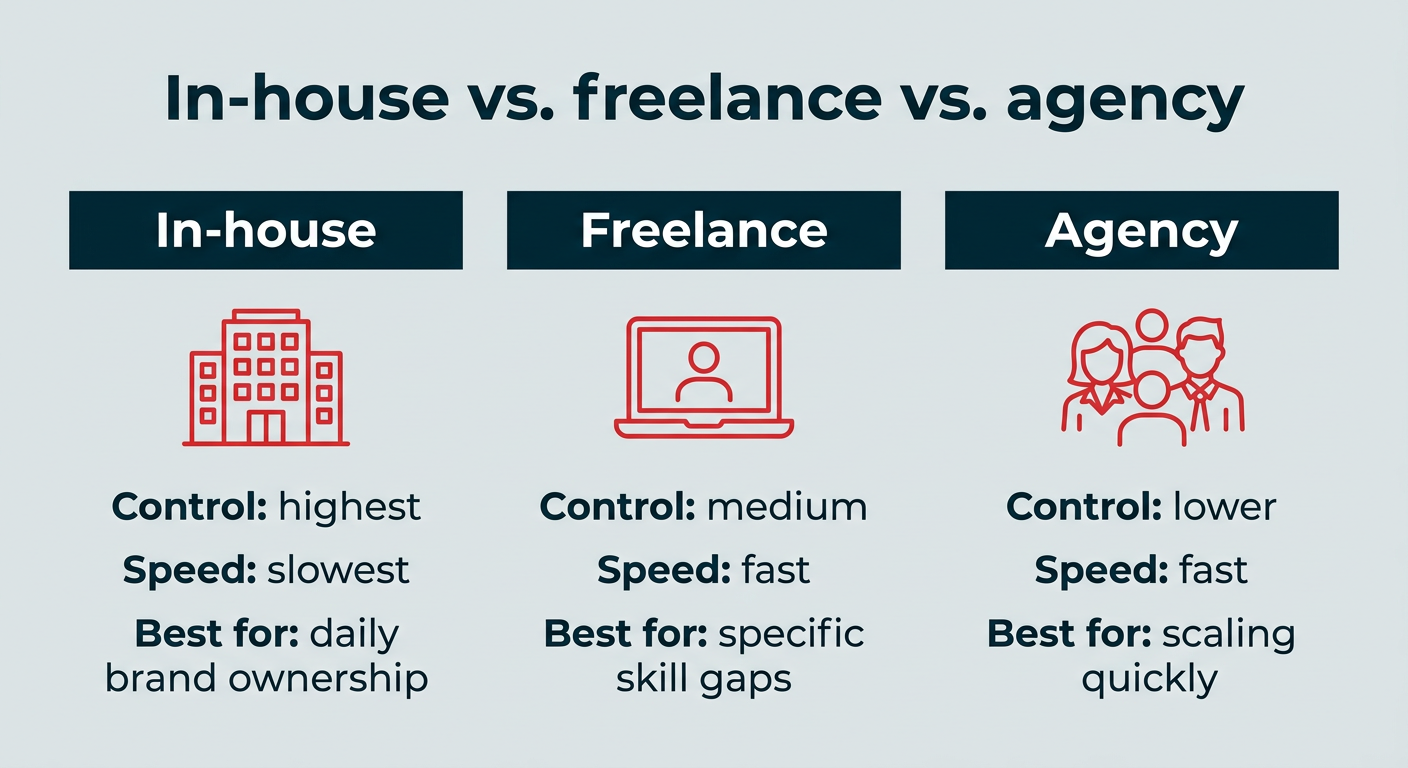
The "make vs. buy" decision hinges on three factors: budget, control, and speed.

- In-House: The gold standard for maintaining a consistent, authentic brand voice. It is the most expensive but offers the highest level of institutional knowledge.
- Freelance: The ideal solution for filling specific skill gaps (e.g., motion graphics or high-end video editing) without the overhead of full-time headcount.
- Agency: Best for rapid scaling. If you are launching in a new market or need to deploy massive paid campaigns quickly, an agency provides the necessary infrastructure and talent depth immediately.
Interviewing for the Future: AI and Human Insight
The emergence of AI has changed the interview process. In 2026, proficiency in AI tools—such as using LLMs for caption variations, summarizing social listening data, or automating initial reports—is a baseline expectation, not a specialty skill.
During interviews, focus on these critical AI competencies:
- Prompt Engineering: Can they use AI to iterate on content concepts?
- Editorial Judgment: Can they recognize when an AI output is "off-brand" and fix it?
- Efficiency: How have they used AI to reduce manual, low-value administrative tasks?
However, the "human factor" remains paramount. Look for candidates who prioritize niche community engagement over chasing viral trends. A red flag in any candidate is an inability to discuss smaller, specialized accounts that are doing excellent work; it suggests a lack of deep research and genuine passion for the craft.
Implications for the Future
The social media landscape is no longer about "being online." It is about being data-literate, operationally efficient, and emotionally intelligent. As we move further into 2026, the gap between companies that treat social as a "marketing channel" and those that treat it as a "strategic pillar" will widen.

For organizations looking to build for the long term, the focus must shift from hiring for "social media experience" to hiring for "strategic agility." Your next hire should be someone who understands the nuances of short-form video but can also defend the ROI of their content in a boardroom.
Onboarding and Long-Term Success
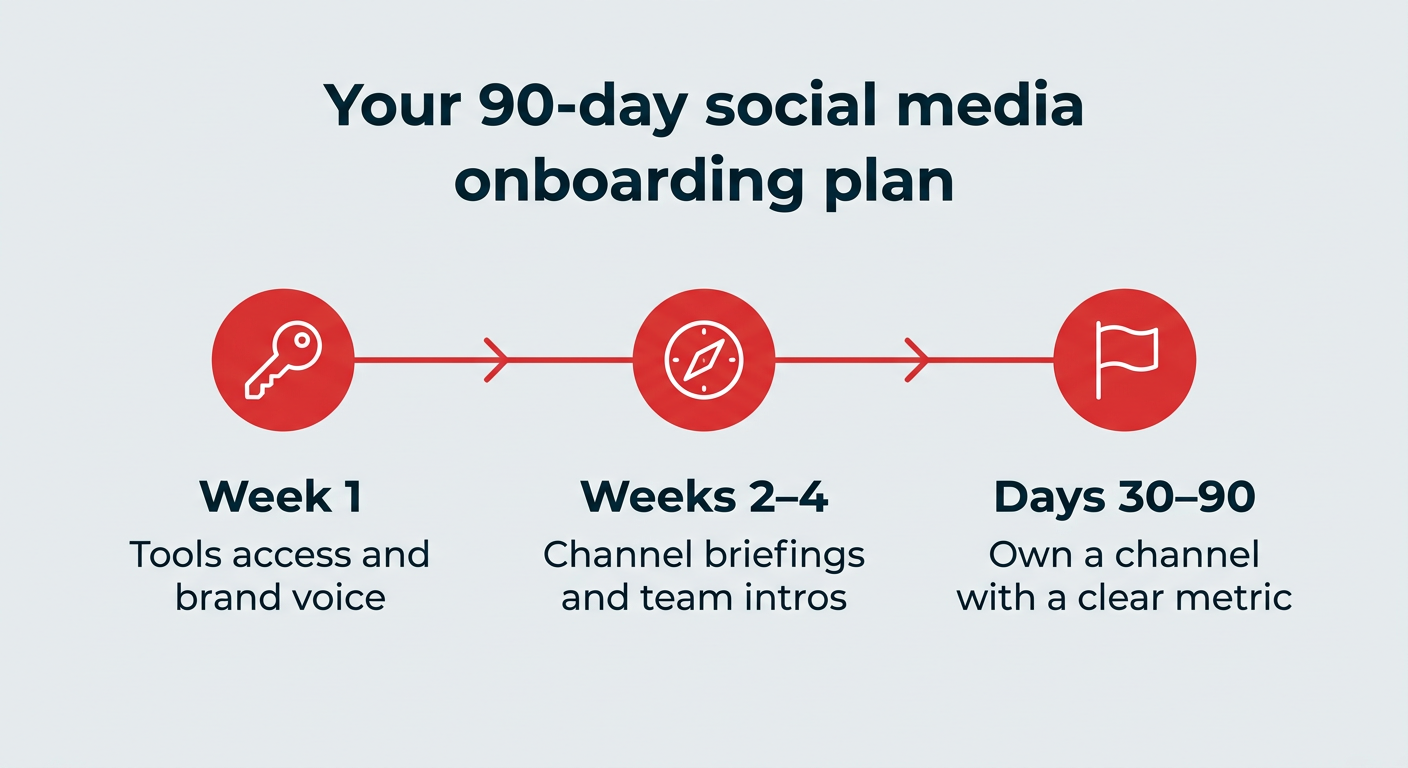
The final piece of the puzzle is onboarding. A structured 90-day plan—covering tool training in week one, brand voice immersion in month one, and independent campaign ownership by day 90—is essential to reduce churn. Investing in continuous upskilling is equally vital; with 77% of HR professionals now prioritizing learning initiatives, a company that does not offer ongoing education for its social team will quickly find itself losing talent to more forward-thinking competitors.
By treating social media hiring as a core business function rather than a support role, companies can turn their social presence into a sustainable competitive advantage, driving customer loyalty and revenue in an increasingly crowded digital economy.
