
Beyond the Vanity Metric: Why Audience Intelligence is the New Currency of Influencer Marketing
The influencer marketing landscape is undergoing a tectonic shift. For years, the industry operated on a "spray and pray" methodology, prioritizing high-level reach, massive follower counts, and viral view counts. However, as marketing budgets face increasing scrutiny, the era of evaluating influencers solely by their vanity metrics is rapidly drawing to a close.
Today’s most successful brands are abandoning the pursuit of sheer scale in favor of precision. They are asking harder, more analytical questions about their target audiences to distinguish between creators who simply command attention and those who genuinely drive business outcomes. This evolution is the focal point of a new comprehensive report, Redefining Influencer Value: How Audience Intelligence Transforms Reach into Revenue, which provides a roadmap for navigating this data-driven landscape.
The Core Thesis: Correlation Does Not Equal Conversion
The central premise of the report is provocative yet empirically grounded: the creators generating the highest volume of views are frequently not the ones generating the most tangible value for a brand. By analyzing datasets across healthcare, gaming, and consumer packaged goods (CPG), the research demonstrates that when marketers move beyond "reach" to examine "audience intelligence"—including search affinity, shopping behaviors, and cultural alignment—the entire strategic calculus changes.
In the past, a brand might select an influencer based on a high engagement rate. Now, sophisticated marketers are looking at the topology of an audience. Where do they go next? What are they searching for before they make a purchase? By identifying these behavioral patterns, companies can shift from being reactive to being proactive, inserting their products into the consumer journey exactly where intent is forming.
Healthcare on Instagram: The Convergence of Clinical and Curated
Perhaps nowhere is the necessity of audience intelligence more apparent than in the healthcare sector. On platforms like Instagram, the healthcare conversation is significantly broader and more fragmented than many traditional brands realize.
A Dual-Narrative Ecosystem
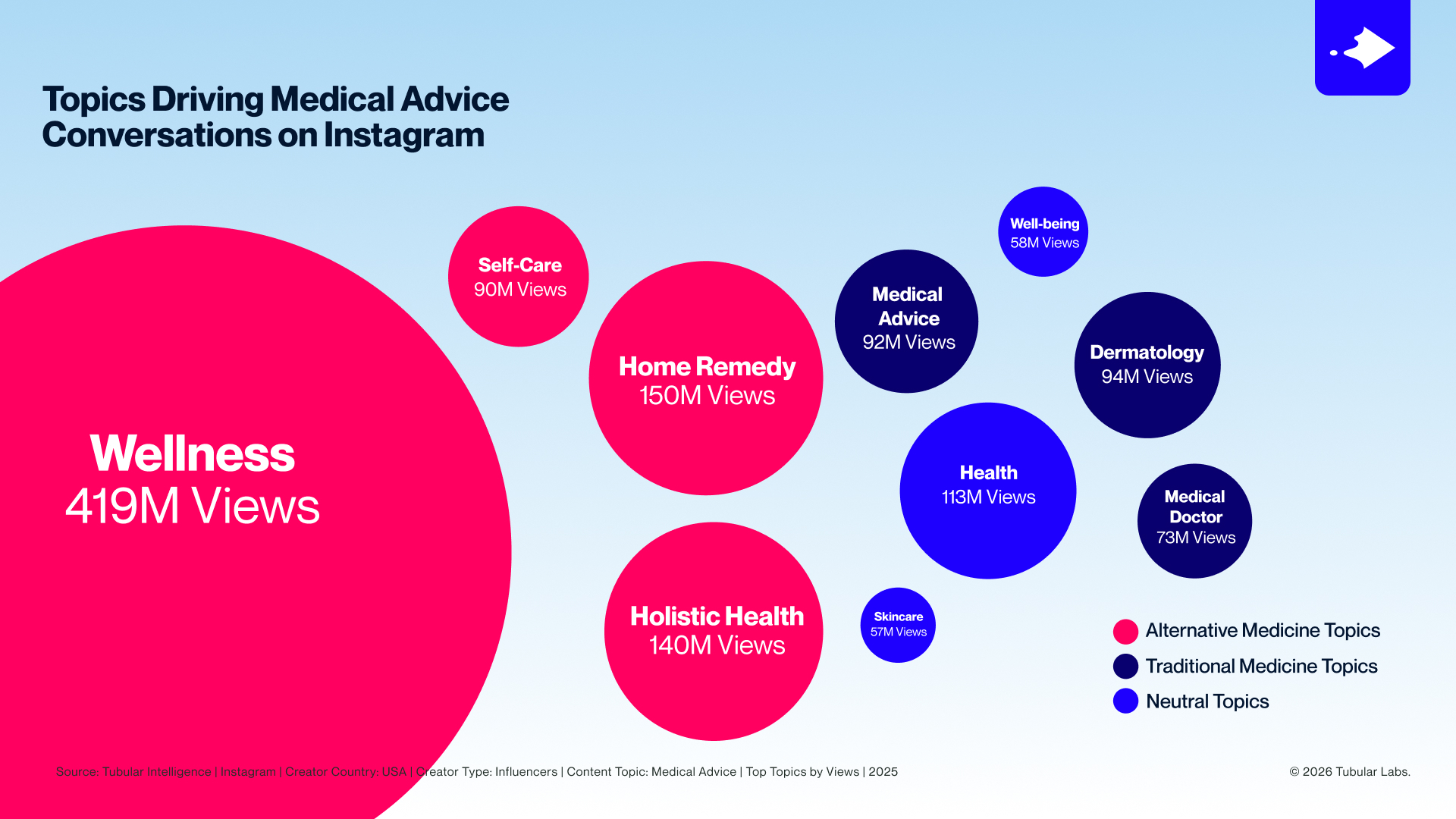
An analysis of U.S. influencer content throughout 2025 reveals a fascinating trend: consumers are not choosing between clinical authority and alternative wellness narratives. Instead, they are consuming both simultaneously. A user might follow a board-certified dermatologist for evidence-based skincare advice while simultaneously engaging with holistic wellness influencers who advocate for natural supplements.
For pharmaceutical, skincare, and health-tech brands, this creates a distinct strategic imperative. If a brand limits its visibility to purely clinical content, it effectively silos itself away from a massive, curious audience that is actively oscillating between medical science and alternative lifestyle content. The strategic opportunity lies in bridging these worlds, meeting the audience at the intersection of curiosity and decision-making.
The Anatomy of an Influencer: A Case Study in Dermatology
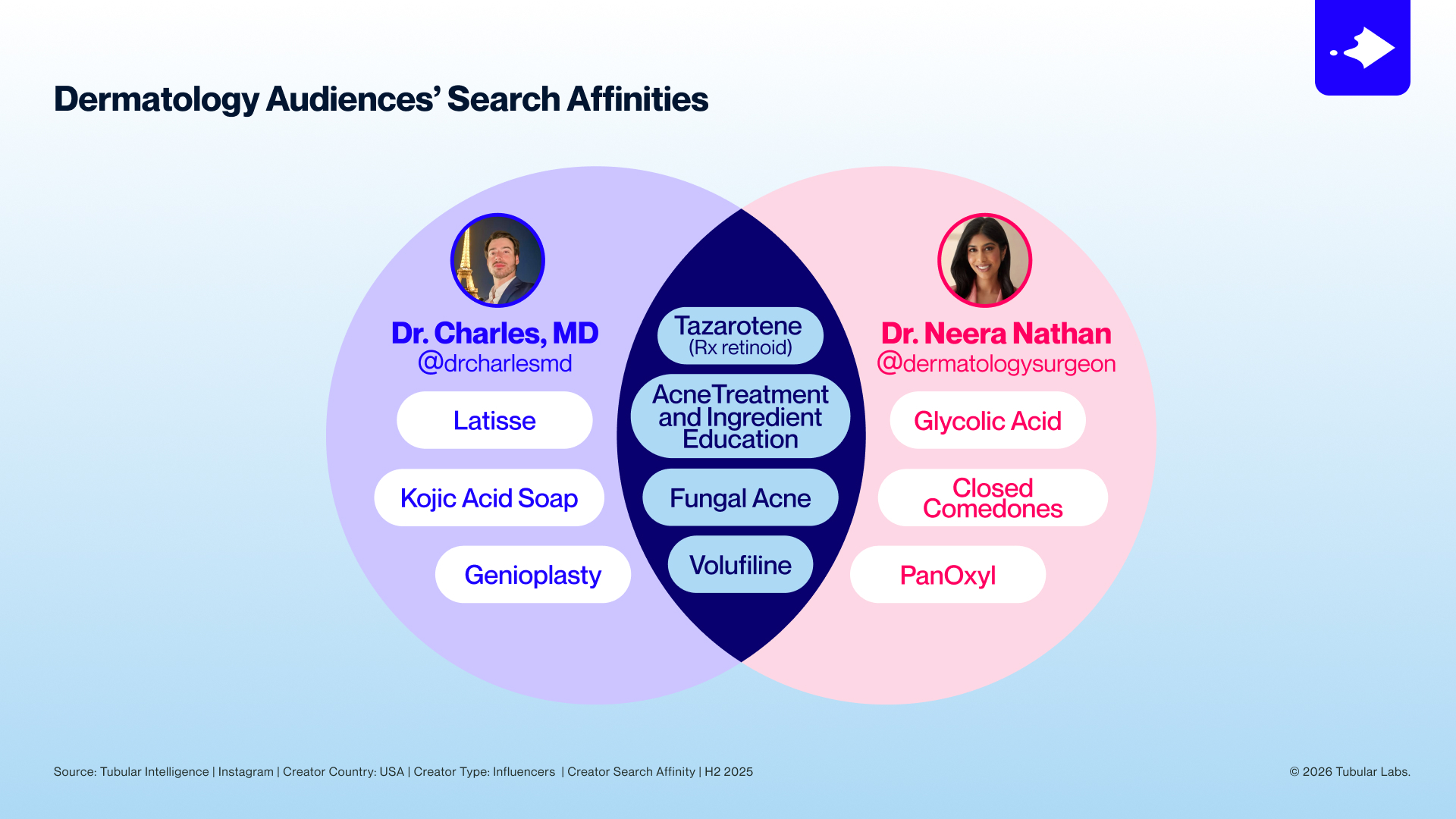
To illustrate how intelligence trumps headcount, the report examines two prominent Instagram dermatology creators: Dr. Charles, MD, and Dr. Neera Nathan.
At first glance, a brand looking to market a product like Latisse might default to Dr. Neera Nathan, who commands a substantial audience of 1.8 million followers. Her content is highly accessible and broadly relevant. However, when layering in audience intelligence, a more nuanced picture emerges.
Data shows an asymmetric overlap: 17% of Dr. Charles, MD’s audience also consumes content from Dr. Neera Nathan, whereas only 2% of her audience actively follows his content. Dr. Charles serves as a high-authority bridge. By partnering with him, a brand can achieve a dual benefit: engaging his highly specialized, scientifically literate audience while simultaneously positioning the brand within the periphery of the broader, mainstream-adjacent audience that follows Dr. Nathan.
This is the power of "strategic layering." It moves beyond the binary choice of "niche vs. massive" and into a sophisticated, multi-tiered acquisition strategy.
Chronology of an Evolving Industry
The maturation of influencer marketing can be viewed through three distinct phases:
- The Awareness Era (2010–2016): Influencer marketing was defined by the "shout-out." The objective was brand awareness, and the primary metric was reach. Influencers were often treated as digital billboards.
- The Engagement Era (2017–2022): Brands became skeptical of fake followers and low-quality reach. The focus shifted to engagement rates—likes, comments, and shares. The "micro-influencer" became the industry darling, as smaller audiences were perceived to be more authentic.
- The Intelligence Era (2023–Present): We are currently in the age of "Outcome-Based Marketing." With advancements in AI and big data, brands can now map the customer journey across social platforms. We are no longer asking "Who has the most followers?" but rather "Who has the audience that is currently searching for the solutions my product provides?"
Global Insights: Gaming and CPG
While healthcare provides a clear case for clinical vs. consumer alignment, the principles of audience intelligence hold true across diverse global markets.
Gaming and Anime: Separating Noise from Intent
In East and Southeast Asia, YouTube gaming and anime influencers generated a staggering 18 billion views in 2025. However, the report indicates that the sheer volume of content acts as a "noise" layer. The creators who actually influence purchase intent for gaming hardware or subscription services represent a tiny, hyper-focused segment of that 18 billion. By filtering by search affinity—looking for audiences who are actively researching gaming peripherals or software updates—brands can identify the small subset of creators who move the needle, avoiding the temptation to overspend on high-reach, low-intent partners.
Brazil and the Power of Cultural Fit
The importance of "Cultural Fit" is perhaps best highlighted by the Brazilian market, which ranked #2 globally for influencer TikTok engagement in 2025. A notable example involves Heineken, which bypassed the traditional "category-fit" influencer (e.g., a beer blogger) to partner with a men’s fashion influencer with a modest 136,000 followers.
The result was massive: 168 million views and 1 million engagements in under two months. The lesson here is that cultural alignment—meeting the consumer where their lifestyle interests lie—can outperform category-specific influencer marketing by an order of magnitude. The audience wasn’t looking for a "beer review"; they were looking for a lifestyle aesthetic, and the brand successfully integrated itself into that narrative.
Official Perspectives: The Shift Toward Data-Driven Strategy
Industry experts emphasize that the primary challenge for marketing departments is the "silo effect." CMOs are increasingly demanding that influencer budgets be subjected to the same rigorous attribution standards as performance marketing.
"The days of evaluating influencers based on a screenshot of their reach are over," says a leading consultant in digital strategy. "We are seeing a transition where the influencer manager is now a data analyst. They are looking at the ‘overlap’ of audiences to build a portfolio of creators, much like a hedge fund manager builds a portfolio of stocks. You want a mix of high-growth, niche creators for credibility and broad-reach creators for awareness."
Implications for Future Campaigns
For brands looking to refine their influencer strategy, the path forward is clear. The "Reach as a Strategy" model is obsolete. Instead, brands should adopt the following four-step framework:
- Map the Audience DNA: Use audience intelligence tools to understand what your target demographic searches for outside of your specific product category.
- Analyze Overlap: Don’t just pick one influencer. Look at the shared audience between creators to understand the "reach-to-authority" ratio.
- Prioritize Intent over Volume: Focus on creators who produce content that satisfies a consumer’s "search intent." If a user is watching a video to learn how to solve a problem that your product addresses, that is a high-intent environment.
- Test for Cultural Resonance: Sometimes the best partner is not the one in your industry, but the one who best reflects the cultural values and aesthetic aspirations of your target customer.
The Bottom Line
Reach is a starting point, not a strategy. As the digital landscape becomes increasingly saturated, the noise will only grow louder. The organizations that win in the next five years will be the ones that stop viewing influencers as "channels" and start viewing them as data-rich nodes within a complex consumer ecosystem.
By leveraging audience intelligence, brands can move beyond the vanity metrics that have dominated the industry for a decade, ensuring that every dollar spent on influencer marketing is an investment in measurable, sustainable business growth. The data is available; the question is whether brands are ready to ask the right questions to unlock it.
For a deeper dive into the specific data, charts, and methodologies used in this analysis, you can download the full report, Redefining Influencer Value: How Audience Intelligence Transforms Reach into Revenue, here.
