
Beyond the Vanity Metric: How Audience Intelligence is Rewriting the Rules of Influencer Marketing
By Global Business Insights Desk
Published: April 2026
Main Facts: The Shift From Reach to Revenue
The modern creator economy is undergoing a structural transformation. For years, the prevailing wisdom of influencer marketing was governed by a simple, often misleading metric: the size of a creator’s following and the sheer volume of views they could rack up on a single post. Brands threw massive budgets at top-tier mega-influencers, assuming that maximum visibility naturally translated into bottom-line growth.
However, a comprehensive new industry analysis—Redefining Influencer Value: How Audience Intelligence Transforms Reach into Revenue—shatters this long-held assumption. The report reveals that organizations winning in the current landscape are not necessarily those with the deepest pockets. Instead, they are the enterprises asking smarter, deeper questions about consumer behavior. By leveraging advanced audience intelligence—including granular search affinities, nuanced shopping behaviors, and deep cultural alignments—these brands are uncovering which creators actually drive tangible business outcomes, rather than just superficial engagement.
Across diverse sectors such as healthcare, gaming, and consumer packaged goods (CPG), the data points to a singular, undeniable truth: the creators generating the most views are frequently not the ones generating the most commercial value.
Chronology: The Evolution of Creator Partnerships
To understand how the industry arrived at this strategic pivot, one must look at the rapid maturation of the digital marketing landscape over the past decade.
- Phase 1: The Wild West of Follower Counts (Early 2010s). In the nascent days of influencer marketing, brands evaluated partnerships almost exclusively through the lens of vanity metrics. If an Instagram account had hundreds of thousands of followers, it was deemed a viable partner, regardless of whether those followers were active, engaged, or genuinely interested in the product category.
- Phase 2: The Engagement Rate Era (Mid-to-Late 2010s). As the market saturated, marketers realized that follower counts could be inflated or meaningless. The industry shifted toward "engagement rate"—likes, comments, and shares relative to audience size. While an improvement, this metric still failed to capture consumer intent, purchase readiness, or brand affinity outside the social platform ecosystem.
- Phase 3: The Rise of Platform-Agnostic Audience Intelligence (2024–2026). Today, marketers face a fragmented digital ecosystem where consumers fluidly move between alternative and clinical narratives, niche gaming communities, and hyper-localized cultural trends. Modern analytics tools now allow brands to analyze cross-watching habits, search behaviors, and overlapping audience ecosystems. This has shifted the focus from how many people view a piece of content to who those people are and how their digital behaviors influence their purchasing decisions.
Supporting Data: Deep-Dive Industry Analysis
The Redefining Influencer Value report underscores this shift by examining how audience intelligence operates across three distinct verticals: healthcare, gaming, and CPG.
Healthcare: Navigating Instagram’s Complex Medical Conversations
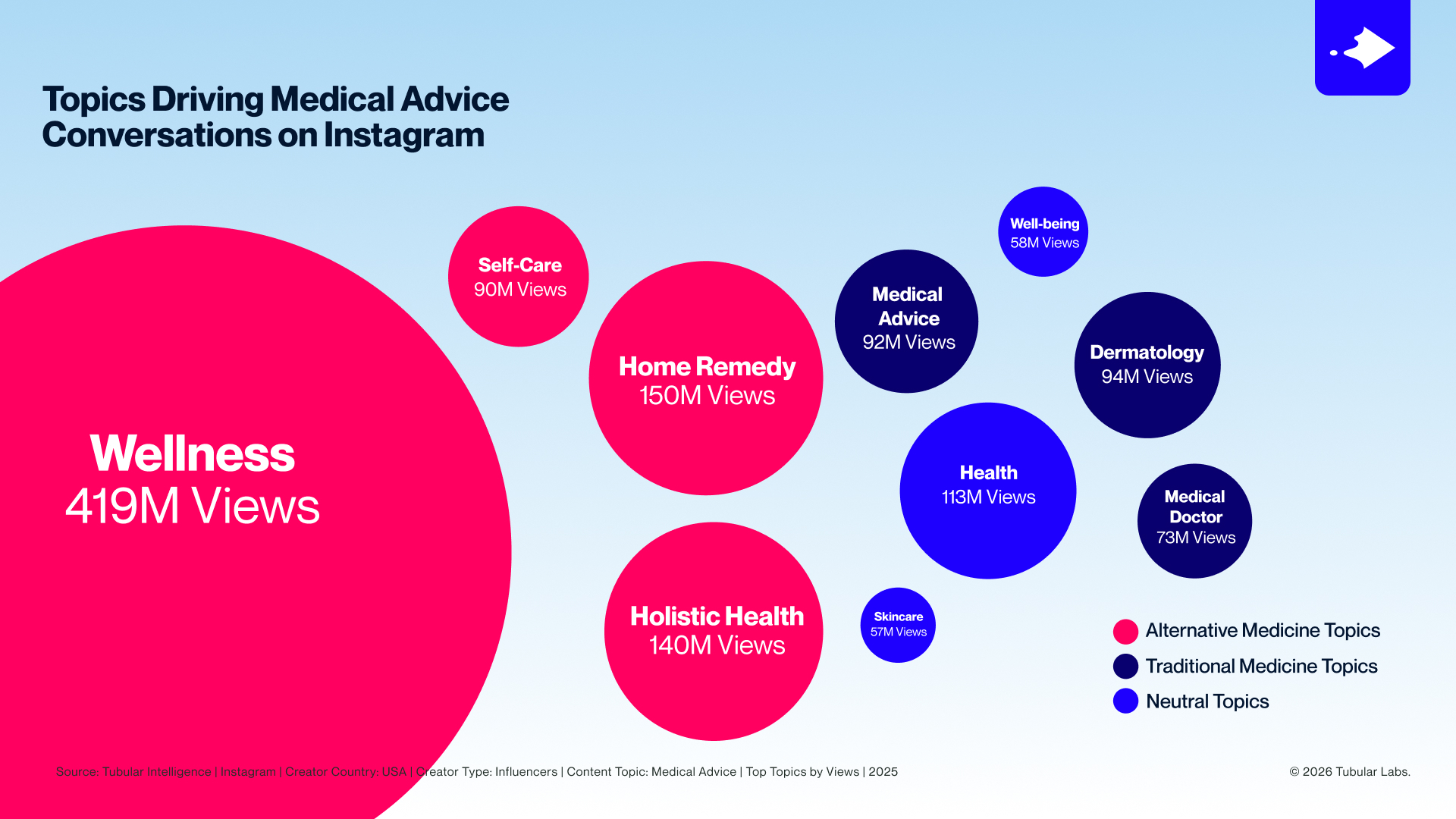
Nowhere is the necessity of advanced audience intelligence more pronounced than in the healthcare, pharmaceutical, and skincare sectors. To understand what truly drives medical and wellness topics on Instagram, analysts tracked leading topics by views among U.S. influencer content.
The data reveals a fascinating duality: consumers are not choosing between clinical narratives and alternative wellness trends; they are consuming both simultaneously. From mainstream dermatological treatments to holistic wellness philosophies, audiences exhibit a blended curiosity. For pharmaceutical brands, skincare lines, and supplement manufacturers, this creates a vital strategic imperative. Brands that restrict their influencer marketing strictly to clinical content risk missing a massive share of the audience whose intent is actively being formed in alternative or hybrid spaces.
The Dermatologist Case Study: Dr. Charles vs. Dr. Neera Nathan
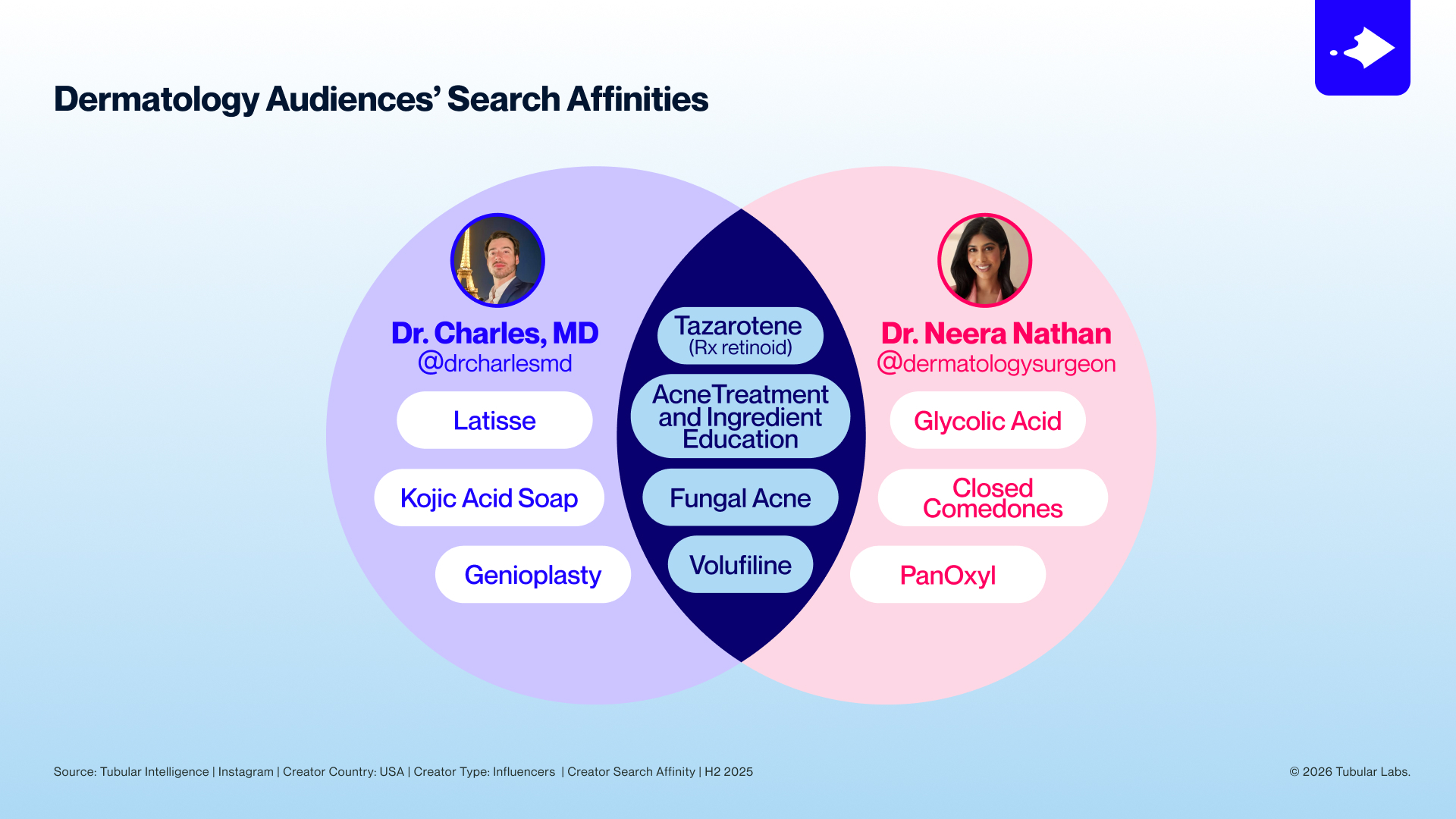
To operationalize this data, consider a scenario where a brand is marketing a specialized dermatological product (such as Latisse). Traditionally, a marketer looking at follower counts alone would immediately gravitate toward Dr. Neera Nathan, whose audience boasts 1.8 million followers—a broad, medically credible base focused heavily on specific treatments and conditions.
However, layering in audience intelligence and search affinities reveals a far more strategic picture. While Dr. Neera Nathan excels at translating complex dermatology topics into accessible, highly shareable education, Dr. Charles, MD approaches the space through a rigorous clinical lens, actively breaking down ingredient science and challenging overhyped beauty trends.
A cross-audience analysis yields a striking statistical insight: 17% of Dr. Charles, MD’s audience also actively watches Dr. Neera Nathan, whereas only 2% of her audience watches him.
This asymmetry represents a golden strategic opportunity. Partnering with Dr. Charles does not merely secure a niche audience; it provides a direct, highly engaged bridge into Dr. Neera’s broader reach. It allows a brand to establish deep clinical credibility and capture high-intent consumers before mainstream market understanding takes hold.
Gaming and Anime: Separating Raw Volume From Purchase Intent
Beyond healthcare, the report highlights similar dynamics in the gaming and entertainment sectors. On YouTube, anime influencers across East and Southeast Asia generated an astonishing 18 billion views in 2025. Yet, raw volume proved to be a poor proxy for commercial impact.
When researchers isolated the creators actually shaping fan behavior, driving brand loyalty, and influencing purchase intent, they found that true influence was concentrated within a much smaller, highly specialized segment of the creator ecosystem. Brands that chased macro-influencers based purely on view counts frequently saw high impressions but low conversion rates, whereas those partnering with micro-communities achieved superior ROI.
CPG and Cultural Alignment: The Brazilian Beverage Breakthrough
In the fast-moving consumer packaged goods (CPG) sector, cultural fit consistently outperformed rigid category fit. In 2025, Brazil ranked second globally in influencer TikTok views and engagement rates.
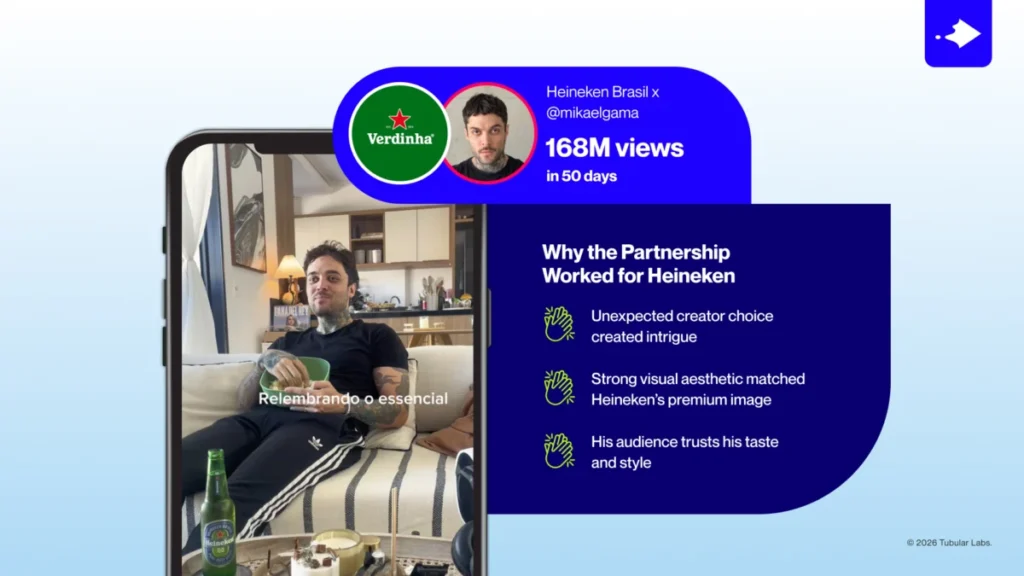
Capitalizing on this hyper-dynamic market, global beverage giant Heineken executed an unexpected campaign: they partnered with a Brazilian men’s fashion creator who had a relatively modest following of just 136,000. Despite not being a traditional food-and-beverage reviewer, the creator’s deep cultural alignment with the target demographic helped generate 168 million views and 1 million engagements within a 50-day window. The success of this campaign demonstrated that cultural resonance and audience overlap far outweigh whether a creator historically posts about a specific product category.
Official Responses and Industry Perspectives
Marketing leaders and data scientists have increasingly rallied behind the philosophy that reach is merely a starting point, not an end-all strategy.
Industry analysts emphasize that modern brands can no longer afford to operate in silos where social media metrics are divorced from broader consumer search behavior. "When you connect audience overlap and search affinities, you remove the guesswork from media planning," note research leads behind the Tubular Labs report. "Marketers are no longer asking ‘Who has the biggest megaphone?’ Instead, they are asking ‘Whose audience is actively searching for the problem our product solves?’"
Chief Marketing Officers across the healthcare and CPG sectors have echoed these sentiments, noting that boards and financial stakeholders increasingly demand accountability that goes beyond impressions. By tying influencer selection to hard data regarding cross-platform viewership and purchase intent, marketing teams can justify larger, more targeted investments with predictable revenue outcomes.
Implications: The Future of Influencer Strategy
The paradigm shift documented in Redefining Influencer Value carries profound implications for how brands structure, execute, and measure influencer partnerships moving forward.
- Death of the Vanity Metric: Follower counts and raw view counts are officially demoted from primary KPIs to secondary diagnostic tools. They indicate scale, but they do not guarantee conversion.
- The Rise of Cross-Audience Mapping: Brands must adopt advanced analytics tools that map audience overlaps. Understanding who watches both Creator A and Creator B allows for tiered, sophisticated campaign structuring that captures both niche authority and broad reach.
- Content Nuance Over Category Purity: As seen in the CPG and healthcare spaces, rigid adherence to traditional category boundaries limits creativity. A fashion influencer can sell beverages; an alternative wellness narrative can prime consumers for clinical pharmaceuticals—provided the underlying audience intelligence validates the psychological alignment.
- A New Actionable Framework for Marketers: Moving forward, brands are advised to implement a systematic framework:
- Step 1: Define the target audience not by broad demographics, but by search affinity and topical interest.
- Step 2: Analyze cross-watching behaviors to identify asymmetric audience overlaps.
- Step 3: Select creators who drive consumer intent and behavioral shifts, rather than mere passive viewership.
- Step 4: Measure success through downstream business outcomes rather than top-of-funnel impressions.
Ultimately, the data makes it clear: with the right audience intelligence, marketers no longer need to gamble on guesswork. By aligning partnerships with verified consumer intent, brands can transform raw digital reach into sustainable, predictable revenue.
