
Beyond the Tool: Why AI Adaptation is the Next Frontier for Marketing Leadership
In the rapid-fire evolution of the modern marketing landscape, the "AI gold rush" has largely concluded. Across the globe, marketing departments have scrambled to procure subscriptions, roll out enterprise-wide LLMs, and host introductory workshops. Yet, a glaring discrepancy has emerged: while AI adoption has reached a tipping point, genuine adaptation remains elusive.
Most marketing teams have successfully integrated the tools, but far fewer have fundamentally changed how they perform their jobs. This gap—between simply having access to technology and transforming the DNA of a marketing organization—is the central challenge facing CMOs today.
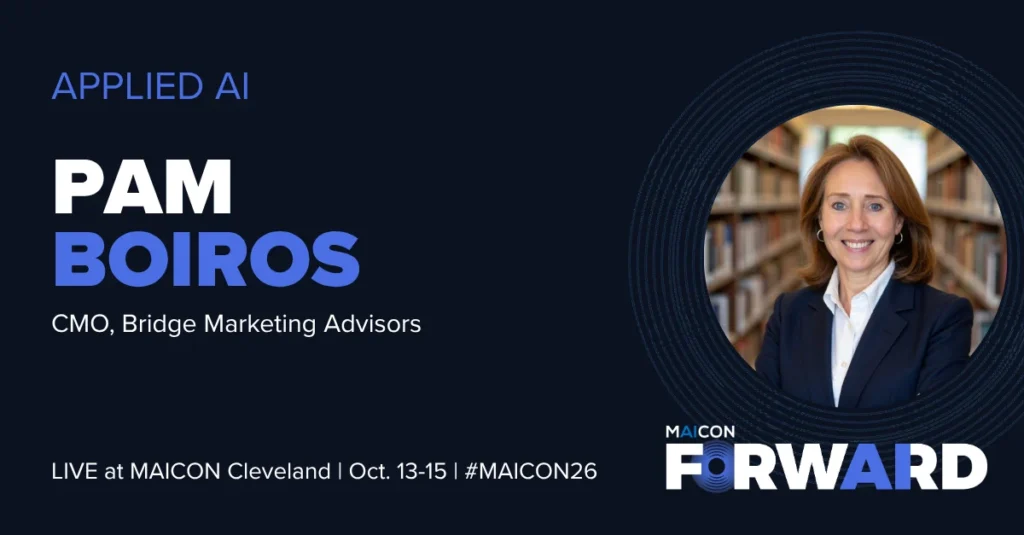
At the upcoming Marketing Artificial Intelligence Conference (MAICON) 2026, industry strategist and fractional CMO Pam Boiros will address this critical inflection point in her keynote session, "AI Adaptation: The People Side of Scale." As a veteran leader who has steered marketing organizations at firms like Skillsoft and meQuilibrium, and as the co-founder of the global community Women Applying AI, Boiros offers a roadmap for leaders looking to move beyond the novelty of AI and into the realm of sustainable operational efficiency.
The Chasm Between Adoption and Adaptation
To understand the current state of the industry, one must first distinguish between two very different organizational states. Adoption is a surface-level success—a logistical achievement where employees have licenses, passwords, and a basic understanding of prompting. It is often measured in vanity metrics like "percentage of staff trained" or "tools deployed."
Adaptation, however, is an existential shift. It is the moment when AI ceases to be a separate "project" or a "side-hustle" and instead becomes the underlying fabric of daily operations.
"You know you’ve moved from AI adoption to AI adaptation when AI stops feeling like a separate initiative and starts changing how the work itself gets done," Boiros explains.
In an adapted organization, the workflow is no longer human-versus-machine; it is a synergistic loop. Teams begin to redesign their internal processes to leverage the unique strengths of both: the machine’s speed, scale, and pattern recognition paired with the human’s judgment, empathy, and strategic creativity. Managers stop measuring "time spent in the tool" and start measuring "quality of output" and "depth of human-centric work."
The Chronology of an AI-Driven Marketing Shift
The timeline of AI integration in marketing has been swift, often leaving leaders in a state of reactive exhaustion:
- Phase 1: The Experimentation Era (2022–2023): Characterized by "shadow AI." Individual contributors experimented with ChatGPT or Midjourney, often without corporate oversight. The primary goal was curiosity and individual productivity gains.
- Phase 2: The Standardization Era (2024–2025): Organizations moved to enterprise licensing. IT and legal departments established guardrails, and L&D teams launched company-wide training initiatives. This was the peak of "adoption."
- Phase 3: The Adaptation Era (2026 and beyond): The current focus. Organizations are now attempting to embed AI into the workflow, measuring outcomes rather than just usage, and fostering a culture that treats AI as a foundational competency rather than an auxiliary skill.
The Five Building Blocks of Adaptation
While many leaders look to technology stacks or data infrastructure as the keys to success, Boiros argues that the foundation of adaptation rests on five pillars. Among these, one is consistently underestimated: Culture.
The Cultural Hurdle
"Culture shows up in what people actually feel safe and empowered to do every day," Boiros notes. In many organizations, the internal culture rewards "polished answers" and absolute certainty. AI, by its very nature, is a tool of iteration and experimentation—a process that often involves messy drafts, hallucinations, and early-stage failures.
When a company culture punishes mistakes, employees default to risk aversion. They either avoid AI entirely or, worse, use it in isolation, hiding their learnings. True adaptation requires a "fail-forward" environment where curiosity is valued, and sharing a failed prompt is viewed as a learning opportunity for the entire department.
The Human-Centric Workflow
The other four building blocks—which will be detailed in depth at MAICON 2026—involve the tactical implementation of AI into the existing marketing lifecycle. This includes mapping out every stage of a campaign (from ideation and drafting to legal review and distribution) and identifying which portions require high-touch human expertise and which can be automated or augmented.
Addressing the Anatomy of Resistance
After three years of intensive training across diverse marketing teams, Boiros has diagnosed the "resistance" that many leaders blame on Luddism or stubbornness. She asserts that what leaders perceive as a lack of willingness is, in reality, a manifestation of fear.
The common refrain—"I don’t have time to learn another tool"—is rarely about the software. It is a defense mechanism rooted in anxiety about career relevance and the fear of falling behind. Employees who have spent years mastering a specific craft (like copywriting or data analysis) often feel that AI threatens their professional identity.
"That’s why I don’t think the answer is simply more training," says Boiros. "What works better is creating space for people to learn without feeling like they’re taking on a second job."
Her approach emphasizes "protected time"—carving out hours in the work week dedicated solely to experimentation, without the pressure of delivering immediate results. By making learning collaborative, she removes the stigma of "not knowing." When peers see one another using AI to solve a genuine pain point, the narrative shifts from "I have to do this" to "I get to do this."
Implications for Marketing Leadership
The transition to an AI-adapted organization has profound implications for how marketing leaders manage their teams.
- The Shift in Management: Managers must transition from being "task-givers" to "AI-assisted coaches." They must set clear expectations for the quality and ethical standards of AI-generated work, acting as the final gatekeepers of brand integrity.
- The Evolution of Talent: Hiring criteria will shift. The ability to write a prompt is becoming a baseline requirement, but the ability to critique, edit, and iterate on AI output is the new premium skill.
- Measurable Outcomes: The metrics of success must change. Forward-thinking CMOs are asking: Are we producing better work? Are our people spending more time on high-level strategy and relationship-building? Have we created repeatable, resilient ways of working that can survive the next leap in model capability?
Preparing for the Future at MAICON 2026
The session at MAICON 2026 is designed to be more than a theoretical overview; it is intended to provide a functional, actionable playbook for leaders at all levels. Attendees can expect to leave with:
- A Framework for Workflow Redesign: A guide to audit existing team processes and identify the high-impact "AI-first" pivot points.
- A Culture-Building Toolkit: Strategies for leaders to model AI usage and create safe, collaborative environments for experimentation.
- The "Anti-Burnout" Training Model: A strategy for upskilling teams that prioritizes time-saving over time-adding, ensuring that AI tools are seen as an asset rather than a burden.
- Guardrail Governance: Practical advice on setting the rules of the road so that employees feel confident and compliant without being stifled by bureaucracy.
As AI continues to mature, the competitive advantage will no longer belong to those who use the most advanced tools. It will belong to the teams that have successfully adapted their culture, their workflows, and their human capital to move in lockstep with the machine.
In a world where technology is a commodity, the human side of the equation—the adaptation of our teams, our mindset, and our processes—becomes the only sustainable differentiator.
For marketing leaders aiming to navigate this transformation, the MAICON 2026 conference offers a rare opportunity to move beyond the hype and into the reality of long-term, scalable success. The future of marketing is not about replacing the human; it is about empowering the human to work at a higher, more impactful level of performance than was ever previously possible.
For those interested in exploring the future of AI-driven strategy and leadership, register today for MAICON 2026 to join Pam Boiros and over 50 industry experts in defining the next era of marketing excellence.
