
Beyond the Silo: How Social Video Intelligence is Revolutionizing Cross-Category Brand Partnerships
In the modern digital economy, traditional demographic targeting has become an increasingly blunt instrument. For decades, marketing playbooks operated on rigid assumptions: beauty enthusiasts cared exclusively about makeup, gamers lived only within the confines of hardware and console ecosystems, and foodies restricted their media consumption to culinary content. However, the proliferation of digital platforms and the democratization of content creation have shattered these neat, compartmentalized silos. Today’s consumers are multidimensional, holding complex, overlapping interests that span seemingly unrelated industries.
According to groundbreaking research from Tubular Labs, the key to unlocking exponential brand growth no longer lies in relying on surface-level vanity metrics like views and basic engagement rates. Instead, the future of strategic collaboration belongs to social video intelligence—a data-driven approach that allows marketers to look past obvious industry pairings and discover highly lucrative, unexpected cross-category partnerships. By analyzing deep audience behaviors and content consumption habits across social platforms, forward-thinking brands are bridging the gaps between distinct verticals, resulting in culturally resonant campaigns that drive unprecedented consumer engagement.
The Main Facts: Redefining Modern Brand Collaborations
The fundamental thesis of Tubular’s latest research is simple yet transformative: audiences do not exist in vacuums. When brands utilize social video analytics to examine what secondary and tertiary content their core demographics consume, they uncover behavioral patterns that traditional market research routinely misses.
Rather than pairing a beauty brand with another cosmetic company, or partnering a gaming studio with a tech hardware manufacturer, modern data intelligence reveals whitespace opportunities where disparate industries intersect. Two prime examples highlight this paradigm shift:
- Charlotte Tilbury x Formula 1 Academy: Bridging the traditionally male-dominated world of elite motorsports with prestige luxury cosmetics.
- Riot Games x Fenty Beauty: Merging the massive, underserved female gaming demographic with a global beauty powerhouse via an Arcane-inspired collection.
These are not merely eccentric marketing stunts; they are calculated, data-backed initiatives rooted in hard consumption metrics. By examining cross-category viewing habits, brands can identify exact audience overlaps, forecast campaign receptivity, and execute high-impact collaborations that capture cultural mindshare.
Chronology of a Paradigm Shift: From Surface Metrics to Deep Intelligence
To understand how the marketing industry arrived at this cross-category renaissance, it is necessary to examine the evolution of digital analytics over the past decade.
Phase One: The Era of Vanity Metrics (Early 2010s)
In the nascent stages of digital video and influencer marketing, brand partnerships were selected primarily on quantitative scale. Marketers chased raw subscriber counts, total views, and surface-level engagement rates. If an influencer had a million followers in a specific category (e.g., tech or lifestyle), they were deemed a viable partner, regardless of whether their audience was actively engaged or genuinely receptive to the advertised product.

Phase Two: Niche Siloing (Mid-to-Late 2010s)
As digital advertising matured, brands grew more sophisticated, leading to hyper-verticalization. Advertisers segmented their budgets strictly by niche. Beauty brands partnered exclusively with beauty vloggers; gaming companies worked solely with let’s-players. While this improved baseline relevance, it ultimately boxed brands into echo chambers, limiting total addressable market expansion and leading to audience fatigue as consumers were bombarded with repetitive, predictable collaborations.
Phase Three: The Data-Driven Cross-Category Era (Present Day)
With the advent of advanced social video intelligence platforms like Tubular Labs, marketers can now map the actual viewing journeys of digital audiences. Instead of guessing what a demographic might like based on broad census data, analysts can track cross-pollination across verticals in real-time. This chronological progression has enabled modern enterprises to move away from homogenous partnerships and embrace bold, cross-industry alliances that defy traditional categorization.
Supporting Data: The Numbers Behind the Unexpected
Data is the ultimate antidote to marketing guesswork. Tubular Labs’ deep-dive analytics into audience behavior provide empirical proof that cross-category viewing is not only common—it is mathematically significant.
The Beauty and Motorsports Intersection
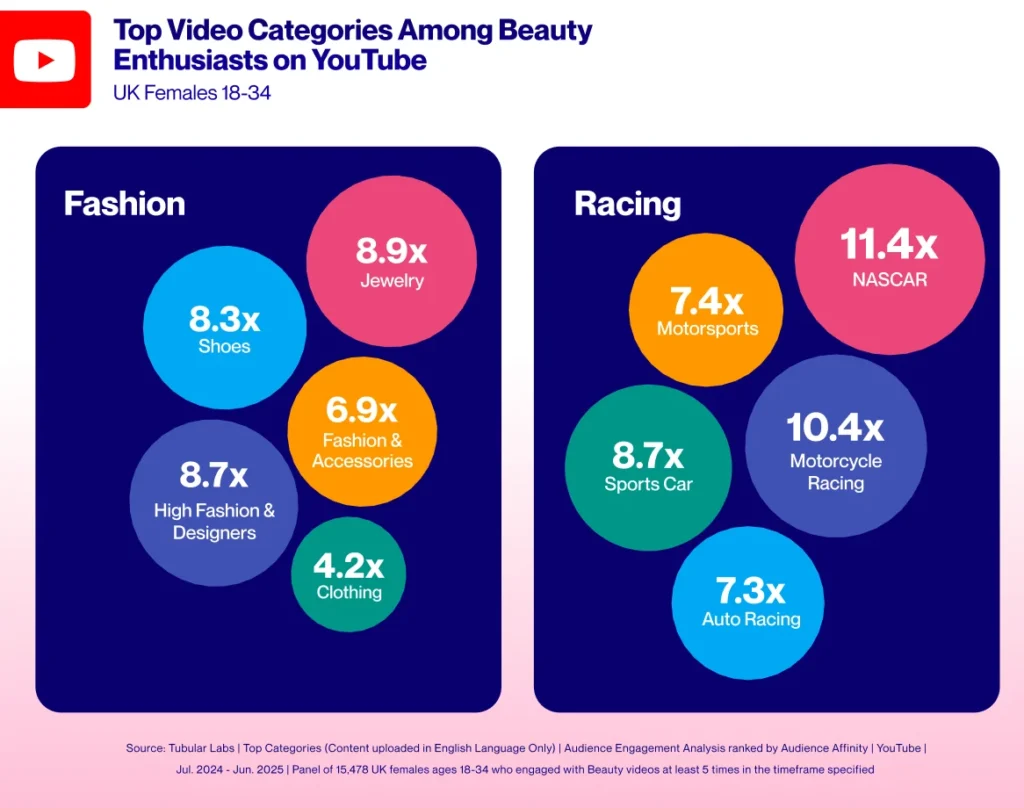
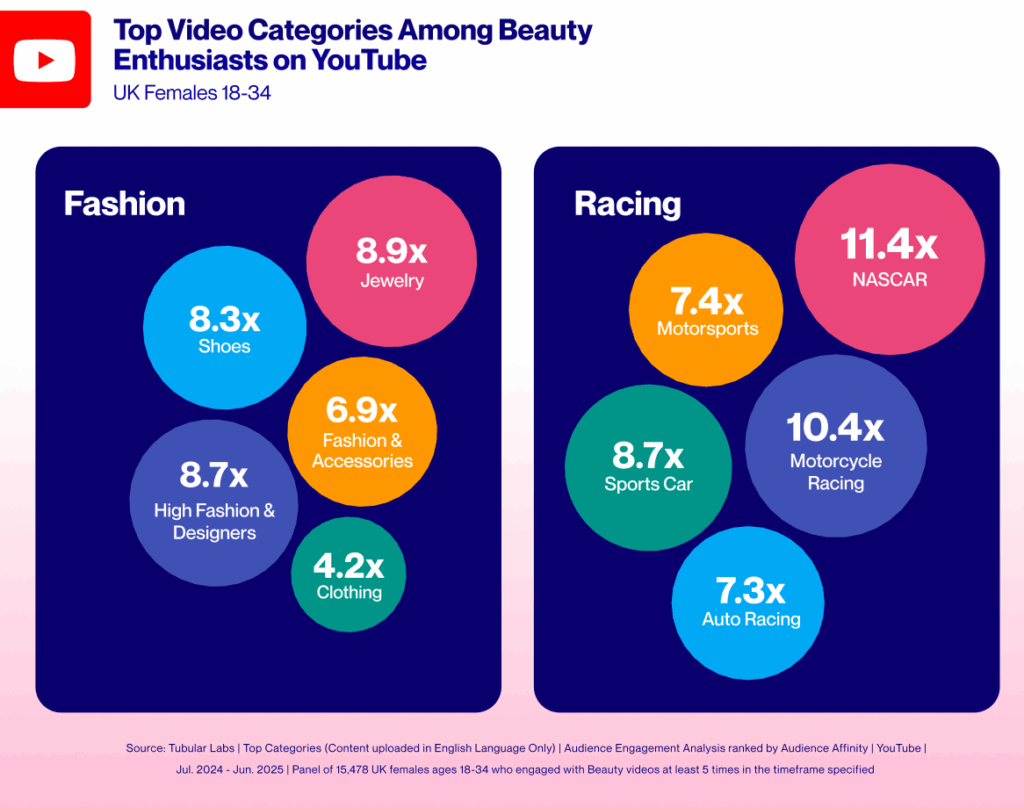
Consider the UK market, where Tubular researchers analyzed the secondary viewing habits of YouTube beauty consumers. While expected overlaps appeared within fashion and jewelry, a startling and statistically significant correlation emerged elsewhere: UK female beauty viewers are 11.4x more likely to watch motorsports content than the platform’s average viewer.
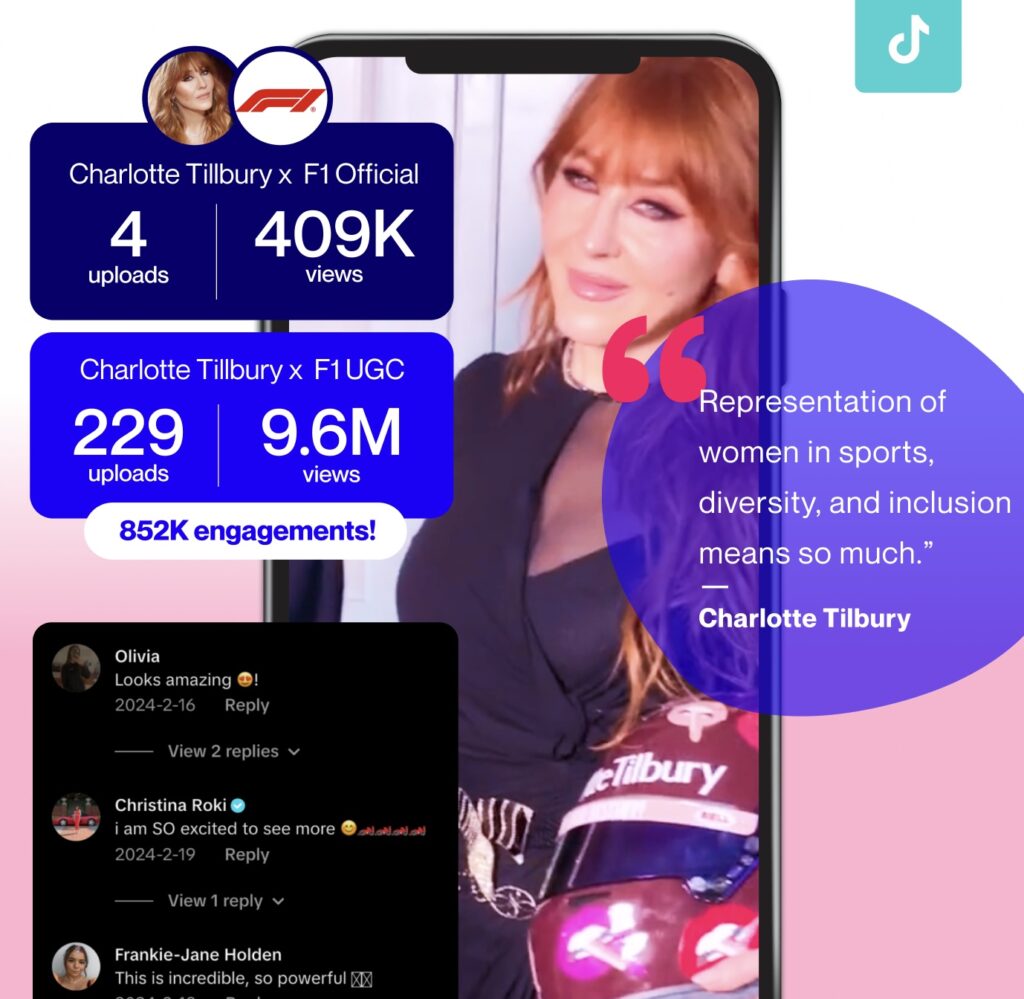
This massive statistical anomaly provided the empirical foundation for Charlotte Tilbury’s historic partnership with the Formula 1 Academy. By recognizing that a vast segment of high-end beauty consumers also possessed a passionate interest in high-speed racing, the brand broke new ground as the first-ever cosmetic sponsor in the academy’s history. The campaign successfully shattered outdated gender-demographic stereotypes, proving that shared passions can span opposite ends of the cultural spectrum.
Gaming Meets Glamour: The Riot Games and Fenty Beauty Synergy
Similarly, the gaming industry has long battled outdated stereotypes regarding its gender makeup. Tubular’s analytics exposed a rapidly growing, highly engaged cohort of female gamers who simultaneously exhibited strong brand affinities for luxury and mass-market beauty giants such as Yves Saint Laurent, NYX, and L’Oréal.
Riot Games capitalized on these hidden insights by orchestrating a blockbuster collaboration with Fenty Beauty, tied to the release of their critically acclaimed animated series Arcane. Rather than traditional product placement, the partnership invited fans into an immersive cross-section of gaming culture and high fashion, generating millions of organic interactions and proving that community-centric activation yields superior return on investment.
Official Responses and Industry Perspectives
Marketing leaders and data scientists are increasingly vocal about the necessity of shedding traditional categorization in favor of holistic audience intelligence.
Industry analysts emphasize that consumers view their entertainment and lifestyle choices through a fluid lens. Modern audiences—particularly Gen Z and Millennials—define themselves by a mosaic of diverse interests rather than a single demographic label. A consumer can be a hardcore gamer, an organic skincare enthusiast, and a Formula 1 aficionado all at once.
According to brand strategists, the traditional agency approach of asking, "How do we target beauty lovers?" is fundamentally flawed. The correct question is now, "Where do beauty lovers spend their digital downtime, and what other passions animate their daily media consumption?"
Executive commentary from leading digital intelligence firms highlights that brands failing to adopt cross-category insights risk plateauing. When every competitor in a specific vertical is fishing in the exact same demographic pond, customer acquisition costs soar while differentiation plummets. Venturing into adjacent, data-backed categories opens up blue ocean spaces where competition is minimal and brand resonance is maximized.
Implications: What This Means for Marketers and Brands
The shift toward data-driven, cross-category partnerships carries profound implications for the future of digital marketing, influencer relations, and media planning.
1. The Death of Demographic Assumptions
Marketers must abandon preconceived notions about consumer behavior. Relying on intuition or historical norms is no longer viable in a media landscape defined by algorithmic discovery and niche micro-communities. Brands must treat audience research as an ongoing, behavioral science rather than a static upfront checklist.
2. A New Framework for Identifying Partnerships
To harness the power of social video intelligence successfully, brands should implement a rigorous, step-by-step evaluation framework:
- Audit Core Audiences: Use video analytics to map the complete content diet of your current consumer base, identifying unexpected secondary and tertiary viewing preferences.
- Look Beyond the Obvious: Deliberately step outside your industry vertical to find partner brands that share high audience affinity indices, even if the connection initially appears unconventional.
- Prioritize Participation Over Consumption: Design campaigns that actively invite audiences to engage, co-create, or interact, rather than passively viewing an ad.
- Measure Holistic Impact: Track performance metrics that span both brand ecosystems to evaluate how successfully the partnership captured new, unpenetrated audience segments.
3. Campaign Innovation and Creative Risk-Taking
True innovation requires a willingness to take calculated, data-backed risks. The success of campaigns like Charlotte Tilbury x F1 Academy and Riot Games x Fenty Beauty demonstrates that consumers reward brands that surprise and delight them. When partnerships are rooted in genuine audience overlap rather than boardroom whims, creative execution feels organic rather than forced.
Conclusion
The evolution of digital media has permanently altered the relationship between brands and their consumers. In an era where attention is fiercely contested, sticking to safe, traditional marketing silos is the riskiest move a brand can make.
By leveraging social video intelligence, marketers no longer have to rely on guesswork or surface-level metrics to find their next big collaboration. They can see precisely where unexpected partnerships will thrive, empowering them to invest confidently in campaigns that break boundaries, capture new market segments, and deliver measurable, extraordinary results.
Ready to uncover hidden growth opportunities and discover unexpected partnership avenues for your brand? Visit Tubular Labs today to request a demo and transform your audience intelligence strategy.
