
Beyond the Rules: Bynder’s 2026 State of DAM Report Reveals AI’s Governance Crisis and the Return of Human Judgment
For nearly two decades, enterprise marketing organizations operated under a comforting assumption: if you build enough rules into your digital asset management and marketing automation systems, the workflows will take care of themselves. The goal was to establish structured, repeatable pipelines that could ingest, tag, and distribute content at ever-increasing speeds.
However, the rapid integration of generative artificial intelligence has shattered this paradigm.
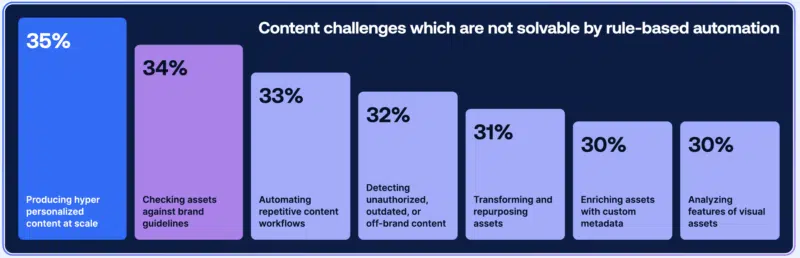
According to Bynder’s newly released "State of DAM Report 2026," an overwhelming 93% of enterprise organizations now face content operations challenges that their existing, rules-based automation systems are fundamentally unequipped to solve. Rather than simply accelerating production, the widespread deployment of AI has introduced a new class of systemic risks.
Today’s marketing leaders are no longer preoccupied with the speed of content generation. Instead, they are struggling to detect off-brand assets, govern AI-generated content, deliver hyper-personalized experiences at scale, and manage workflows that have grown exponentially complex.
1. Main Facts: The Limits of Algorithmic Control
The core revelation of the 2026 report is that traditional, rules-based automation is failing when confronted with the probabilistic nature of artificial intelligence. Rules-based systems excel in predictable, standardized environments. They operate on strict "if-this-then-that" logic, which works perfectly for routing files, applying static metadata, or pushing approved assets to specific distribution channels.
Generative AI, however, does not follow rigid paths. By its very design, generative AI acts probabilistically, interpreting prompts to construct novel text, images, and video. Because LLMs (Large Language Models) and diffusion models operate by predicting the next logical element rather than adhering to absolute parameters, they frequently introduce unauthorized variations.
This behavior has shifted the primary challenge for marketers. The operational bottleneck is no longer the creation of content, but the governance of what has been created. Organizations that once celebrated the sheer volume of assets AI could generate are now asking a much more difficult question: How do we control what our AI tools are producing?
2. Chronology: The Evolution of Marketing Automation (2010–2026)
To understand why enterprise marketing operations have reached this critical inflection point, it is necessary to examine the technological trajectory of the past fifteen years.
+-----------------------------------------------------------------------------------+
|                                  CHRONOLOGY                                       |
+-----------------------------------------------------------------------------------+
| 2010–2018: The Era of Structured DAM & Rules-Based Automation                     |
| • Focus on centralization, static metadata tagging, and basic workflow routing.    |
| • "If-this-then-that" logic successfully manages predictable digital assets.     |
+-----------------------------------------------------------------------------------+
| 2019–2022: The Content Explosion & Multi-Channel Proliferation                    |
| • Rise of social commerce, personalized email campaigns, and global localization.  |
| • Rules-based systems begin to strain under the weight of manual asset variations.|
+-----------------------------------------------------------------------------------+
| 2023–2024: The Generative AI Gold Rush                                            |
| • Rapid, unchecked adoption of GenAI tools for copy, design, and ideation.        |
| • Organizations prioritize content volume over governance, leading to brand drift.|
+-----------------------------------------------------------------------------------+
| 2025–2026: The Governance Crisis & Return of Human-in-the-Loop                    |
| • 93% of enterprise brands hit operational limits with rules-based systems.       |
| • Focus shifts from speed of generation to security, legal compliance, and trust. |
+-----------------------------------------------------------------------------------+
The Era of Structured DAM (2010–2018)
During this period, Digital Asset Management (DAM) platforms functioned primarily as highly organized libraries. Marketers focused on centralizing assets, establishing standard metadata taxonomies, and automating basic tasks—such as resizing images for different channels or notifying stakeholders when an asset was ready for review. Efficiency was defined by how quickly a human could find and deploy a pre-approved asset.
The Content Explosion (2019–2022)
As social media platforms diversified and consumer expectations shifted toward personalized experiences, the demand for content skyrocketed. Marketers had to produce dozens of variations of a single asset to satisfy different regions, demographics, and channels. Rules-based automation was pushed to its limits, requiring highly complex, fragile workflow structures to manage localization and distribution.
The Generative AI Gold Rush (2023–2024)
The commercialization of advanced generative AI tools promised a frictionless solution to the content crunch. Marketing departments rushed to integrate AI into their creative pipelines, using it to write copy, generate imagery, and localize assets in seconds. During this phase, success was measured by output volume. Governance, brand consistency, and legal reviews were frequently bypassed in the pursuit of speed.
The Governance Crisis and Realignment (2025–2026)
By 2026, the systemic vulnerabilities of unchecked AI adoption became impossible to ignore. Brands began experiencing "brand drift," where AI-generated content subtly diverged from established visual and verbal guidelines. Additionally, legal departments raised alarms over intellectual property exposure, copyright compliance, and data privacy.
This has brought the industry to its current state: a conscious deceleration of fully automated processes in favor of hybrid, human-governed frameworks.
3. Supporting Data: Risk, Anxiety, and the Human-in-the-Loop Model
Bynder’s 2026 report provides quantitative proof of this industry-wide shift in priorities. The data highlights a profound anxiety regarding security, compliance, and the limitations of automated systems.
Top Concerns When Using AI in Content Operations
When enterprise marketers were asked to identify their primary apprehensions regarding the use of AI in content creation and management, the responses focused heavily on risk mitigation rather than operational speed:
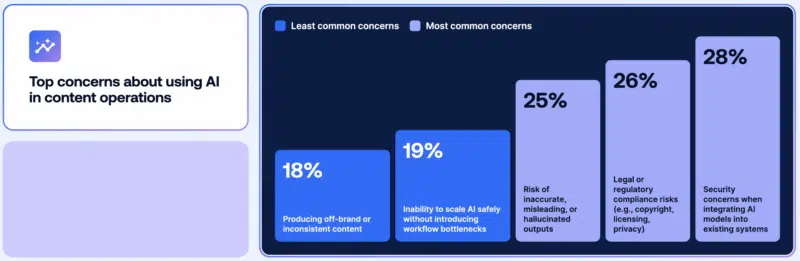
- Security: Cited as the single greatest concern. Marketers are deeply worried about data leaks, proprietary assets being used to train public models, and the vulnerability of automated pipelines to external manipulation.
- Legal and Regulatory Compliance: As regulatory bodies worldwide introduce stricter guidelines regarding AI transparency, copyright infringement, and data privacy (such as the European Union’s AI Act), enterprise brands are terrified of facing costly litigation or brand damage from unverified AI outputs.
- Inaccurate or Hallucinated Outputs: The tendency of AI models to generate factually incorrect information or visually anomalous elements remains a significant hurdle for brand safety.
- Inconsistent Brand Content: AI tools often fail to capture the subtle nuances of a brand’s voice, color palette, or messaging guidelines, resulting in fragmented customer experiences.
- Workflow Bottlenecks: Far from streamlining operations, the lack of automated quality control has created massive backlogs as human editors struggle to review a tidal wave of AI-generated assets.
The Rise of Human-in-the-Loop (HITL) Workflows
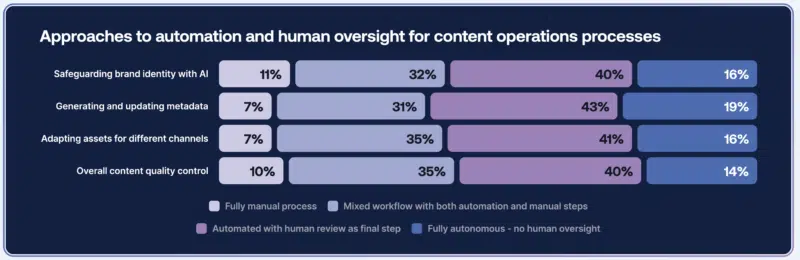
Rather than relinquishing control to autonomous AI systems, the vast majority of enterprise organizations are implementing hybrid workflows that keep humans firmly in charge of the final output.
| Workflow Strategy | Percentage of Respondents | Operational Description |
|---|---|---|
| Automation with Human Approval | 40% – 44% | AI/automation handles the initial generation, formatting, or translation, but a human must manually review and provide final sign-off before publication. |
| Mixed Hybrid Workflows | 31% – 35% | Automation and manual human reviews are deeply integrated at multiple stages of the asset lifecycle (e.g., human prompts -> AI draft -> human edit -> AI formatting -> human final approval). |
| Fully Automated / Fully Manual | Remaining % | Only a small minority of brands trust fully automated end-to-end pipelines, while a declining segment remains entirely manual. |
These statistics reveal a critical truth: AI is not replacing human marketers; instead, it is shifting their primary responsibility from production to governance.
4. Official Responses and the Reimagining of the DAM
The findings of the 2026 report have forced a fundamental reassessment of marketing technology (MarTech) architectures. Industry leaders, software architects, and platform providers are speaking out on how enterprise systems must evolve to survive this new environment.
The Shift from Storage to Active Governance
Historically, a DAM was a passive repository—a digital filing cabinet. Today, industry analysts argue that the DAM must become the "brain" of the entire marketing ecosystem.
In response to the report, product strategists have emphasized that AI cannot operate safely in a vacuum. To produce reliable, on-brand content, generative models require contextual boundaries. They need real-time access to:
- Up-to-date brand guidelines.
- Approved visual assets and color profiles.
- Rigorous metadata taxonomies that define asset permissions, regional licensing restrictions, and expiration dates.
By embedding these rules directly into the DAM and using it as a centralized integration hub, organizations can create a "bounded environment" for AI. Instead of querying the open web or relying on generic base models, generative tools can use Retrieval-Augmented Generation (RAG) and secure APIs to pull only from a brand’s verified repository.
Constantine von Hoffman on the MarTech Bottleneck
Reflecting on the broader implications of these operational challenges, Constantine von Hoffman, Senior Editor at MarTech, has frequently noted that the primary obstacles in modern marketing are rarely technological limitations. Instead, they are operational bottlenecks.
As von Hoffman’s editorial coverage suggests, marketing organizations are discovering that buying more software does not solve fundamental process deficiencies. If an organization does not have a clear strategy for who owns, reviews, and approves content, introducing AI will simply accelerate the rate at which bad or off-brand content is produced.
5. Implications: The New Paradigm of Marketing Operations
The transition from rules-based automation to human-in-the-loop AI governance carries profound implications for the future of business, technology, and organizational design.
+-----------------------------------------------------------------------------------+
|                         IMPLICATIONS OF THE GOVERNANCE SHIFT                      |
+-----------------------------------------------------------------------------------+
| OPERATIONAL:                                                                      |
| • Marketing roles evolve from "creators" to "editors" and "compliance officers."  |
| • Focus shifts to prompting, auditing, and quality assurance.                     |
+-----------------------------------------------------------------------------------+
| LEGAL & COMPLIANCE:                                                               |
| • Increased scrutiny under regulations like the EU AI Act.                        |
| • Brands must prove asset provenance and secure explicit licensing rights.        |
| • Rise of "watermarking" and cryptographic asset verification.                     |
+-----------------------------------------------------------------------------------+
| STRATEGIC:                                                                        |
| • Brand equity is tied directly to trust and consistency.                         |
| • Hyper-personalization requires structured, pre-approved modular asset kits.     |
+-----------------------------------------------------------------------------------+
| MARTECH ARCHITECTURE:                                                             |
| • DAMs evolve from passive storage units into active AI-grounding engines.        |
| • Seamless integration of security, digital rights, and metadata across tools.    |
+-----------------------------------------------------------------------------------+
Operational Implications: The Evolving Marketing Role
The day-to-day responsibilities of creative and operational teams are undergoing a massive transformation. The traditional copywriter or graphic designer is increasingly acting as an editor, prompt engineer, and brand guardian.

Instead of spending hours drafting initial concepts, creative professionals are directing AI engines to produce variations, then applying their expert judgment to refine, polish, and approve the outputs. This requires a new set of skills centered around critical thinking, visual literacy, and a deep understanding of brand strategy, rather than purely technical execution.
Legal and Compliance Implications: The Battle for Trust
As regulatory bodies increase their scrutiny of digital media, the cost of compliance failures is skyrocketing. Under emerging legal frameworks, brands must be able to prove the provenance of their assets. They must verify that the training data used by their AI tools did not violate copyright laws and that their personalized campaigns do not breach consumer privacy regulations.
Consequently, digital rights management (DRM) and metadata auditing are becoming real-time compliance steps embedded directly within campaign creation workflows, rather than a final check before launch.
Strategic Implications: The Premium on Brand Consistency
In an internet flooded with cheap, AI-generated noise, brand consistency and authenticity have become premium differentiators. Consumers are quickly developing fatigue for generic, algorithmically generated content.
Brands that can maintain a highly distinct, cohesive visual and verbal identity across all touchpoints will build deeper trust and equity. Conversely, companies that rely on fully automated, unmonitored content pipelines risk diluting their brand value and alienating their audiences through fragmented, inconsistent messaging.

Conclusion: Deciding Where Automation Ends
The past two decades of marketing were defined by a single-minded drive toward total automation. The goal was to remove human friction from every possible process to maximize speed and volume.
Bynder’s State of DAM Report 2026 serves as a definitive warning that this era has reached its logical limit. The introduction of generative AI has proven that infinite scale without governance is a recipe for operational chaos, legal liability, and brand degradation.
The challenge for modern marketing leaders is no longer determining how much of their workflow can be automated. The true challenge is deciding where automation should end and where human judgment, creativity, and accountability must begin. By pairing the speed of AI with the strategic oversight of human professionals—anchored by a secure, highly organized digital asset management foundation—enterprise organizations can finally build a content engine that is both fast and incredibly resilient.
