
Beyond the Prompt: Why Marketing’s Next Frontier is Building, Not Just Using, AI Tools
In the rapidly evolving landscape of digital marketing, the conversation around Artificial Intelligence has hit a plateau. For the past two years, the industry narrative has been dominated by a singular directive: “Use AI to do your job faster.” Teams are being pushed to draft content at scale, automate email sequences, and accelerate reporting. Yet, as the novelty of generative AI begins to wane, a more profound, structural shift is emerging.
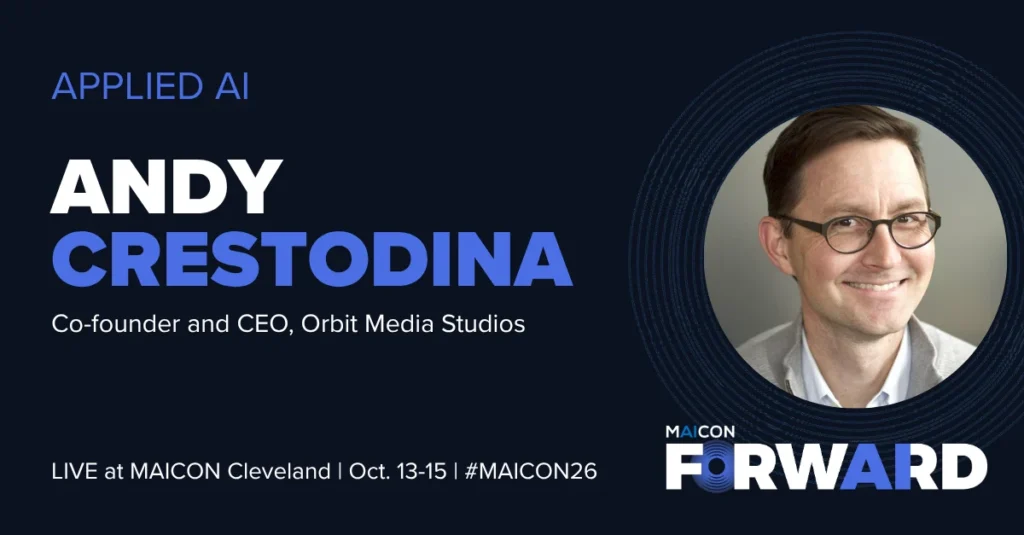
The question is no longer how to use AI as a high-speed intern; it is how to transform individual marketing tasks into permanent, automated tools that handle the heavy lifting indefinitely. This transition from "using AI" to "building AI systems" serves as the foundational theme for Andy Crestodina’s upcoming keynote at the Marketing Artificial Intelligence Conference (MAICON) 2026.
The Paradigm Shift: From Manual Labor to Architectural Design
Andy Crestodina, co-founder and CMO of Orbit Media, argues that the marketing profession is undergoing a fundamental metamorphosis. "The work of marketing has changed," Crestodina explains. "Modern marketing workflows evolve in a specific sequence—from 100% done-by-human-hands to 100% done by assistants, and then reviewed by humans."
For many, the current application of AI is transactional. A marketer writes a prompt, receives an output, edits it, and moves on. This is a linear, one-off process. Crestodina suggests that the true value of AI lies in its ability to be codified. By moving from sporadic prompting to building "AI worker bees," marketers can institutionalize their expertise. However, he warns that this is a process of iteration, not instant gratification. "My most powerful assistants evolved gradually," he says. "I don’t think you can one-shot a great AI worker bee."
The Expert as the Architect
One of the most persistent myths in the current AI gold rush is that the "best" AI tools are those purchased off the shelf from software vendors. Crestodina challenges this, suggesting that the most sophisticated AI assistants are not being built by developers in Silicon Valley, but by the subject matter experts already embedded within marketing teams.
"The best assistants are built by people who already do that job well," Crestodina notes. "The expert at the job is the best suited to evaluate AI’s output, judge it, and make improvements."
This perspective shifts the role of the senior marketer from "task performer" to "systems architect." When an expert uses AI, they are performing a "skill transfer." They are taking years of tacit knowledge—understanding brand voice, audience pain points, and conversion triggers—and embedding those nuances into a prompt or a chain of prompts. In doing so, they are not just completing a task; they are creating a reusable, scalable asset that can elevate the performance of less-skilled team members.
Prompts as Code: The New Programming Language
The barrier to entry for building these sophisticated systems is lower than ever before. Andrej Karpathy, a pioneer in the AI field and co-founder of OpenAI, famously stated that "the hot new programming language is English."
Crestodina echoes this sentiment, urging marketers to stop viewing prompts as mere suggestions and start viewing them as functional code. "Your prompts are code. They are functions. They are tools," he asserts. "Work hard on them. Look for novel new inputs to combine with them. Look carefully at the outputs. Test them. Iterate and improve them."
This "engineering" mindset is essential for the future of marketing operations. When a prompt is treated as a piece of software, it undergoes version control. It is tested for edge cases. It is optimized for speed and accuracy. Once a prompt reaches a high level of efficacy, it shouldn’t live in a siloed chat history; it should be centralized, shared across the organization, and integrated into broader automated workflows.
The Sequence of Evolution: A Chronology of Workflow Automation
Crestodina’s philosophy suggests a structured chronology for how marketing departments should integrate AI into their DNA:
- The Exploratory Phase: Initial experimentation where marketers learn the capabilities of LLMs (Large Language Models) through manual, one-off prompts.
- The Optimization Phase: Moving beyond basic prompts to "Prompt Engineering," where specific structures (persona, context, format, constraints) are applied to achieve consistent results.
- The Integration Phase: Combining multiple prompts into "chained" workflows, where the output of one AI agent becomes the input for another, creating a sequence of operations.
- The Automation Phase: Using APIs or low-code platforms to trigger these sequences automatically, moving the process from a manual "copy-paste" task to an autonomous system that works in the background.
Implications for Marketing Strategy and Performance
The implications of this shift are profound for both agency and in-house teams. For years, the efficacy of marketing has been tied to the output of the individual. If your best writer left the company, your content quality dropped. By codifying that writer’s approach into an AI-driven tool, the "knowledge" of the best performer is captured and preserved.
Furthermore, this approach addresses the perennial struggle of marketing performance. Crestodina, whose work is deeply rooted in the data-driven reality that "most websites do not consistently drive qualified leads," views AI as the missing link in conversion rate optimization. By building tools that constantly iterate on landing page copy, email subject lines, or lead magnet ideas based on historical performance data, marketers can create a "performance engine" that never sleeps.
Preparing for MAICON 2026
At MAICON 2026, Crestodina’s session will serve as a roadmap for this transition. The session is specifically designed for marketers who have moved past the "beginner" phase of AI—those who have played with ChatGPT or Claude but are struggling to find a way to make these tools a permanent part of their operational infrastructure.
Attendees can expect to explore:
- Workflow Identification: How to audit a team’s current processes to determine which are ripe for automation and which require a human touch.
- The Anatomy of a Tool: A deep dive into creating robust, high-performance prompts that function as specialized software.
- Cultural Shifts: How to manage the internal transition from manual work to "management" of AI systems, and how to foster a culture of shared "prompt libraries" within the organization.
The Human Element: Why Expertise Still Matters
Critics of AI-driven marketing often fear the total displacement of human creativity. However, Crestodina’s perspective provides a more optimistic counter-narrative: AI does not replace the expert; it amplifies them.
The "human-in-the-loop" requirement becomes even more critical as automation increases. If you automate a bad process, you simply scale the error. Therefore, the role of the marketer evolves into that of a curator and editor. As the AI handles the "busywork"—the heavy lifting of data aggregation, structural drafting, and formatting—the human marketer is freed to focus on high-level strategy, emotional resonance, and ethical decision-making.
The gap between a mediocre marketer and a great one in the coming years will not be defined by their ability to write a fast email. It will be defined by their imagination—their ability to look at a manual process and see the potential for a new, automated tool that doesn’t just save time, but fundamentally improves the quality of the output.
Conclusion: Stop Shopping, Start Building
The closing argument for the modern marketer is clear: the era of hunting for the "perfect" new SaaS tool is nearing its end. The tools that will define the next decade of marketing success are already inside your head, waiting to be codified.
As we look toward MAICON 2026, the call to action is for marketers to take ownership of their workflows. By shifting the focus from consuming AI technology to engineering it, professionals can secure their value in an automated future. As Crestodina aptly puts it: "Don’t look for new tools. Make your own tools. The only gap is our own imaginations."
For those ready to move from the chaos of manual tasks to the precision of automated systems, the journey begins with a single prompt. Join the conversation at MAICON 2026, where the industry’s brightest minds are not just talking about the future of AI—they are building the frameworks to own it.
