
Beyond the Pilot: The Urgent Shift from AI Adoption to AI Adaptation
The marketing landscape has undergone a seismic shift. In the span of just a few years, artificial intelligence has moved from the periphery of experimental tech to the center of the corporate stack. Most marketing organizations have successfully cleared the first hurdle: adoption. They have purchased the licenses, signed the enterprise agreements, and hosted the introductory workshops.
However, a glaring gap remains. While tools are ubiquitous, the fundamental way marketing teams operate remains largely unchanged. This "adoption-adaptation gap" is the defining challenge for leadership in the coming years.
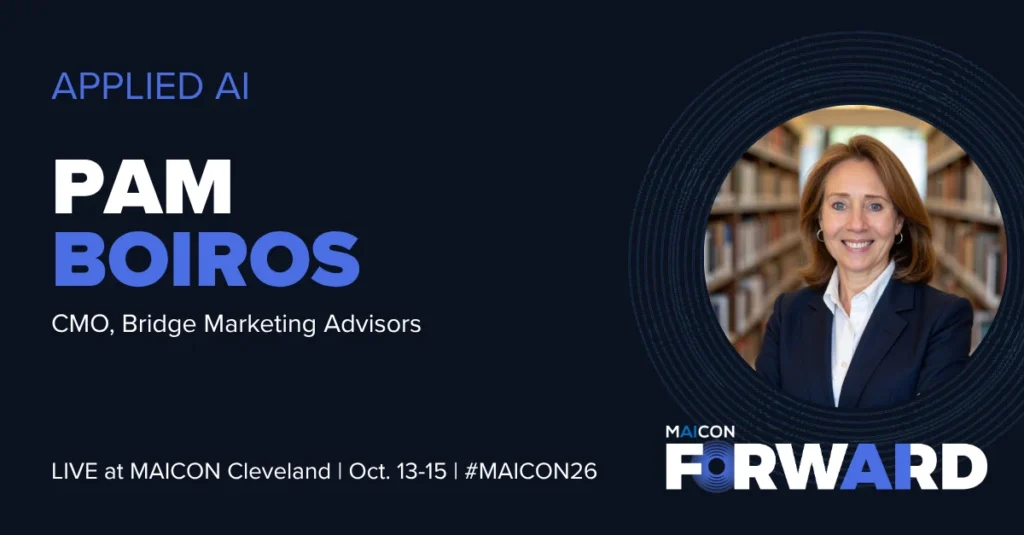
At MAICON 2026, Pam Boiros—a fractional Chief Marketing Officer at Bridge Marketing Advisors, veteran marketing leader at companies like Skillsoft and meQuilibrium, and co-founder of Women Applying AI—will address this critical inflection point. Her session, "AI Adaptation: The People Side of Scale," argues that if AI still feels like a separate initiative rather than the fabric of daily work, the organization has yet to truly adapt.
The Chronology of an AI Transformation
To understand where we are, we must look at the timeline of the "AI Wave."
Phase 1: The Novelty Surge (2022–2023)
The release of generative AI tools sparked a "gold rush" mentality. Marketing departments scrambled to integrate chatbots and image generators, often as individual productivity hacks. The focus was on speed and curiosity.
Phase 2: The Adoption Era (2023–2024)
Organizations began formalizing their relationship with AI. Policies were drafted, enterprise subscriptions were deployed, and "AI Literacy" became a buzzword in HR departments. During this phase, the success metric was simple: How many employees have access to the tools?
Phase 3: The Adaptation Crisis (2025–Present)
We have arrived at a point where tools are no longer the bottleneck. The bottleneck is now process, culture, and human integration. Leaders are discovering that merely handing a writer a tool doesn’t make them a better marketer; it often just creates a faster way to generate average work. The current focus is shifting from access to integration.
Defining the Adaptation Threshold
Boiros draws a firm line between the two concepts. "You know you’ve moved from AI adoption to AI adaptation," she explains, "when AI stops feeling like a separate initiative and starts changing how the work itself gets done."
Adaptation is not about layering AI on top of existing broken processes; it is about the redesign of the marketing ecosystem. In an adapted environment, managers move away from managing tasks and toward coaching AI-assisted outputs. Quality control is no longer a final check, but a continuous process of human judgment applied to machine-generated drafts.
True adaptation requires a workforce that possesses three critical attributes:
- Confidence: The ability to experiment without fear of failure.
- Judgment: The ability to audit, challenge, and refine machine output.
- Clarity: A precise understanding of corporate guardrails, removing the anxiety of "am I allowed to do this?"
Supporting Data: The Five Pillars of Adaptation
Boiros has identified five foundational pillars required to bridge the gap. While many organizations focus heavily on the technical and structural components, they frequently stumble on the most critical, intangible element: Culture.
1. The Cultural Imperative
"Culture shows up in what people actually feel safe and empowered to do every day," Boiros notes. In organizations where perfection is the primary KPI, AI becomes a threat. Employees fear that if they admit they are "learning" or "experimenting," they are signaling incompetence. High-performing teams, by contrast, treat AI as a collective experiment. They document their failures as rigorously as their successes.
2. Workflow Redesign
Adaptation requires mapping the "human-in-the-loop" cadence. Where does human creativity provide the most ROI? If a team spends 80% of their time on data synthesis and 20% on strategy, a successful adaptation reverses that ratio, utilizing AI for the heavy lifting of synthesis while shifting the human focus to high-level emotional intelligence and brand strategy.
3. The Measurement Shift
In the adoption phase, metrics were focused on usage (e.g., "How many prompts did we run?"). In the adaptation phase, the questions must evolve. Leaders should be asking:
- Are we producing higher-quality creative?
- Is our time-to-market improved without sacrificing brand integrity?
- Have we created repeatable workflows that survive the next software update?
4. Continuous Governance
Adaptation requires "living guardrails." As models evolve, so must the rules of engagement. This prevents the "Shadow AI" phenomenon, where employees use unauthorized tools because the official ones are too restrictive or cumbersome.
5. Collaborative Learning
The siloed use of AI is the death of scale. When teams share their "prompt libraries" and their "workflow hacks," they build an organizational intelligence that is far greater than the sum of its parts.
The Psychological Roots of Resistance
Why do some teams thrive while others stagnate? Boiros suggests that resistance is rarely about technology—it is about fear.
When a seasoned marketer expresses reluctance to use AI, they are often expressing an existential fear regarding their career relevance. They worry about the "time tax"—the feeling that learning a new tool is a second job on top of an already overwhelming workload.
"That’s why I don’t think the answer is simply more training," Boiros says. "What works better is creating space for people to learn without feeling like they’re taking on a second job."
Resistance often manifests as a dismissal: "I tried it, it didn’t work." This is usually a sign of a lack of support. If an employee tries AI and gets a mediocre result, they need a manager who can help them refine their prompt or adjust their workflow, not a manager who says, "I told you it wasn’t useful."
Implications for Future Leadership
The implications of this shift are profound. For CMOs and marketing directors, the goal is no longer to be the "tech-savviest" person in the room. The goal is to be the architect of an environment that can absorb change.
Leaders who master this transition will see a massive leap in efficiency. But more importantly, they will see an increase in morale. When AI handles the drudgery, marketers are freed to return to the parts of the job that actually require humanity: storytelling, empathy, and relationship building.
The transition from adoption to adaptation is a long-term play. It requires:
- Protected Time: Giving teams dedicated hours to experiment on real projects.
- Transparent Modeling: When leadership uses AI and shares their own mistakes, it breaks the stigma of the learning curve.
- Small Wins: Focusing on incremental improvements in daily workflows rather than grand, disruptive overhauls.
Moving Toward MAICON 2026
As the marketing industry gathers for MAICON 2026, the conversation will shift from "What tools should we buy?" to "How do we change how we work?"
Pam Boiros’s session will serve as a pragmatic guide for this transition. Attendees will not merely walk away with theory; they will receive a tactical playbook designed to turn AI from an individual productivity hack into a core team capability.
The future of marketing is not AI-versus-Human. It is an integrated model where the technology is the engine and the human remains the navigator. By focusing on the "people side of scale," organizations can ensure that they aren’t just adopting the latest tech—they are adapting their culture to thrive in an AI-augmented world.
Join the conversation at MAICON 2026. Whether you are a team lead, a strategist, or a CMO, the path to adaptation starts with a single, honest look at how your team spends its day. Register today to join the leaders who are defining the next era of marketing.
