
Beyond the Map: Why Your Customer Journey Strategy is Failing and How to Fix It
Most organizations today suffer from a "journey paradox." They have invested heavily in sophisticated journey maps, high-fidelity customer personas, and detailed sentiment analysis. Yet, when it comes to the boardroom—where capital is allocated and strategic priorities are set—these insights are conspicuously absent.
The reality is that for most companies, customer journey maps have become little more than aesthetic wall art—static artifacts that describe the problem but fail to influence the solution. To move the needle, firms must stop treating journeys as "deliverables" and start utilizing them as "decision systems."
The Core Disconnect: Why CX Initiatives Stall
Last week, during a high-level portfolio review, a cross-functional team scrutinized a backlog of work representing millions of dollars in investment. The projects were vetted for technical feasibility, budget, and ROI, but one critical lens was missing: a clear, data-backed view of which customer journeys those projects were actually improving—or, more dangerously, breaking.
This is the common trap of the modern Customer Experience (CX) department. When CX teams position journeys strictly as design tools or internal research deliverables, they inevitably become isolated. They circulate findings, host workshops, and produce polished PDFs, but they fail to infiltrate the decision-making machinery that shapes the business.
The result is a structural paralysis:
- CX Teams see the friction, but lack the authority to change the work.
- Business Leaders see the symptoms of the problem (churn, high support costs), but lack the context to know which levers to pull.
By the time journey insights are presented, the budget is locked, the roadmap is finalized, and the work is already underway. The "voice of the customer" is relegated to a post-hoc justification rather than a foundational requirement.
A Chronology of Operational Failure: The Silo Effect
The inefficiency of the status quo is best illustrated by a case study involving a global financial services firm. The bank’s customer onboarding process took 30 days. On the surface, this was an operational issue; underneath, it was a systemic failure of governance.
The Timeline of Disconnected Optimization:
- Phase 1 (The Silo Optimization): Risk management, IT, and sales departments each optimized their specific segment of the onboarding journey. Risk prioritized security, IT prioritized system stability, and sales prioritized speed of application entry.
- Phase 2 (The Fragmented Experience): Because there was no shared, end-to-end view of the customer, each department made local decisions that caused global friction. Customers were asked for the same information multiple times, and back-end processes were decoupled from front-end promises.
- Phase 3 (The Stalemate): For years, the 30-day timeline was accepted as "the cost of doing business" in a regulated environment. No single department felt responsible for the total customer experience.
- Phase 4 (The Intervention): When the bank finally mapped the end-to-end journey for leadership, the reality of the friction became undeniable.
- Phase 5 (The Business Decision): Once executives understood the cumulative impact of their departmental silos, they made a high-level strategic call: reduce onboarding from 30 days to two.
This was not a "CX initiative" in the traditional sense; it was a fundamental business decision that required the redistribution of resources, a change in risk appetite, and a total overhaul of cross-functional workflows.
Defining the "Journey Decision System"
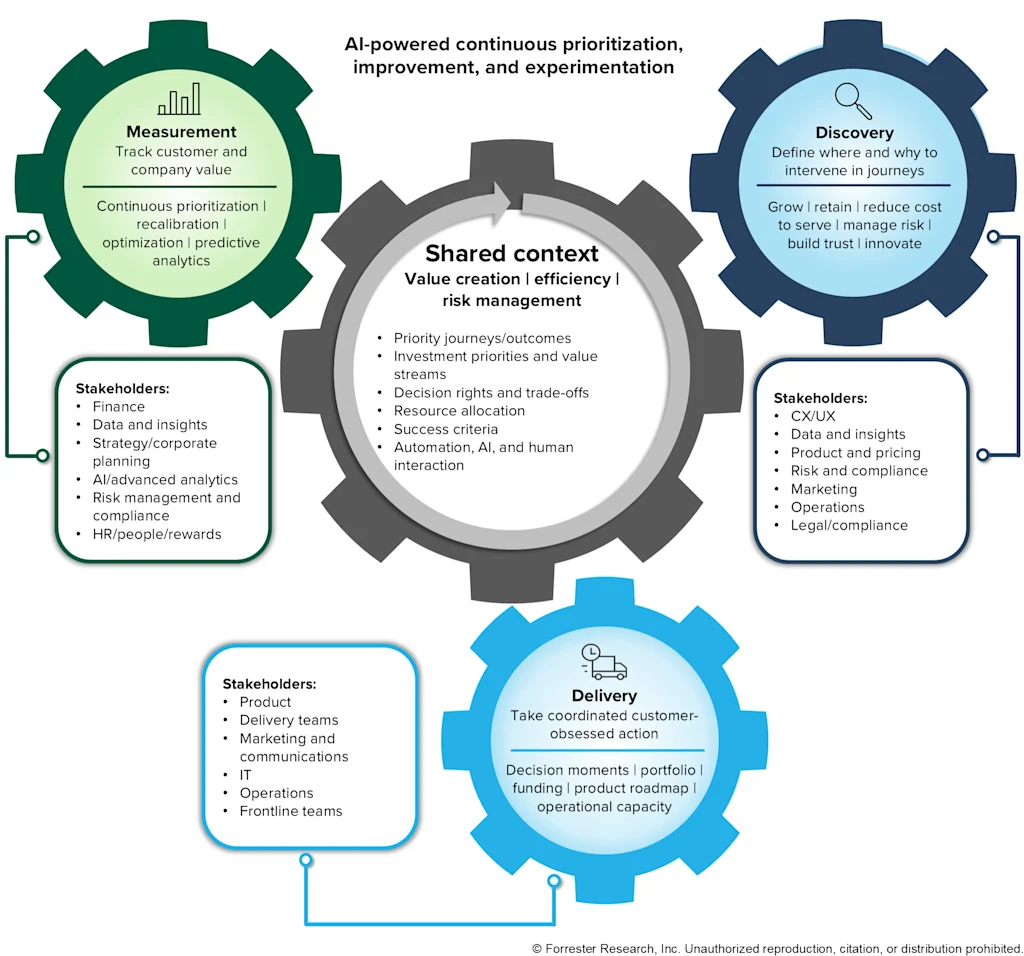
To avoid the fate of the siloed bank, forward-thinking firms are moving toward what Forrester defines as a Journey Decision System (JDS).
A JDS is not a document; it is an operating model. It embeds customer journey context directly into the architecture of how an organization sets priorities, allocates capital, and governs delivery.
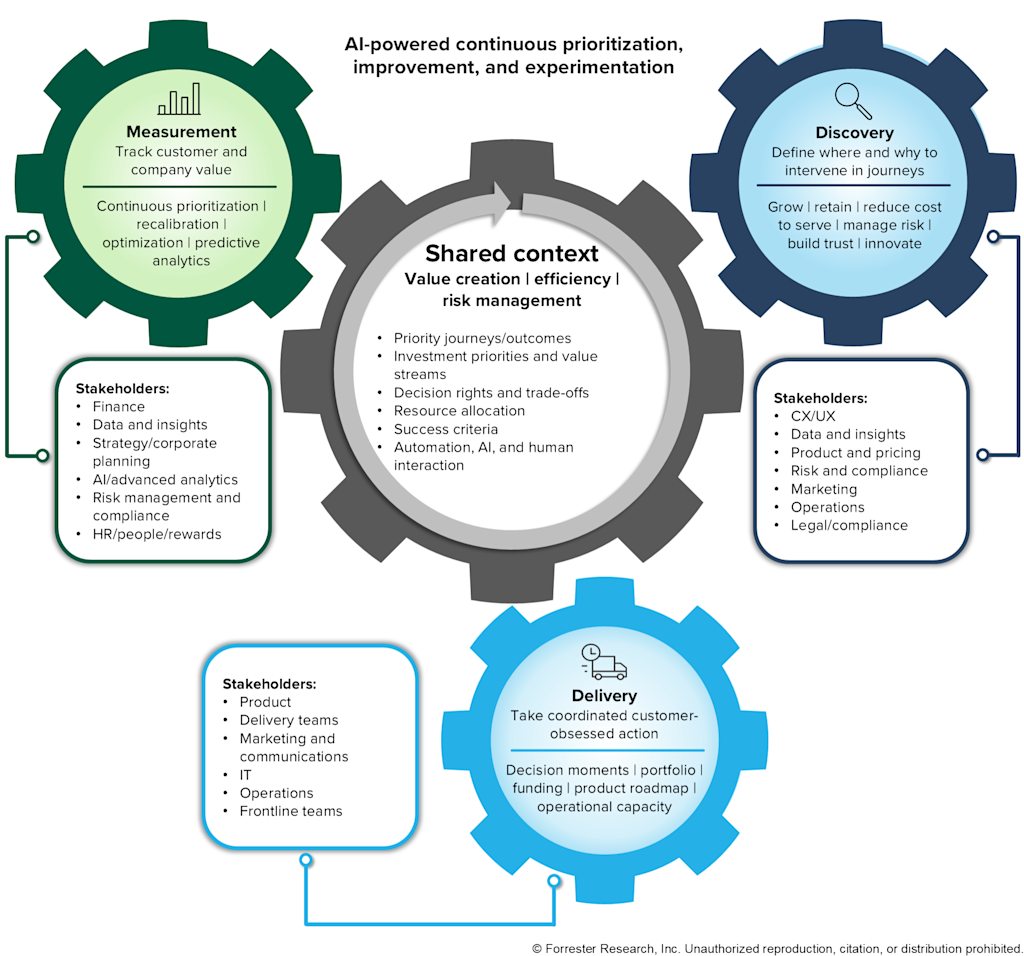
Key Components of a JDS:
- Shared Accountability: Moving away from departmental KPIs toward "journey metrics" that transcend silos.
- Predictive Impact Modeling: Using journey data to forecast how a proposed change in one function (e.g., IT infrastructure) will ripple through the customer experience.
- Dynamic Governance: Establishing a "journey office" or cross-functional council that has the power to override local departmental optimization in favor of holistic customer value.
Supporting Data: The Cost of Ignoring the Journey
The business case for integrating journeys into decision-making is stark. Data indicates that companies failing to align cross-functional workflows suffer from a "complexity tax."
- Revenue Leakage: Customers experiencing disjointed transitions between sales, onboarding, and support show a 15–20% higher propensity to churn within the first 90 days.
- Operational Inefficiency: Organizations that operate in silos spend 30% more on redundant internal coordination and "fixing" issues caused by upstream departmental decisions.
- Investment Misallocation: Research suggests that up to 40% of IT and product spend is directed toward features or processes that provide negligible value to the customer journey, largely because the decision-makers were focused on internal metrics rather than the customer’s actual path.
The Executive Imperative: From Output to Input
A persistent misconception in the C-suite is that journey mapping is a "CX task"—a creative exercise for designers to color-code user pain points. This perspective is fundamentally wrong and represents a massive missed opportunity for enterprise value.
When journeys are elevated to the boardroom, they serve as a powerful tool for:
- Exposing Trade-offs: Every business decision involves a trade-off. A JDS makes those trade-offs visible. If you optimize for "Risk" at the expense of "Speed," the system shows exactly where the customer drops off.
- Strategic Alignment: When executives speak the language of journeys, they align on the outcome (e.g., "reduce onboarding time") rather than the output (e.g., "build a new form").
- Risk Mitigation: By visualizing the end-to-end journey, leaders can see where "optimizing one function" will inevitably break another, allowing for proactive, rather than reactive, management.
Practical Steps: How to Start
If you are currently overwhelmed by the prospect of "mapping everything," you are already on the wrong path. Success in implementing a JDS is not about the breadth of your maps; it is about the depth of your influence.
1. Solve One Specific, High-Value Problem
Identify a single, painful journey—like the bank’s 30-day onboarding process—that is currently failing. Use this as your pilot. Focus your efforts on mapping the touchpoints, the data handoffs, and the departmental KPIs involved in that one specific experience.
2. Connect the Journey to the Ledger
Map the costs associated with the friction in that journey. If customers are dropping off due to a 30-day wait, calculate the Customer Acquisition Cost (CAC) lost. Presenting this to the CFO or CEO creates a financial mandate for change that a "customer empathy" presentation never could.
3. Establish a Governance Loop
Create a recurring meeting that is not about "reviewing a map," but about "reviewing a portfolio of decisions." Use the journey data to ask: "Does this project prioritize the customer outcome we’ve agreed on, or does it prioritize departmental ease?"
Implications for the Future of CX
The era of the "CX deliverable" is drawing to a close. The future belongs to organizations that treat customer intelligence as an enterprise-wide operating system.
As the business landscape grows more complex, the firms that win will not be those with the prettiest journey maps. They will be the firms that have successfully embedded the customer’s perspective into their capital allocation, their resource planning, and their executive decision-making.
Whether you are a CX leader trying to gain traction or an executive trying to break through departmental inertia, the message is clear: Stop showing them the map and start changing the system.
For those looking to deepen their implementation, consider consulting the latest industry frameworks, such as "Journeys As A Decision System" and the accompanying Executive Guide. These resources provide the roadmap for moving from theoretical insight to structural, high-impact business transformation.
