
The Architect of the Future: Why Andrew Yang is the Defining Voice for the AI Era
Every leader currently navigating the complex waters of artificial intelligence faces a singular, haunting challenge: How does one maintain institutional stability when the technology being deployed is moving significantly faster than our policies, our economic frameworks, and our social safety nets?
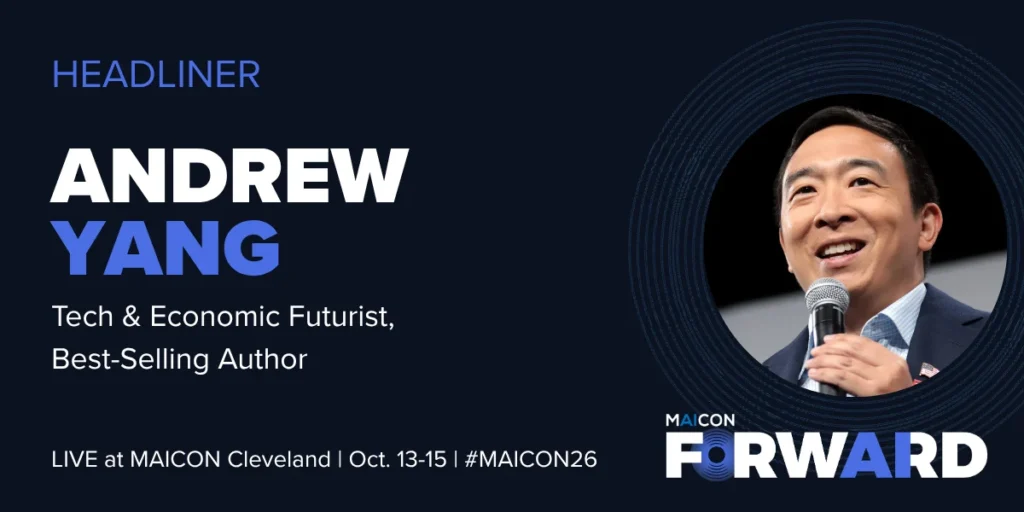
It is the defining question of our time, and for years, one voice has consistently cut through the noise of Silicon Valley hype and Washington gridlock. Andrew Yang—entrepreneur, former presidential candidate, and bestselling author—is set to take the stage as a keynote speaker at MAICON 2026. His message is no longer a warning of what might happen; it is a diagnostic of what is already underway.
The Prophet of Automation: A Chronology of Foresight
To understand the weight of Andrew Yang’s presence at MAICON 2026, one must look back at the trajectory of his public life. Long before generative AI became a household term or a boardroom mandate, Yang was already articulating the tectonic shifts that would redefine the 21st-century workforce.
The 2020 Campaign: The Early Warning System
When Yang launched his 2020 presidential bid, his platform was anchored by a singular, urgent premise: AI and automation were poised to hollow out the American middle class. At the time, the U.S. economy was experiencing a period of growth, and the idea of mass technological unemployment felt like a distant, dystopian fantasy to many political analysts. Yang was frequently dismissed as a fringe candidate with an alarmist fixation on robots.
However, his insistence that the "Fourth Industrial Revolution" would arrive with unforeseen velocity proved to be remarkably accurate. He used the national stage to introduce the concept of Universal Basic Income (UBI) not as a socialist handout, but as a necessary "capitalism that doesn’t start at zero"—a floor for human dignity in an age where traditional labor value is being decoupled from output.
The Post-Campaign Pivot
Following his presidential run, Yang did not retreat from the discourse. He authored Forward, a national bestseller that critiqued the structural failures of American governance. He founded the Forward Party to bypass the binary limitations of the two-party system, arguing that the challenges posed by AI require a level of pragmatic, independent policy-making that the current establishment is incapable of delivering.
Through his podcast and his nonprofit advocacy, Yang has spent the intervening years interviewing the world’s leading technologists, economists, and ethicists. He has transitioned from a political candidate to an essential bridge-builder between the technical elite who create AI and the societal stakeholders who must live with its consequences.
Supporting Data: The Reality of Displacement
The urgency of Yang’s message is no longer theoretical. Recent data suggests that the disruptions he predicted are now manifesting with clinical precision across multiple industries.
In a 2024 blog post titled "AI and the Rest of Us," Yang provided a granular look at the immediate impact of generative AI. He recounted a conversation with a business leader who had recently terminated 15 designers because a single AI-driven workflow could replicate their creative output at a fraction of the cost. This anecdote serves as a microcosm for a broader, systemic trend: the transition from "AI as a tool" to "AI as a replacement."
According to various economic indices, the displacement of creative and white-collar roles is accelerating. Unlike the automation of the 20th century, which primarily affected manufacturing, current AI trends are impacting fields that were previously considered "automation-proof"—graphic design, copywriting, legal discovery, and data analysis. As these roles evolve, organizations are finding that they can achieve higher levels of output with significantly smaller human headcounts. For business leaders, this offers an immediate efficiency gain, but it poses a macro-economic crisis that, as Yang notes, will require a fundamental rewrite of our social contract.
Official Perspectives: The "Human-Centered" Imperative
The core of Yang’s philosophy is not an anti-technology stance. He is an unabashed proponent of AI’s potential to revolutionize healthcare, accelerate scientific discovery, and solve some of the most stubborn human ailments. He recognizes that the genie is out of the bottle; the focus must now shift from resistance to adaptation.
![Andrew Yang: How AI Can Build a Future that Works for Everyone [MAICON 2026]](https://www.marketingaiinstitute.com/hubfs/Andrew%20Yang.png)
His "Human-Centered Economy" framework posits that if left to the current market incentives, the downsides of AI—such as wealth concentration and widespread labor displacement—will be inevitable. His proposed response involves:
- Economic Decoupling: Moving toward a system where basic human needs are met independently of the labor market.
- Institutional Agility: Reforming the legislative process so that it can keep pace with technical innovation.
- Governance as Innovation: Encouraging leaders to view ethical AI implementation as a competitive advantage rather than a regulatory burden.
In his 2025 TED Talk, Yang emphasized that the "future of work" is not about humans competing with machines, but about redesigning the economy so that the efficiencies gained from AI are shared by the society that enabled their development.
The Implications for Today’s Leaders
For the leaders and strategists attending MAICON 2026, Yang’s insights are not abstract political theories; they are operational imperatives. The decisions made in the next 24 months regarding AI adoption will determine the long-term viability of organizations.
Workforce Planning and Risk Management
Leaders must now grapple with the "middle-management squeeze." As AI takes over administrative and analytical tasks, the traditional path for professional development is vanishing. How do firms train the next generation of leaders if the entry-level tasks are being automated? Yang’s work suggests that firms must prioritize human-centric skills—empathy, strategy, and high-level judgment—that AI cannot replicate.
Vendor Evaluation and Ethical Governance
Beyond efficiency, the legal and ethical liabilities of AI are mounting. Yang argues that organizations that fail to build robust, transparent, and human-aligned AI policies will eventually face a "trust deficit" that no amount of efficiency can overcome. His call to action for executives is to move beyond the technical implementation and focus on the organizational culture that will sustain an AI-driven workforce.
What to Expect at MAICON 2026
At the upcoming MAICON 2026, Andrew Yang will deliver a keynote titled, "The Human-Centered Economy: Building a Future That Works for Everyone." This session is designed to serve as a roadmap for the transition ahead.
Attendees can expect a departure from standard tech-conference platitudes. Instead, Yang will focus on:
- The Velocity of Change: A realistic assessment of how fast the workplace is shifting and why traditional institutional responses are failing.
- The New Social Contract: How business leaders can partner with policymakers to ensure that AI adoption doesn’t destroy the consumer base that supports their industries.
- Practical Frameworks: Actionable steps for integrating AI while maintaining the human talent necessary for long-term innovation.
Conclusion: A Call for Grounded Leadership
We are currently living through the most significant technological transition since the dawn of the internet, if not the Industrial Revolution itself. In such a period of flux, the temptation to succumb to either blind optimism or panicked obstructionism is high. Andrew Yang offers a third way: grounded, clear-eyed realism.
His career—from his early days as a tech entrepreneur to his role as a public intellectual and advocate—has consistently demonstrated a capacity to see around corners. As he prepares to address the audience at MAICON 2026, he brings with him a wealth of experience, a network of the world’s brightest minds, and an unyielding commitment to the idea that our technology should serve us, not the other way around.
For those responsible for steering their organizations through this shift, the opportunity to engage with Yang’s framework is invaluable. He does not offer a utopia; he offers a strategy for survival and success in an era where the only constant is the speed of innovation.
Join us at MAICON 2026 to hear Andrew Yang, along with more than 50 other business and AI leaders, as they dissect the challenges and opportunities of our collective future. The conversation is happening, and for those who wish to lead rather than be led, the time to prepare is now.
