
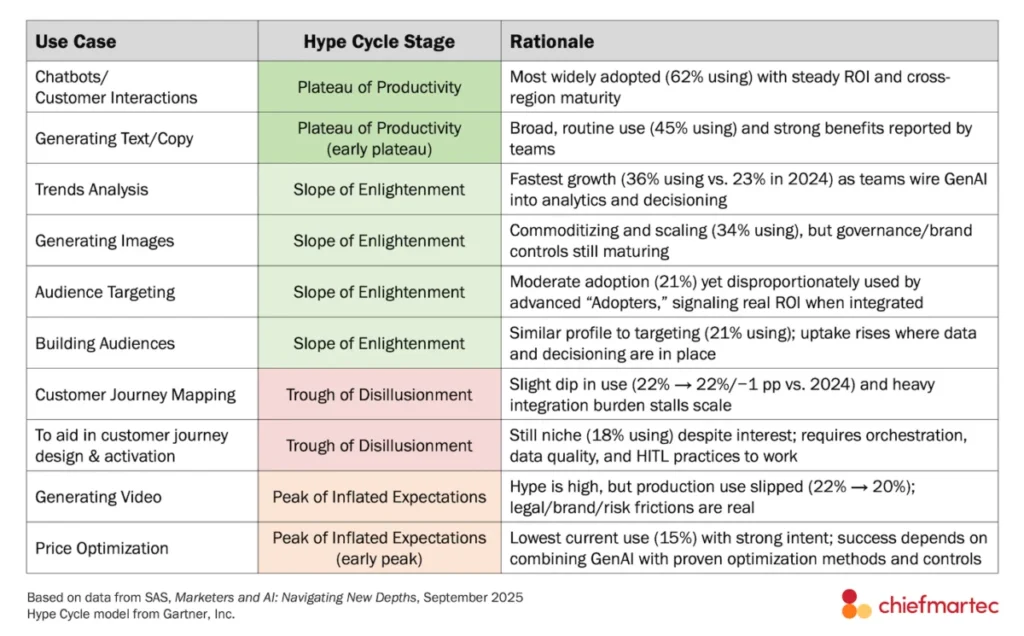
Beyond the Hype: Decoding the Rapid Evolution of Generative AI in Marketing
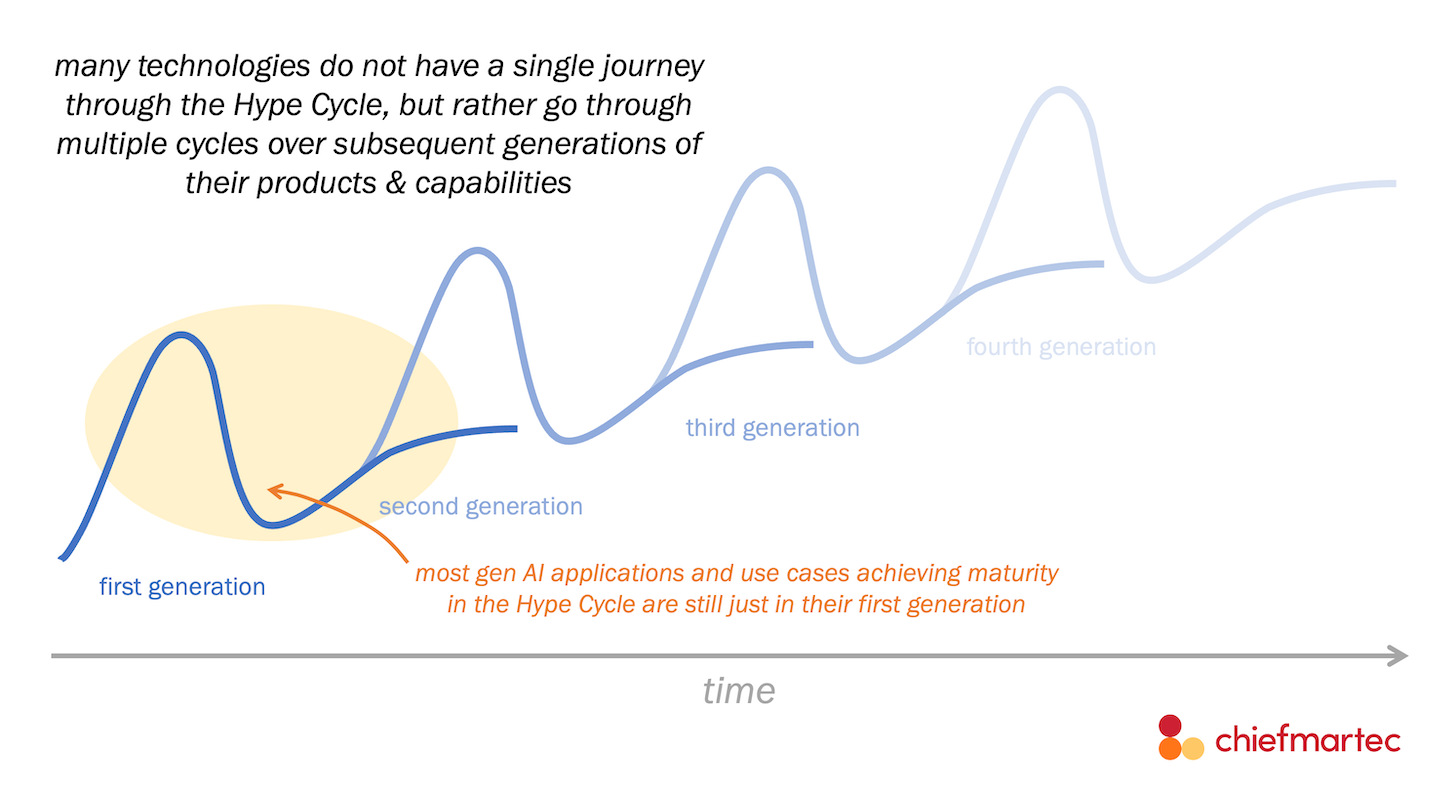
The "Hype Cycle"—a framework famously popularized by Gartner—has long been the gold standard for measuring the maturity, adoption, and social application of new technologies. It is a curve both revered for its predictive clarity and reviled for its oversimplification. Yet, in the fast-moving landscape of marketing technology (martech), the Hype Cycle is undergoing a radical stress test. As generative AI (GenAI) reshapes the industry, it has become increasingly clear that we are no longer dealing with a singular technology moving along a predictable arc. Instead, we are witnessing a chaotic, multi-layered collision of innovation waves.
The Multi-Layered Reality of AI Adoption
To understand where we stand in the era of artificial intelligence, we must first abandon the notion that "GenAI" is a monolithic entity. It is not a single point on a graph. Rather, it is a vast ecosystem of applications—from automated content generation and predictive analytics to autonomous customer service agents—each moving at its own distinct velocity.
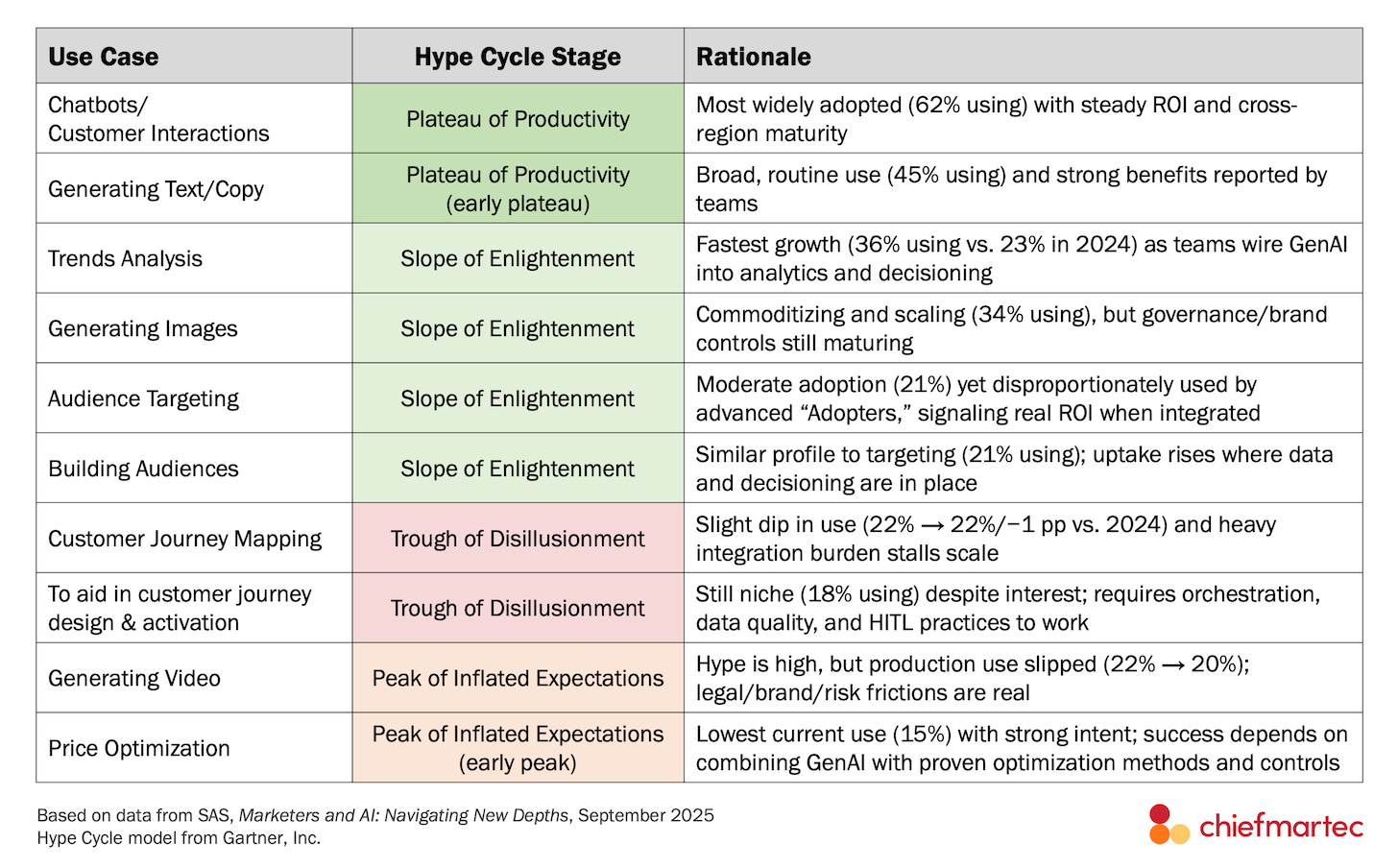
At any given moment, the industry can find itself simultaneously in the "Peak of Inflated Expectations," the "Trough of Disillusionment," and the "Slope of Enlightenment." This is not a contradiction; it is a symptom of generational maturation. Many of the tools currently being deployed are strictly "first-generation" applications. Our current standards for a sophisticated AI chatbot are rudimentary compared to the expectations we will inevitably set in two, five, or ten years.
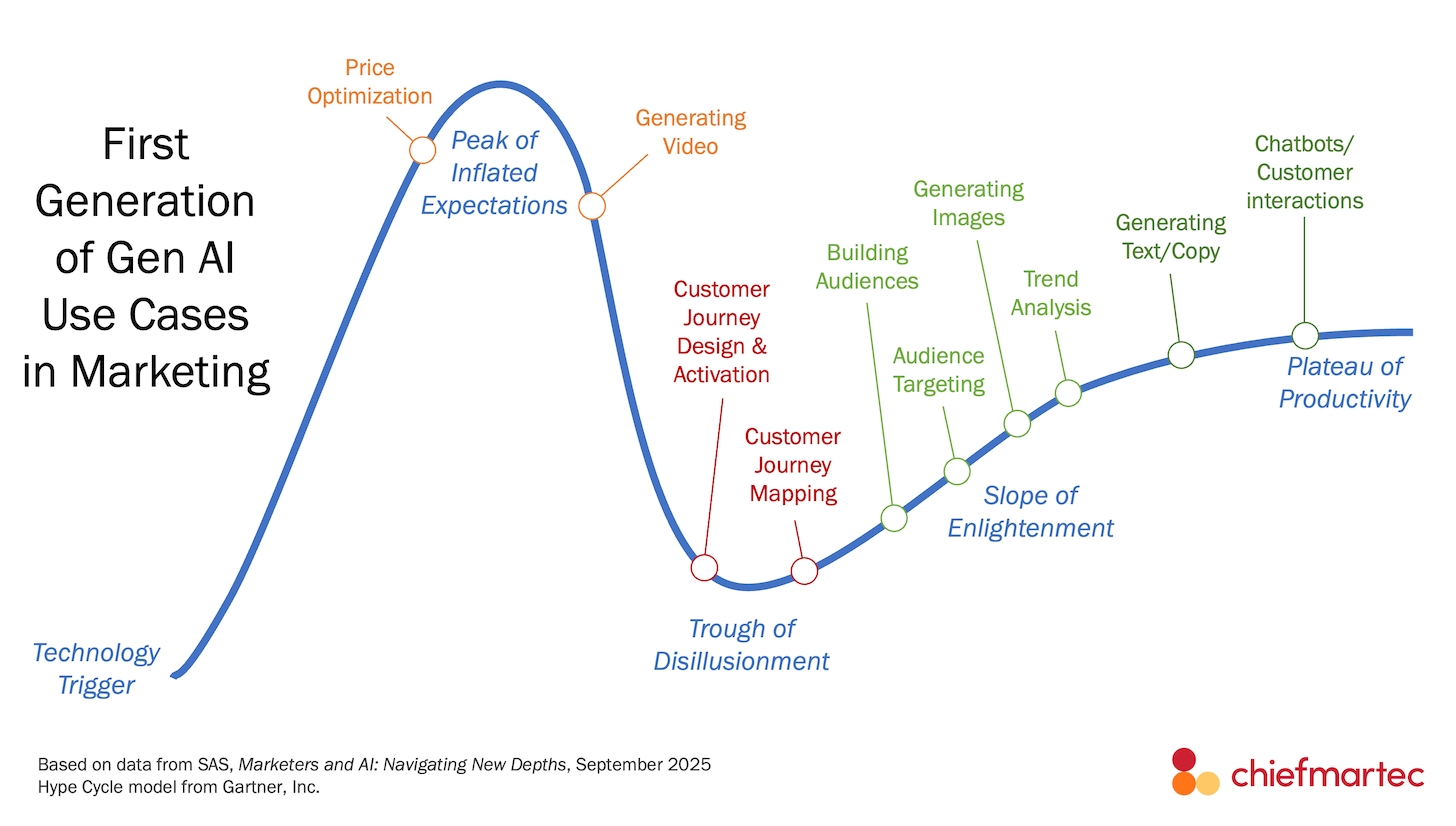
Consider the humble customer service chatbot. Today, these tools excel at answering straightforward, FAQ-style inquiries. However, future iterations will possess significantly more agency, capable of executing complex cross-sell motions, handling nuanced service disputes, and autonomously managing customer lifecycles. As each of these capabilities matures, it undergoes its own, distinct Hype Cycle. Consequently, while the basic chatbot may have reached the "Plateau of Productivity," the next generation of "Autonomous AI Agents" is already beginning its ascent toward the "Peak of Inflated Expectations."
The Acceleration of Innovation Cycles
Perhaps the most jarring aspect of this transition is the compression of time. Historically, a technology might spend a decade traversing the path from the initial "Trigger" to the "Plateau of Productivity." Today, that journey is being compressed into mere months. We are seeing the industry launch into the next cycle before the previous one has even finished its first.
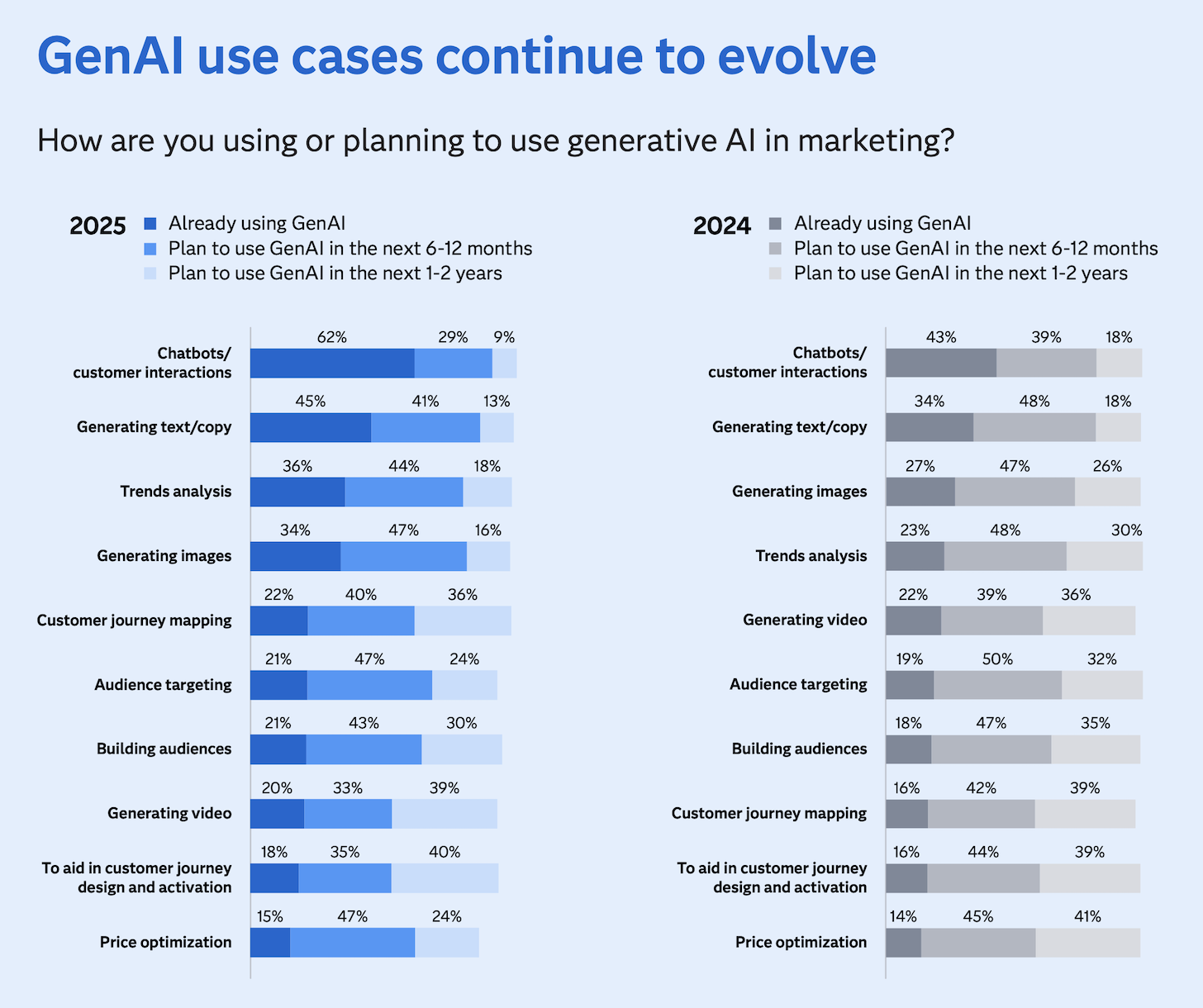
This acceleration is creating a palpable sense of vertigo among marketing professionals. However, a new report from SAS, titled Marketers and AI: Navigating New Depths, provides the necessary empirical data to ground this frenzy. By surveying 300 industry leaders, the report offers a granular look at the maturation rates of ten critical GenAI marketing use cases between 2024 and 2025.
Supporting Data: Mapping the Shift
The SAS data reveals that while some applications are settling into reliable, productive workflows, others are hitting the wall of reality. The most significant acceleration has been seen in areas like automated content creation, personalized email campaigns, and real-time customer data analysis.
The Rise of Adoption
The twelve-month period between 2024 and 2025 has seen an impressive surge in the practical integration of GenAI. The most accelerated use cases include:
- Content Ideation and Drafting: Teams have moved past the "novelty" phase and are now treating AI as a standard co-pilot for copy production.
- Customer Segmentation: AI’s ability to parse massive datasets into actionable personas has seen a rapid shift from experimental to operational.
- Hyper-Personalization: The ability to tailor messaging at scale is no longer a "nice-to-have," but a core requirement for competitive digital marketing.
These three areas currently represent the highest levels of adoption, effectively cementing their place on the "Plateau of Productivity." When a technology reaches this stage, the initial hype has faded, replaced by the quiet, consistent value of ROI-driven execution.
The Trough of Disillusionment
Conversely, the data highlights use cases that have reversed direction, showing a marked reduction in adoption. This typically occurs when a technology is oversold. Organizations implement a tool expecting a "magic button" solution, only to find that the integration costs, data quality issues, or hallucinations outweigh the immediate benefits. These use cases have fallen into the "Trough of Disillusionment," a necessary phase where teams recalibrate their strategies, address technical debt, and refine their expectations for what the technology can actually deliver.
Implications for the Modern CMO
The implications of this rapid, tiered cycle are profound. Marketing leaders must adopt a "portfolio approach" to their technology stack. They cannot treat all AI investments as equal.
- Segment Your Stack: Distinguish between "Stable AI" (the tools currently on the Plateau of Productivity) and "Experimental AI" (the tools climbing the Peak of Inflated Expectations). Stable AI should be managed for efficiency and ROI; Experimental AI should be managed for learning and agility.
- Plan for Obsolescence: Because the cycles are compressing, the software you buy today may be obsolete in 18 months. Avoid long-term, rigid vendor lock-in where possible. Prioritize modular, API-first architectures that allow you to swap in the "next generation" of models as they become available.
- Manage Organizational Expectations: As a leader, it is your job to prevent the "Disillusionment" phase from becoming a "Defunding" phase. When teams hit the trough, ensure they understand that this is a normal part of the innovation cycle, not a failure of the technology itself.
Future Horizons: Beyond GenAI
While the current obsession is generative AI, the SAS report hints at the next wave of disruption: quantum computing. While still in its infancy, the early considerations of quantum computing in marketing indicate that the industry is already preparing for the next, even more radical shift in how we process and utilize consumer data.
For those in the martech space, the speed of this evolution can feel exhausting. However, it is precisely this rapid succession of hype and maturation that makes the current era of marketing so exhilarating. We are no longer waiting for the future; we are actively building it, cycle by cycle.
Conclusion
The Hype Cycle, while often abused or misinterpreted, remains a vital lens through which to view the evolution of martech. By acknowledging that we are dealing with multiple, overlapping generations of technology, marketing professionals can better navigate the transition from initial excitement to sustained, productive value.
The goal is not to avoid the hype, but to understand where you are on the curve. Are you in the initial thrill of the peak, or are you doing the hard, foundational work in the trough? Recognizing the difference is the first step toward building a resilient, AI-powered marketing organization that can thrive regardless of where the next cycle begins. As we look ahead, one thing remains certain: the only constant in marketing is the acceleration of the next big thing.
