
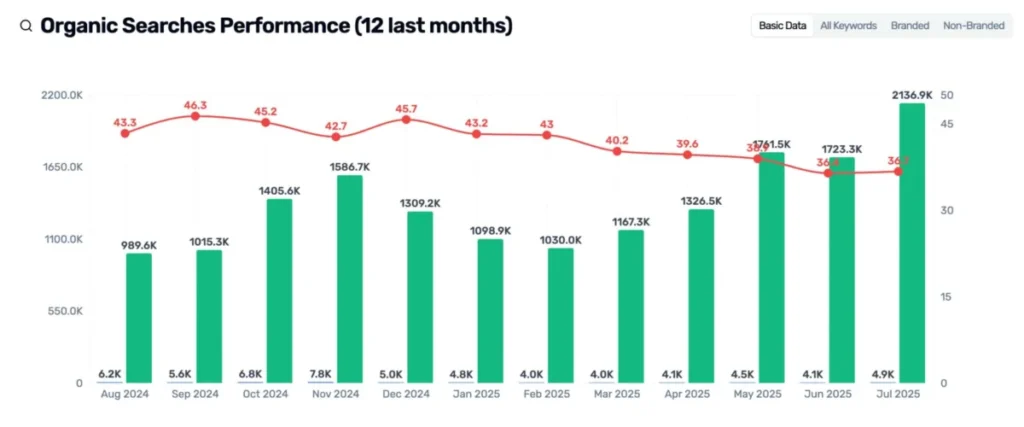
Beyond Rankings: Why the Branded vs. Non-Branded Dichotomy Defines Modern SEO
Originally published on the Growthrocks blog by our Chief Strategist.
In the digital marketing landscape, not all search queries are created equal. For years, SEO practitioners have treated every keyword as a potential victory, but this "growth at any cost" mindset is increasingly outdated. To truly understand the health of a digital ecosystem, one must draw a sharp line between branded and non-branded search traffic.
This distinction is more than just a reporting preference; it is the fundamental framework for understanding the interplay between brand awareness and search intent. In an era dominated by Large Language Models (LLMs) and AI-generated search summaries, this segmentation has transitioned from a "nice-to-have" metric to a critical survival skill for any brand looking to remain relevant.
Main Facts: The Anatomy of Search Intent
At its core, the search landscape is bifurcated into two distinct categories:
- Branded Keywords: These include your company name, product names, misspellings of your brand, and variations that combine your brand with specific services. These represent high-intent users—individuals who already recognize your organization or have been influenced by your offline marketing, PR efforts, or social media presence.
- Non-Branded Keywords: These are the generic, category-level search terms that define your industry. Whether it’s "best CRM software" or "how to fix a leaky faucet," these queries capture users in the early discovery phase.
The fundamental truth of modern SEO is that non-branded keywords are where the battles are fought. They are highly competitive, demand-capturing assets. Conversely, branded keywords serve as a barometer for your brand’s overall health and the efficacy of your top-of-funnel marketing activities.
Chronology: The Evolution of the "Curiosity Index"
To track the effectiveness of this brand-building, we developed the Google Curiosity Index. While not an official industry term, it serves as the missing link between traditional SEO performance and tangible brand impact.
Historically, SEO teams have focused exclusively on rankings, backlinks, and page speed. However, as the digital space has become saturated, the "Curiosity Index"—the measurement of how often users actively seek out a brand name over time—has emerged as a vital indicator.
- The Early Days: SEO was largely binary. You ranked, or you didn’t.
- The Middle Era: Marketing teams began to recognize that PR, events, and offline partnerships were driving traffic that wasn’t being captured by standard SEO tools.
- The Current AI Era: We are now in a phase where "Brand Gravity"—the force of your brand pulling users directly to you—determines how LLMs interpret your authority.
Supporting Data: The AI Popularity Contest
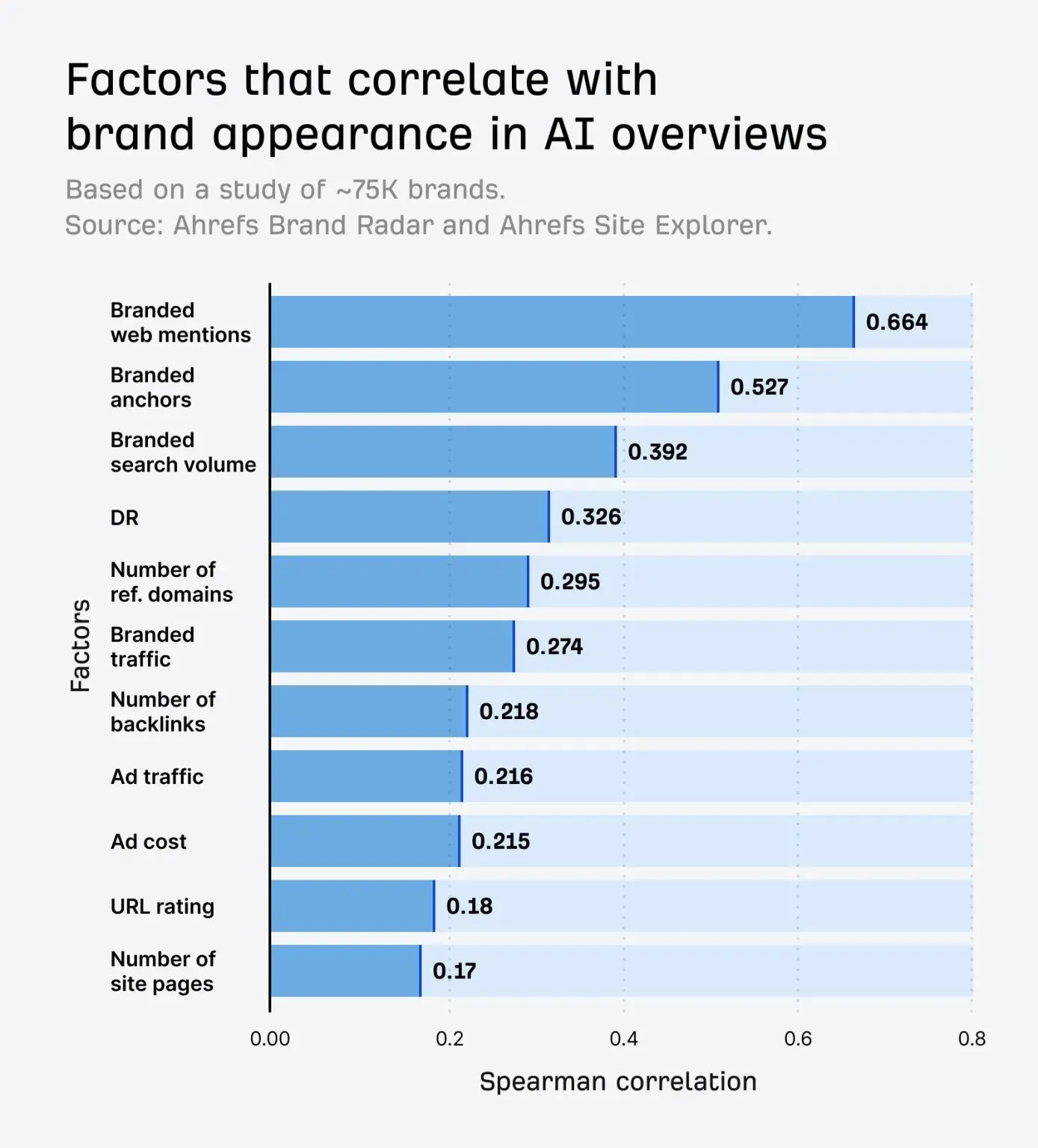
Recent data from Ahrefs has shed light on a transformative reality: AI Overviews (SGE) favor brand signals over traditional SEO metrics.
When comparing factors that correlate with appearing in AI-generated summaries, the top three contributors are:
- Brand Mentions: The frequency with which a brand is cited across the web.
- Domain Authority: The overarching strength and history of the site.
- Search Volume for Branded Terms: The "Curiosity Index" in action.
Contrast this with traditional signals like keyword density, exact-match anchor text, or meta-description optimization. While these remain important for standard blue-link results, they are losing ground to the "popularity" metrics favored by LLMs.
LLMs function similarly to humans reading the internet: they prioritize familiar names with consistent context. If your brand is consistently mentioned alongside the problems you solve, the algorithm eventually treats your brand as a synonymous entity with that solution. In the age of AI, branded keywords are a shortcut to becoming an "AI-cited" authority.
Official Perspectives: The Problem of Attribution
One of the most persistent issues in digital marketing is the blurred line of accountability. When SEO teams include branded traffic in their monthly reports, they inflate their perceived performance.
- The Brand/PR/Communications Team: Should be held accountable for the growth of branded search. Their work—events, social campaigns, PR, and partnerships—is what creates the "Curiosity" that brings users to the search bar.
- The SEO Team: Should be judged on their ability to capture net new traffic via non-branded, intent-based keywords.
By failing to separate these buckets, companies create a distorted reality. If a brand spends $100,000 on a PR campaign, and branded search traffic increases, the SEO team shouldn’t claim that as an organic "win." When teams don’t distinguish between these, they fail to identify which initiatives are actually driving growth, leading to inefficient budget allocation and strategic drift.
Implications for Future Strategy
The shift toward AI-centric search has several profound implications for how we structure digital strategies:
1. The Domain Name Connection
There is a profound semantic tie between your domain name and your brand. Many users now bypass the URL bar entirely, typing the brand name into Google to reach the site. This is brand interest masquerading as SEO traffic. If your domain is too generic, you lose the ability to capture this "shortcut" traffic.
2. The "Brand Gravity" Effect
SEO is no longer just about ranking; it is about being remembered. When a user searches for your brand, they are performing a high-intent action. Your strategy must now focus on ensuring that your brand presence is consistent across all channels so that when an LLM looks for a "trusted source," your brand is the obvious choice.
3. Tactical Implementation
To operationalize this, teams must:
- Filter and Classify: Since Google Search Console (GSC) does not natively segment branded vs. non-branded traffic, you must export, filter, and manually re-visualize this data.
- Monitor Volatility: A sudden drop in branded search is a leading indicator of a PR disaster or a failure in top-of-funnel awareness.
- Leverage Intelligence Tools: Platforms like
os.growthrocks.comhave been designed specifically to automate this segmentation, removing the manual labor from the process and providing a clear, accurate view of performance.
Conclusion: Mastering the New Search Reality
Your SEO strategy is not merely about climbing the SERPs; it is about building a presence that the algorithm cannot ignore. By focusing on the "Curiosity Index" and recognizing the power of branded search in an AI-dominated landscape, you transition from playing a game of technical optimizations to building a brand that dominates the digital conversation.
If you are not tracking branded and non-branded traffic separately, you are flying blind. You are missing the data that tells you whether your brand is gaining traction or if your SEO team is simply riding the coattails of your offline marketing.
In the final analysis, remember this: when someone types your name into Google, that is not SEO. That is brand gravity. And in the new age of AI, that is the most valuable asset you own.
