

Beyond Lightspeed eCom: The Definitive 2026 Guide to the Top 5 Alternatives for Retailers
For years, hybrid retailers—those operating both a physical storefront and a digital web presence—relied on Lightspeed eCom as a dependable bridge between their cash registers and their online checkouts. However, strategic realignments have fundamentally altered the landscape. Lightspeed eCom is no longer retailed as a standalone product; instead, it is bundled into the more robust, highly-priced Lightspeed Retail ecosystem.
For many modern merchants, this bundling has exposed the platform’s core vulnerabilities: rapidly escalating monthly overhead as locations and registers multiply, an online storefront tooling suite that struggles to keep pace with dedicated ecommerce builders, and an architecture explicitly optimized for physical retail rather than digital-first growth.
After rigorously evaluating the leading ecommerce engines across pricing architectures, omnichannel sales features, point-of-sale (POS) integration depth, design flexibility, and day-to-day usability, we have shortlisted five elite Lightspeed eCom alternatives worthy of your capital and migration effort.

Main Facts: The Changing Retail Software Landscape
To understand why retailers are migrating away from Lightspeed, it is necessary to examine the current economic and structural realities of the platform. Lightspeed Retail’s entry-level "Basic" plan starts at $89 per month billed annually, with Core and Plus tiers climbing significantly higher. Furthermore, Lightspeed Payments typically extracts around 2.6% + $0.10 for in-person transactions and 2.9% + $0.30 for online checkouts.
While these costs are justifiable for complex multi-location operations requiring heavy-duty supplier, purchase order, and deep inventory management tools, they represent a heavy financial burden for:
- Single-location boutiques or service shops with modest product lines.
- Online-first brands that operate physical pop-ups only on occasion.
- Budget-conscious operators seeking predictable, scalable monthly expenses without mandatory retail POS fees.
To address these pain points, merchants are turning to specialized alternatives that balance online sophistication with physical sales capabilities—often at a lower initial price point.

Comparative Matrix: Side-by-Side Evaluation
Before diving into individual reviews, examine how the top alternatives compare across key operational metrics:
| Platform | Best For | Starting Price (Billed Annually) | Free Plan or Trial | Native Payment Transaction Fees | Built-In POS | AI Store Builder |
|---|---|---|---|---|---|---|
| Shopify | All-round online & in-store selling | $29 / month | 3-day trial, then $1/mo for 3 mos | 2.9% + $0.30 (Basic online) | Yes (Shopify POS) | Yes |
| Square Online | Budget-conscious retailers | $0 (Free plan) | Free plan forever | 2.9% + $0.30 online | Yes (Square POS) | Yes |
| BigCommerce | Large catalogs & scaling stores | $29 / month | 15-day free trial | 0% platform fee on any gateway | Via 3rd-party integrations | Yes |
| WooCommerce | Customization & WordPress users | Free plugin (hosting extra) | Free plugin (Open Source) | 2.9% + $0.30 (WooPayments, US) | Via extensions | Limited (via plugins) |
| Wix | Beginners & design-led stores | $17/mo ($29 to sell) | Free plan forever (no selling) | 2.9% + $0.30 (Wix Payments, US) | Yes (Wix POS, US only) | Yes |
Note: Pricing and fees reflect published US rates at the time of publication and are subject to change.
Chronology of Platform Evolution: How We Got Here
The evolution of retail technology over the past decade has compressed what used to require an army of IT professionals into a matter of drag-and-drop configurations.

- The Siloed Era (Early 2010s): Online stores and brick-and-mortar cash registers operated on entirely separate databases, forcing retailers to manually reconcile inventory nightly.
- The Omnichannel Revolution (Mid 2010s): Platforms like Lightspeed pioneered unified commerce, tying physical barcodes directly to digital cart inventories.
- The Specialization Split (2020s–Present): While POS-first platforms leaned heavily into enterprise inventory and supply-chain logistics (driving up costs), digital-first builders like Shopify and BigCommerce perfected headless architecture, advanced marketing ecosystems, and AI-driven storefront generation. Today, merchants are no longer willing to compromise on online design or marketing tools just to keep their inventory synced with a physical register.
The Top 5 Lightspeed eCom Alternatives Reviewed
1. Shopify: Best All-Round Alternative
Shopify stands out as the most direct like-for-like replacement for Lightspeed eCom. It accomplishes the same fundamental task: uniting your online storefront and physical registers under a single inventory and customer database. However, because Shopify was engineered online-first, its storefront templates, checkout conversion rates, and digital marketing integrations far outperform Lightspeed’s native digital tooling.
- Pros: Unmatched app and theme ecosystem; superior checkout optimization; predictable tiered pricing; robust AI-powered store creation and merchandising tools.
- Cons: Section-based editor can feel restrictive for developers seeking absolute free-form drag-and-drop design; paid apps and premium themes can quickly inflate monthly overhead.
- Pricing Breakdown: Shopify’s core plans include Basic ($29/mo), Grow ($79/mo), and Advanced ($299/mo) when billed annually.
2. Square Online: Best Budget Alternative for Retailers
If your primary motivation for leaving Lightspeed is overhead reduction, Square Online warrants immediate testing. It offers a genuinely free ecommerce tier that links directly to Square’s free POS software, enabling micro-retailers and local cafes to run physical and digital operations with zero monthly software costs.
- Pros: Free ecommerce plan available; simple, frictionless setup; excellent for small-scale local pickup and delivery workflows.
- Cons: Limited design flexibility; displays Square branding on the free tier; inventory tools lack the deep multi-location transfer and purchase-order capabilities of Lightspeed.
- Pricing Breakdown: Ranges from $0 (Free Plan) to $29/mo (Plus) and $79/mo (Premium) when billed annually.
3. BigCommerce: Best for Large Catalogs
BigCommerce is tailored for merchants managing extensive inventories who generate the bulk of their revenue online. It includes advanced out-of-the-box features—such as native product filtering, multi-currency support, and complex variant options—that typically require third-party paid apps on other platforms. Crucially, BigCommerce charges zero platform transaction fees regardless of your chosen payment gateway.

- Pros: Enterprise-grade catalog management; zero transaction fees; robust B2B and wholesale features built natively into the platform.
- Cons: No native point-of-sale system (requires third-party hardware integration for physical retail); strict annual sales volume thresholds on each plan tier.
- Pricing Breakdown: Self-service plans range from $29/mo (Standard) to $79/mo (Plus) and $299/mo (Pro) based on annual billing and sales caps.
4. WooCommerce: Best for Customization
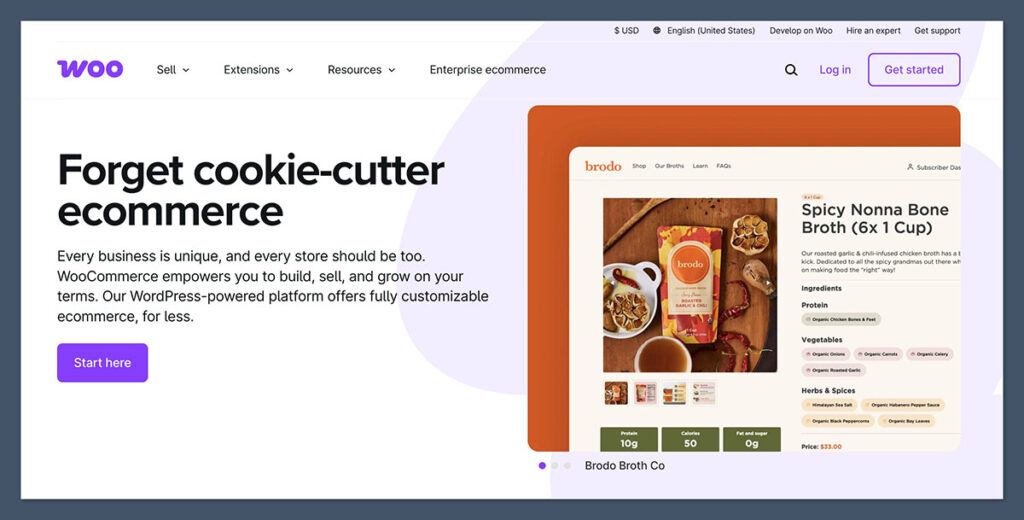
Operating as an open-source plugin built on WordPress, WooCommerce offers absolute ownership of your store’s source code, database, and operational data. If your web presence relies heavily on content publishing, custom workflows, or bespoke database interactions, WooCommerce provides unmatched flexibility.
- Pros: 100% data and code ownership; access to tens of thousands of WordPress plugins and themes; zero platform subscription fees for the base software.
- Cons: You are personally responsible for web hosting, security patches, backups, and technical troubleshooting; scaling requires technical oversight.
- Pricing Breakdown: The core plugin is free. Realistic monthly budgets range from $10 to $40/mo for managed hosting, plus optional paid extensions and premium themes.
5. Wix: Best for Beginners
Wix has evolved into a formidable ecommerce contender, anchored by an advanced AI website generator and a fluid, free-form drag-and-drop editor. It suits independent boutiques and visual brands that prioritize aesthetics and integrated digital marketing suites over complex warehouse management.
- Pros: Industry-leading visual design freedom; intuitive AI onboarding; tightly integrated email marketing, booking systems, and CRM tools.
- Cons: Inventory tooling is relatively shallow compared to Lightspeed; Wix POS hardware is currently restricted primarily to the United States market.
- Pricing Breakdown: Ecommerce functionality becomes available on the Core plan ($29/mo) and Business plan ($36/mo) when billed annually.
Official Responses and Strategic Implications
Industry analysts note that software convergence is forcing retail brands to make a strategic choice: either commit fully to an enterprise POS ecosystem like Lightspeed Retail for complex multi-warehouse physical operations, or pivot to an agile, digital-first commerce platform (like Shopify or BigCommerce) that treats physical sales as an extension of the digital storefront.
Key Implications for Store Owners:
- Total Cost of Ownership (TCO): Moving away from Lightspeed’s bundled retail pricing often lowers fixed software costs, but merchants must calculate potential expenditures on third-party apps and plugins.
- Data Portability: Product catalogs, customer profiles, and order histories can be exported via CSV or migrated via automated services like Cart2Cart. However, migration requires meticulous pre-launch testing to prevent inventory discrepancies.
- Omnichannel Continuity: Retailers with active foot traffic must ensure their chosen alternative supports reliable barcode scanning, receipt printing, and local inventory sync if they choose to abandon integrated POS hardware.
Conclusion and Recommendations
Selecting the ideal Lightspeed eCom alternative ultimately depends on the specific friction points that prompted your search.
- Choose Shopify if you want the safest, most robust all-round replacement that maintains a powerful unified online-and-offline sales model.
- Choose Square Online if your bottom line is suffering under high software fees and your inventory needs are straightforward.
- Choose BigCommerce if you manage a massive catalog of products and sell primarily through digital channels.
- Choose WooCommerce if you demand absolute control over code, hosting, and custom platform architecture.
- Choose Wix if your brand is design-driven, customer-facing, and requires an effortless, highly visual setup process.
Before making a permanent commitment, leverage free trials, free plans, and low-cost introductory periods to test your chosen platform’s backend workflow against your daily retail operations.
