

B2B Marketing Doesn’t Have a Performance Problem — It Has an Evidence Problem
By Caroline Hodson
Founder and Managing Director, WoolfHodson
Executive Summary & Main Facts
In the modern enterprise landscape, B2B marketing departments rarely suffer from a lack of activity. Campaigns launch, content floods digital channels, leads are generated, and sales pipelines fluctuate. Marketing teams universally recognize—and mathematically understand—that they are actively contributing to top-line revenue. Yet, when it comes to proving this contribution to the C-suite and the board of directors, a profound operational disconnect occurs.
Budgets are allocated, deals are closed, and somewhere in the complex vortex between those two financial milestones, the data tethering marketing actions to revenue shatters. This data fragmentation creates a severe lack of visibility, forcing marketing teams into a perpetual, exhausting defensive posture. Instead of focusing energy on scaling growth, entering new markets, and optimizing campaigns, marketing leaders spend critical hours justifying their existence, defending line items, and arguing for baseline funding.
The core reality highlighted by industry analysts and operational experts is clear: B2B marketing does not have a performance problem; it has an evidence problem. Resolving this crisis requires moving away from superficial metrics and treating performance tracking not as a reporting afterthought, but as an architectural discipline.

The Vicious Cycle: From Budget Cuts to Underperformance
To understand how B2B marketing organizations fall into this defensive trap, one must examine the self-reinforcing downward spiral that governs corporate budgeting cycles:
- The Proof Deficit: Without a clear, transparent attribution model, marketing cannot definitively prove its return on investment (ROI).
- The Budget Squeeze: Without hard proof of ROI, executive leadership and finance teams view marketing as a cost center rather than a revenue engine, making it politically and financially difficult to secure necessary funding.
- The Underfunding Penalty: Reduced or stagnant budgets mean programs are starved of resources, resulting in underperforming campaigns, lower lead quality, and weaker pipeline velocity.
- The Deepened Divide: Poor performance makes it even harder to produce the compelling evidence required in subsequent budgeting cycles, trapping the team deeper inside the loop.
At the root of this continuous loop are fundamental, persistent questions that keep B2B marketing leaders awake at night:
- Which exact touchpoints genuinely moved a prospective account down the funnel?
- How do we account for long sales cycles involving dozens of stakeholders across multiple channels?
- Are we measuring activities that matter, or are we simply tracking metrics that are easy to count?
Most legacy reporting frameworks attempt to answer these complex questions through an overly simplistic lens. They treat enterprise B2B influence as a single, isolated event—such as a form fill or a gated asset download—rather than recognizing it for what it truly is: an interconnected, multi-layered set of human and digital interactions unfolding over many months.
Chronology of the Attribution Crisis: How We Got Here
The struggle to connect marketing to revenue is not new, but its urgency has accelerated alongside the evolution of modern enterprise technology.
Phase 1: The Siloed Era (Pre-2010s)
In earlier decades, marketing accountability was largely segregated. Brand awareness was measured in impressions, share of voice, and reach, while sales operated entirely independently. CRM adoption was in its infancy, and lead handoffs resembled a baton drop in a dark room. Marketing claimed victory based on raw lead volume; sales dismissed those leads as low-quality. The data architecture simply did not exist to bridge the divide.
Phase 2: The MarTech Explosion (2010s–2020)
The 2010s witnessed an unprecedented proliferation of marketing technology (MarTech) stacks. Organizations adopted marketing automation platforms (MAPs), content management systems, social listening tools, and advanced analytics dashboards. While these tools generated massive volumes of data, they also created localized silos. First-touch and last-touch attribution models became standard defaults because they were easy to implement, despite being mathematically and strategically flawed for long, complex B2B sales cycles.
Phase 3: The Era of Economic Scrutiny (2020–Present)
Following macroeconomic shifts, rising capital costs, and tightening enterprise budgets, CFOs and boards began demanding absolute transparency on every dollar spent. Simple lead counts and surface-level metrics no longer satisfied executive stakeholders. Today, B2B marketing leaders face an unforgiving mandate: connect campaigns directly to closed-won revenue or face structural budget contractions. This has brought the evidence crisis to a boiling point.
Supporting Data & Structural Realities
Solving this crisis does not require pursuing an elusive state of perfection. Rather, it requires operational discipline, a modern technical architecture, and the executive confidence to make strategic decisions based on directional data rather than waiting for a level of certainty that will never materialize.

Many mature B2B organizations have already implemented foundational reporting layers:
- Campaign-level ROI reporting across primary channels.
- First-touch and last-touch attribution models.
- Pipeline velocity tracking to monitor deal progression.
- Periodic assessments of marketing’s influence on closed-won revenue.
While these approaches offer a baseline, they quickly hit a glass ceiling when faced with enterprise buying committees. Building robust, enterprise-grade foundations requires addressing harder, structural questions:
- How does our attribution model account for dark social, peer-to-peer recommendations, and off-platform dark funnel interactions?
- Is our data foundation unified, or are duplicate contacts and disparate definitions of "qualified pipeline" skewing the numbers?
- Do our sales and marketing teams share a unified taxonomy for funnel stages, or are we speaking entirely different operational languages?
As the foundational industry axiom dictates: You can’t report on what you can’t measure. And you can’t measure what you can’t connect.
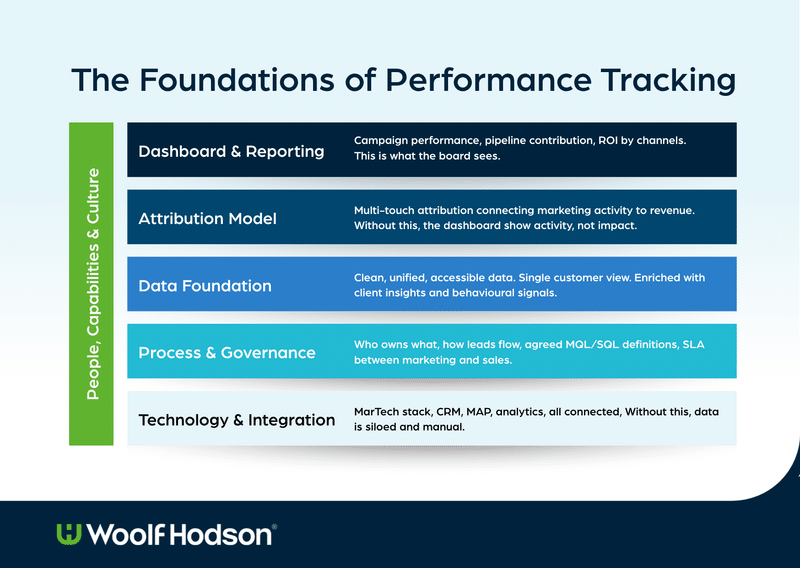
While sleek dashboards and executive visualization tools are the highly visible outputs of performance-tracking capabilities, the foundational layers beneath them must function flawlessly for the numbers to hold any strategic meaning.

+-------------------------------------------------------+
|                 THE EXECUTIVE DASHBOARD               |
|      (What the Board Sees & Uses to Judge Success)    |
+-------------------------------------------------------+
                           ^
                           | Depends upon
+-------------------------------------------------------+
|                ANALYTICS & REPORTING LAYER            |
|       (Attribution Models & Insight Generation)       |
+-------------------------------------------------------+
                           ^
                           | Powered by
+-------------------------------------------------------+
|               THE MARKETING ENGINE                    |
|    (Signal Capture, Orchestration, AI Workflows)      |
+-------------------------------------------------------+
                           ^
                           | Built upon
+-------------------------------------------------------+
|              CLEAN DATA & PROCESS FOUNDATION           |
|      (Unified Taxonomy, Lead Flow, Data Hygiene)      |
+-------------------------------------------------------+
Every single metric displayed on an executive screen relies entirely on an underlying influence model that accurately connects activity to revenue. It depends on a clean, unified data foundation, robust internal processes that define ownership and lead flow, and integrated technology that ties the ecosystem together.
Expert Insights and Official Perspectives
According to Caroline Hodson, Founder and Managing Director of WoolfHodson, the trap lies in relying too heavily on software solutions without fixing the underlying operational ecosystem. Working with global technology, telecommunications, banking, professional services, and private equity-backed businesses, Hodson and her team observe firsthand how marketing analytics often break down.
"While technology is a great enabler, it is only one element of a broader ecosystem," Hodson explains. "It takes great design, disciplined processes, and, critically, stakeholder buy-in to get a true return from technology investments."
Hodson emphasizes that marketing performance reporting has reached the absolute limits of current infrastructure in many companies. To push past these boundaries, organizations must build their strategies from the bottom up. By investing heavily in foundational data integrity and attribution hygiene, marketing leaders can ensure that when the business asks what marketing contributed, the answer is trusted, complete, and definitively evidence-based.

Further compounding the complexity of this challenge is the broader evolution of B2B demand generation. Industry experts note that tracking B2B revenue should not feel like chasing a constantly moving target. In discussions regarding attribution realities, leaders emphasize that modern demand generation requires integrating multi-channel signals—ranging from traditional account-based marketing (ABM) to creator-led B2B video content—into a cohesive framework that reflects how modern buyers actually research and purchase software and services.
Implications: Moving from Budget Defender to Revenue Optimizer
Transitioning from a reactive budget defender to an proactive revenue optimizer requires a profound shift in how marketing teams operate, measure success, and collaborate with adjacent go-to-market (GTM) functions.
1. The Integrated GTM Engine
The analytics and reporting layer drives the critical output that the rest of the organization uses to judge marketing success. It serves as the diagnostic dashboard showing how well the marketing engine is tuned and how seamlessly it operates alongside sales and customer success.
Within this framework:

- Signal capture feeds customer intelligence.
- Intelligence and insights directly drive campaign orchestration.
- Well-orchestrated engagement programs generate new behavioral signals.
This self-sustaining engine—fueled by clean, unified data, powered by automated processes, and increasingly accelerated by AI-driven workflows—enables marketing teams to act with conviction.
2. Strategic Alignment with Sales
When attribution is transparent and data is trusted, friction between sales and marketing dissipates. Both teams share a single version of truth regarding what constitutes a qualified opportunity, how pipeline velocity is calculated, and which campaigns are driving enterprise-value deals. Marketing transitions from being viewed as an expense item that needs trimming during downturns to an indispensable growth lever.
3. Actionable Next Steps for Marketing Leaders
For organizations looking to break free from the evidence trap, the path forward involves a strategic audit:
- Assess Current Maturity: Determine where your organization currently sits on the analytics maturity curve. Are you stuck in first-touch attribution, or do you have multi-touch visibility?
- Audit the Foundation: Look beneath the dashboard. Is your CRM data clean? Are lead-routing processes documented and enforced? Do sales and marketing agree on pipeline definitions?
- Identify High-Leverage Moves: Rather than trying to overhaul your entire MarTech stack overnight, pinpoint the single structural bottleneck preventing accurate attribution and invest engineering and operational resources there first.
By treating attribution and performance tracking as an architectural discipline rather than a reporting exercise, B2B organizations can finally silence the skeptics, secure sustainable budgets, and reclaim their role as true architects of enterprise growth.
