
Beyond the Peak: Navigating the Multi-Layered Hype Cycle of Generative AI in Marketing
The Gartner Hype Cycle is perhaps the most divisive framework in the technology industry. It is simultaneously revered as a roadmap for innovation and reviled as an oversimplification of complex market dynamics. However, as generative AI (GenAI) reshapes the marketing landscape, the limitations of viewing innovation as a single, linear trajectory have never been more apparent.
To understand the current state of MarTech, we must move beyond the idea that "GenAI" is a monolithic entity. Instead, we must recognize that we are living through a series of overlapping, high-speed, and distinct Hype Cycles that are fundamentally altering how brands connect with consumers.
The Myth of the Monolithic Hype Cycle
The primary error in current discourse is the attempt to locate "GenAI" at a specific point on the Hype Cycle. Is it at the Peak of Inflated Expectations? Is it plunging into the Trough of Disillusionment? Or has it already reached the Slope of Enlightenment?
The reality is that it is all of the above. Different applications of generative AI—from predictive lead scoring and automated content creation to autonomous customer service agents—are currently navigating different stages of the Hype Cycle simultaneously.
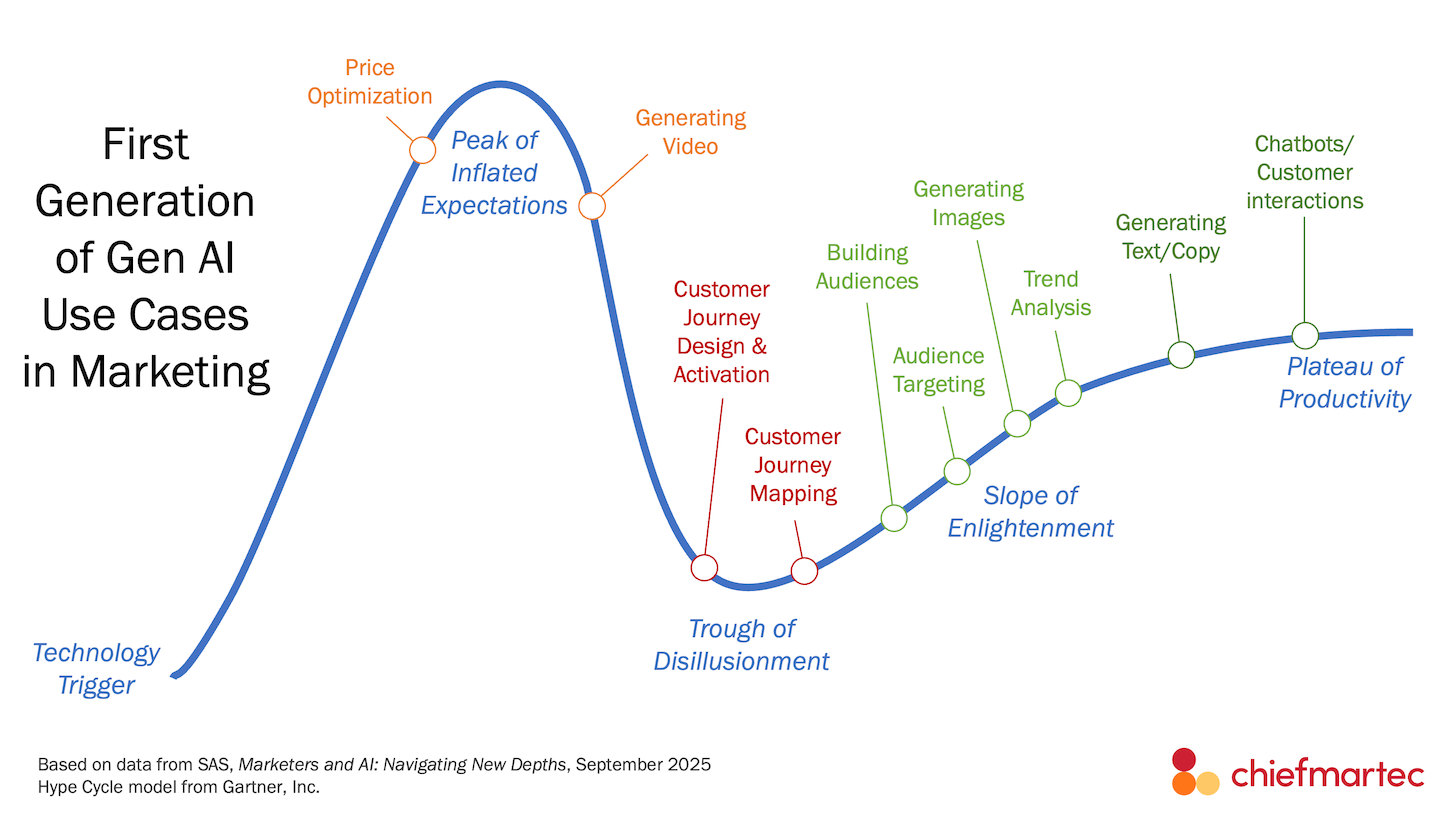
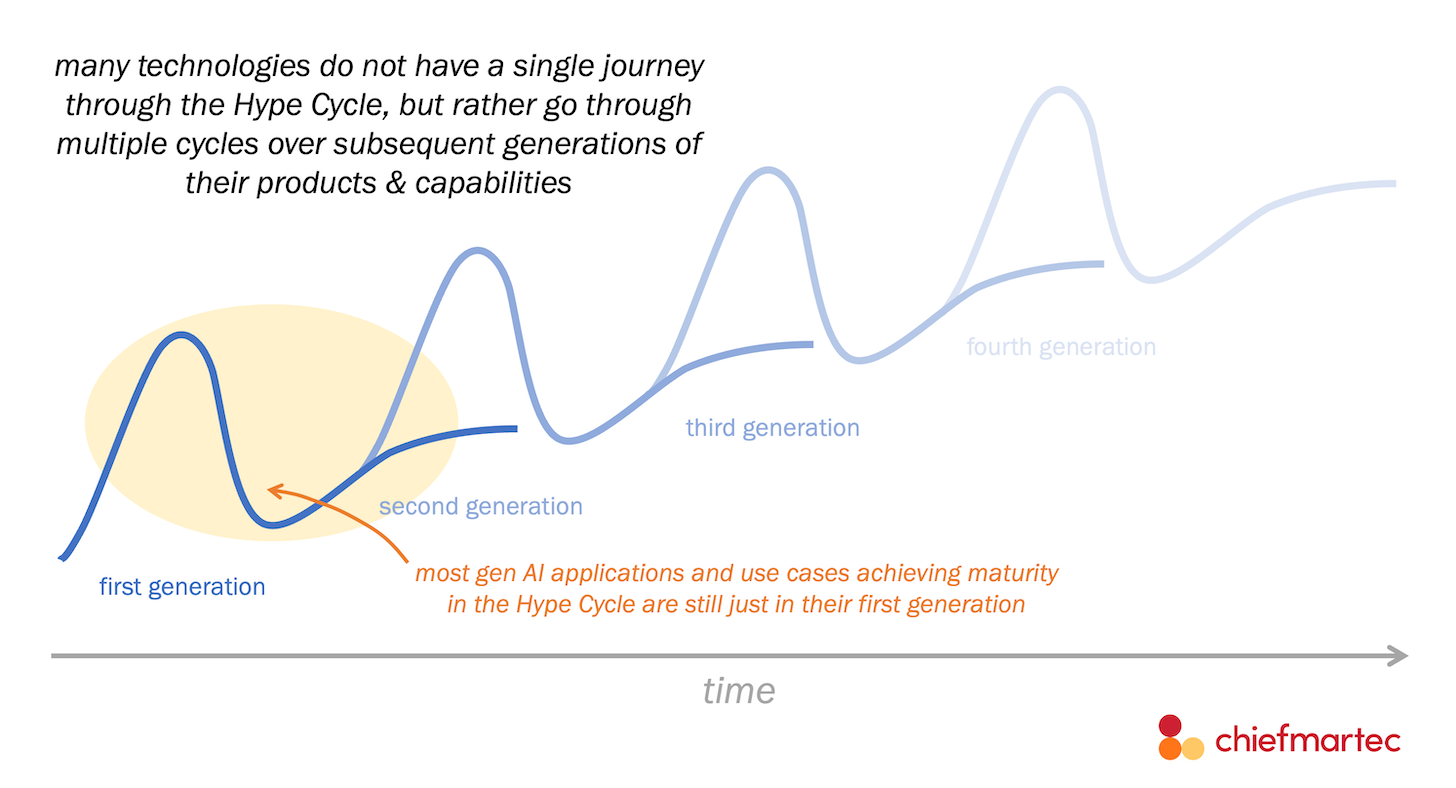
Moreover, we are currently witnessing the "first generation" of these tools. Much like the transition from early, clunky internet browsers to the sophisticated web applications of today, our current GenAI tools are merely the prologue. We expect modest utility from today’s chatbots, but in five to ten years, those expectations will seem quaint. As these technologies evolve into their second and third iterations, each generation will trigger its own, unique Hype Cycle. We may find ourselves at the Plateau of Productivity for a legacy chatbot, while simultaneously dealing with the Peak of Inflated Expectations for an emergent, autonomous AI agent.
Chronology of an Accelerated Evolution
The speed at which these technologies are maturing is unprecedented. Historically, a breakthrough technology might take a decade to traverse the path from the initial Trigger to the Plateau of Productivity. In the current climate, that cycle is being compressed into mere months.
In 2024, the industry was in a state of frantic experimentation, testing the waters of what LLMs (Large Language Models) could do for marketing workflows. By 2025, that experimentation has matured into tactical implementation, with specific use cases demonstrating clear ROI. This compressed timeline leaves little room for hesitation; before a marketing team can fully integrate one generation of AI, the next is already commanding the market’s attention. This rapid-fire succession of technological leaps is precisely what causes the "pit of the stomach" sensation of acceleration felt by CMOs and MarTech professionals globally.
Supporting Data: The SAS Report Insights
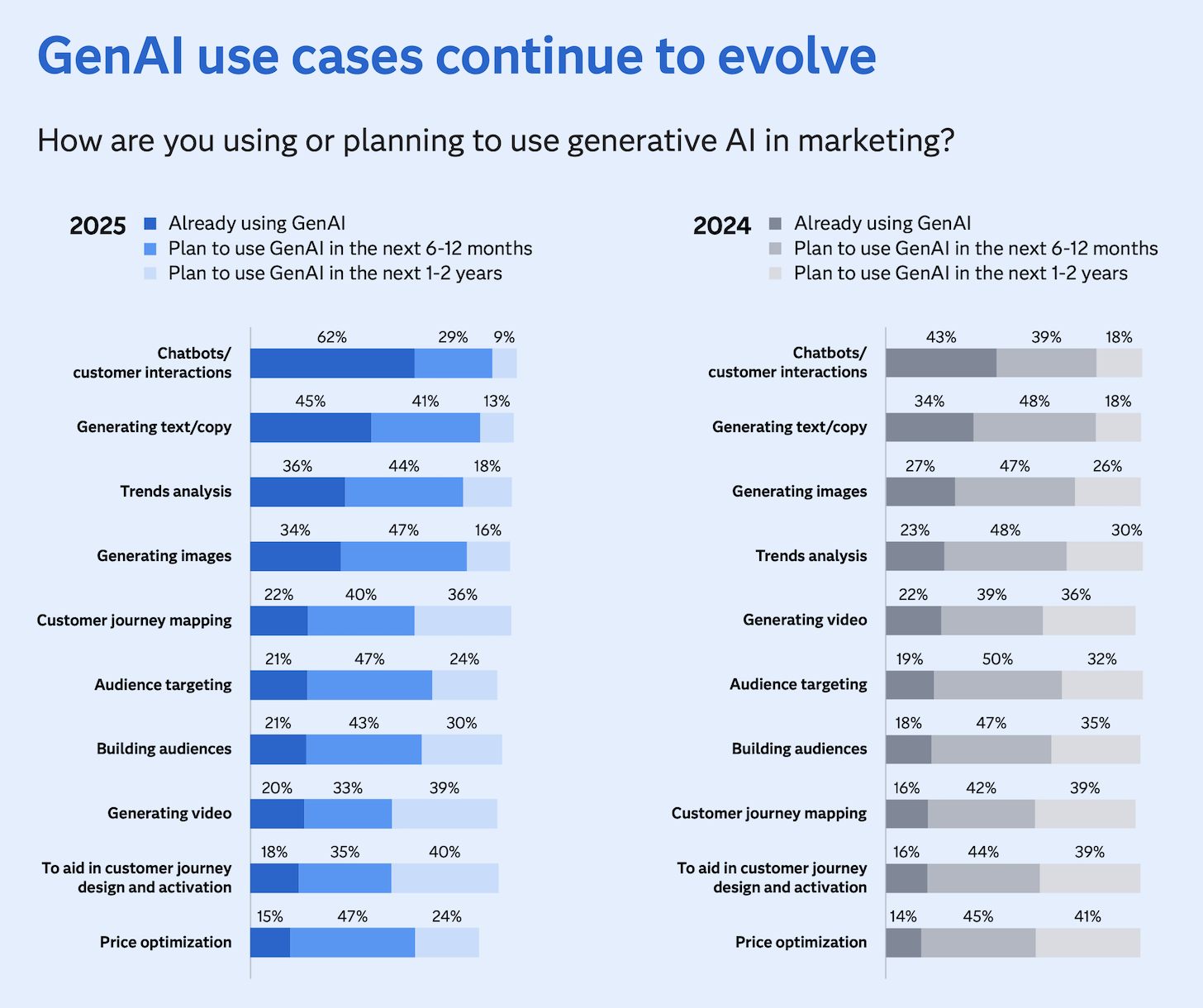
A new report from SAS, Marketers and AI: Navigating New Depths, provides the empirical backbone needed to map these movements. Surveying 300 professionals, the report highlights a significant maturation in how marketing teams are prioritizing their AI investments between 2024 and 2025.
The data reveals that several use cases have seen double-digit growth in adoption rates. The most accelerated areas include:
- Customer Service Personalization: Moving from experimental to operational.
- Predictive Analytics for Customer Journeys: Transitioning from "nice-to-have" to a foundational data strategy.
- Automated Content Optimization: Where AI is no longer just drafting content but refining it for specific segment performance.
Interestingly, the report also identifies a "reversal" in some areas. A small subset of tools that saw significant hype in 2024 have actually seen a dip in reported adoption in 2025. This is a hallmark of the Trough of Disillusionment. When initial promises of "automated marketing magic" failed to deliver immediate, seamless results, organizations pulled back to recalibrate, prune ineffective tools, and refocus on pragmatic, high-value applications.
Mapping the Use Cases: A Rationale for Placement
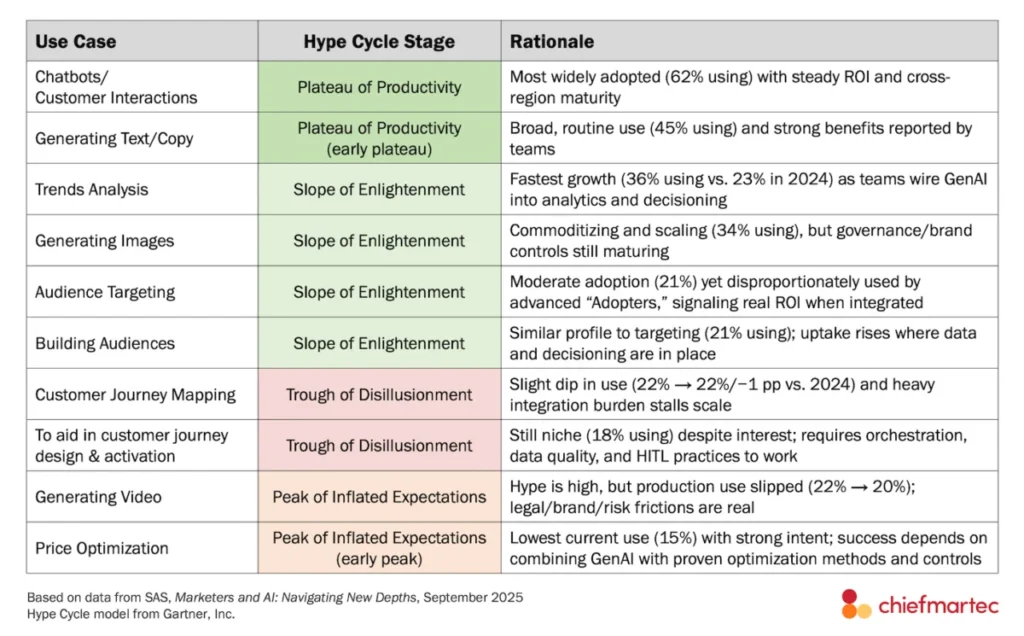
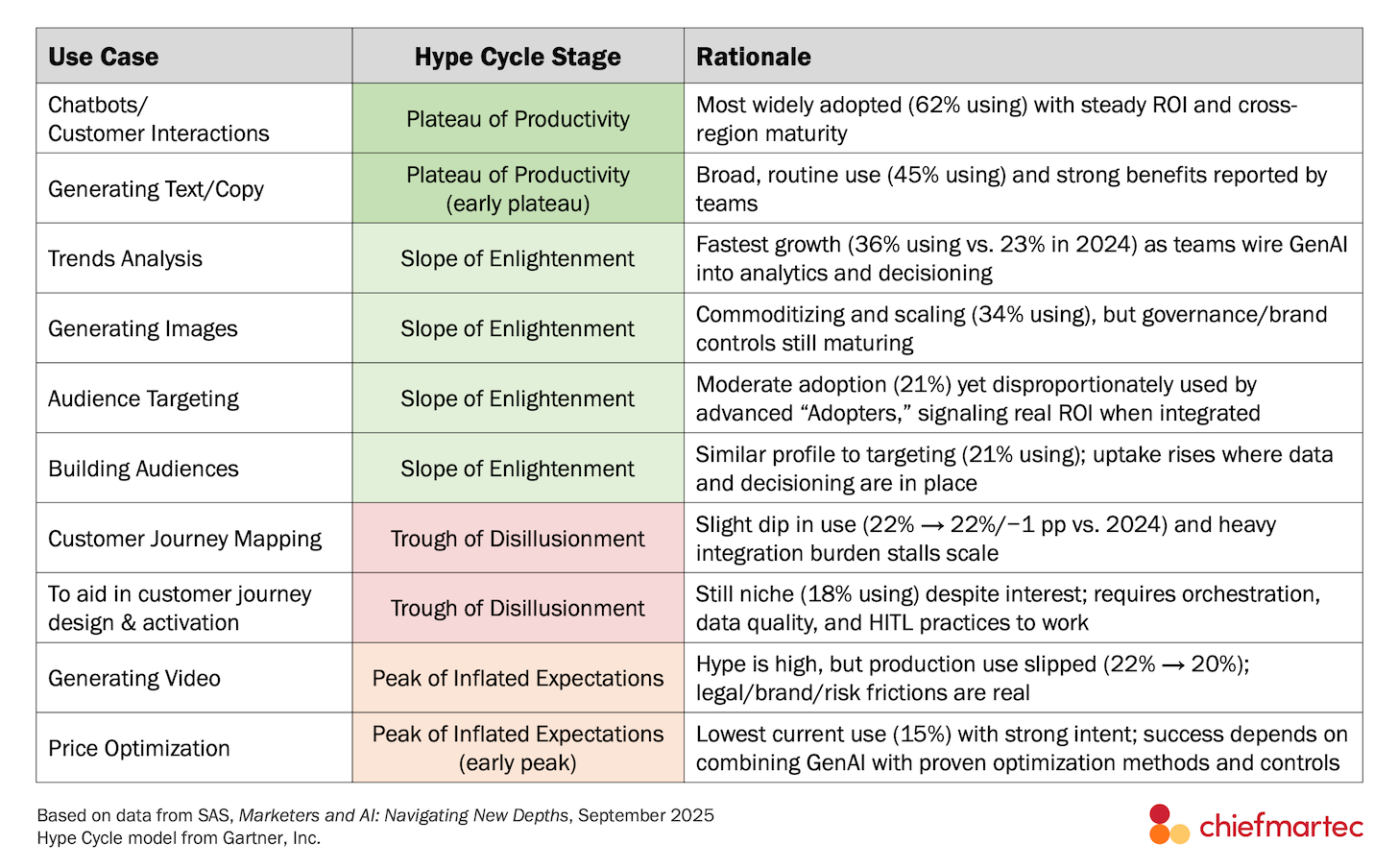
By synthesizing the SAS data with broader industry anecdotes, we can map these specific use cases onto the Hype Cycle.
The Plateau of Productivity
The tools that have successfully transitioned to the Plateau of Productivity are those that solve specific, non-glamorous problems. These include automated reporting, basic customer support chatbots, and email optimization tools. They are no longer "revolutionary"; they are simply efficient. They have become the utility players of the marketing tech stack.
The Peak of Inflated Expectations
Conversely, the "agentic" side of AI—autonomous agents capable of cross-sell and upsell motions without human intervention—is currently scaling the Peak. The narrative around these tools is one of boundless possibility, often outpacing the current technical capability to integrate them into complex, existing legacy systems.
The Trough of Disillusionment
The Trough is currently occupied by early-stage generative tools that promised to replace human creativity entirely or automate complex, highly nuanced brand strategy without human oversight. As teams have discovered that these tools require heavy human editing and brand governance, the "magic" has worn off, leading to a more sober, realistic assessment of their utility.
Implications for CMOs and Decision Makers
For the modern marketing leader, the implication of this multi-layered Hype Cycle is clear: diversification of strategy is paramount.
- Stop searching for the "GenAI Strategy": Instead, develop a portfolio approach. Allocate budget to "Plateau" technologies for immediate efficiency gains, and reserve a smaller "Innovation Fund" for "Peak" technologies that may not pay off for two or three years.
- Plan for Obsolescence: Because the cycle is so compressed, assume that any GenAI tool you license today will have a significantly more powerful, cost-effective successor within 18 months. Avoid long-term, rigid vendor lock-in where possible.
- Governance as a Competitive Advantage: As AI agents move from experimental playthings to autonomous brand representatives, governance becomes the new marketing frontier. The risk of brand-damaging outputs in a "Peak" technology is high; ensure that your internal guardrails are as advanced as the AI you are deploying.
The Future: Beyond GenAI
While GenAI continues to dominate the headlines, the horizon is already shifting. The SAS report touches on the early considerations of quantum computing in marketing. While quantum technology is currently in the "Innovation Trigger" phase—far removed from the daily life of a campaign manager—the history of the last two years teaches us one lesson: the transition from trigger to impact is happening faster than we dare imagine.
We are entering an era where the marketing stack is no longer a collection of static software, but a fluid, living organism of evolving intelligence. It is an exhilarating, if exhausting, time to be in the industry. The ability to hold the tension between the current plateau of productivity and the next peak of inflated expectations is the new hallmark of a first-rate marketing intelligence.
As we move forward, the winners will not be those who adopt the most AI, but those who can most effectively navigate the cycles of hype to find the genuine, compounding value beneath. The rollercoaster is not stopping; the goal is to learn how to balance while it is in motion.
