
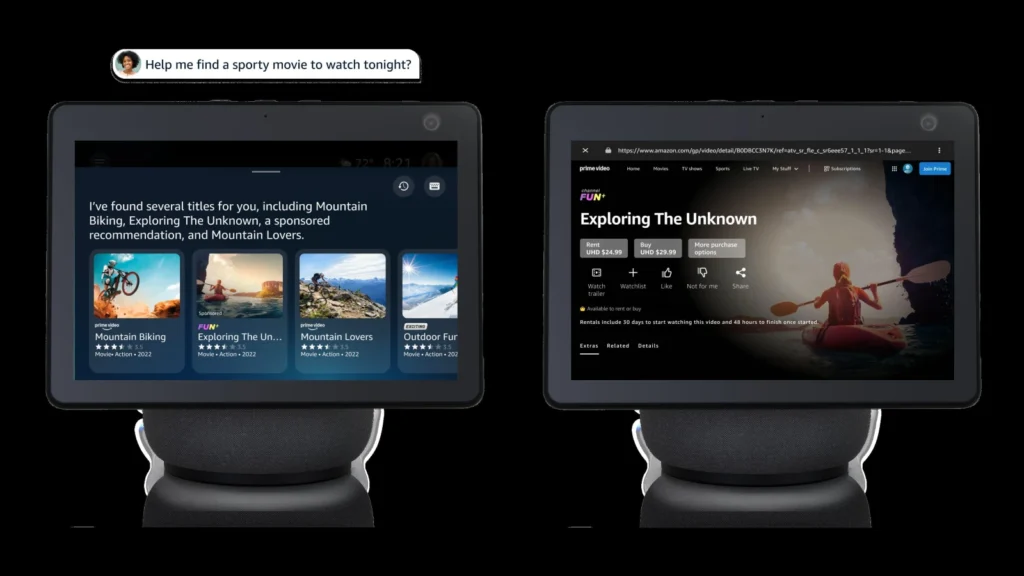
Amazon Democratizes Conversational Advertising: Self-Service Access to Alexa+ Ads for M&E Brands
In a significant strategic expansion of its advertising ecosystem, Amazon announced on June 17, 2026, that it has opened its Conversational Entertainment Ads format on Alexa+ to self-service advertisers. Previously locked behind a managed-service wall—requiring intervention from Amazon’s internal account teams—this ad format is now accessible to all buyers managing their own campaigns via the Amazon Demand-Side Platform (DSP).
This move marks a critical evolution in how media and entertainment (M&E) companies engage with audiences. By integrating Alexa+ into the existing Sponsored Tiles workflow for Fire TV and Prime Video, Amazon is effectively collapsing the silos between streaming platforms and conversational AI, creating a unified, high-intent advertising surface.
Main Facts: The Integration of Alexa+ into the DSP
The June 17 update is characterized by its frictionless implementation. Advertisers currently running Sponsored Tiles campaigns on Fire TV or Prime Video will now see "Alexa" automatically enabled as an inventory source for all new line items.
The core of this offering is the Conversational Entertainment Ad, a specialized display format that renders on high-performance Echo Show devices. When a user asks a voice-enabled query regarding entertainment—such as “What should I watch?” or “Is the new season of The Boys out?”—Alexa+ serves a recommendation integrated with a sponsored tile.
Crucially, the user experience is designed for immediate conversion. Through a combination of voice commands and touch, consumers can subscribe to Prime Video Channels or purchase/rent individual titles (TVOD) directly on their Echo Show screen without ever exiting the conversational interface.
A Chronology of Amazon’s Advertising Evolution
To understand the significance of this launch, one must look at the rapid cadence of Amazon’s ad-tech development over the last 18 months:
- February 2025: Amazon launches Alexa+ in Early Access for premium Echo Show devices.
- September 30, 2025: Amazon unveils the Echo Show 8 and 11, featuring advanced AZ3/AZ3 Pro silicon designed specifically to handle the heavy compute loads of generative AI.
- November 10, 2025: Amazon unifies its DSP and Sponsored Ads interface into a single "Campaign Manager" platform, setting the stage for centralized, cross-surface buying.
- February 4, 2026: Alexa+ moves out of Early Access, becoming a free, standard feature for all U.S. Prime members, significantly expanding the addressable user base.
- April 7, 2026: The Conversational Entertainment Ad format is introduced, but strictly as a managed-service buy for large-scale advertisers.
- June 17, 2026: Self-service access is granted via Amazon DSP, allowing mid-tier and smaller advertisers to participate in the conversational ad ecosystem.
Supporting Data: Scaling the AI-Powered Ad Surface
The commercial viability of this format rests on two pillars: hardware penetration and the shift in consumer behavior toward AI-assisted content discovery.
The Hardware Ecosystem
Conversational Entertainment Ads require a screen and advanced natural language processing. By restricting the format to the Echo Show 8 and 11, Amazon ensures that the display rendering remains high-fidelity. These devices, equipped with in-cell touch and negative liquid crystal displays, provide the visual real estate necessary to convert a "discovery" moment into a "purchase" moment.
The Scale of Reach
Amazon’s ad business is currently a juggernaut, posting $17.2 billion in revenue in Q1 2026 alone—a 24% year-over-year increase. With a global base of nearly 300 million Fire TV device owners, the infrastructure is already primed for video-based ad consumption. While the Echo Show install base is more niche than the standard Echo Dot, the demographic is highly qualified: these users have invested in premium, screen-equipped home assistants, making them prime targets for high-intent M&E marketing.
Official Perspective and Strategic Rationale
While Amazon rarely provides direct executive quotes in these technical releases, the company’s stated goal is clear: maximizing customer acquisition through a unified solution.
By moving the format from managed-service to self-service, Amazon is removing the "barrier to entry" typically associated with high-touch agency relationships. In official communications, Amazon emphasizes that this is not just about reach, but about intent. When a customer asks an AI assistant for a recommendation, they are expressing a level of intent that passive browsing cannot replicate.
This aligns with comments made by Amazon’s ad chief, Alan Moss, in May 2026, who stated that Prime Video and live sports are now "one business." By forcing the convergence of Fire TV, Prime Video, and Alexa into a single campaign manager, Amazon is signaling that it no longer views these as separate channels, but as a singular, fluid entertainment experience.
Implications for Media and Entertainment Advertisers
Operational Efficiency
For M&E advertisers, the primary benefit of the June 17 launch is the elimination of "creative bloat." Historically, launching on a new surface required bespoke assets and separate campaign structures. With this update, the existing Sponsored Tiles creative—already optimized for Fire TV—is automatically repurposed for the Echo Show. This significantly lowers production costs and time-to-market.
The Power of Dual-Modality
The interaction model is a significant departure from standard display advertising. Because the Echo Show supports both touch and voice, the ad unit feels like a natural part of the conversation. If a user likes a trailer or a tile displayed by Alexa, they can verbally command the device to "Add to Watchlist" or "Subscribe," creating a frictionless path to conversion that mimics the ease of a physical store purchase.
Lowering Financial Barriers
The shift to self-service democratizes access. Managed-service arrangements at Amazon often carry high minimum spend thresholds and require months of planning. Self-service, by contrast, allows for:
- Agility: Campaigns can be launched, paused, or modified in real-time.
- Budget Flexibility: Smaller studios or niche streaming services can now experiment with high-intent conversational ads without the need for massive upfront commitments.
- Data-Driven Iteration: Because the campaign resides within the unified Campaign Manager, advertisers can use "Ads Agent"—Amazon’s AI-driven automation tool—to optimize targeting segments and budgets based on cross-surface performance data.
Limitations and Future Outlook
Despite the excitement, the rollout is not without its boundaries.
- Geographic Restriction: The launch is strictly limited to the United States. International advertisers will have to wait for further market expansion.
- Device Eligibility: The format only functions on the newest Echo Show hardware capable of running the latest version of Alexa+. Older legacy devices are excluded.
- Industry Focus: This remains a strictly M&E-focused product. Retailers, CPG brands, and automotive companies—which make up a massive portion of Amazon’s ad revenue—do not yet have access to this conversational format.
The Road Ahead
The trajectory for Alexa+ is clear: Amazon is intent on turning its AI assistant into a proactive commercial agent. As the "Ads Agent" tools continue to improve, it is likely that Amazon will introduce more advanced, personalized creative generation for these conversational ads, perhaps allowing for dynamic ad copy that changes based on the user’s specific viewing history or current mood.
For now, the June 17 expansion represents a "closing of the loop." By aligning the self-service buying model with the cutting-edge conversational capabilities of Alexa+, Amazon has provided M&E advertisers with a potent new tool to capture consumers at the exact moment they decide what to watch next. In an increasingly fragmented streaming landscape, this ability to reach viewers at the point of discovery is likely to become the new gold standard for subscriber acquisition.
