
Beyond the Hype: Decoding the Rapid Evolution of Generative AI in Marketing
The Gartner Hype Cycle is perhaps the most divisive tool in the technology lexicon. It is simultaneously revered as a roadmap for innovation and reviled as a reductive oversimplification of complex market dynamics. Yet, when applied to the current explosion of Generative AI (GenAI) within the marketing technology (martech) landscape, the model reveals a profound truth: we are not witnessing a single, monolithic wave of change, but rather a series of overlapping, high-velocity tsunamis.
As the industry grapples with the transition from the "experimental" phase of AI to "integrated operations," a new report from SAS, Marketers and AI: Navigating New Depths, offers empirical evidence that the lifecycle of AI adoption is accelerating at an unprecedented rate.
The Myth of a Single Hype Cycle
A common mistake among marketers and strategists is the assumption that "GenAI" exists at a single point on the Hype Cycle. Is it at the Peak of Inflated Expectations? The Trough of Disillusionment? Or has it finally hit the Plateau of Productivity?
The answer is, quite simply, all of the above.
Generative AI is not a single technology; it is a category of applications, each with its own trajectory. For example, a basic content generation tool for social media copy may have already reached the Plateau of Productivity, while a complex, autonomous AI agent capable of multi-step cross-selling workflows may still be climbing the Peak of Inflated Expectations.
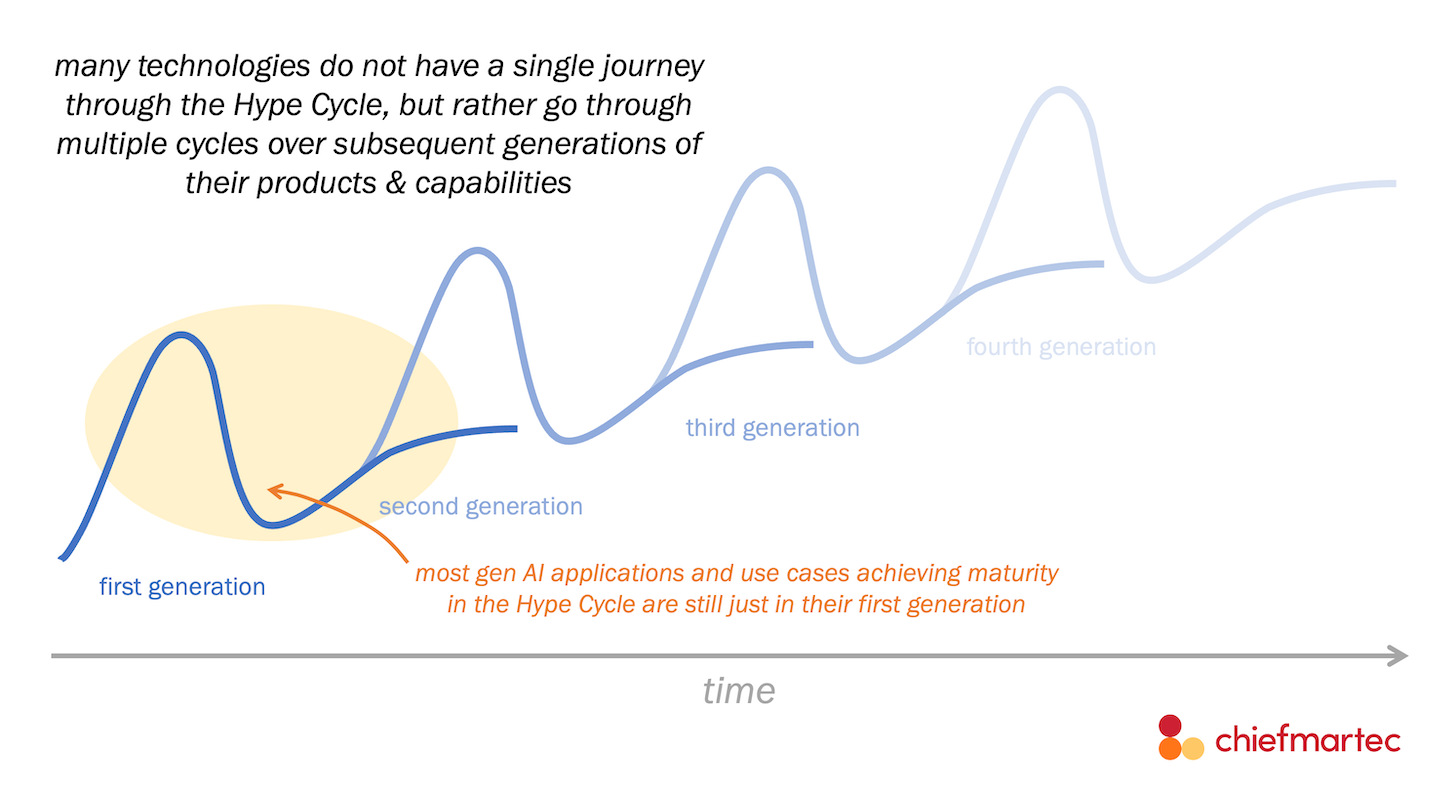
Furthermore, we are currently trapped in a cycle of "first-generation" technology. Today’s chatbots, which we might view as highly sophisticated, will likely look archaic in five years. As these tools evolve from reactive responders to proactive agents, each generation will undergo its own mini-Hype Cycle. We can be sitting comfortably on the Plateau of Productivity for a legacy chatbot while simultaneously watching the next, more powerful iteration plummet into the Trough of Disillusionment as companies realize that the promise of "autonomous agents" requires a level of infrastructure and data hygiene that doesn’t yet exist.
This phenomenon—where a technology exists in multiple stages of the Hype Cycle simultaneously—is the defining characteristic of the current martech era. It requires a "first-rate intelligence," as F. Scott Fitzgerald famously suggested, to hold two opposing ideas in the mind at once: that AI is both a mature, indispensable utility and a nascent, overhyped experiment.
Chronology of the AI Acceleration
The speed at which these applications move through the Hype Cycle is arguably the most significant shift in the history of martech. Historically, the journey from "Trigger" to "Plateau" spanned a decade. Today, that journey is compressed into 18 to 24 months.
The 2024 Inflection Point
In early 2024, the industry was defined by "AI tourism." Marketing departments were experimenting with ChatGPT and Midjourney, primarily for ideation. The focus was on "what can this do?" rather than "how does this integrate into our ROI model?"
The 2025 Realignment
By mid-2025, the narrative shifted from exploration to integration. According to the SAS data, the industry began a brutal culling process. Use cases that did not yield immediate, measurable business outcomes—or those that proved too difficult to scale—began to see a decline in active adoption. Meanwhile, the use cases that demonstrated clear, direct impact on the bottom line saw rapid, almost vertical growth in adoption.
We are now entering a phase where the "next generation" of AI—specifically autonomous agents and predictive modeling—is beginning its own cycle. The velocity of this cycle creates a constant state of "innovation whiplash," where marketing teams are forced to abandon yesterday’s "must-have" tool to make room for tomorrow’s "disruptive" capability.
Supporting Data: The SAS Analysis
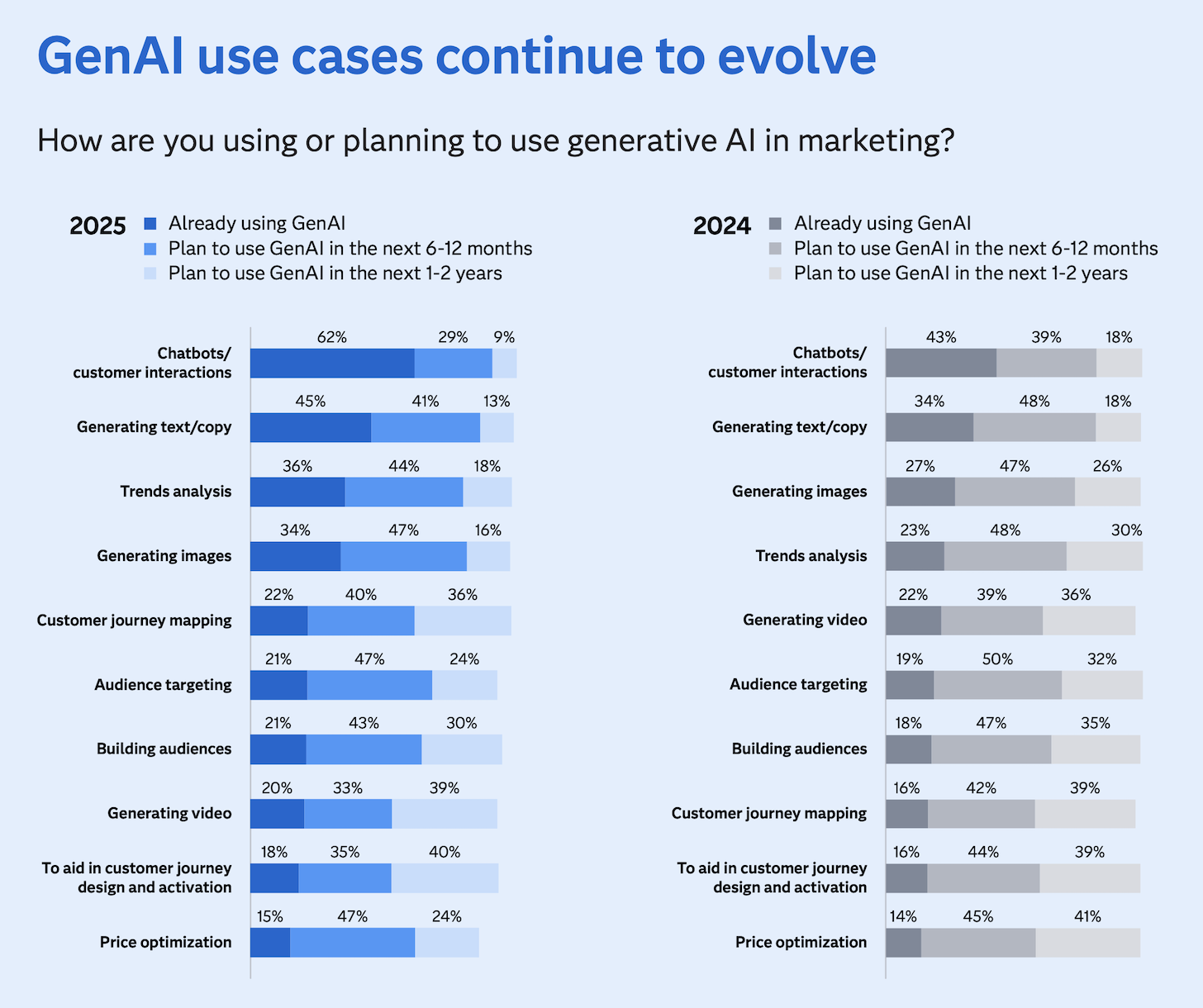
The SAS report, Marketers and AI: Navigating New Depths, provides a quantitative snapshot of this maturity. By surveying 300 marketing professionals, SAS compared adoption versus planning across 10 key GenAI applications.
The Rise of Utility
The data reveals that the most adopted use cases are those that offer the most immediate friction reduction. The top three most accelerated use cases include:
- Content Personalization at Scale: Moving from generic templates to dynamic, AI-tailored messaging.
- Predictive Customer Insights: Using AI to move from descriptive analytics to prescriptive, forward-looking strategies.
- Automated Content Creation: The transition from human-written copy to AI-assisted drafting.
These areas represent the current Plateau of Productivity. They are no longer "hyped"; they are "required."
The "Trough" Signals
Conversely, the data highlights use cases that have seen a reduction in adoption over the past 12 months. This is a critical indicator of the Trough of Disillusionment. When an application sees a decline in adoption, it is often because the initial implementation proved to be a "black box" that didn’t integrate with existing CRM or ERP systems, or because the cost of human oversight (AI hallucination mitigation) outweighed the cost savings of the tool itself.
Official Perspectives and Expert Interpretation
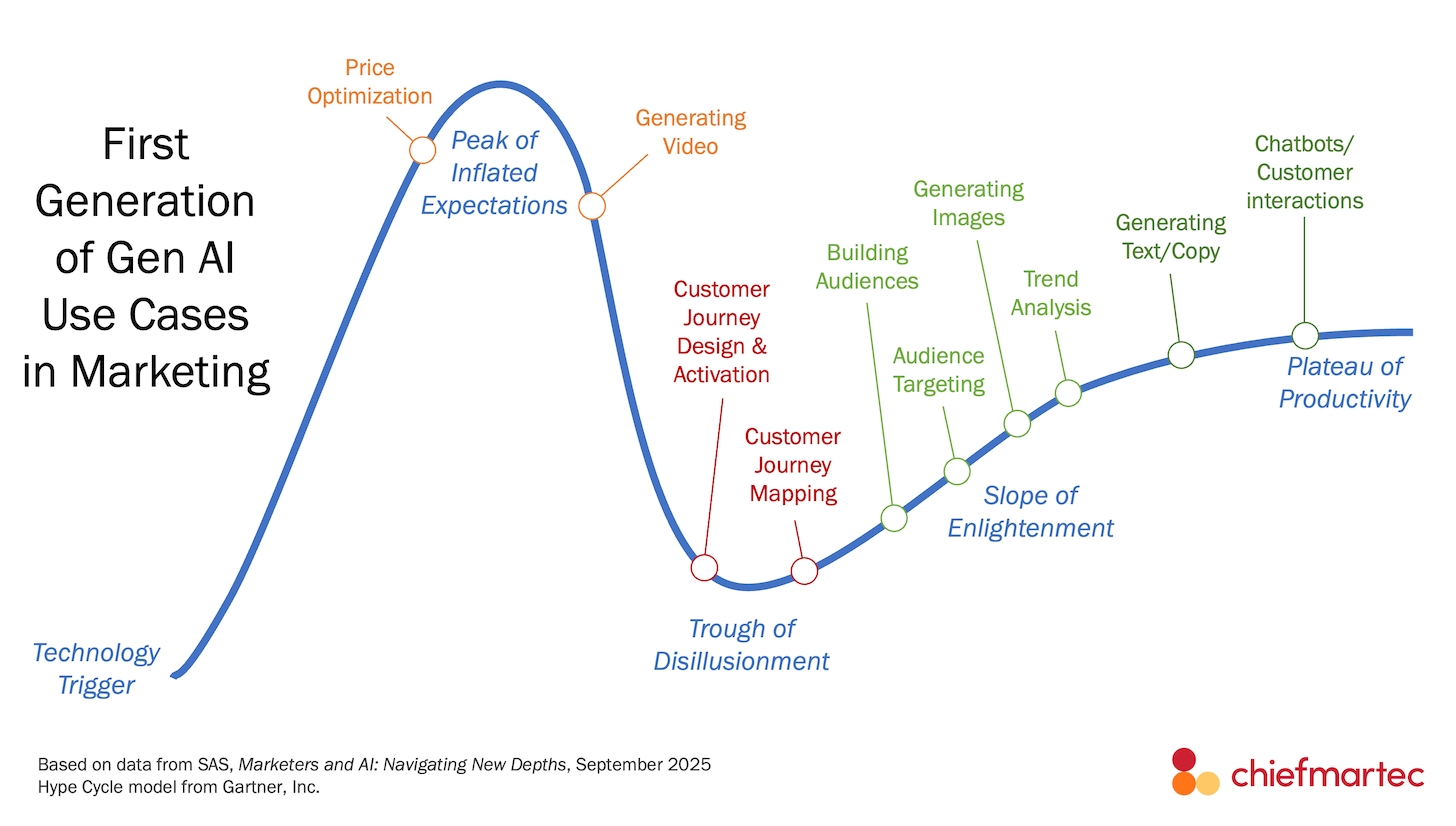
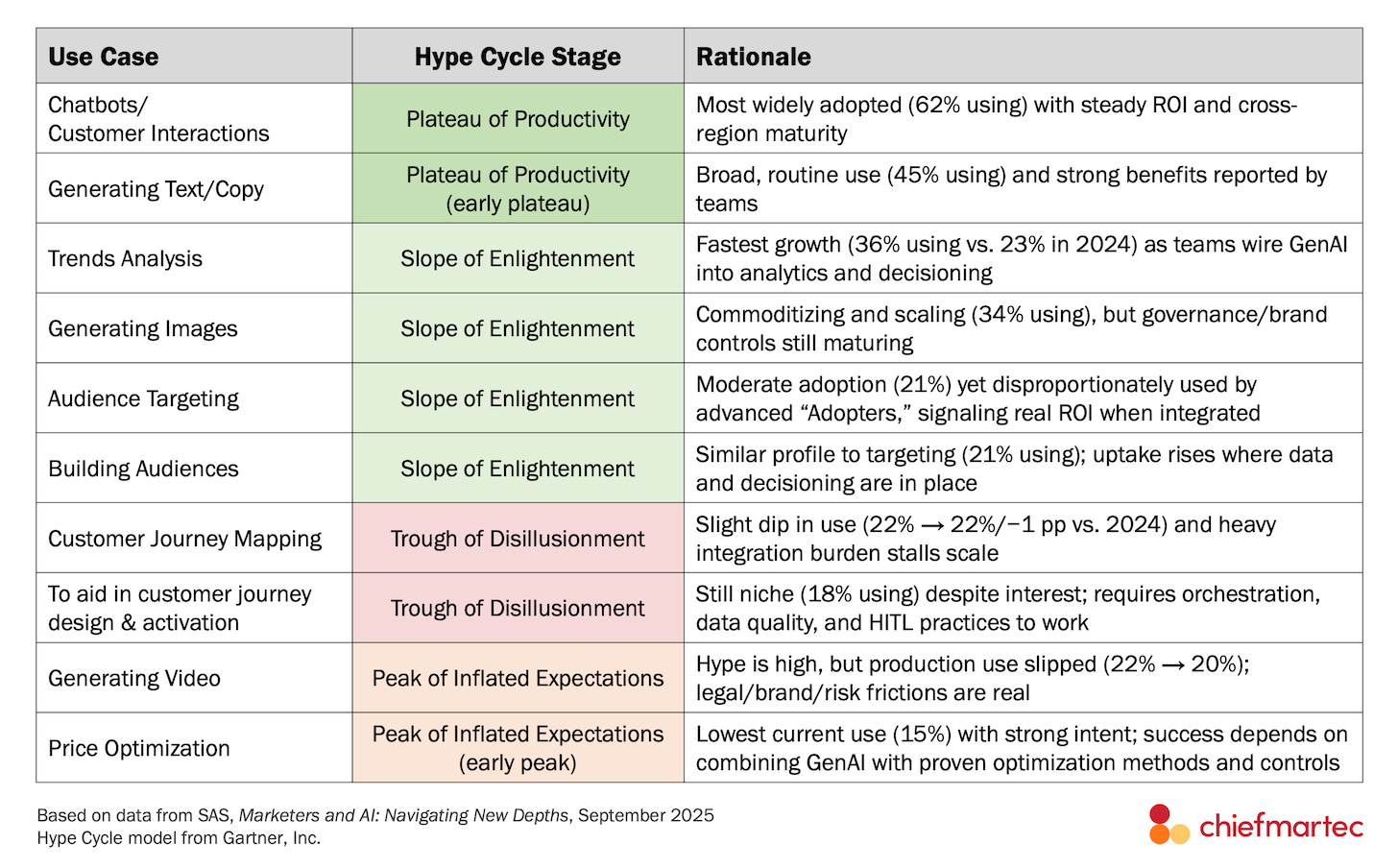
While Gartner did not author this specific map, industry experts like Scott Brinker (ChiefMartec) have utilized the framework to provide a visual heuristic for where these technologies sit.
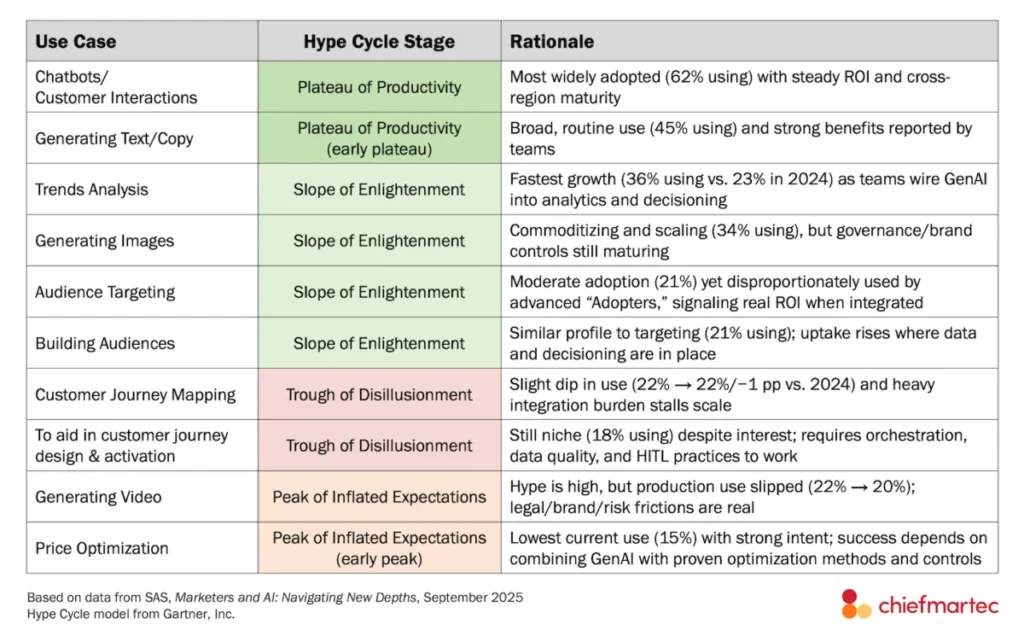
The rationale for placing these technologies on the Hype Cycle is based on the delta between "hype" (public discourse and marketing spend) and "utility" (actual, sustainable deployment).
- At the Peak: Use cases that are heavily marketed but currently face high barriers to entry, such as fully autonomous "agentic" customer service bots.
- In the Trough: Technologies that promised to replace human roles entirely but are now being "re-humanized" with heavy oversight, often leading to temporary abandonment as firms reassess their strategy.
- On the Plateau: Mature applications like generative text and basic image synthesis, where the technology is stable and the business case is well-defined.
Implications for the Modern CMO
What does this rapid cycle mean for the Chief Marketing Officer? It suggests a fundamental change in the operational philosophy of the marketing department.
1. Shift from "AI-First" to "Value-First"
The primary implication is that "AI" is no longer a strategy; it is a component. CMOs must move away from the temptation to implement every new tool that hits the market. Instead, they must map their internal needs against the Hype Cycle. If a technology is in the "Peak of Inflated Expectations," the organization should approach it with a "pilot-only" mindset. If it is on the "Plateau of Productivity," it should be treated as a core operational requirement.
2. Preparing for the "Next Wave"
The SAS report also hints at the horizon: the early considerations of quantum computing and advanced causal AI. For marketers, this means the cycle will not slow down. The "exhilarating" nature of this environment is also its greatest challenge. The ability to manage a portfolio of technologies—each at a different stage of maturity—will become the defining skill set of the future marketing leader.
3. The Human-AI Hybrid
The ultimate lesson from the current Hype Cycle is that the technology is not a replacement for human intellect, but a catalyst for it. The tools that have successfully moved to the Plateau of Productivity are those that keep a human in the loop, acting as editors, curators, and strategic directors. The companies that tried to "set and forget" their AI initiatives are the ones currently languishing in the Trough of Disillusionment.
Conclusion
We are in the midst of a generational shift that is occurring at the speed of software. The Hype Cycle, once a tool for long-term planning, has become a high-frequency trading desk for martech. By understanding that we must navigate multiple cycles simultaneously, and by relying on empirical data—rather than the echo chambers of tech influencers—marketers can successfully bridge the gap between today’s inflated promises and tomorrow’s productive reality.
As the industry looks toward the next frontier, the question for CMOs is no longer "what is the next big thing?" but rather, "how quickly can we move this from hype to habit?"
