
Fourthwall vs. Spring (Teespring): The Ultimate 2026 Creator Commerce Showdown
As the digital creator economy matures, content creators are moving past traditional ad-revenue models and looking for reliable, scalable ways to monetize their audiences. E-commerce has become the holy grail for YouTubers, Twitch streamers, TikTokers, and independent artists alike.
However, choosing the right infrastructure to sell merchandise, digital products, and community memberships can make or break a creator’s business. Two platforms consistently dominate this conversation: Spring (formerly Teespring) and Fourthwall.
While both platforms have been heavily reviewed and utilized across the e-commerce landscape, a closer look reveals that they are drifting further apart in philosophy, functionality, and long-term utility. This comprehensive review breaks down how Fourthwall and Spring compare across pricing, store building, product catalogs, print-on-demand quality, and overall support.
Main Facts: At a Glance
At their core, both platforms serve creators who want to sell custom products without managing warehouses or handling complex logistics. Yet, their approaches to business are fundamentally different.
- Spring: Designed primarily as a quick-launch social storefront. It allows creators to set up a basic merchandise shop in minutes, sync with platforms like YouTube and Twitch, and rely on Spring to handle manufacturing, payments, and fulfillment.
- Fourthwall: Positioned as an all-in-one e-commerce and brand-building ecosystem. Beyond print-on-demand (POD) merchandise, Fourthwall enables creators to sell digital downloads, manage recurring community memberships, accept direct donations, and sell self-fulfilled or custom-sourced inventory via a fully customizable storefront with a custom domain.
- The Financial Model: Both platforms offer robust free tiers, acting as the Merchant of Record (MoR). This means both Spring and Fourthwall shoulder the heavy burden of global tax collection, compliance, and remittance, saving creators countless hours of administrative work.
Chronology and Recent Platform Evolution
To understand where Fourthwall and Spring stand today, it is essential to examine how both platforms have evolved in response to changing creator demands.
Spring’s Pivot Toward Streamlined Operations
Originally launched as Teespring, the platform rebranded to simply "Spring" to reflect a broader catalog extending beyond custom tees. Over recent years, Spring has doubled down on security, checkout efficiency, and simplified listing tools.
- Enhanced Security & Checkout: Spring introduced multi-factor authentication (MFA) for user accounts and upgraded its checkout system to support modern payment methods, including crypto, Apple Pay, and PayPal.
- Bulk Controls: Recognizing that creators often manage dozens of designs, Spring rolled out new listing controls that allow users to bulk-edit designs, modify pricing globally, and easily restore or archive old product lines.
- Dedicated Support: The company established a specialized Creator Experience team to triage issues more efficiently.
Fourthwall’s Focus on Customer Retention and Ecosystem Expansion
Fourthwall has aggressively expanded its feature set, transforming from a high-end POD provider into a comprehensive brand incubator.
- AI Integration: Fourthwall launched "Eli," an intelligent 24/7 dashboard assistant designed to help creators automate price updates, tweak store aesthetics, and even map a single design across an entire product line automatically.
- Advanced Marketing Integrations: Fourthwall deepened its integration ecosystem, most notably launching a seamless sync with Kit (formerly ConvertKit). This allows creators to tag subscribers, buyers, and members automatically, triggering targeted welcome sequences or promotional offers.
- Community and Fundraising Tools: Recent updates include integrations with Throne for wishlist support, enhanced analytics for Twitch gifting, a dedicated designer marketplace to connect creators with illustrators, and financial management partnerships with Karat.
Comparative Data: Feature Breakdown
| Area | Fourthwall | Spring |
|---|---|---|
| Best Fit | Creators and small brands building multi-stream revenue businesses | Creators launching quick merchandise drops tied to social content |
| Storefront | Fully customizable branded website with custom domain support | Hosted social storefront with basic domain support |
| Physical Products | Curated, retail-grade POD catalog plus self-sourced stock | Standard POD merchandise produced and shipped by Spring |
| Digital Products | Built-in, with full ownership of audience data | Built-in, with files hosted directly by Spring |
| Memberships | Native paid tiers, member perks, private posts, video, and livestreams | None |
| Key Integrations | YouTube, TikTok Shop, Twitch, Kit, Klaviyo, Mailchimp, Zapier, etc. | YouTube, Twitch, Discord, Linktree, Store Drop |
| Tax Handling | Fourthwall acts as Merchant of Record | Spring acts as Merchant of Record |
Pricing, Fees, Margins, and True Cost
When evaluating free-to-use e-commerce platforms, the devil is always in the details regarding transaction fees and product margins.
Fourthwall Pricing Structure
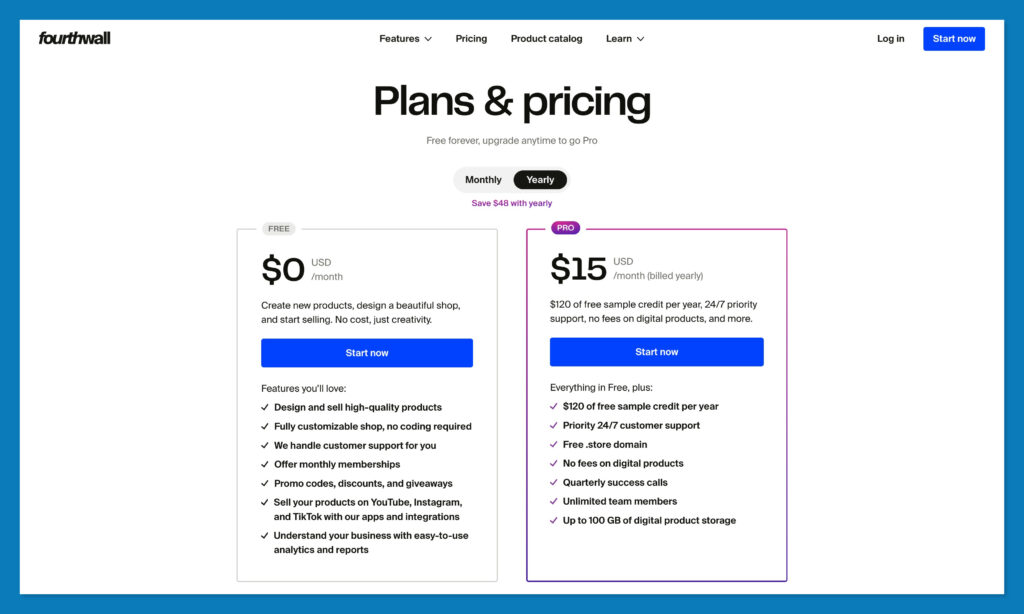
Fourthwall offers a robust Free Plan that includes a customizable store, up to 50 product listings, and support for one team member. You pay zero platform fees on physical product sales (aside from standard payment processing fees), though digital products and memberships carry a 5% platform fee.
For scaling creators, the Pro Plan costs $19 per month ($180 annually). It removes the digital product fee, expands the product listing limit to 500, supports unlimited team members, provides $10 in monthly sample credits, and unlocks priority premium support.
Spring Pricing Structure
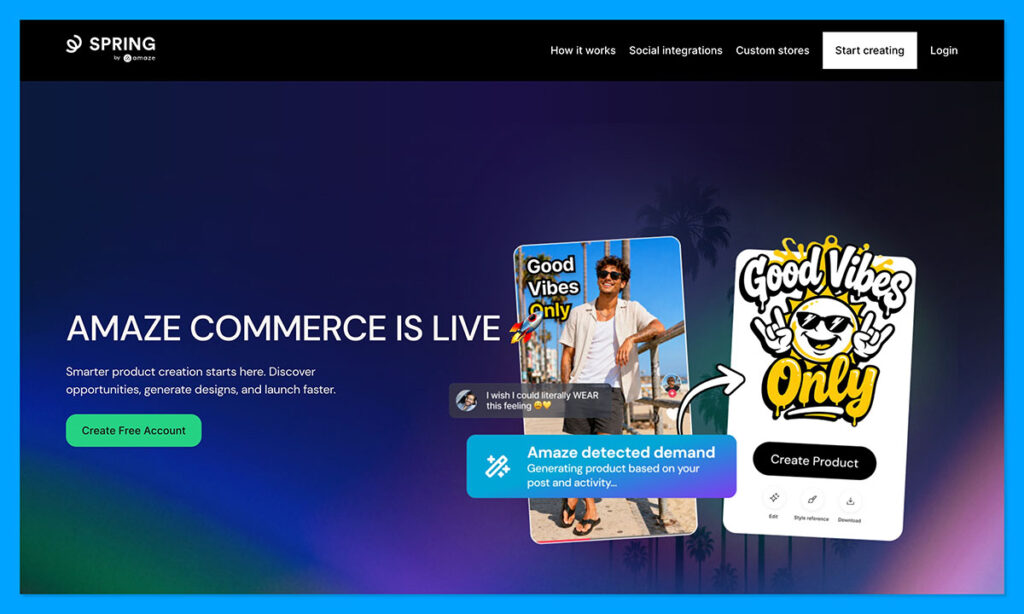
Spring operates on a single free model. Setting up a store costs nothing. However, calculating profits can be complex: every item carries a platform-determined base production cost, and creators set their own retail prices above that baseline.
For digital downloads, Spring charges a steep 20% fee plus $1.70 per sale. For example, selling a $10 eBook on Spring nets the creator just $6.30, making Fourthwall significantly more attractive for digital-first creators.
Store Building, Customization, and Integrations
The gap in store-building capabilities between the two platforms is substantial.
- Spring: Built for speed, not depth. You can add a logo, a hero banner, brand colors, and social links to a pre-set template. However, you cannot build out complex page hierarchies, integrate native email marketing, or write blog posts. You must rely on external tools for content marketing.
- Fourthwall: Operates as a true e-commerce builder. It grants deep control over themes, layouts, custom CSS/HTML, product collections, and domains, alongside a robust Storefront API. Furthermore, Fourthwall natively supports blogging for content marketing and integrates seamlessly with powerhouse email marketing tools like Klaviyo and Mailchimp, alongside its deep Kit synchronization.
Print-on-Demand (POD) Quality and Logistics
Merchandise quality can make or break a creator’s reputation.
- Fourthwall’s Curated Approach: Fourthwall takes a quality-first approach to its catalog. While base costs can occasionally run slightly higher, items feature retail-grade blanks (including their signature collection) with apparel options ranging from standard direct-to-garment (DTG) printing and embroidery to screen-printing, cut-and-sew, and sublimation. Fourthwall partners with global production hubs across North America, Europe, the UK, Japan, and Australia, with average delivery times ranging from 5 to 10 days.
- Spring’s Volume Approach: Spring offers roughly 200 product types spanning apparel, accessories, and home goods. While base prices can be competitive, print consistency can occasionally vary. Spring provides a valuable option to order samples at base cost before launching products to the public. Global shipping partners service the US, EU, Mexico, India, and Australia, though production and tracking can stretch up to 10 business days, followed by an additional 4 to 7 days for transit.
Official Support and Customer Service Policies
Both platforms alleviate the administrative nightmare of global taxation by acting as the Merchant of Record (MoR), handling VAT, sales tax calculations, and global remittance on behalf of the creator.
When it comes to customer service for buyers:
- Spring implements a "Make It Right" policy, offering refunds or replacements for damaged or defective items reported within 30 days. However, they do not handle customer service requests stemming from buyer remorse, such as incorrect size or color choices.
- Fourthwall similarly handles defective or damaged items for its POD catalog, taking customer support off the creator’s plate for manufacturing errors. Like Spring, it does not accept general returns for made-to-order merchandise.
For creators themselves, Fourthwall stands out by offering assistance via "Eli" (its 24/7 AI dashboard assistant) and dedicated success calls for Pro tier users.
Industry Implications: Which Platform Should You Choose?
The decision between Spring and Fourthwall ultimately hinges on your long-term business strategy as a creator.
Choose Spring If:
You view merchandise as a casual side project. If you have an existing social media audience, want to drop a few limited-edition t-shirts or digital items quickly, and require zero upfront investment or store-design overhead, Spring is an exceptionally fast and frictionless tool.
Choose Fourthwall If:
You view your content business as a legitimate, scalable brand. If you plan to diversify your income streams over time—combining print-on-demand goods, self-sourced inventory, digital downloads, recurring community memberships, and direct donations under a custom domain—Fourthwall provides the infrastructure to grow without forcing a disruptive platform migration down the road.
