
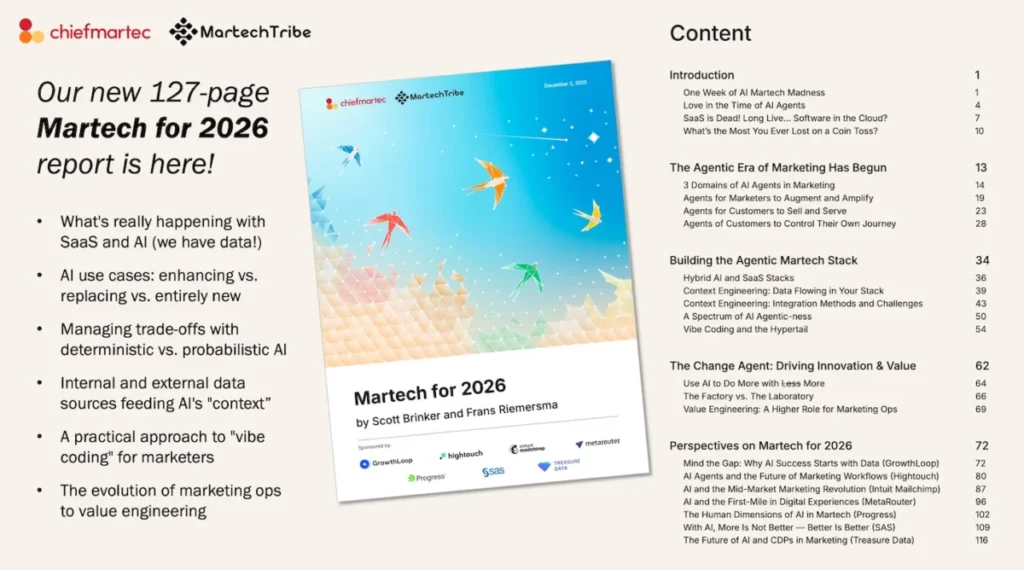
The Future of the Industry: Unveiling the “Martech for 2026” Comprehensive Report
In an era defined by rapid-fire technological shifts and the relentless integration of generative AI into every facet of the business landscape, marketing professionals are often left to navigate a sea of conflicting advice, vendor jargon, and unproven trends. Today, the marketing technology community takes a definitive step toward clarity with the launch of the "Martech for 2026" report—a massive, 127-page deep dive designed to synthesize the current state of the industry and project the trajectory for the coming year.
Produced by industry stalwarts, this report eschews the traditional "gatekeeping" of high-value industry research. By removing lead-generation forms, social media engagement requirements, and paywalls, the authors have signaled a commitment to democratizing access to high-level strategic insights.
The Genesis of a Roadmap: Main Facts
The "Martech for 2026" report arrives at a pivotal moment. As organizations move past the initial "AI hype cycle," the focus is shifting from novelty to utility. The report is the culmination of months of rigorous research, data analysis, and expert interviews.
At its core, the publication is built upon the AI & Data in Marketing survey, conducted earlier this year. The findings are distilled into plain-language explanations, eschewing the impenetrable techno-jargon that often plagues the sector. Instead, the report relies on visual illustrations and data-backed analysis to provide a framework for CMOs, CTOs, and marketing practitioners to understand the technical and operational shifts awaiting them in 2026.
A Chronology of Research: How the Report Took Shape
The development of this report followed a structured, multi-phase methodology designed to ensure both editorial integrity and practical applicability.
- Phase I: The Data Collection (Q3 2025): The research team launched the AI & Data in Marketing survey, capturing the sentiment and technical maturity of thousands of professionals across the globe. This quantitative backbone provides the empirical foundation for the report’s conclusions.
- Phase II: Editorial Synthesis (Q4 2025): The findings were cross-referenced against current market movements, including the consolidation of the Martech landscape and the evolution of AI agentic workflows.
- Phase III: Industry Collaboration (November 2025): To provide a multi-faceted perspective, the authors conducted a series of deep-dive interviews with seven industry-leading organizations.
- Phase IV: Publication and Distribution (December 2025): The report was finalized and released as an open-access document, prioritizing accessibility over traditional gated marketing tactics.
Supporting Data: The Current Landscape
The report’s strength lies in its refusal to treat AI as a monolithic "magic bullet." Instead, it breaks down the complexities of modern marketing into actionable themes. The supporting data from the AI & Data in Marketing survey suggests a distinct shift in priorities:
- Data Quality as a Prerequisite: A significant portion of the data reveals that organizations are hitting a "data wall." AI models are only as good as the underlying data sets; therefore, the report emphasizes that data hygiene and accessibility are no longer "back-office" concerns but core marketing imperatives.
- The Shift Toward "Better" over "More": Quantitative data indicates that marketers are experiencing content fatigue. The survey results show a growing preference for high-precision, AI-augmented personalization over the sheer volume of AI-generated content.
- Human-in-the-Loop Integration: Despite the push toward full automation, the research identifies a strong trend toward "Human-in-the-loop" systems. The most successful teams are those that use AI to augment human decision-making rather than attempting to replace it entirely.
Official Perspectives: Insights from Industry Leaders
One of the most innovative aspects of the "Martech for 2026" report is the inclusion of dedicated chapters featuring insights from seven key sponsors. By engaging in long-form interviews rather than allowing sponsors to influence editorial content, the authors have curated a series of expert perspectives that define the current state of play:
- GrowthLoop: Focuses on the "Mind the Gap" phenomenon—the realization that AI success is inextricably tied to the quality and flow of internal data.
- Hightouch: Explores the rise of "AI Agents" and how these autonomous units will fundamentally alter marketing workflows in the next 12 months.
- Intuit Mailchimp: Provides a unique look at the mid-market revolution, highlighting how AI is democratizing high-end marketing capabilities for smaller, resource-constrained teams.
- MetaRouter: Addresses the "First-Mile" of digital experience, emphasizing the importance of server-side data collection and privacy-first architecture.
- Progress: Offers a nuanced take on the "Human Dimensions of AI," arguing that culture and team dynamics are as important as the software stack itself.
- SAS: Challenges the prevailing "more is better" mantra, advocating for a refined, analytical approach where accuracy and strategic relevance take precedence over raw output.
- Treasure Data: Examines the evolution of the Customer Data Platform (CDP) and how AI is transforming these systems into the "brain" of the marketing organization.
The Implications for 2026 and Beyond
The release of this report has immediate implications for how organizations will budget, hire, and strategize in the coming year.
1. The Death of the "Generalist" AI Strategy
The report implies that the era of general-purpose AI is giving way to domain-specific application. Companies that survive until 2026 will be those that tailor their AI models to their specific vertical, data structure, and customer base. The "one-size-fits-all" approach to Martech is officially obsolete.
2. Operationalizing the "First-Mile"
With increasing scrutiny on data privacy and the degradation of third-party cookies, the "First-Mile" of data collection—the moment a user interacts with a brand—has become the most valuable real estate in marketing. The report suggests that investment must shift toward robust, first-party data capture mechanisms that prioritize transparency and compliance.
3. The Human-AI Hybrid Model
Perhaps the most optimistic takeaway from the 127-page document is the role of the human professional. Far from being rendered obsolete, the marketer of 2026 will evolve into an "orchestrator." The report highlights that as AI agents take over repetitive tasks, the human element—strategy, empathy, ethical oversight, and creative direction—becomes the primary competitive differentiator.
4. A New Economic Model for Knowledge
By releasing this research for free, the authors are challenging the industry’s status quo. The report demonstrates that it is possible to produce high-rigor, high-value content without turning the audience into a lead-generation commodity. This sets a new benchmark for industry thought leadership, suggesting that in a crowded, noisy market, "radical transparency" is the most effective way to build trust and authority.
Conclusion: Preparing for the Shift
As we approach 2026, the Martech landscape will continue to expand, consolidate, and evolve. The "Martech for 2026" report is not just a summary of current trends; it is an invitation to participate in a more sophisticated, data-driven, and human-centric future.
For the 42,000+ professionals currently tracking these developments, the challenge lies in application. The insights contained within this document are not merely for passive reading; they serve as a blueprint for the organizational changes required to stay competitive. Whether you are a solo practitioner or a leader within an enterprise-level marketing department, the consensus is clear: the future belongs to those who prioritize data maturity, agentic workflows, and the strategic deployment of human ingenuity.
The authors have provided the roadmap; the rest is up to the practitioners in the field. As the industry moves toward 2026, the question is no longer "what can AI do?" but rather "how will we, as human marketers, guide these powerful tools to create genuine, long-term value?" The answer, according to the report, begins with the data we choose to use and the people we choose to empower.
