
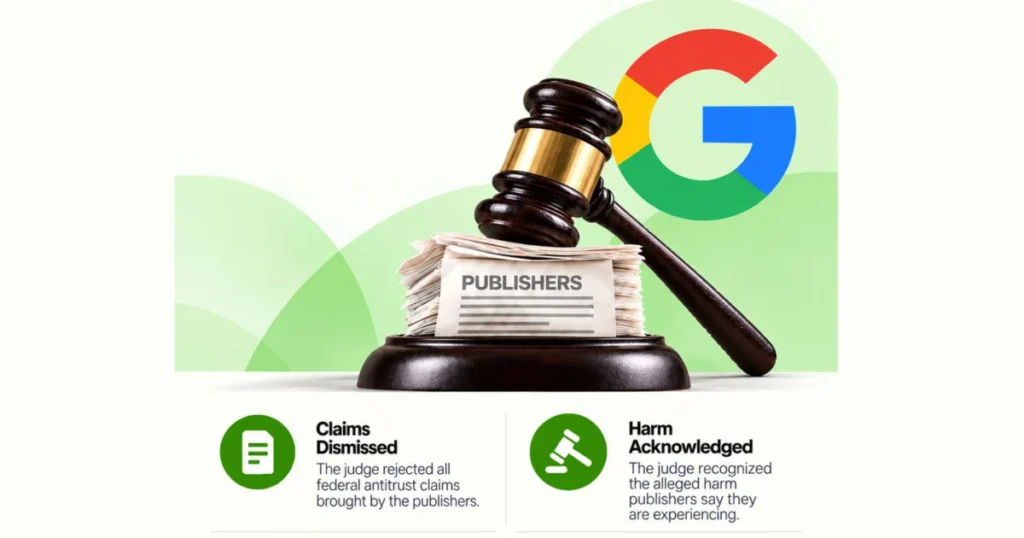
Judge Mehta Dismisses Antitrust Lawsuits Against Google by Chegg and Penske Media, Acknowledging Industry-Wide Publisher Distress
WASHINGTON — In a highly anticipated and closely watched antitrust ruling, U.S. District Judge Amit Mehta has dismissed the amended complaints brought forward by prominent digital publishers Chegg and Penske Media Corporation (PMC) against tech giant Google. While the court explicitly acknowledged the profound economic hardships facing modern publishers, journalists, and online creators, the presiding judge ruled that the plaintiffs ultimately failed to satisfy the rigorous legal thresholds required under federal antitrust law.
The dismissal, issued in a detailed memorandum opinion, brings an immediate halt to a high-profile legal challenge that sought to hold Google accountable for its dominant search practices, the utilization of publisher content without direct compensation, and the rapid deployment of AI-driven search features. However, the ruling underscores the immense structural gap that often exists between real-world industry suffering and the specific, stringent evidentiary requirements mandated by American antitrust jurisprudence.
Main Facts of the Ruling
The core of Judge Mehta’s decision centers on the legal inadequacy of the plaintiffs’ pleadings rather than a wholesale vindication of Google’s business practices. The lawsuits, filed separately by education technology platform Chegg and media conglomerate Penske Media (publisher of titles such as Rolling Stone, Billboard, and Variety), alleged multiple violations of federal antitrust statutes, alongside state-level claims of unjust enrichment.
In his ruling, Judge Mehta dismissed the federal claims with prejudice in part, while granting Penske’s motion to dismiss without prejudice—leaving the door open for a potential appeal or a revised complaint, depending on the plaintiffs’ next legal maneuvers. Crucially, the court rejected five distinct categories of legal claims advanced by the publishers:
- Reciprocal Dealing: Allegations that publishers supply content in exchange for Google-driven referral traffic.
- Tying: Claims that Google illegally leverages its dominance in general search to force adoption of AI Overviews.
- Unlawful Monopoly Maintenance: Arguments asserting that publishers possess the legal standing to challenge Google’s search monopoly as "suppliers" or "inextricably intertwined" parties.
- Attempted Monopolization and Monopoly Leveraging: Assertions that Google is systematically working to dominate digital publishing markets.
- Unjust Enrichment: State-law claims originating in California, which the federal court declined to evaluate after dismissing all underlying federal questions.
Chronology and Background of the Litigation
To understand the weight of Judge Mehta’s decision, it is necessary to examine the broader legal and regulatory timeline that has targeted Google’s business model over recent years:
- The Broader DOJ Antitrust Scrutiny: The legal pressure on Google intensified significantly when the U.S. Department of Justice (DOJ), alongside multiple state attorneys general, brought landmark antitrust suits against the company regarding its dominance in general search and search text ads—a case over which Judge Mehta also presided, ultimately ruling that Google operates an illegal monopoly.
- Publishers Enter the Fray: Buoyed by the DOJ’s early legal successes and growing industry-wide alarm over declining referral traffic, publishers like Chegg and Penske Media filed their respective private antitrust complaints. They argued that Google’s practices—ranging from scraping proprietary data to indexing content without financial compensation—starved digital publishing of necessary revenue.
- Google Files Motions to Dismiss: Google’s legal team pushed back aggressively, arguing that the plaintiffs failed to establish the foundational elements of antitrust injury, market definition, and contractual agreement.
- The Amended Complaints: Following initial judicial skepticism, the publishers filed amended complaints attempting to shore up their market definitions and theories of harm.
- The Current Dismissal: Judge Mehta’s recent memorandum opinion addresses these amended filings, systematically dismantling each category of claims for failing to meet the strict standards of federal pleading rules.
Sympathy Without Legal Relief: A Judicial Paradox
One of the most striking elements of Judge Mehta’s written opinion is his explicit acknowledgment of the existential threat facing the digital content ecosystem. The court made it clear that dismissing the lawsuits was not a reflection of indifference toward the plight of modern media companies.
In his opinion, Judge Mehta wrote:
"The court does not treat Plaintiffs’ alleged harms lightly. Nor is it unsympathetic to the situation publishers now find themselves in, and the knock-on consequences to journalists, educators, and other online creators whose content Google takes and repurposes without compensation."
Despite this acknowledgment, the judge emphasized that judicial sympathy cannot substitute for statutory compliance. The lawsuits foundered not because the publishers failed to prove they were hurting, but because their legal theories failed to connect that hurt to actionable violations under the Sherman Act and related federal statutes.
Detailed Breakdown of the Five Rejected Claim Categories
Judge Mehta’s memorandum methodically dismantled each of the five legal pillars upon which Chegg and Penske Media built their cases.
1. The Failure of the "Reciprocal Dealing" Argument
The plaintiffs attempted to frame their relationship with Google as a form of reciprocal dealing—an arrangement where two parties agree to exchange business benefits. Under this theory, publishers allow Google’s web crawlers to index and display their original content, and in return, Google routes valuable search referral traffic back to their websites.
Judge Mehta ruled that the plaintiffs failed to plausibly allege an actual agreement. The complaint lacked evidence of negotiated terms, direct communications between Google and the publishers establishing a quid pro quo, or the foundational elements of a binding contractual arrangement.
Highlighting the fatal flaw in the plaintiffs’ logic, the judge noted:
"Plaintiffs have pleaded only that they have an ‘expectation’ that Google will send them search traffic if they make their content available for free. But an expectation is not an agreement."
2. Flaws in the "Tying" Claim
Penske Media attempted to assert a tying arrangement, arguing that Google leverages its dominant market power over traditional Google Search to force users and advertisers to adopt a secondary, separate product: AI Overviews.
The court rejected this argument, ruling that Penske failed to establish that Google Search and AI Overviews constitute distinct products with independent, separate consumer demand—a mandatory prerequisite for a legally cognizable tying claim under antitrust law.
3. The Question of Antitrust "Standing"
A central hurdle for the publishers was establishing "antitrust standing"—the legal right to sue for antitrust violations. Publishers argued they had standing under two alternative theories: first, as "suppliers" of search index data and "purchasers" of search referral traffic; and second, because their economic injuries were "inextricably intertwined" with the injuries suffered by Google’s emerging AI competitors.
Judge Mehta rejected both frameworks. He noted that merely participating in the ecosystem as content creators does not automatically grant a publisher standing to challenge market-wide monopoly maintenance in general search services.
Explaining the dismissal of these counts, the judge stated:
"To survive a motion to dismiss, Plaintiffs must plausibly establish that they have antitrust standing as to these claims. As with other plaintiffs appearing before this court, they have not… Neither theory persuades."
4. Attempted Monopolization and Monopoly Leveraging
The publishers also claimed that Google was attempting to monopolize downstream and upstream digital publishing markets and leveraging its search dominance to crush competition in those spaces.
The court threw out these claims due to vague market definitions and a lack of supporting empirical data. Judge Mehta pointed out that the plaintiffs failed to clearly define the specific publishing markets Google was allegedly trying to dominate, nor did they quantify Google’s market share within those poorly defined spaces.
Regarding Chegg, the judge observed that the company failed to plead a "dangerous probability of monopolization." Regarding Penske, he noted that the publisher did not offer "a single fact to support their allegation that Google has a dangerous probability of monopolizing the sweeping market they describe."
5. Dismissal of State-Law Unjust Enrichment Claims
With all federal antitrust questions dismissed, the court faced a choice regarding the remaining state-law claims—specifically, California claims of unjust enrichment.
Federal courts possess supplemental jurisdiction over state-law claims tied to federal lawsuits, but judges routinely decline to exercise that jurisdiction once the primary federal questions are eliminated. Citing principles of judicial economy, convenience, and fairness, Judge Mehta opted to dismiss the state-law claims without prejudice, leaving the plaintiffs free to refile them in state court if they choose.
Supporting Data and Industry Context
The legal setback for Chegg and Penske Media occurs against a backdrop of sweeping transformation across the digital media and search landscapes. Data from digital analytics firms and industry associations illustrate the mounting pressures that prompted these lawsuits in the first place:
- The Decline of Referral Traffic: Over the past three years, referral traffic from major search engines to independent news and publishing sites has plummeted by an estimated 20% to 40%, driven largely by search engine result page (SERP) features that answer user queries directly on the results page.
- The Rise of Generative AI: The rapid rollout of Google’s AI Overviews has accelerated this trend. Studies indicate that users are increasingly satisfied with AI-generated summaries, sharply reducing the incentive to click through to original publisher websites where advertisements and subscriptions generate revenue.
- The Value Gap: Digital publishers spend billions of dollars annually on original reporting, investigative journalism, and educational content creation, much of which is ingested by large language models (LLMs) and search crawlers to train AI systems without direct licensing fees or revenue-sharing agreements.
Official Responses and Industry Reaction
Reactions to the ruling have been swift, reflecting the deep polarization between tech platforms and the content creator ecosystem:
- Publisher Perspectives: While representatives for Chegg and Penske Media have not yet detailed their immediate appellate strategy, industry advocates have expressed deep disappointment. Many argue that current antitrust laws, drafted in an era of industrial monopolies, are ill-equipped to handle the modern digital economy, where platform dominance relies on data extraction and algorithmic intermediation rather than traditional price-fixing.
- SEO and Creator Communities: Search engine optimization (SEO) professionals and independent digital creators viewed the ruling as a stark reminder of the legal barriers standing in the way of platform accountability. Many online creators feel caught in a bind: they must make their content accessible to Google crawlers to remain visible online, yet doing so feeds the very systems that siphon away their audience.
- Google’s Stance: Google has consistently maintained that its search engine operates to benefit users by connecting them with high-end, relevant web content quickly and efficiently. The company argues that indexing public web pages constitutes fair use and that sending billions of clicks to publishers every day provides massive, tangible value to the digital publishing industry.
Long-Term Implications for Big Tech and Digital Publishing
Judge Mehta’s dismissal serves as a pivotal checkpoint in the ongoing legal battles reshaping the internet. While the decision is a clear procedural victory for Google, it highlights several critical takeaways for the future of digital publishing and antitrust law:
- The Need for Precision in Private Antitrust Litigation: Private plaintiffs looking to challenge Big Tech cannot rely on broad assertions of economic distress or general unfairness. Future lawsuits will require airtight market definitions, quantifiable data regarding market share, and carefully constructed legal theories that align directly with statutory definitions of agreements and monopolies.
- Legislative Reform as the True Battleground: As traditional antitrust statutes prove difficult to apply to the complex realities of algorithmic search and AI content scraping, industry experts suggest that long-term relief for publishers may ultimately depend on legislative action—such as specialized copyright reforms, mandatory data-licensing frameworks, or digital bargaining laws similar to those enacted in other jurisdictions like Australia and Canada.
- The Shadow of the DOJ Monopoly Ruling: It is vital to note that while private publishers like Chegg and Penske failed to meet federal pleading standards, Google remains under immense regulatory pressure from the Department of Justice’s separate, successful monopolization case. Remedies in that government-led litigation could still alter how Google operates its search engine, indirectly impacting the web traffic and visibility enjoyed by publishers worldwide.
For now, the legal doors remain closed to Chegg and Penske Media under their current federal complaints, but the underlying tensions between platform gatekeepers and the creators of the web remain as volatile and unresolved as ever.
