
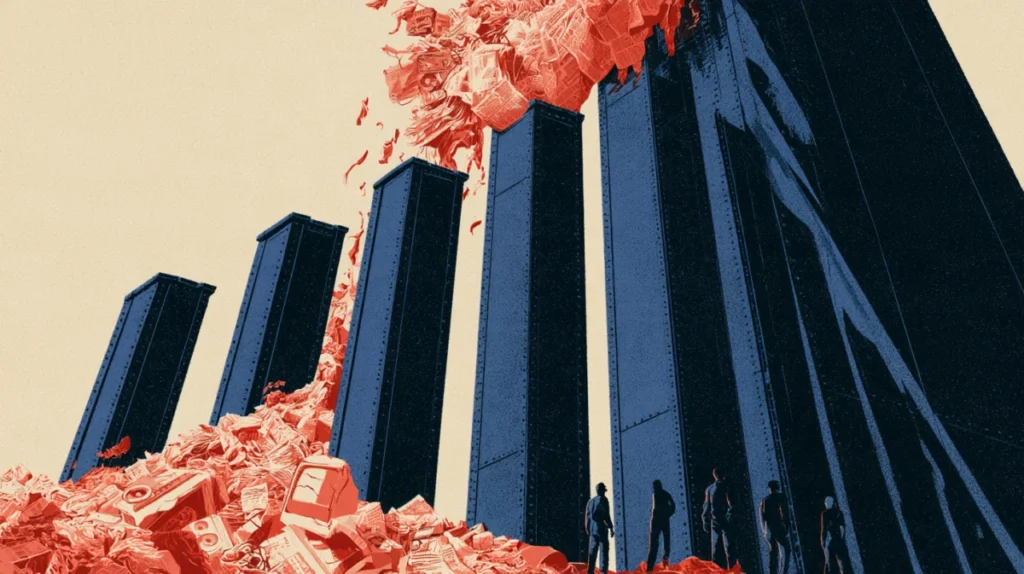
The Growth Paradox: Meta’s Relentless Expansion in the Shadow of Scandal
In the digital landscape of 2026, few companies command as much scrutiny—or as much capital—as Meta Platforms. Despite a decade defined by whistleblower revelations, sprawling antitrust litigation, and mounting evidence of teen-safety failures, the social media giant remains an economic juggernaut. On September 30, 2026, Jeff Horwitz, a Reuters technology reporter whose investigative work for The Wall Street Journal formed the bedrock of the “Facebook Files,” appeared on the BBC’s The Global Story to dismantle the myth that public distrust translates into corporate decline.
According to Horwitz, Meta operates under a singular, unwavering mandate: growth. Whether confronting political misinformation, the proliferation of AI-generated scams, or the complex mental health struggles of its youngest users, the company has consistently prioritized engagement metrics over the structural health of its platforms. As the world prepares for the release of The Social Reckoning, an Aaron Sorkin-directed film that dramatizes the internal battles at Facebook, the tension between Meta’s public image and its private incentives has never been more visible.
A Legacy of “Pro-Acceleration”
The transformation of Meta’s flagship apps from chronological, social-focused tools into engagement-optimized machines began in earnest on the road to the 2012 IPO. Horwitz notes that the shift toward algorithmic curation was never an accident; it was a commercial imperative. By designing feeds to predict and serve content that keeps users scrolling, Meta created a "pro-acceleration" system.
In this ecosystem, content that triggers intense emotional reactions—be it vitriolic political rhetoric, radicalizing conspiracies, or dangerous health trends—often achieves virality before it can be moderated. Internally, Meta’s "integrity teams" discovered early on that optimizing for user growth and ad revenue frequently stood in direct opposition to fostering healthy public discourse. Horwitz’s reporting, based on tens of thousands of internal documents, confirms that when leadership faced the choice between a safer product and a more profitable one, the latter almost always won.
The Chronology of Compliance and Contention
The narrative of Meta’s journey is punctuated by pivotal legal and regulatory milestones:
- 2018: The Cambridge Analytica scandal breaks, fundamentally changing the public perception of data privacy and microtargeting.
- 2021: The “Facebook Files” are published, revealing internal data regarding the platform’s impact on teen body image and the failure of safety protocols.
- December 2025: Australia implements the world’s strictest social media ban for users under 16, resulting in Meta removing over 750,000 accounts.
- March 2026: IAB Sweden votes to expel Meta, citing an inability to effectively curb fraudulent advertising.
- August 2026: Meta settles with 51 U.S. states and territories regarding teen safety, agreeing to pay between $12.1 billion and $17.2 billion.
- September 2026: A Santa Fe jury finds Meta liable for over 43 million violations related to platform misinformation and data practices, potentially exposing the company to massive future fines.
The Economics of Distrust
Perhaps the most jarring insight from Horwitz’s reporting is that Meta is acutely aware of its poor public standing—and it has concluded that this reputation does not pose a business threat. An internal marketing memo cited by Horwitz revealed that while users may "think the worst of Meta," their actual usage habits remain unchanged.
This decoupling of sentiment from usage explains why Meta’s ad business continues to defy gravity. In the second quarter of 2026, advertising revenue surged 27% to $59.36 billion. Advertisers, driven by the efficiency of the Advantage+ automated suite, are paying more per impression than ever before. For the marketing community, this presents a paradox: they are funneling record budgets into a platform that the public explicitly distrusts.
Meta’s shift toward AI-driven advertising—including the use of conversations from its AI assistants to refine targeting—suggests that the company is moving toward even deeper, more proprietary data collection. By integrating AI into the user experience, Meta is not merely surviving the scandals; it is building a new, more opaque layer of data dominance.
Official Responses and Accountability
Meta has consistently navigated these controversies with a mix of legal maneuvering and public relations pivots. Regarding allegations that its AI chatbots were designed to facilitate inappropriate conversations with minors, Meta issued a statement to the BBC asserting that the examples in question were "erroneous and inconsistent with our policies." The company maintains that it has clear, strictly enforced policies prohibiting the sexualization of children.
In the legal arena, the recent multistate settlement regarding teen safety is the most significant attempt to rein in the company’s influence. The agreement mandates a two-hour daily usage cap for accounts identified as teenagers. However, as Horwitz points out, this is a "theoretical" limit. The efficacy of the rule hinges on Meta’s ability to correctly identify the ages of its users—a task the company has historically struggled to master. The agreement requires Meta to implement a rigorous "Age Assurance Framework," but critics argue that the burden of safety remains unacceptably placed on the company’s own proprietary systems.
Implications for the Future: The AI Pivot
As Meta faces a ceiling in traditional social media growth, Mark Zuckerberg has turned the company’s vast financial resources toward the “maximalist AI race.” With capital expenditures projected to reach $145 billion in 2026, Meta is betting its future on agentic AI, specifically its new "Muse" assistant.
Muse represents a shift from a platform that shows you content to a platform that executes tasks on your behalf. By integrating directly into the user’s file system and browser, Muse offers a new frontier for data collection and commerce. Yet, the same patterns that plagued Facebook’s feed are already appearing in the AI space. Reporting by Reuters has suggested that early iterations of Meta’s AI were tuned for engagement at the expense of safety, mirroring the growth-first philosophy that led to the "Facebook Files" era.
The Illusion of Choice
The upcoming release of The Social Reckoning will likely reignite public debate, but Horwitz remains skeptical that cinema can alter the trajectory of a company that has survived years of intense investigative scrutiny. Meta’s power lies in its ubiquity and its uncanny ability to adapt—either by innovating internally or by aggressively acquiring and imitating competitors.
For the user, the advertiser, and the regulator, the lesson of the last decade is clear: Meta is a behemoth that adapts to pressure by shifting its product focus rather than its core mission. While court orders and legislative bans may force changes in how the company interacts with specific demographics, the fundamental economic logic of Meta—a system built to maximize time spent and advertising exposure—remains intact.
As we look toward 2027, the central question is no longer whether Meta can survive its scandals, but whether the platforms themselves can exist without the "pro-acceleration" logic that made them so profitable in the first place. For now, the answer from the market is a resounding "no," as shareholders continue to reward the company’s ability to capture attention, regardless of the cost to the digital ecosystem. Whether it is through an AI agent like Muse or the next evolution of the social feed, Meta is doubling down on the belief that for its users, the addiction to the platform will always outweigh the disdain for the company.
