
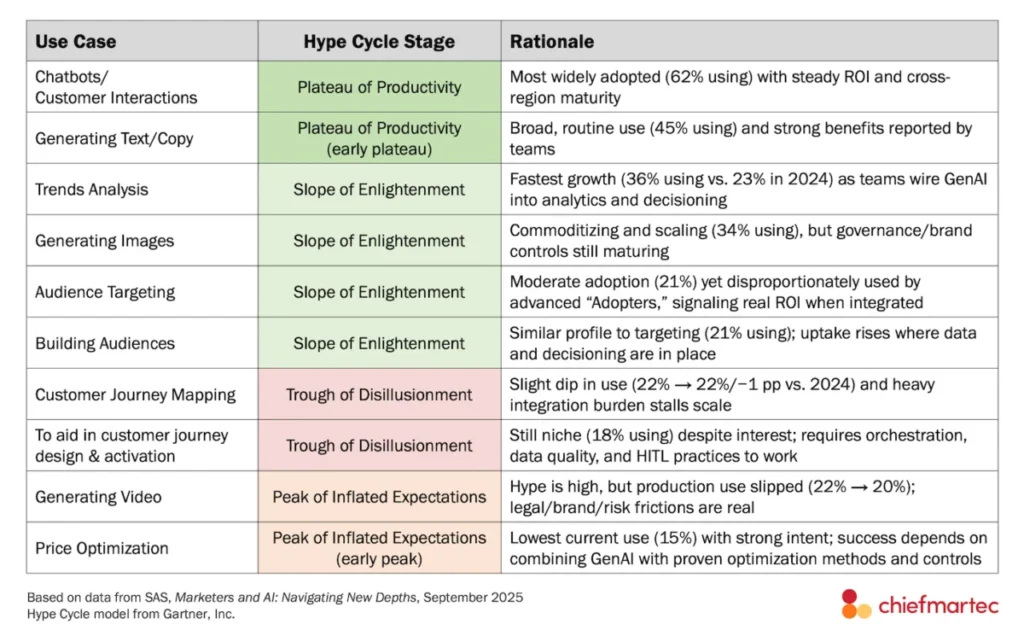
The Accelerated Hype Cycle: Decoding the Maturation of Generative AI in Marketing
The Gartner Hype Cycle is perhaps the most divisive framework in the technology sector. To some, it is an essential compass for navigating the chaotic waters of emerging innovation; to others, it is an oversimplified abstraction. However, as the marketing technology (martech) landscape faces an unprecedented infusion of generative AI, the necessity of such frameworks has never been more apparent.
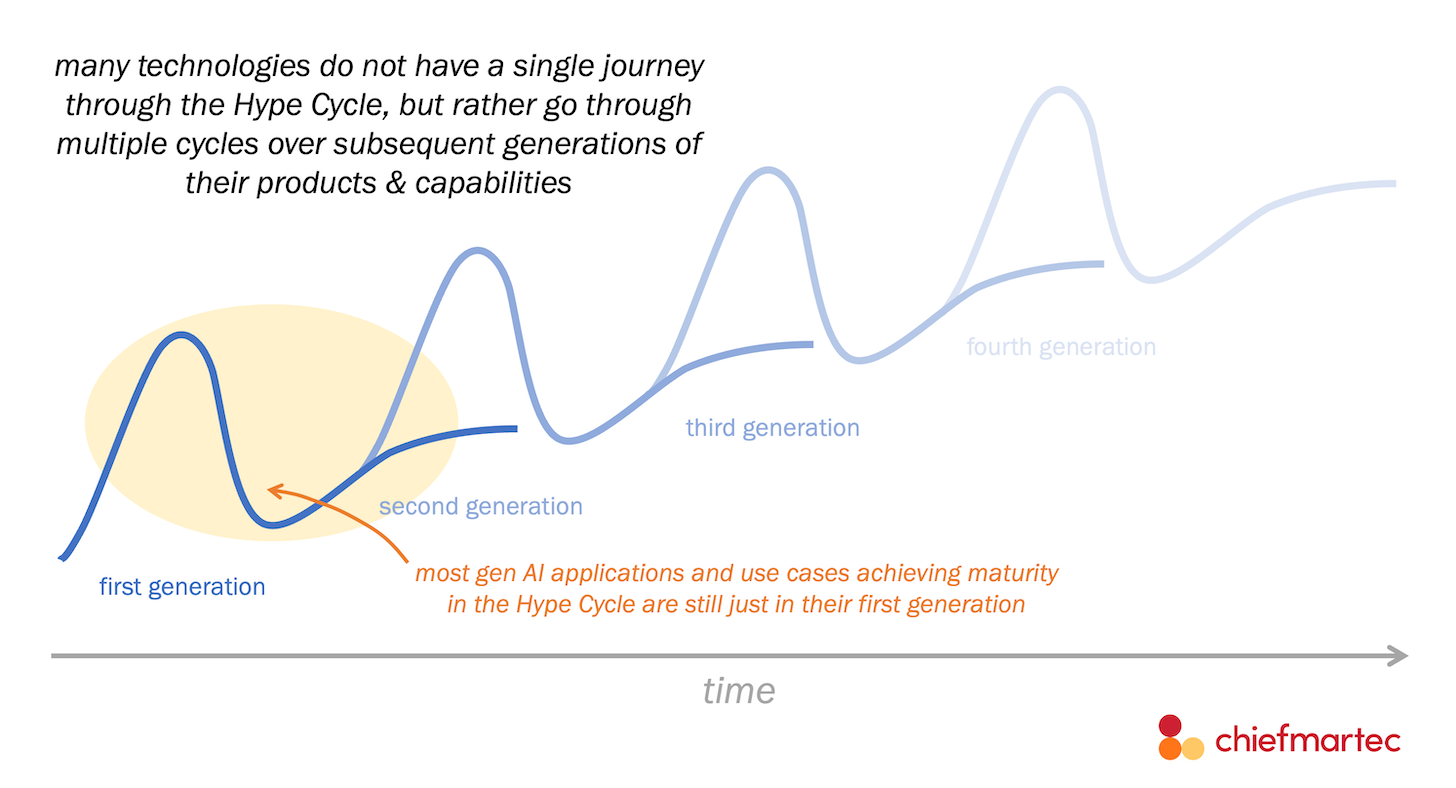
Recent analysis suggests that we are no longer dealing with a single, linear trajectory. Instead, we are witnessing a "stacked" Hype Cycle, where multiple generations of AI applications operate simultaneously at different stages of maturity. A new report from SAS, Marketers and AI: Navigating New Depths, provides empirical validation for this phenomenon, offering a data-backed look at how marketing teams are moving from the initial thrill of experimentation toward functional, business-driven integration.
The Myth of the Monolithic Tech Trend
A common pitfall for martech leaders is the tendency to treat "Generative AI" as a singular, monolithic entity. This perspective assumes that all AI tools are currently at the same point on the adoption curve. In reality, the landscape is fragmented.
Generative AI is not a single technology moving along a solitary Hype Cycle; it is an ecosystem of applications. Some use cases—such as basic content generation or email copy drafting—have already moved toward the "Plateau of Productivity." Others, perhaps more complex autonomous agents, are currently struggling in the "Trough of Disillusionment," while the next generation of predictive, agentic AI is still firmly in the "Peak of Inflated Expectations."
The "Generational" Nature of AI Evolution
The current state of AI is merely the "first generation." Consider the humble customer service chatbot. Today, a standard AI-powered bot can provide relatively accurate answers to straightforward queries. However, our expectations for these systems are currently modest compared to the capabilities we will demand in two, five, or ten years.
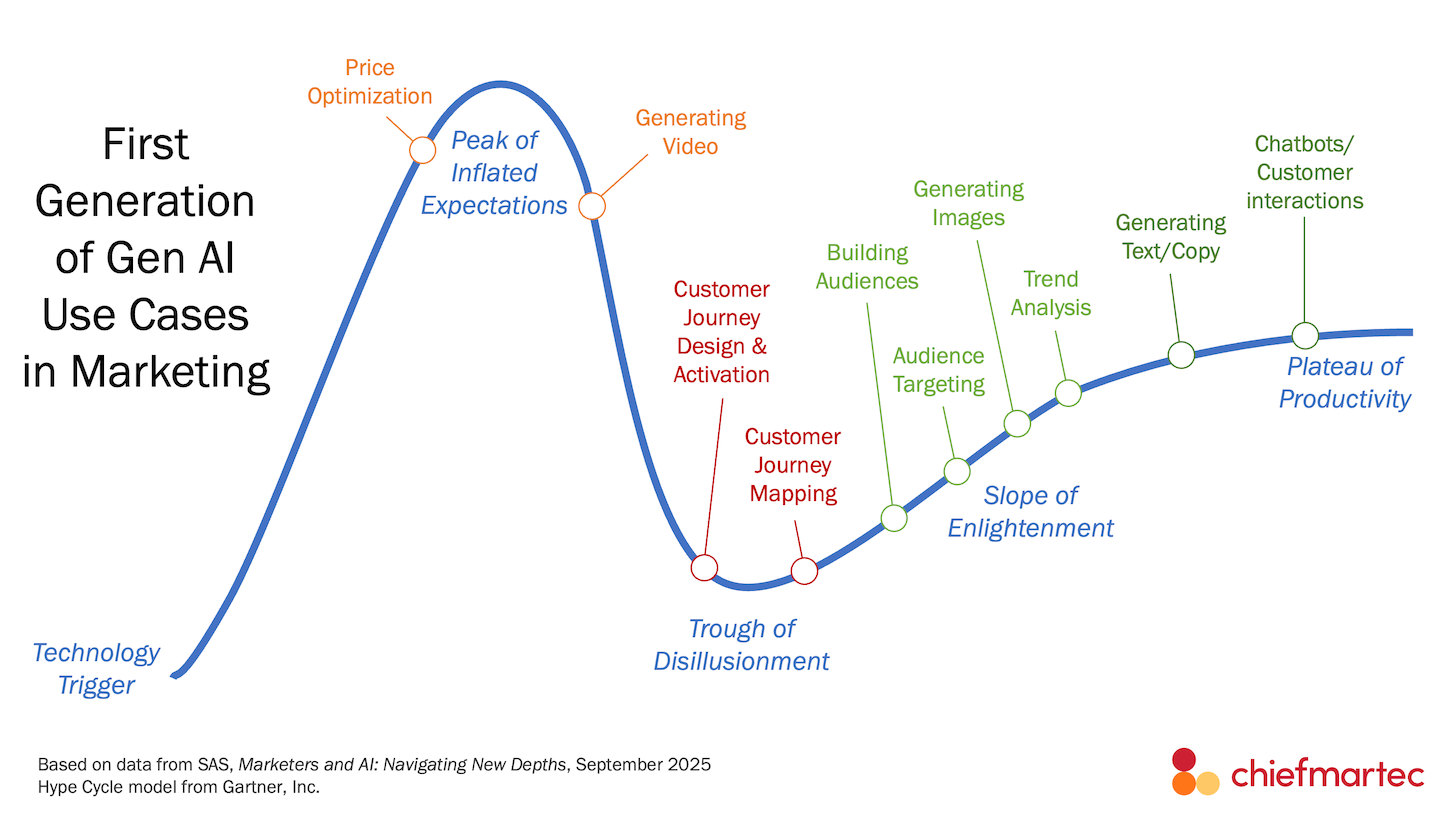
Future iterations will move beyond simple query-response loops. We are looking toward AI agents that possess true agency—capable of executing complex, multi-step workflows, performing autonomous cross-sell and upsell motions, and handling nuanced customer disputes without human intervention. Crucially, each of these subsequent generations will likely follow its own independent Hype Cycle. We can be comfortably situated at the Plateau of Productivity for today’s chatbots while simultaneously embarking on a fresh, overhyped cycle for tomorrow’s autonomous agents.
Chronology of Adoption: The Unprecedented Speed of Innovation
The most striking characteristic of the current AI boom is the velocity of its adoption. Historically, a technology might take a decade to travel from the initial "Innovation Trigger" to the "Plateau of Productivity." Today, that journey is being compressed into a matter of months.
This acceleration is palpable. Marketing teams are not waiting for one generation to fully mature before jumping into the next. The "time to market" for new AI-powered features is so rapid that practitioners are constantly managing a portfolio of AI tools, each at a different lifecycle stage.
Mapping the 2024–2025 Shift
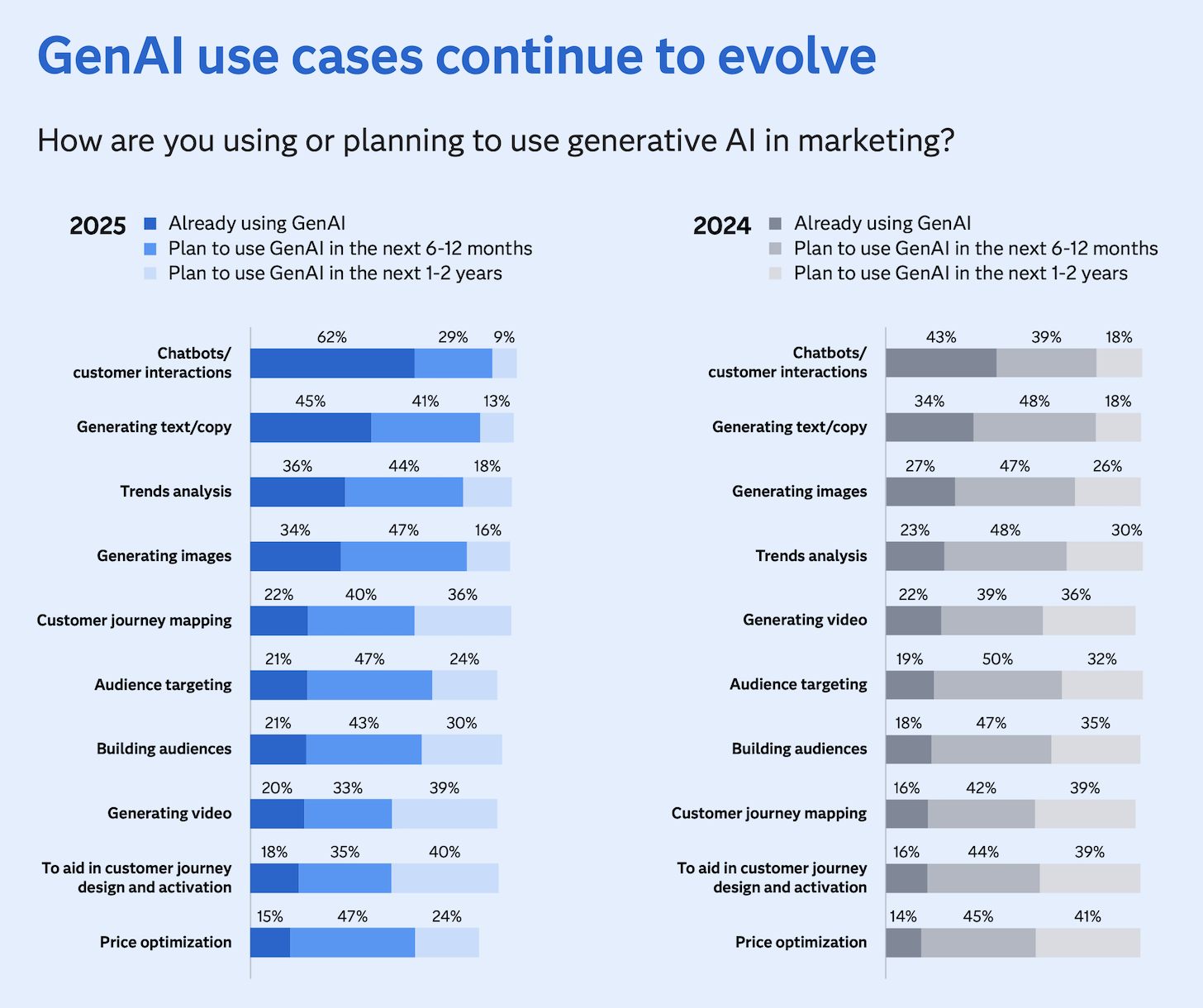
Data from the latest SAS report highlights this rapid movement. By comparing adoption rates between 2024 and 2025 across 300 marketing professionals, we can observe clear trends in where value is being realized.
The most dramatic accelerations have been seen in:
- Content Creation: The primary entry point for most teams.
- Customer Personalization: A pivot from generic AI content to data-informed, targeted experiences.
- Data Analytics/Insight Generation: Moving beyond mere content production into the realm of strategic decision-making.
These three use cases are currently the most adopted, signaling they have crossed the "Chasm" and are settling into the Plateau of Productivity. Conversely, some early "darlings" of the AI marketing world have seen a reduction in adoption over the past year. This is a classic indicator of the Trough of Disillusionment—a period where the initial shine has worn off, and teams are discovering the limitations, costs, and integration complexities that were overlooked during the initial hype phase.
Supporting Data: Dissecting the SAS Report
The SAS Marketers and AI report provides a vital empirical backbone to these observations. By evaluating 10 specific generative AI use cases, the researchers found that while enthusiasm remains high, the application of these tools is becoming more surgical.
Adoption vs. Planning
The report distinguishes between "active adoption" and "early-stage planning." This distinction is critical. When adoption numbers rise while planning numbers drop, it suggests that a use case has moved from the "experimental" phase to the "operational" phase.
For instance, generative AI for basic social media copy has seen a surge in actual adoption. However, more complex implementations, such as real-time predictive lead scoring, are still largely in the planning phase. This confirms that marketers are prioritizing "low-hanging fruit" that offers immediate efficiency gains over high-risk, high-reward projects that require deep infrastructural changes.
The "Reversal" Trend
Perhaps most revealing are the use cases that saw a decline in usage. In the tech world, this is rarely a sign of total failure; rather, it represents a "market correction." Companies that rushed to deploy AI for tasks where it wasn’t truly fit-for-purpose (e.g., complex creative strategy or brand-sensitive long-form content) are pulling back to reassess their requirements. This is a healthy maturation process, marking the shift from "AI for AI’s sake" to "AI for business outcomes."
Implications for Martech Strategy
For the modern Chief Marketing Officer (CMO) or Marketing Technologist, the implication is clear: stop looking for a single AI strategy. Instead, develop a "portfolio approach" to the Hype Cycle.
1. Embracing Dual-Stage Management
Marketing leaders must be comfortable holding two opposing thoughts simultaneously. You must be able to manage the mature, stable AI tools that are delivering consistent ROI on the Plateau of Productivity, while simultaneously sponsoring the risky, "overhyped" pilots that sit at the Peak of Inflated Expectations. This is the definition of "first-rate intelligence" in the modern age.
2. The Infrastructure Tax
The move toward advanced AI, particularly agentic workflows, is not free. As we move out of the initial "chat" era and into the "agent" era, the reliance on high-quality, clean, and accessible data will become the primary bottleneck. If your Martech stack isn’t integrated, your AI agents will be blind. The "Trough of Disillusionment" is often where companies realize that their underlying data quality is the limiting factor in AI performance.
3. Preparing for Future Disruptions
The SAS report also touches on the early considerations of quantum computing in marketing. While this may seem like science fiction to some, the speed at which we moved from LLMs (Large Language Models) to widespread agentic AI serves as a warning. The next decade will not be defined by a single transformation, but by a continuous stream of them. The ability to pivot, unlearn, and reintegrate new technologies will be the primary competitive advantage for the marketing departments of the future.
Conclusion: An Exhilarating Horizon
We are currently living through one of the most volatile and exciting periods in the history of marketing. The rapid cycling of generative AI technologies—from peak to trough to plateau—is not a sign of instability; it is a sign of a market learning in real-time.
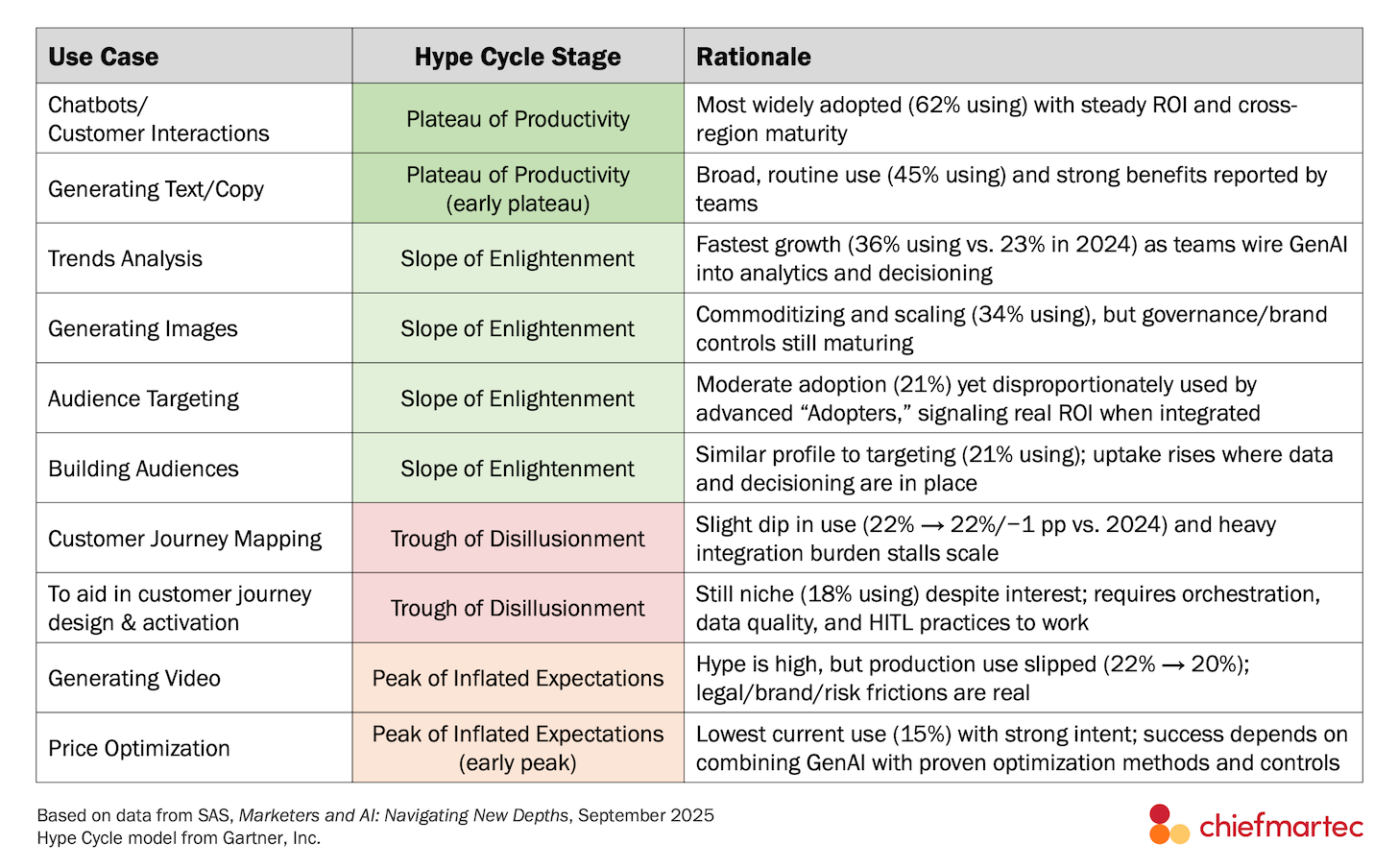
As we look toward the future, the goal for martech professionals should not be to escape the Hype Cycle, but to master it. By using data-driven insights from reports like the one provided by SAS, and by understanding that we are managing multiple generations of technology simultaneously, marketers can move past the noise.
The era of "hype-driven development" is slowly giving way to "value-driven deployment." It is a challenging, complex, and sometimes exhausting transition—but for those willing to navigate the depths, it is undeniably an exhilarating time to be in marketing. As we continue to refine our tools, the focus must remain on the ultimate goal: using these powerful, shifting technologies to create deeper, more meaningful connections with the human beings at the end of every marketing campaign.
