

Fourthwall vs. Spring (Teespring): The Ultimate 2026 Creator Commerce Showdown
Navigating the creator economy requires more than just a camera and an audience; it demands a robust financial engine. For years, content creators looking to monetize their influence through merchandise and digital goods faced a binary choice: settle for basic, highly restrictive social storefronts or wrestle with enterprise-grade ecommerce setups designed for traditional retailers.
Two platforms—Spring (formerly Teespring) and Fourthwall—have positioned themselves as leaders in bridging this gap. While both platforms have been heavily reviewed and utilized across the digital landscape, choosing between them remains surprisingly tricky. Beneath their polished interfaces, the two ecosystems are structurally further apart than they initially appear.
This comprehensive analysis examines the core facts, chronological evolution, supporting data, platform responses, and long-term industry implications of Fourthwall versus Spring.
Main Facts: Core Offerings at a Glance
To understand the divergence between Spring and Fourthwall, one must examine their fundamental architectural philosophies.
Spring: The Fast Social Storefront
Spring remains one of the absolute easiest ways to sell merchandise if you already possess an existing audience.

- The Setup: Creators build a simple, hosted storefront with a limited layout, select products from Spring’s catalog, apply custom artwork, and launch straight through the platform.
- Ecosystem Integration: Spring connects natively with major social channels, making it a favorite for monetization across YouTube, Twitch, and Discord.
- The Workflow: You control the artwork and retail pricing. Spring manages production, payment processing, site hosting, global delivery, and buyer support.
Fourthwall: The Comprehensive Brand Ecosystem
Fourthwall is equally creator-friendly, but it functions as a much more comprehensive ecommerce solution.
- The Setup: Creators receive a fully customizable storefront complete with a custom domain, advanced HTML/CSS controls, and an intuitive AI shop assistant named Eli.
- Product Diversification: Beyond retail-grade print-on-demand (POD) merch, Fourthwall allows creators to sell digital downloads, recurring memberships, subscriptions, gift cards, and self-fulfilled stock. It also natively accepts fan donations.
- The Workflow: Fourthwall acts as your Merchant of Record (MoR), integrates deeply with advanced marketing tools, and provides ample headroom for long-term brand scaling.
| Comparative Area | Fourthwall | Spring |
|---|---|---|
| Best Fit | Creators & small brands building diversified income sources | Creators launching quick merch drops around social content |
| Storefront | Customizable branded website with a custom domain | Hosted social storefront with limited domain support |
| Physical Goods | Curated POD catalog plus self-sourced/inventoried stock | POD merchandise produced and shipped entirely by Spring |
| Digital Products | Built-in, with full audience data ownership retained by the seller | Built-in, with Spring hosting and managing the files |
| Memberships | Native paid tiers, member-only posts, video, and livestreams | None available |
| Integrations | YouTube, TikTok Shop, Twitch, Kit, Klaviyo, Mailchimp, Zapier | YouTube, Twitch, Discord, Linktree, Store Drop |
| Tax Handling | Fourthwall is the Merchant of Record | Spring is the Merchant of Record |
Chronology: How Both Platforms Evolved
To appreciate where Spring and Fourthwall stand today, it is essential to trace their historical trajectories within the creator space.
Spring: From Custom Apparel Pioneer to Social Drops
- 2011–2018 (The Teespring Era): Originally launched as Teespring, the platform pioneered the crowd-funded apparel model, allowing anyone to design a t-shirt and run a campaign. If a minimum threshold of orders was met, the shirts were printed and shipped.
- 2019–2021 (The Pivot to Creators): Recognizing the shift toward influencer marketing, the company rebranded to "Spring" to reflect a broader product catalog (beyond just tees) and doubled down on social integrations, heavily courting YouTubers and Twitch streamers.
- 2024–2026 (Streamlining Experience): Recent platform updates have focused heavily on account security (implementing multi-factor authentication), backend listing controls for bulk-editing, and enhancing checkout flexibility to accept modern payment methods like Apple Pay and cryptocurrencies.
Fourthwall: Building the Modern Creator Brand
- The Newcomer Advantage: Fourthwall entered the market later, built from the ground up to address the rigid limitations legacy POD platforms imposed on growing creators.
- Feature Expansion: Rather than starting solely with apparel, Fourthwall integrated memberships, donations, and digital downloads into its foundation from day one.
- Recent 2025–2026 Innovations: Fourthwall has leaned heavily into automation and retention, introducing the AI assistant Eli, native integrations with Kit (formerly ConvertKit) for automated email sequences, Throne wishlist integrations, and a designer marketplace to connect creators with professional illustrators.
Supporting Data: Pricing, Fees, Margins, and True Costs
A platform can look appealing on paper, but the underlying fee structure dictates real-world profitability. Fortunately, both platforms offer free entry tiers.
Fourthwall Pricing and Margins
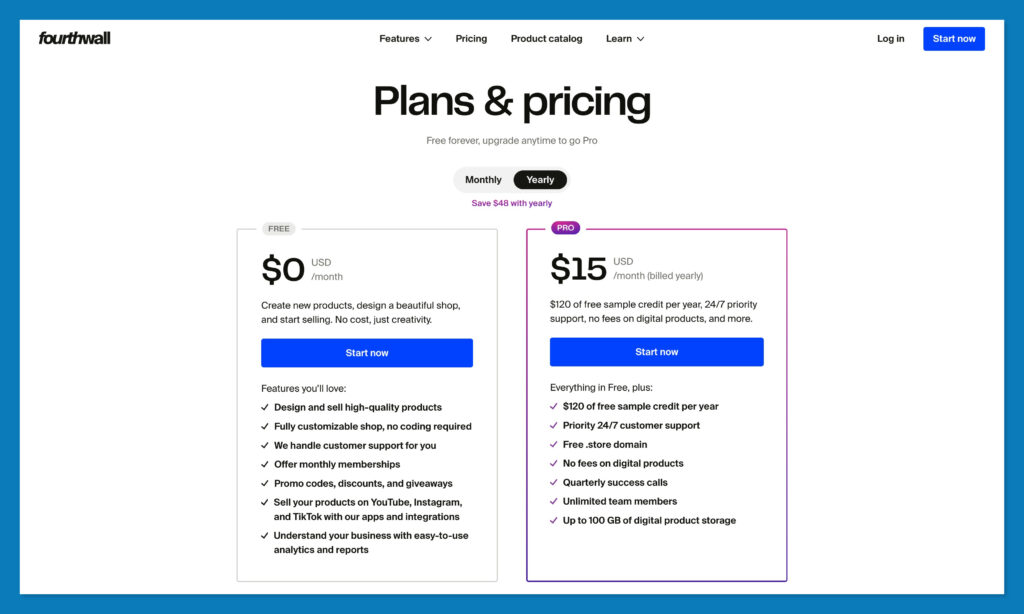
- The Free Plan: Includes a customizable store, digital and physical product options, one additional team member, and up to 50 active listings. There are zero platform fees on physical product sales (creators only pay standard payment processing fees). However, digital products and memberships carry a 5% platform fee.
- The Pro Plan ($19/month or $180/year): Removes digital product fees entirely, increases the product limit to 500, unlocks unlimited team members, provides $10 monthly in physical sample credits, and grants priority support.
Spring Pricing and Margins
- The Single Free Plan: Anyone can open a store at no cost. However, profit margins can be complex to calculate. Spring sets a base production cost for every item, and creators add their markup on top to determine the retail price.
- Digital Penalties: Selling digital goods on Spring incurs a steeper penalty—a 20% charge plus $1.70 per sale. For instance, selling a $10 eBook nets the creator just $6.30.
Quality vs. Cost Analysis
While Spring occasionally offers slightly lower base production costs on basic apparel, Fourthwall’s curated catalog heavily emphasizes retail-grade blanks and superior print fidelity (including embroidery, screen-printing, and sublimation). For pure physical merch drops on a budget, Spring holds its own. For digital downloads, memberships, or blended brand stores, Fourthwall proves mathematically and qualitatively superior.
Store Building, Integrations, and Marketing Capabilities
The structural divide between the two platforms becomes most glaring when examining store customization and marketing workflows.
Spring: Built for Speed, Not Expansion
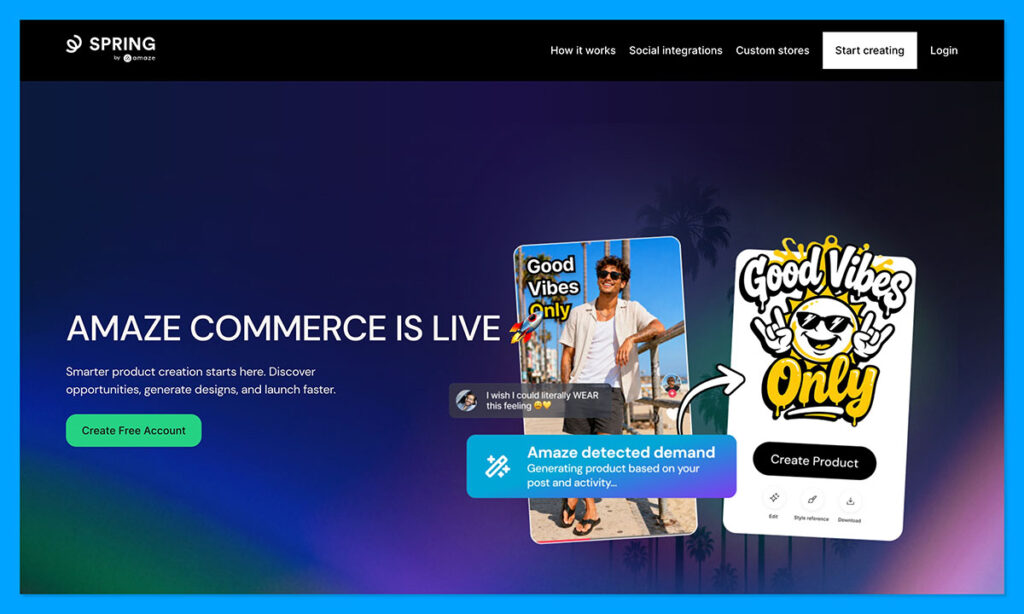
Spring does not feature a traditional website builder. Instead, it offers a streamlined wizard where creators drop a logo, select a brand color, add a hero banner, link social handles, and showcase featured products.
- The Limitations: Advanced email marketing automation, blogging tools, and custom page architectures are absent. Creators must manually export customer data or drive traffic entirely through social platforms.
- The Pluses: It connects seamlessly with YouTube Product Shelves, Twitch extensions, and Linktree.
Fourthwall: Full Creative Ownership
Fourthwall functions as a legitimate website builder wrapped in creator-friendly infrastructure.
- Design & Code Control: Creators gain granular control over page layouts, themes, custom domains, and CSS/HTML styling.
- Marketing Integrations: Beyond social commerce channels (TikTok Shop, YouTube, Twitch), Fourthwall integrates directly with elite email marketing engines like Klaviyo, Mailchimp, and Kit. These integrations allow automated welcome sequences, behavioral tagging, and segmented cart-abandonment flows based on real-time purchase data.
- Content Marketing: Creators can easily launch built-in blogs to drive organic search traffic and establish long-term brand authority.
Official Responses and Platform Strategies
Both companies have publicly outlined distinct strategic visions for the future of creator commerce.
Spring’s official stance centers on friction reduction for high-volume content creators who view merchandise as a periodic marketing campaign rather than a full-time retail business. By investing in a dedicated Creator Experience team and streamlining bulk-editing tools, Spring aims to keep the barrier to entry as low as possible. Their philosophy is simple: Get in, launch a drop, let Spring handle the heavy lifting, and get back to creating content.
Fourthwall’s official stance focuses on sustainable independence and community retention. Executives emphasize that reliance on social media algorithms leaves creators vulnerable. By providing native membership tiers, direct customer data ownership, and automated retention tools via the Kit integration, Fourthwall champions the narrative of the creator-as-entrepreneur. As Fourthwall representatives frequently state: Merch shouldn’t just be a one-off stunt; it should be the foundation of a lasting independent business.
Implications: Which Platform Should You Choose?
Deciding between Spring and Fourthwall ultimately depends on your long-term business goals, content schedule, and monetization strategy.
Choose Spring If:
- You are a content creator with an active social audience (YouTube, Twitch, Discord).
- You want to launch a quick, hassle-free merchandise drop without designing a full website.
- You do not plan to offer recurring memberships, digital subscriptions, or complex tiered products.
- You prefer a hands-off approach where the platform absorbs the entire operational weight of a basic storefront.
Choose Fourthwall If:
- You want to build a genuine, scalable brand with a custom domain and professional aesthetic.
- You intend to diversify your revenue streams by combining print-on-demand goods, self-fulfilled inventory, digital downloads, and paid fan memberships.
- You value owning your customer data for email marketing and long-term retention campaigns.
- You want advanced tools—such as AI-assisted collection building, automated workflows, and comprehensive analytics—that allow your business to scale without forcing a painful platform migration down the road.
Final Verdict: If your brand is defined entirely by your immediate social media output, Spring provides a fast, frictionless vehicle for quick cash flow. But if you view your content career as the starting point for a multi-faceted digital empire, Fourthwall offers the comprehensive foundation required to build a brand that truly lasts.
