
Precision at Scale: Crazy Egg Unveils 11 New Audience Filters for Advanced A/B Testing
In the rapidly evolving landscape of conversion rate optimization (CRO), the ability to deliver the right message to the right person at the precise moment of engagement has transitioned from a competitive advantage to a fundamental necessity. Today, Crazy Egg, a pioneer in user behavior analytics and web testing, announced a significant expansion of its A/B testing suite. By introducing 11 new audience targeting filters, the platform is empowering marketers to transition away from broad-spectrum testing toward hyper-personalized, segment-specific experimentation.
This update represents a structural shift in how teams manage digital experiences. By allowing marketers to slice their traffic data with unprecedented granularity—based on acquisition channels, engagement depth, and custom-defined site data—Crazy Egg is addressing the "average user" fallacy that has long plagued A/B testing methodologies.
The Evolution of Precision: A Chronology of Targeting
To understand the significance of this update, one must look at the progression of web experimentation. In the early 2010s, A/B testing was largely binary: Test Version A against Version B across the entirety of a site’s traffic. However, as the digital ecosystem became fragmented across mobile devices, social platforms, and varying user intents, this "one-size-fits-all" approach began to yield diminishing returns.
- Phase 1: The Basics (Historical Context): Initial iterations of A/B testing focused on global changes—changing a button color or headline for all visitors. The primary filters were limited to device type and basic geographic location.
- Phase 2: Behavioral Awareness (Mid-2020s): Tools began incorporating UTM parameters and user lifecycle status (new vs. returning). This allowed for basic segmentation but lacked the depth required for complex customer journeys.
- Phase 3: The Current Shift (2026 Update): With the release of these 11 new filters, Crazy Egg has moved into the era of "Contextual Personalization." The new filters allow for the orchestration of experiences that account for how a user arrived, their specific history on the site, and proprietary data points passed from the user’s backend systems.
This rollout, arriving in August 2026, marks the most significant expansion of the Crazy Egg testing engine to date, signaling a pivot toward integrating behavioral data with direct site-side activation.
Deconstructing the Update: What’s New?
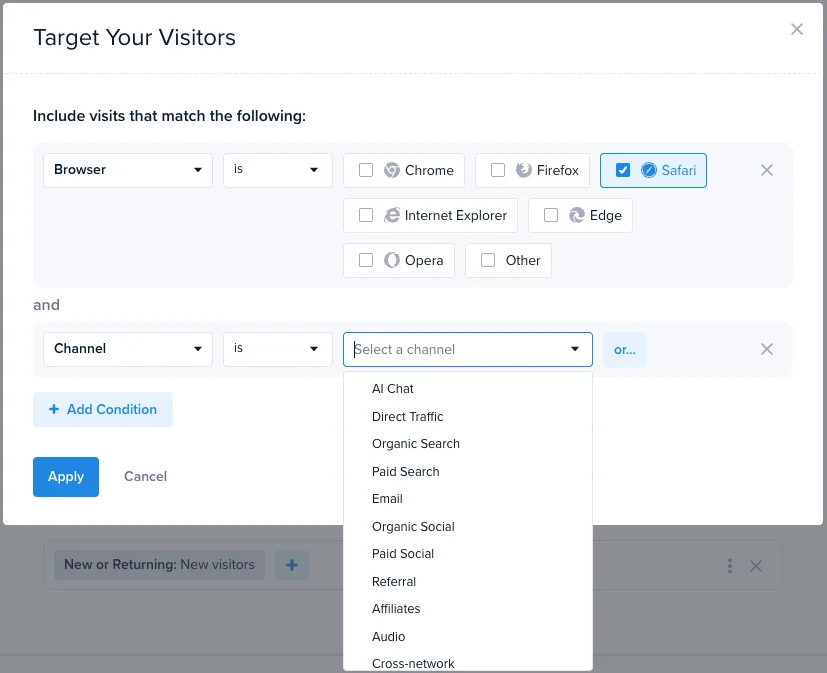
The core of this update lies in the flexibility of the targeting engine. The new filters act as a "layering" mechanism. These do not replace existing functionality but rather enhance the "AND/OR" logic that users apply to their experiment environments.
The Power of Granular Segmentation
By allowing marketers to combine these 11 new filters with established metrics—such as device, country, and previous page views—the possibilities for test design become virtually infinite.
For example, a marketing team can now create an experiment specifically for:
- The "High-Intent" Segment: Visitors arriving from a paid social media campaign who have spent more than 30 seconds on a landing page, combined with a custom "loyalty score" passed from a CRM.
- The "Re-engagement" Segment: Returning visitors who have previously interacted with a specific product category but have not yet converted, filtered by their browser type and regional language settings.
The absence of limits on how many filters can be applied simultaneously allows for the creation of "micro-segments." These segments are where the highest conversion rates are typically found, as the content being served matches the user’s exact psychological state.
Supporting Data: Why Hyper-Targeting Matters
Industry data consistently supports the shift toward personalized A/B testing. According to recent benchmarks in the digital marketing sector, generic A/B tests often suffer from "dilution," where the success of a variant is masked by the poor performance of a non-target audience segment.
- Conversion Uplift: Companies that utilize advanced segmentation in their testing cycles report, on average, a 15% to 25% higher conversion rate compared to those running site-wide experiments.
- Reduced Bounce Rates: When landing pages are tailored to the source of the traffic—such as matching the language of a Facebook ad to the landing page headline—bounce rates decrease significantly, often by double digits.
- Data Accuracy: By isolating specific cohorts, the "noise" of extraneous variables is reduced, allowing for statistically significant results to be reached in shorter timeframes.
The integration of these 11 filters allows for what analysts call "High-Fidelity Testing," where the variance in data is minimized, and the confidence interval of the experiment is increased.
Official Responses and Strategic Implications
Crazy Egg’s product team emphasizes that this update is designed for both the data-driven marketer and the growth-focused executive. By providing these tools, they are effectively bridging the gap between an analytics platform and a Content Management System (CMS).
"We are moving beyond testing," a company spokesperson noted. "We are empowering our users to curate experiences. The goal isn’t just to see which headline works best; it’s to understand which headline works best for a specific customer persona who arrived through a specific channel."
Implications for Enterprise vs. Pro Plans
The distribution of these features reflects the platform’s tiered value proposition:
- Enterprise Plans: Gain access to the full suite of 11 new filters. This is designed for high-traffic sites where segmenting users by complex behavioral patterns is necessary to achieve incremental gains that impact the bottom line.
- Pro Plans: Retain access to core filters like Language and Variant testing. This ensures that the essential toolkit remains available to growing businesses while reserving advanced, data-rich segmentation for larger enterprises.
Personalization vs. Testing: A Strategic Pivot
A key highlight of this release is the explicit distinction Crazy Egg is making between A/B testing and Personalization.
Traditionally, A/B testing implies a 50/50 or 80/20 split, where the goal is to identify a "winner." However, the new update encourages users to use these filters for permanent personalization. By setting a test to route 100% of a specific segment’s traffic to a customized variant, the "test" essentially becomes a permanent, tailored experience for that specific audience.
This is a game-changer for companies that want to serve different content to different regions or customer segments without building separate landing pages from scratch. It allows for:
- Dynamic Messaging: Automatically displaying localized offers to specific geographic cohorts.
- Lifecycle Management: Showing returning customers a different "hero" section than a first-time visitor.
- A/B/n Testing at Scale: Testing three or four variations simultaneously, each targeted to a specific traffic source, thereby maximizing the efficiency of the test cycle.
Conclusion: The Road Ahead
As the digital landscape becomes increasingly cluttered, the "generic" web experience is becoming obsolete. Users expect their interactions with brands to be intuitive and relevant to their personal needs and acquisition paths.
Crazy Egg’s introduction of 11 new audience filters is a clear acknowledgment of this trend. By providing the tools to map customer data directly onto site experiences, they are enabling a level of precision that was once reserved for high-end, bespoke development teams.
For the modern marketer, the message is clear: Stop testing for the masses. Start testing for the individual. With this update, the technical barriers to that goal have been significantly lowered, setting a new standard for what businesses can expect from their conversion optimization tools in the coming years. As companies begin to implement these filters, the industry should expect to see a surge in higher conversion rates, more relevant customer journeys, and a more sophisticated approach to digital growth.
