
The Anatomy of Search: Why Branded vs. Non-Branded Keywords Define Modern SEO Success
Originally published in the GrowthRocks blog by our Chief Strategist.
In the digital marketing landscape, not all search queries are created equal. For years, SEO practitioners have obsessively tracked rankings, clicks, and impressions, often lumping all traffic into a single, monolithic metric of "success." However, this approach is fundamentally flawed. To truly understand the efficacy of your marketing ecosystem, you must bifurcate your performance data into two distinct buckets: branded and non-branded keywords.
By separating these, you stop measuring "vanity traffic" and start measuring "market impact." This distinction is the bedrock of a sophisticated growth strategy.
1. The Google Curiosity Index: Bridging SEO and Brand
Before dissecting the technical differences, we must address a critical concept: the Google Curiosity Index. While not an official Google metric, this framework serves as the missing link between SEO performance and broader brand equity.
The Curiosity Index measures how often users search for your brand name over time. It is a powerful barometer for non-SEO activities—PR stunts, viral social media campaigns, offline events, and strategic partnerships. When your offline marketing succeeds, your Curiosity Index rises. It tracks the "echo" of your brand in the digital ether, providing a tangible way to see how your reputation influences search behavior.
2. Defining the Battlefield: Branded vs. Non-Branded
Branded Keywords: The High-Intent Moat
Branded keywords are queries that contain your company name, product names, or specific proprietary terminology. These users are rarely "browsing"—they are looking for you specifically. They have either encountered your marketing through external channels or are returning customers. Branded search is the ultimate validation of your brand’s presence in the market.
Non-Branded Keywords: The SEO Arena
Non-branded keywords are generic, category-level terms (e.g., "best project management software" or "how to automate email workflows"). These are the front lines of the SEO war. Because these users are in the "discovery" phase of the buyer journey, they are effectively shopping for solutions. Dominating these terms requires high-quality content, technical excellence, and consistent link-building. This is where your SEO strategy is truly tested.
3. Attribution: Why Accountability Matters
In many organizations, the lines of accountability are dangerously blurred. SEO teams often report branded traffic as a "win," conflating the success of a PR campaign or a direct-mail flyer with the organic reach of their keyword strategy.
Attribution defines accountability:
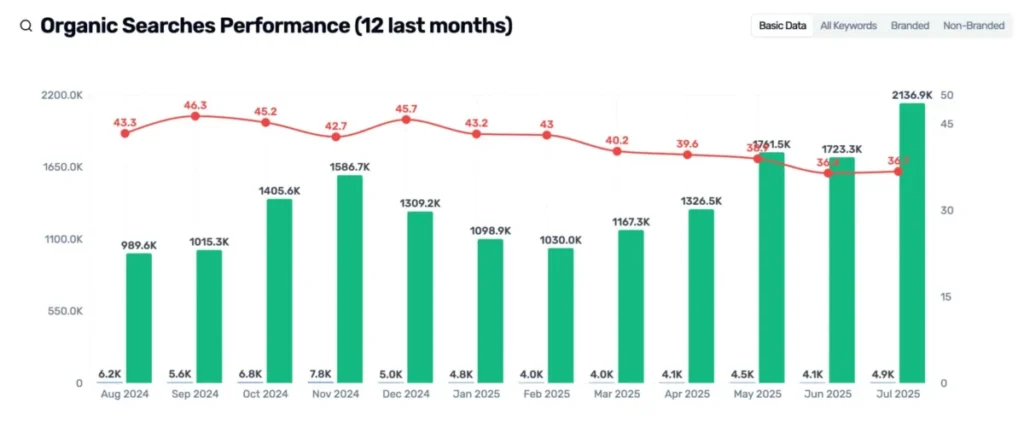
- Brand/PR/Comms Teams: These teams are responsible for driving branded searches. Their goal is to keep the company top-of-mind so that when a user searches, they search for you.
- SEO Teams: These teams are responsible for capturing "net new" traffic. Their goal is to identify and dominate non-branded intent, pulling potential customers into the funnel who may not have known the brand existed previously.
When you fail to separate these, you lose the ability to diagnose problems. If your traffic drops, is it because your SEO strategy is failing, or because your brand is losing its cultural relevance? Without segmentation, you are flying blind.
4. The AI Paradigm Shift: Popularity Contests
The arrival of Large Language Models (LLMs) and AI Overviews—such as Google’s SGE, Perplexity, and ChatGPT—has fundamentally altered the value proposition of branded keywords.
Supporting Data: Why Brand Signals Rule
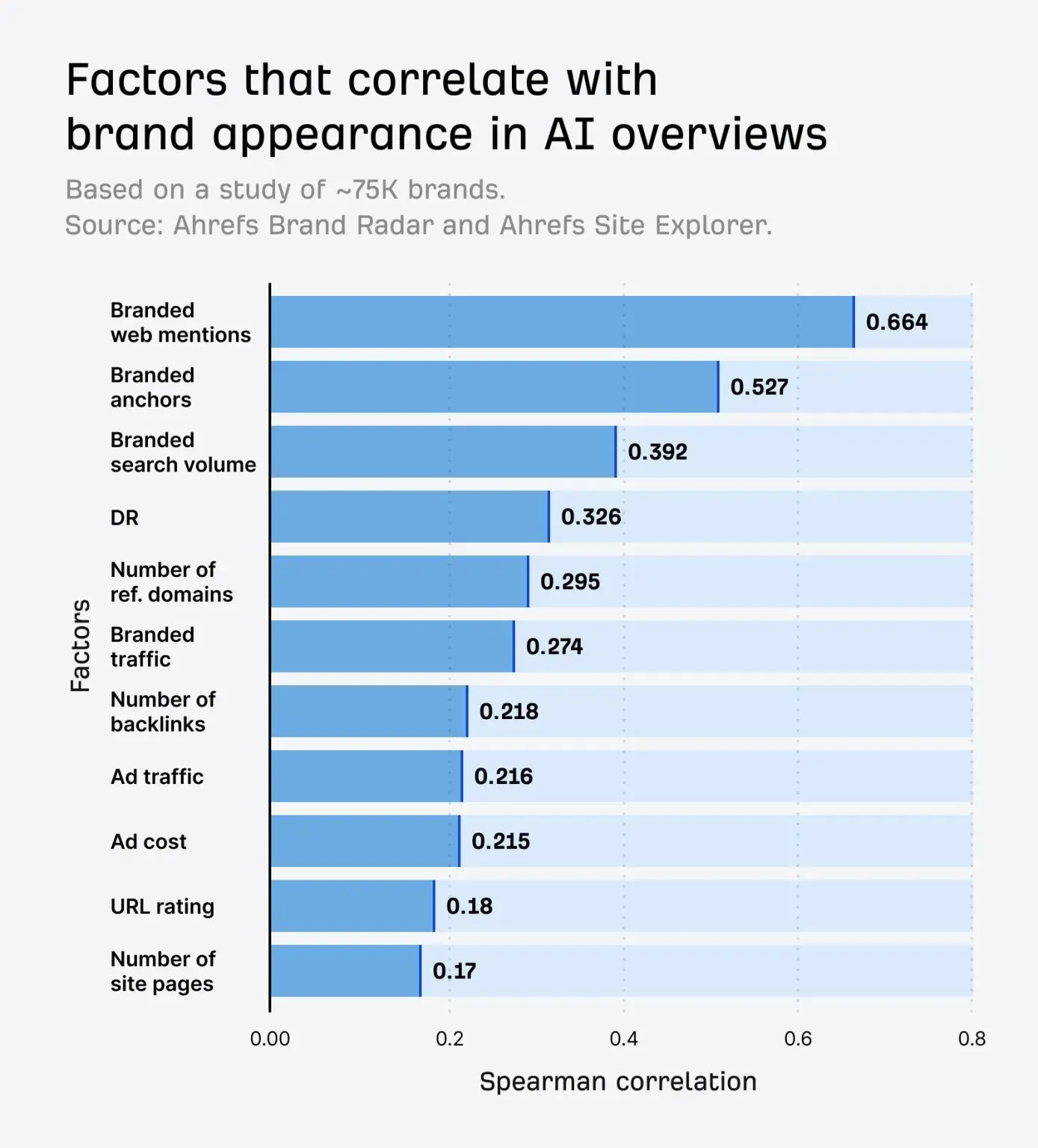
Recent studies, including research highlighted by Ahrefs, indicate that brand presence is the single most significant factor in whether a company appears in AI-generated search summaries. The top three factors for AI inclusion are:
- Brand mentions: The frequency with which a brand is cited in trusted sources.
- Domain authority: The established "trust" associated with your URL.
- Entity context: How well the LLM understands your brand’s specific ecosystem of products and solutions.
Traditional SEO signals—like backlink volume and exact-match keyword density—are becoming secondary. AI is, in essence, a massive popularity contest. If LLMs behave like human researchers, they gravitate toward names they recognize, names that appear consistently across the web with authoritative context.
The Implication for Strategy
- Trust is the new currency: AI models prioritize entities they can "trust." Your branded search volume is a primary signal of that trust.
- The "AI-Cited" Authority: Branded search isn’t just about traffic; it’s about training the model. By maintaining high branded search volume, you feed the LLM the context it needs to cite you as an authority in AI Overviews.
- Contextual Consistency: Brands must ensure that their name, products, and services are consistently represented across all digital touchpoints. If the internet talks about you, the AI will listen.
5. The Domain Name Connection
There is a symbiotic relationship between your domain name and your branded keywords. Often, users search for a company name, and Google serves the domain. However, a "Pro Tip" for any SEO analyst: check your Google Search Console (GSC) for queries where users type your domain name (e.g., "growthrocks.com") into the search box instead of the URL bar. This is "navigational" search, and it is a pure signal of strong brand equity. If this number is high, you have achieved top-of-mind awareness.
6. Practical Implementation: How to Master the Data
The challenge remains: Google Search Console does not natively segment branded vs. non-branded traffic. You must perform the heavy lifting yourself.
The Manual Workflow
- Export: Download your performance data from GSC.
- Filter: Use regex (Regular Expressions) to create a list of your branded terms (including misspellings and common variations).
- Classify: Create a "Branded" bucket and a "Non-Branded" bucket.
- Visualize: Plot these against each other month-over-month.
For teams looking to scale this, tools like our Monthly SEO Monitoring Handbook provide templates to automate this, while platforms like os.growthrocks.com handle the classification in real-time, allowing teams to instantly identify if a dip in traffic is due to a brand crisis or an SEO algorithm update.
7. Implications and Conclusion: The Era of Brand Gravity
The shift toward an AI-dominated search landscape is not a death knell for SEO; it is an evolution. The goal is no longer just to "rank higher." The goal is to cultivate Brand Gravity—the magnetic pull that causes users to seek you out by name and causes AI models to cite you as the source of truth.
When someone types your name into a search engine, you aren’t just winning a keyword battle; you are winning the war for consumer mindshare. In the post-AI era, your branded keywords are your shortcut to authority. Stop measuring just the "clicks" and start measuring the "gravity." Your growth depends on it.
