
The Model Context Protocol (MCP): Bridging the Gap Between Generic AI and Proprietary Marketing Intelligence
The digital marketing landscape is currently undergoing its most significant transformation since the advent of the search engine. As artificial intelligence moves from a novelty tool to the primary interface for consumer discovery, a new technical standard has emerged to ensure brands remain relevant in an automated world. The Model Context Protocol (MCP) is rapidly becoming the "USB-C" of the AI era, providing a universal connector between sophisticated Large Language Models (LLMs) and the proprietary data that defines a business’s competitive edge.
Main Facts: The Collapse of the Buyer Journey
For over two decades, the consumer path to purchase was a linear, multi-step process. A buyer would identify a need, search a category on Google, click through several organic results, compare providers on third-party review sites, and eventually narrow down their choices. Recent market analysis suggests this ten-step journey has collapsed into a two-step interaction: a user asks an AI assistant for a recommendation, and the AI provides a definitive shortlist.
The implications for marketers are binary. If a brand is not among the three or four names returned by an AI model like ChatGPT, Claude, or Gemini, that brand is effectively invisible. They haven’t just lost the deal; they were never in the consideration set to begin with.
To combat this, marketing teams are turning to the Model Context Protocol (MCP). MCP is an open, standardized framework that allows AI assistants to plug directly into a company’s internal files, databases, and analytics platforms. By moving beyond the generic information found in an LLM’s training data, MCP enables AI to provide brand-specific, data-driven insights that are accurate, timely, and actionable.
Chronology: From Keyword Matching to Contextual Intelligence
The evolution of search and discovery can be viewed through three distinct eras, culminating in the current shift toward MCP-enabled intelligence.

The Era of Traditional SEO (2000–2022)
In this phase, the primary goal was visibility on Search Engine Results Pages (SERPs). Marketers focused on keyword density, backlink profiles, and technical site health. The "middleman" was the search engine algorithm, which indexed the web and presented a list of links for the user to evaluate.
The Rise of the "Black Box" AI (2023–Early 2024)
With the launch of advanced LLMs, users began asking questions directly to AI. However, these models were "stateless" and disconnected from real-time company data. They relied on training data that was often months or years old. Marketers struggled with "hallucinations" and generic advice that failed to reflect their brand’s unique value propositions or current inventory.
The MCP Integration Phase (Late 2024–Present)
The introduction of the Model Context Protocol represents the third era. Recognizing that the value of AI is limited by the data it can access, industry leaders moved toward a standardized protocol. MCP allows for a "handshake" between the model and the enterprise. Instead of a marketer manually pasting data into a chat window, the AI now has a secure, real-time bridge to the company’s "Source of Truth."
Supporting Data: Why Data Connectivity is the New Differentiator
The effectiveness of AI in a marketing context is directly proportional to the quality of the data it consumes. Without MCP, an AI assistant provides "market-level platitudes"—advice that is technically correct but applies equally to every competitor in the sector.
The Power of Live Data Integration
When an AI is connected via MCP to live search-demand data and internal analytics, the output shifts from generic to strategic. For example:

- Unconnected AI: Suggests "improving blog content" to increase visibility.
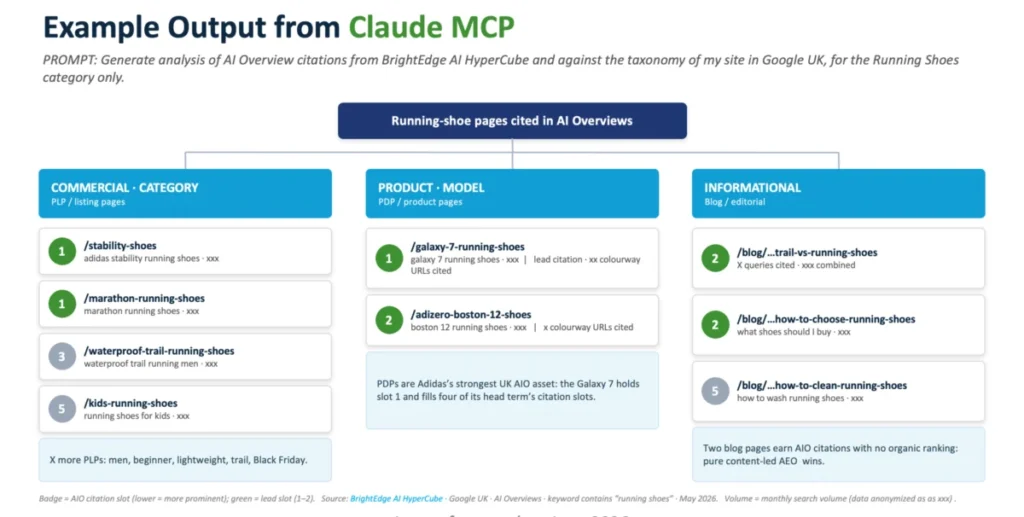
- MCP-Connected AI: Identifies three specific high-intent service pages that are currently losing share to a specific competitor in AI-generated answers, then outlines the exact content gaps to close that lead.
Transforming Team Workflows
The utility of MCP extends across the entire marketing hierarchy. Because the protocol provides a single point of connection, it serves multiple functions simultaneously:
- SEO Teams: Can query the AI to see exactly where the brand appears in "AI Overviews" and identify which technical hurdles are preventing the model from citing their site.
- Content Managers: Can prioritize their editorial calendars based on real-time "AI visibility gaps" rather than outdated keyword volume metrics.
- Performance Marketers: Can connect CRM data to the AI to identify which creative assets are driving the highest lifetime value (LTV) customers, allowing for instantaneous campaign adjustments.
Perspectives: Expert Views on the "USB-C" of AI
Industry experts and Chief Marketing Officers (CMOs) increasingly view MCP not as a luxury, but as a foundational requirement for modern infrastructure. The consensus among technical leaders is that the protocol solves the "fragmentation problem" that plagued early AI adoption.
"The analogy of the USB-C port is a fair one," notes industry analyst Lem Park. "It is one universal connector that lets any compatible AI agent plug into the systems you use, read their data, and act inside them."
From a leadership perspective, the value of MCP lies in its ability to synthesize complex signals into executive summaries. A CMO rarely has the time to dig through five different analytics dashboards. A connected AI assistant can "roll up" those live signals into a headline report, answering questions like, "How is our brand sentiment trending compared to our top three rivals this week?" or "Which marketing channels are showing a diminishing return on investment right now?"
However, experts also warn that this power comes with a responsibility for data hygiene. The prevailing sentiment is that "AI is only as good as the data that feeds it." For MCP to be effective, the underlying data sources must be:

- Accurate: Free from errors that lead to "confident hallucinations."
- Precise: Granular enough to provide specific recommendations.
- Current: Reflecting the market as it exists today, not last quarter.
- Trusted: Validated by the teams who are expected to act on the insights.
Implications: The Future of Marketing in an MCP-Driven World
The widespread adoption of MCP has profound implications for how marketing departments are structured and how they compete for market share.
The Security and Governance Mandate
As companies open "bridges" to their proprietary data, security becomes the top priority. Marketers can no longer operate in a vacuum; they must work closely with IT and security teams to ensure that MCP connections are governed by strict permissions. The risk of "leaking" proprietary strategy to a public model is a significant concern that requires robust data-masking and "bring-your-own-cloud" (BYOC) AI environments.
The End of Generic Content
MCP-enabled AI will likely signal the end of the "content farm" era. When every brand has access to AI that can write a generic 800-word article, the only way to stand out is through unique data and perspective. Brands that use MCP to feed their AI specific, proprietary insights—such as internal case studies, unique customer surveys, or real-time inventory data—will produce content that AI assistants are more likely to recommend to users.
Real-Time Strategy Execution
In the past, marketing strategy was a quarterly or annual exercise. With MCP, strategy becomes a living process. If a competitor launches a surprise campaign or a new trend emerges on social media, a connected AI can immediately detect the shift in search patterns and suggest a pivot. The "speed to insight" becomes a primary competitive advantage.
Conclusion: Adapting to the New Buyer Reality
The buyer journey has changed, and there is no going back to the ten-step process of the past. Consumers have embraced the efficiency of AI-driven recommendations, and they expect those recommendations to be accurate.

For marketers, the path forward is clear: to remain relevant, they must ensure that AI models have a deep, data-driven understanding of their brand. The Model Context Protocol is the bridge that makes this possible. By connecting trusted, live data to the reasoning power of modern LLMs, marketing teams can move from providing generic advice to executing high-precision, brand-level priorities. In this new era, the winners will not be those with the cleverest prompts, but those who connected the best data to the right models the fastest.
