
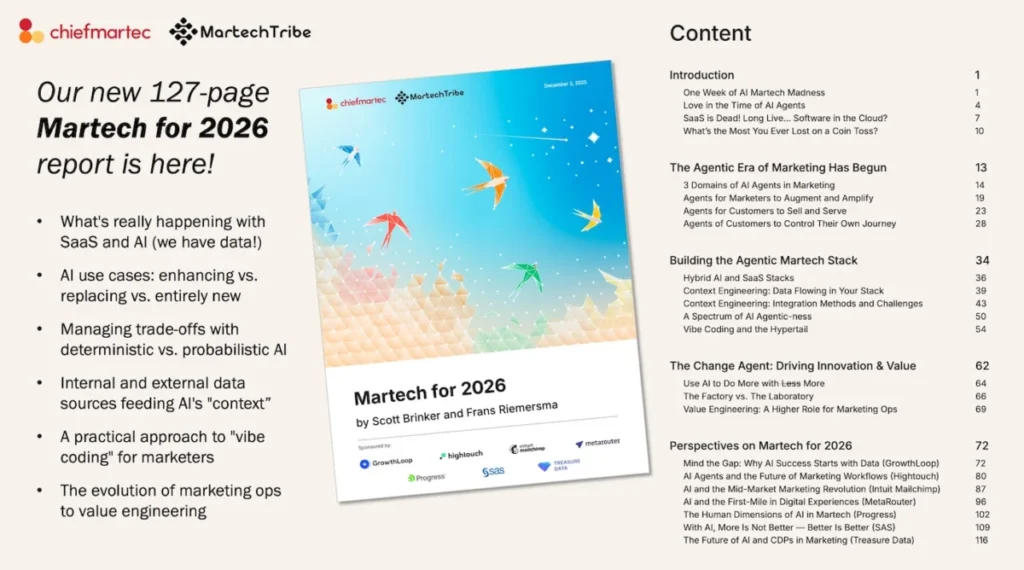
Navigating the Future: Unpacking the "Martech for 2026" Industry Blueprint
In an era defined by rapid-fire technological shifts, the marketing landscape is undergoing its most profound transformation since the dawn of the internet. As organizations scramble to decipher the intersection of artificial intelligence, data governance, and customer experience, a new, comprehensive guide has emerged to provide much-needed clarity.
The recently released Martech for 2026 report, a 127-page deep dive spearheaded by industry thought leader Scott Brinker and collaborator Frans Riemersma, serves as a strategic compass for professionals operating at the nexus of technology and marketing. Eschewing the industry-standard "gated content" model, the authors have made the entire report available as a direct, frictionless download, emphasizing accessibility over lead generation.
The Core Mandate: Why 2026?
The Martech for 2026 report is not merely a collection of trend forecasts; it is a tactical manual designed to bridge the gap between current operational chaos and future-proofed marketing maturity. By synthesizing months of rigorous research, the document addresses the primary friction points facing modern CMOs and marketing technologists.
The report arrives at a critical juncture. For years, the martech industry has operated under the assumption that "more is better"—more tools, more data, and more automation. As we approach 2026, the narrative is shifting toward efficiency, quality, and the human element. The report’s central thesis is that the future of marketing is not about collecting the most sophisticated stack, but about orchestrating the smartest one.
A Chronology of the Research Process
The development of this report was a months-long endeavor that prioritized empirical evidence over speculative hype.
- Phase 1: Survey Design and Deployment. The process began with the AI & Data in Marketing survey, conducted earlier this year. This primary research captured the sentiment, pain points, and adoption rates of thousands of professionals across the global marketing spectrum.
- Phase 2: Data Synthesis and Editorial Curation. Following the data collection, the team embarked on a multi-month synthesis phase. The objective was to translate complex, often contradictory data into actionable, plain-language insights, avoiding the dense jargon that frequently plagues industry white papers.
- Phase 3: Expert Interviews. Recognizing that the future of martech is an ecosystem effort, the authors conducted a series of deep-dive interviews with leaders from seven key industry players: GrowthLoop, Hightouch, Intuit Mailchimp, MetaRouter, Progress, SAS, and Treasure Data.
- Phase 4: Publication. The final report was unveiled in late 2025, strategically timed to serve as a foundational document for organizations beginning their 2026 fiscal planning.
Data-Driven Foundations: The Pulse of the Industry
At the heart of the Martech for 2026 report lies the raw data from the AI & Data in Marketing survey. This quantitative foundation provides a snapshot of the industry’s current state.
The data suggests a significant maturation in how marketing teams perceive AI. While 2023 and 2024 were characterized by "AI experimentation"—often done in silos—the 2026 outlook reveals a push toward integration. Organizations are moving away from novelty-seeking toward structural deployment, where AI is embedded into existing workflows rather than being treated as a separate, experimental "add-on."
Furthermore, the report highlights a critical tension: while interest in AI remains at an all-time high, there is a mounting concern regarding "data debt." Companies are realizing that their AI initiatives are only as effective as the underlying data hygiene. The report provides visual illustrations that simplify these technical bottlenecks, offering a roadmap for teams to clean, unify, and leverage their data assets effectively.
Perspectives from the Frontline: Official Responses
A unique feature of the Martech for 2026 report is its collaborative chapters. By partnering with seven industry leaders, Brinker and Riemersma provide a multidimensional view of the market. Crucially, the authors maintained complete editorial independence; these partners provided their perspectives after the core research was already established.
1. GrowthLoop: Closing the Data Gap
GrowthLoop emphasizes that the bottleneck for AI isn’t the model itself, but the data feed. Their contribution, "Mind the Gap," argues that the transition from AI potential to AI performance requires a fundamental shift in how data is structured and accessible to marketing teams.
2. Hightouch: The Era of AI Agents
Highlighting the shift in workflow, Hightouch discusses the transition from static tools to dynamic, autonomous agents. The future, they argue, is not in marketers doing more manual work, but in agents executing workflows that were previously considered too complex for automation.
3. Intuit Mailchimp: The Mid-Market Revolution
For small-to-medium enterprises, the barrier to entry for AI has traditionally been high. Intuit Mailchimp’s analysis focuses on how the "mid-market" is currently witnessing a democratization of technology, where sophisticated capabilities are becoming accessible without requiring a massive engineering team.
4. MetaRouter: The "First-Mile" Challenge
Data quality begins at the moment of capture. MetaRouter tackles the "First-Mile" problem, detailing how organizations must secure, sanitize, and standardize customer data the second it is generated on a digital property to ensure downstream AI effectiveness.
5. Progress: The Human Element
Amidst the fervor for automation, Progress reminds readers that the "Human Dimension" remains the primary variable in success. Their chapter warns against the "de-skilling" of marketing teams and advocates for a hybrid approach where AI enhances human creativity rather than replacing it.
6. SAS: Quality Over Quantity
In a direct rebuke of the "more is better" culture, SAS offers a pragmatic view: "Better is Better." Their analysis centers on the necessity of choosing high-quality, reliable AI models over the breadth of "shiny object" technologies, emphasizing stability and governance in long-term strategy.
7. Treasure Data: The CDP’s Role in the AI Era
Treasure Data explores the future of the Customer Data Platform (CDP). They posit that the CDP is moving from a passive storage unit to an active "AI engine" that synthesizes customer profiles in real-time to trigger personalized, predictive experiences.
Implications: Preparing for the 2026 Landscape
The Martech for 2026 report arrives at a time when marketing leaders are under immense pressure to prove ROI while navigating a volatile tech landscape. The implications for the industry are clear:
1. The End of "Tool Bloat"
The era of uncontrolled SaaS sprawl is nearing an end. Organizations that continue to add disparate tools without a cohesive integration strategy will struggle to keep pace with those that are consolidating their tech stacks around robust, data-integrated platforms.
2. Data Governance as a Competitive Advantage
The report makes it clear: you cannot automate excellence on a foundation of messy data. Organizations must prioritize data engineering and governance as core marketing competencies. By 2026, the gap between those who can effectively "feed" their AI and those who cannot will be a decisive competitive differentiator.
3. The Human-AI Partnership
The most successful organizations in 2026 will be those that view AI as a force multiplier for human creativity, not a cost-cutting replacement. Developing the skills of the workforce to manage, interpret, and refine AI outputs will be the primary task of the modern CMO.
4. The Shift Toward Value-Driven Martech
By demonstrating that high-quality, research-driven insights can be provided without expensive barriers or "arm-twisting," the report itself serves as a model for the future of marketing: helpful, transparent, and focused on value delivery.
Conclusion: A Call to Action
The Martech for 2026 report is more than a document; it is a collaborative effort to define the next era of the profession. For those tasked with navigating the complexity of the current market, it provides the essential tools to move forward with confidence.
As Scott Brinker and Frans Riemersma noted upon the release, the goal is to provide genuine utility to the community. In an industry often obscured by buzzwords and paywalls, this report stands as a beacon of clarity. Professionals are encouraged to engage with the material, reflect on the findings, and begin the necessary work of aligning their organizations for the realities of the coming years.
The future of marketing is not happening to us; it is being built by us. With the right data, the right mindset, and a focus on what is truly "better," 2026 promises to be a year of unprecedented effectiveness for the savvy marketing technologist.
