
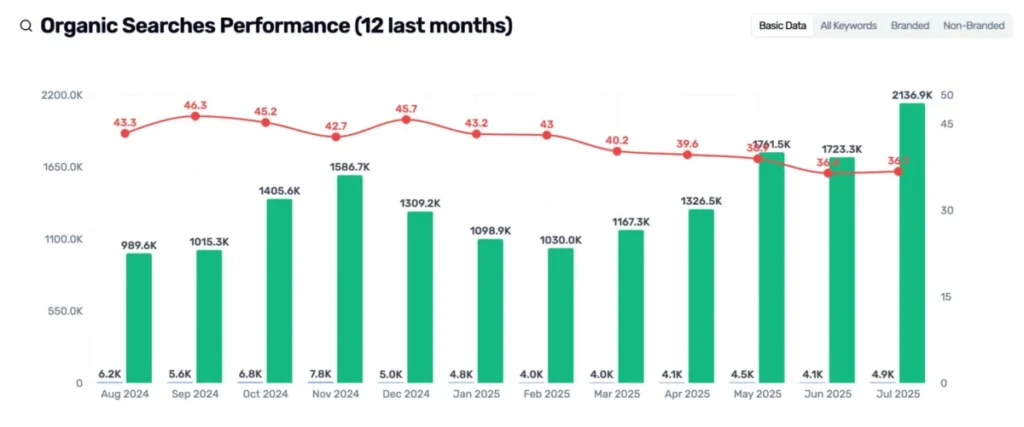
The Brand Gravity Shift: Why Modern SEO is Now a Popularity Contest
This article was originally published on the GrowthRocks blog by our Chief Strategist.
In the digital marketing landscape, not all search terms are created equal. For years, SEO practitioners have obsessively tracked rankings, clicks, and impressions. Yet, many teams fail to distinguish between the two fundamental drivers of search traffic: branded and non-branded keywords. By failing to separate these, businesses often create a distorted reality of their performance, inflating the success of SEO efforts while masking the true efficacy of their broader marketing ecosystem.
The Google Curiosity Index: Measuring Brand Impact
Before dissecting the dichotomy of search intent, it is essential to revisit the Google Curiosity Index—a concept introduced in our SEO ranking metrics breakdown. While not an official Google metric, the Curiosity Index serves as a vital barometer for brand awareness. It tracks the frequency with which users search for your brand name over time.
The Index acts as the missing link between traditional SEO performance and tangible brand impact. It is one of the few metrics capable of revealing how offline or non-SEO activities—such as public relations, physical events, and strategic partnerships—actually permeate the digital consciousness of your audience. If your PR team secures a feature in a major publication, the Curiosity Index is where you go to measure the resulting "search echo."
Decoding the Search Intent Divide
To understand how your brand grows, you must first categorize your traffic into two distinct buckets:
Branded Keywords: The "High-Intent" Faithful
Branded keywords include any search query that features your company name or variations thereof. These users are not merely browsing; they are high-intent individuals. They have heard of you, been influenced by your marketing, or are returning to a familiar solution. They represent the culmination of your brand equity.
Non-Branded Keywords: The "Discovery" Battlefield
Non-branded keywords are generic, category-level search terms (e.g., "best project management software" or "how to automate email marketing"). This is where the true "SEO battle" is fought. These keywords capture demand in the early stages of the buyer journey. They are highly competitive and serve as the primary indicator of how well your content strategy aligns with the needs of a wider, often unaware, market.
Attribution: Who "Owns" the Growth?
Attribution is not just a technical requirement; it is a framework for accountability. Too often, SEO teams claim credit for branded traffic, essentially patting themselves on the back for work the PR, social media, or event marketing teams have actually done.
- Brand, PR, and Communications: These teams are the primary architects of branded search. Their campaigns build the awareness that forces users to search for the company by name.
- The SEO Team: Their mandate is to drive net new traffic. Success here is defined by capturing users who have never heard of the brand but are actively searching for a solution that the brand provides.
When SEO teams conflate these two, they mask the health of the marketing funnel. If branded traffic drops, the issue isn’t an SEO failure—it’s a brand awareness crisis.
The Post-AI Era: A Fundamental Shift in Search
The rise of Large Language Models (LLMs) and AI Overviews has fundamentally altered the rules of the game. We are no longer living in a world where blue links are the only prize.
According to recent data from Ahrefs, the top factors correlating with a brand’s presence in AI Overviews are not the traditional SEO metrics we once cherished. Factors like "backlink count," "keyword density," and "meta tag optimization" are being superseded by:
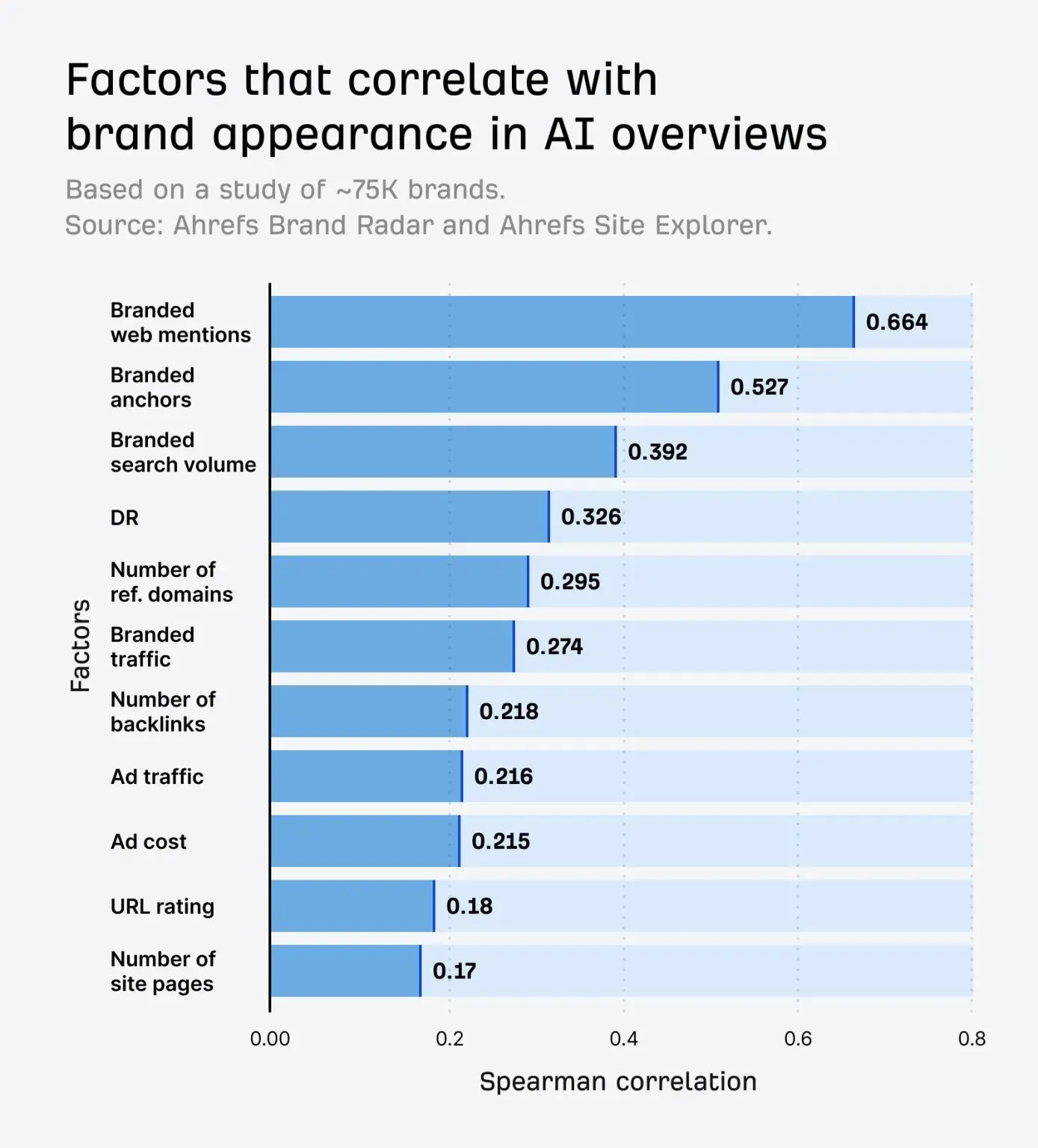
- Brand Strength/Recognition: AI models are trained to prioritize sources that are already established authorities.
- Consistent Contextual Association: How often the brand is mentioned alongside specific topics in the training data.
- User Preference Signals: The model’s propensity to cite brands that users already trust and search for by name.
Why AI Favors the Famous
LLMs, whether powering Google’s AI Overviews, Perplexity, or ChatGPT, function by predicting the most useful, trustworthy, and relevant response to a query. They behave like human experts reading the entire internet: they gravitate toward familiar names.
If a brand has significant "brand gravity"—meaning it is frequently searched, discussed, and linked to in authoritative contexts—it effectively becomes the "safe" answer for an AI model. In this sense, branded keywords are a shortcut to becoming an AI-cited authority. You aren’t gaming the system; you are simply providing the algorithm with the familiarity it was designed to prioritize.
Implications for Strategic Planning
This shift toward "AI as a popularity contest" carries three major implications for business strategy:
- The Brand-as-SEO Strategy: You can no longer separate brand building from SEO. Every press release, LinkedIn post, and conference sponsorship is now a direct signal to the AI models that decide who appears in the "answer" box.
- Domain Authority Over Page Authority: AI models look at the breadth of a domain’s expertise. A brand that is consistently associated with a specific industry topic will be favored over a standalone, high-ranking blog post from a site with no established presence.
- The Death of "Content-Only" SEO: Writing 100 articles on a topic is no longer enough. You need the brand footprint that makes the AI believe those articles are the definitive source.
The Semantic Link: Your Domain as a Brand
There is a profound semantic tie between your brand name and your domain name. If your brand is "GrowthRocks," your search traffic for "GrowthRocks" is the ultimate validation of your brand identity.
Pro Tip: Audit your Google Search Console (GSC) regularly. If you see high volumes of users typing your domain name directly into the search bar rather than the URL bar, you are witnessing "brand interest masquerading as SEO traffic." This is a healthy sign of brand loyalty, but it must be clearly segmented from your organic discovery growth.
How to Operationalize This Data
The challenge, as many SEO managers know, is that Google Search Console does not natively separate these buckets. It requires manual labor: exporting data, filtering for branded vs. non-branded strings, and re-visualizing the trends.
To maintain a clear view of your performance, follow this three-step workflow:
- Segment: Create a permanent list of branded keywords (company name, product names, executive names).
- Filter: Use a tool or a custom script to isolate these from your GSC data monthly.
- Correlate: Overlay your marketing spend (events, PR, paid ads) against the volatility of your branded search volume.
At GrowthRocks, we realized that manual segmentation was a bottleneck to growth. That is why we built this functionality directly into our SEO intelligence tool, os.growthrocks.com. It automates the classification of search traffic, allowing teams to see, in real-time, how much of their traffic is "earned" through brand gravity and how much is "won" through SEO technical excellence.
Conclusion: The Era of Brand Gravity
Your SEO strategy is no longer just about ranking higher for a set of keywords; it is about ensuring your brand is remembered. When a user bypasses the search results and types your name into the search bar, that is not SEO—that is brand gravity.
In a future where AI synthesizes information, brand gravity is the only moat that cannot be easily replicated by an algorithm. By focusing on building a brand that the internet trusts, you ensure that when the AI goes looking for an answer, it finds yours.
