
Beyond the "Average" Driver: Why Inclusive Design is the Next Frontier for Automotive Innovation
By Hannah Jachim, Researcher
The automotive industry is currently navigating a period of unprecedented volatility. Caught between the relentless pressure to innovate, the crushing weight of rising production costs, and the technical complexity of transitioning to software-defined and electric platforms, Original Equipment Manufacturers (OEMs) are finding their profit margins thinner than ever. Simultaneously, customer expectations are shifting at breakneck speed.
For decades, the industry has relied on a dangerous myth: the "average" driver. Engineering teams have spent billions of dollars designing vehicles around a standardized, middle-of-the-road persona—a user profile that, in reality, reflects an increasingly small segment of the global population. By designing for the "average," OEMs have inadvertently sidelined millions of potential customers, creating barriers that stifle innovation and alienate the very markets they hope to capture.
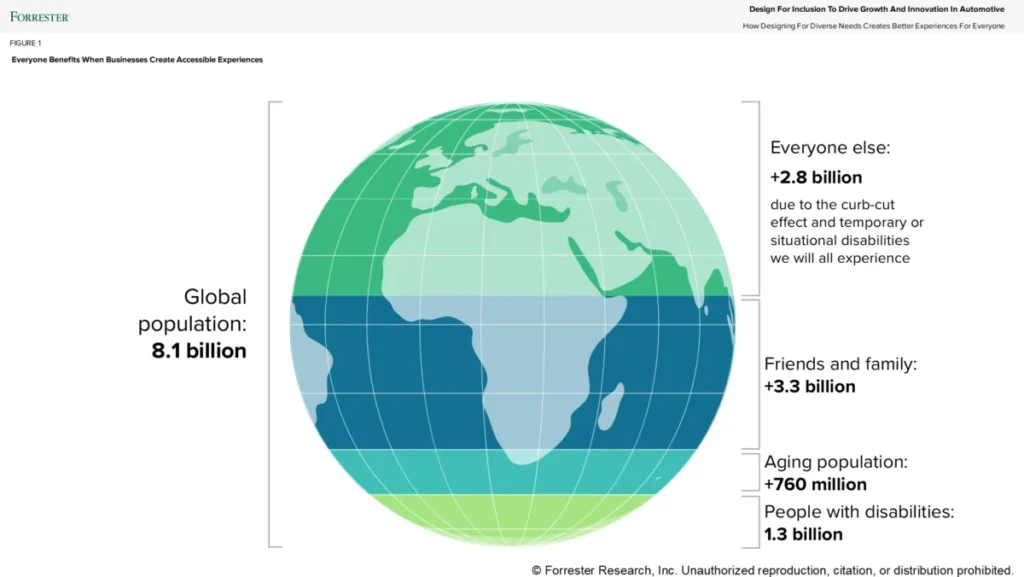
However, a paradigm shift is underway. Forward-thinking automotive leaders are beginning to realize that when they design for diverse needs—including those of individuals with disabilities, aging populations, and people with temporary impairments—they unlock the "curb-cut effect." Much like how sidewalk curb cuts were originally designed for wheelchair users but ended up benefiting parents with strollers, delivery workers, and travelers with luggage, inclusive automotive design creates superior experiences for everyone.
Our latest report, Design For Inclusion To Drive Growth And Innovation In Automotive, argues that inclusive design is no longer a peripheral compliance or ethical box-ticking exercise. It is a strategic lever for growth, brand differentiation, and long-term survival in a competitive, commoditized market.
The Core Problem: Designing for a Ghost Persona
For most of the 20th century, the "average" driver was the north star of automotive engineering. This persona informed everything from seat ergonomics and pedal placement to the complexity of infotainment systems. But the 21st-century driver is not a monolith.
The disconnect between legacy design philosophies and current reality is profound. Demographic shifts, including an aging global population, mean that a significant portion of the driver pool now deals with reduced dexterity, vision, or cognitive load. By ignoring these realities, OEMs are not just failing to be inclusive; they are failing to design for the future of their own customer base.
The Cost of Exclusion
When a vehicle’s user interface is too complex for an elderly driver, it is likely too distracting for a teenager. When a seat design excludes someone of a non-standard height or body type, it is likely uncomfortable for everyone during long-haul travel. Exclusion is not just a moral failure—it is a design failure that limits the total addressable market.
Chronology of an Industry Pivot
The transition toward inclusive design has not happened overnight. It is the culmination of several overlapping industry shifts.
- 1990s – 2010s: The Era of Compliance: Accessibility in automotive was largely viewed through the lens of legal requirements. Efforts were reactive, focusing on retrofitting vehicles for specific disability-related modifications rather than integrating inclusive features into the base chassis.
- 2015 – 2020: The Rise of Digital Experience (DX): As screens replaced analog buttons, the industry realized that software could provide a bridge to inclusion. Digital interfaces offered the possibility of high contrast, voice control, and reconfigurable menus. However, these were often implemented as "accessibility modes" rather than core UX principles.
- 2020 – Present: The Strategic Awakening: The dual shocks of the COVID-19 pandemic and the rapid acceleration of the Software-Defined Vehicle (SDV) era forced a rethink. OEMs began to recognize that inclusive design—making the car usable for the widest range of people—is a prerequisite for the next generation of autonomous and shared mobility.
Supporting Data: The Business Case for Inclusion
Why should a C-suite executive prioritize inclusive design when margins are already tight? The data is clear: inclusive design is a growth multiplier.
- Expanded Market Penetration: By catering to the 15-20% of the population who identify as having some form of disability, OEMs can capture a loyal, underserved market segment that often has high purchasing power but low brand affinity due to lack of options.
- Reduced R&D Waste: Retrofitting a vehicle after the design phase is exponentially more expensive than incorporating inclusive features at the concept stage.
- Future-Proofing for an Aging Workforce: As the global workforce stays active longer, vehicles that are easier to enter, exit, and operate will become the preferred choice for a massive demographic segment.
- The Innovation Ripple Effect: Features designed for inclusion—such as predictive voice recognition, haptic feedback, and simplified cockpit ergonomics—consistently rank as "top-tier features" in consumer preference surveys, regardless of the user’s physical ability.
Overcoming the Barriers: A Roadmap for OEMs
Moving forward requires a fundamental shift in how engineering and product teams operate. We have identified three primary hurdles—and the solutions to dismantle them.
1. Breaking the "Average" Bias in Research
The Barrier: Most user research relies on convenience sampling, which excludes marginalized or non-standard users.
The Solution: Expand research and testing protocols to reflect real-world diversity. This means actively recruiting participants with a wide spectrum of physical, cognitive, and sensory needs throughout the entire product design and development process. By uncovering "edge cases" early, engineers can build solutions that solve for the most difficult users, resulting in a more robust and intuitive experience for the mainstream.
2. Standardizing Inclusive Requirements
The Barrier: Inclusive features are often siloed or considered "add-ons," leading to fragmented user experiences.
The Solution: Align cross-functional teams around shared inclusive design requirements from day one. This requires making customizability a default, not a feature. For instance, the industry should push for standardized fixing points in the cabin for common adaptations, the ability for users to easily move Human-Machine Interface (HMI) modules, and the freedom to choose between voice, haptic, or tactile input methods. When a car acts as a platform that the user can adapt to their needs, brand loyalty increases significantly.
3. Leveraging Technological Inflection Points
The Barrier: Legacy thinking keeps design tethered to the constraints of traditional internal combustion vehicles.
The Solution: Use the shift to EVs, software-defined architectures, and autonomous vehicles to hit the "reset" button. These transitions represent a clean slate. An EV’s flat floor architecture provides more interior space, which is an ideal opportunity to reimagine accessibility. A software-defined vehicle allows for over-the-air updates to accessibility settings, meaning the car can evolve to meet the user’s changing needs over time.
Implications: The Competitive Advantage of Empathy
The implications for the automotive industry are stark. In the coming decade, the manufacturers that win will not be those with the highest horsepower or the most aggressive styling. They will be the ones that understand that a vehicle is a tool for autonomy.
When an OEM designs for inclusion, they are effectively designing for the most challenging environments. A UI that is usable for someone with a cognitive impairment is, by definition, a UI that is safer for a driver navigating heavy traffic while tired. A seat that is accessible to someone with limited mobility is, by definition, a more comfortable seat for a long-distance traveler.
Official Perspectives on the Shift
Industry leaders who have begun integrating these principles report a shift in corporate culture. By moving from a "compliance-first" to a "user-first" mentality, companies have found that engineering teams are more motivated when they are solving human problems rather than merely meeting engineering specifications.
Furthermore, as regulatory bodies in the EU and North America tighten accessibility standards, those who have proactively adopted inclusive design will avoid the costly disruption of forced recalls or redesigns. They will be ahead of the curve, setting the standard for the rest of the market.
Conclusion: Designing the Future
The "curb-cut effect" is the ultimate proof that inclusive design is not a charity; it is a catalyst for excellence. The automotive industry stands at a crossroads. It can continue to chase the ghost of the "average" driver, or it can embrace the reality of human diversity.
The path forward is clear: integrate inclusive research, standardize modular and customizable design, and treat every major technological transition as a moment to build a more accessible world. By doing so, automotive firms will not only drive growth and innovation—they will secure their place as essential partners in the mobility of every human being, regardless of their starting point.
For a deeper dive into these strategies and to learn how to embed inclusive design as a core competency within your organization, we invite you to explore our full report: Design For Inclusion To Drive Growth And Innovation In Automotive. To discuss the implications for your specific roadmap, we encourage you to schedule an inquiry or a guidance session with our research team.
The future of the road is inclusive. Are you ready to drive it?
