

The Modern Commerce Stack: Why Shopify and Basecamp Are Complements, Not Competitors
In the rapidly evolving digital economy of 2026, business owners are frequently trapped in a "feature fatigue" cycle. When evaluating software, the natural instinct is to pit popular platforms against one another to find a singular winner. However, a comprehensive analysis of the current market reveals a fundamental shift: successful online businesses are no longer searching for an "all-in-one" solution. Instead, they are curating a "best-of-breed" stack.
Two names that frequently surface in these discussions are Shopify and Basecamp. While both are giants in their respective domains, they serve fundamentally different masters. Shopify is the engine of commerce, while Basecamp is the cockpit of collaboration. This analysis explores why viewing these platforms as rivals is a strategic error, and how integrating them is the key to scaling an ecommerce brand.
The Core Disconnect: Defining the Purpose
To understand the relationship between these two platforms, one must first define their primary utility.
Shopify is a hosted ecommerce powerhouse. Its architecture is built around a single, non-negotiable goal: the conversion of traffic into revenue. It handles the "front-of-house" operations—product catalogs, inventory management, secure payment processing, and customer data.
Basecamp, conversely, is an "internal operations" tool. It is designed to manage the "back-of-house"—the human side of the business. It is a project management and communication ecosystem where strategy is debated, tasks are assigned, and the daily grind of running a company is organized.
The confusion arises because founders often look for a tool that can do both. The reality, however, is that asking Shopify to manage complex project workflows is as ineffective as asking Basecamp to process a credit card payment.

A Chronological Evolution of the Stack
Historically, the "storefront" and the "team" were managed in separate silos. In the early 2010s, a merchant might use a rudimentary shopping cart while coordinating via disorganized email chains.
By 2020, the rise of the "Remote-First" era pushed tools like Basecamp to the forefront of operational management. Simultaneously, Shopify’s transition into a comprehensive, headless-ready platform solidified its dominance as the primary storefront choice.
As we reach 2026, the maturity of middleware—tools like Zapier, Make, and custom API connectors—has allowed these two distinct platforms to communicate. We have moved from a "monolithic software" era to an "interconnected stack" era. Today, the most successful brands treat their store data (Shopify) as the trigger for their team’s operational actions (Basecamp).
Economic Implications: The Cost of Scaling
Pricing structures reveal the different target demographics for both platforms.
Shopify: Scaling with Success
Shopify operates on a tiered SaaS model. Its cost is tied to the complexity of the business. While the Basic plan is accessible for startups, the total cost of ownership (TCO) increases as a store grows. Merchants must account for:
- Tiered Subscription Fees: Monthly recurring costs.
- Payment Processing: A percentage-based fee that scales with revenue.
- App Ecosystem: To achieve advanced functionality (e.g., loyalty programs, advanced B2B portals), merchants often pay for third-party apps, which can significantly inflate the monthly bill.
Basecamp: Predictable Collaboration
Basecamp’s pricing is famously contrarian in a SaaS world obsessed with "per-seat" licensing. By charging a flat monthly fee for the entire team—regardless of how many people are added—Basecamp removes the financial penalty for growth. For an agency or an in-house ecommerce team, this provides budget predictability that Shopify’s variable-cost model cannot offer.

Feature Deep-Dive: Where They Shine
Shopify: The Commerce Engine
Shopify is effectively an operating system for selling.
- Inventory & POS: Whether selling online, on social media, or via physical retail, Shopify acts as the "single source of truth."
- AI Integration: With "Shopify Magic," the platform now automates product descriptions and marketing copy, reducing the time from product upload to live store.
- Extensibility: With over 8,000 apps, the platform is virtually infinitely customizable. If a feature isn’t native, there is almost certainly an app or an API endpoint to build it.
Basecamp: The Collaboration Hub
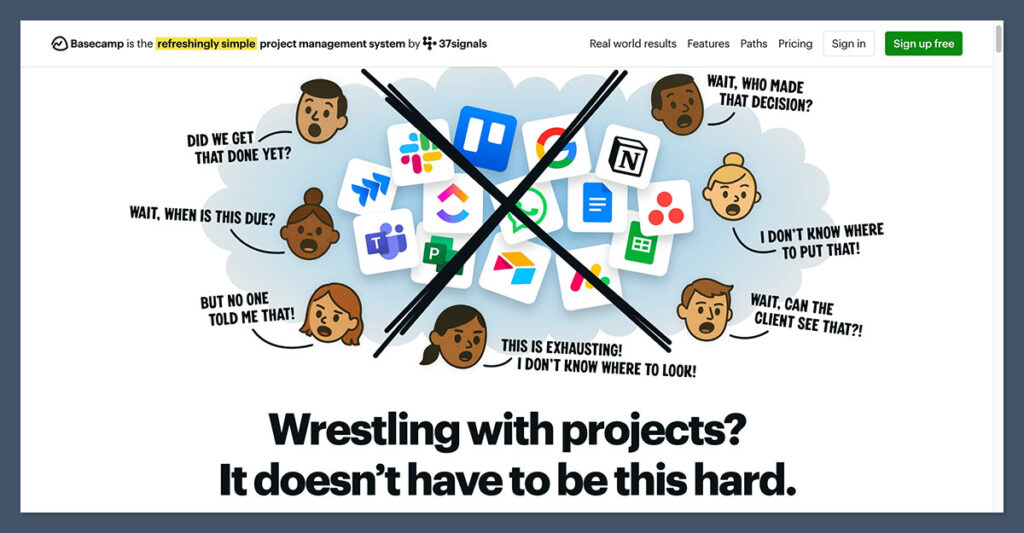
Basecamp is designed to eliminate "tool sprawl." By bundling message boards, to-dos, schedules, and file storage into a single URL, it reduces the need for constant context switching.
- Communication Philosophy: By separating "Campfire" (real-time chat) from "Message Boards" (long-form, searchable updates), Basecamp forces teams to prioritize clarity over speed.
- Project Transparency: Every project is a contained environment. For an agency managing 20 different Shopify client builds, this keeps every asset and conversation siloed and secure.
The "Bridge": How to Integrate for Efficiency
The magic of a modern stack is not in choosing one or the other, but in creating a seamless workflow between them. Using automation tools, developers can build a "digital bridge" that connects the two:
- Order-to-Task Automation: When a "High-Value" order is flagged in Shopify, a Zapier integration can automatically trigger a "Client Success" task in the relevant Basecamp project.
- Product Launch Cycles: When a new product is added to the Shopify catalog as a "Draft," the marketing team is alerted via a Basecamp message board, allowing them to begin work on the launch campaign.
- Customer Feedback Loops: Negative reviews or service tickets from the Shopify interface can be routed to a specific Basecamp project to be addressed by the operations team.
This integration transforms Basecamp from a generic project tool into a specialized ecommerce management layer.
Supporting Data: The Case for a Dual-Platform Strategy
According to 2026 industry benchmarks, businesses utilizing a dedicated project management tool alongside their commerce platform see a 22% increase in operational efficiency.
- Communication: Teams using Basecamp report a 40% reduction in internal email volume, as updates are consolidated within project-specific boards.
- Sales Conversion: Stores using the full Shopify ecosystem (including its POS and AI tools) show a higher average order value (AOV) compared to those using fragmented, DIY, or low-cost shopping cart alternatives.
The data suggests that the "versus" debate is a distraction. The real hurdle is not which tool to use, but how to effectively integrate them to prevent data silos.
Final Verdict: Why You Need Both
If you are an aspiring entrepreneur, your immediate bottleneck is likely revenue. Therefore, your first priority is to secure a store. In this scenario, Shopify is non-negotiable. It is the most robust, secure, and feature-rich platform to handle your commerce needs.
However, as you grow, your new bottleneck will inevitably become coordination. As your team expands and the volume of products and orders increases, the manual overhead of managing these operations via email or Slack becomes a point of failure. This is the moment to adopt Basecamp.
The Strategic Roadmap
- Phase 1 (The Launch): Focus entirely on Shopify. Optimize your storefront, master your inventory, and refine your conversion funnel.
- Phase 2 (The Scale): As you add your first few employees or hire an agency, implement Basecamp. Use it to centralize your SOPs (Standard Operating Procedures), team communication, and project timelines.
- Phase 3 (The Optimization): Use middleware to bridge the two. Automate the handoffs between your sales data and your team’s execution.
In conclusion, Shopify and Basecamp represent the two pillars of a sustainable online business: the ability to sell effectively and the ability to manage the people who make those sales possible. They are not competitors; they are the foundation of a professional-grade commerce stack. Don’t choose one over the other—choose both, and watch your business move from a chaotic startup to a finely-tuned operation.
