
The AI Frontier: Navigating the 2026 B2B Go-To-Market Revolution
As the B2B marketing landscape enters 2026, the industry finds itself at a critical inflection point. The era of speculative AI hype is receding, replaced by the pragmatic—and often daunting—reality of operational integration. Jon Miller, the visionary co-founder of Marketo and a seminal figure in modern B2B marketing, has released his 2026 forecast, providing a roadmap for an industry grappling with the rapid transition from human-led workflows to agent-mediated ecosystems.
Miller’s analysis suggests that 2026 will be the year the "AI-powered" vision finally enters the boardroom, albeit with significant friction. While the promise of 1:1 personalization and autonomous agents is finally within reach, the journey to implementation will be defined by hybrid models, "composable" architectures, and a desperate search for human-centric value in a sea of automated content.
The New Reality: Main Facts of the 2026 Landscape
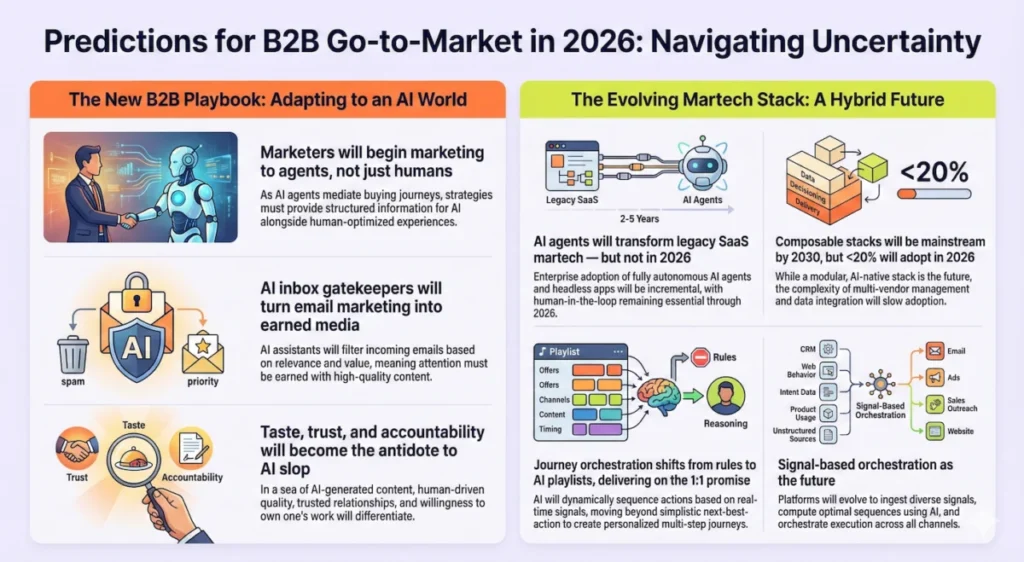
The central thesis of the 2026 outlook is the emergence of the "Agentic Buying Committee." For decades, B2B marketers have optimized their strategies for human buyers. Today, they must contend with AI agents that perform the heavy lifting of research, comparison, and initial vendor evaluation.
Marketing to the Machine
The primary shift in 2026 is that B2B entities are no longer just marketing to people; they are marketing to the "Answer Engines." With over 90% of B2B buyers utilizing AI tools like ChatGPT or Google AI Overviews to conduct research, the ability to feed these systems structured, accurate information is becoming the new "SEO."
However, Miller cautions against over-optimizing for the machine. While "Answer Engine Optimization" (AEO) is currently a priority, he argues that static content markup will eventually become a temporary crutch. As LLMs grow more sophisticated, they will prioritize human-authored, high-value insights over machine-readable metadata.
A Chronological Shift: From Rules to Reasoning
To understand how we arrived at this moment, one must look at the evolution of B2B marketing over the last three years:
- 2023: The "Year of Exploration." Marketers began experimenting with generative AI for basic copywriting and content ideation.
- 2024: The "Year of Integration." Organizations began plugging AI into existing workflows, focusing on efficiency gains and basic CRM automation.
- 2025: The "Year of Answer Engines." The explosion of AEO and the widespread adoption of AI-mediated research changed how vendors are evaluated.
- 2026 (The Current Outlook): The "Year of Reasoning." The shift from brittle, rules-based automation (the "if-this-then-that" model) to autonomous, reasoning-based AI systems that can handle ambiguity and complex decision-making.
Supporting Data and Market Trends
The transition toward agentic marketing is supported by significant shifts in how enterprises are allocating their digital budgets. Data from The Digital Bloom and Chiefmartec highlight a diverging path:
- Investment Pivot: AEO investment is projected to grow by 51% in 2026, compared to a mere 14% increase in traditional SEO.
- The "Silent Freeze": Data from Pave indicates that employment for AI-exposed positions—specifically at the entry level—has dropped significantly. At large tech firms, the percentage of employees aged 21–25 fell from 15% in 2023 to just 6.8% by late 2025.
- Composable Adoption: While fully modular "composable" stacks are the industry’s north star, less than 20% of B2B organizations are expected to reach full implementation in 2026. Most are settling for "composable lite"—a middle ground where data warehouses serve as the foundation, but legacy platforms handle the final orchestration.
Official Industry Perspectives: The "Human-in-the-Loop" Mandate
Leading industry voices, including Scott Brinker and Forrester analysts, emphasize a common theme: the danger of over-automating. While the vision of a "headless" marketing department—where an AI orchestrates every campaign without human intervention—is technically possible, it is not yet practical.
"We’re not getting full autonomy in 2026," Miller asserts. "We’re getting advanced driver assistance." The industry consensus is that enterprise marketing teams require an "air traffic control" model. AI should suggest, sequence, and manage frequency, but the final decision-making power must remain firmly in the hands of the human operator.
Furthermore, the rise of "AI slop"—low-quality, mass-produced AI content—has made "Taste" and "Trust" the most valuable commodities in B2B. Buyers are increasingly ignoring institutional brand promises in favor of individual creators and voices they trust. As a result, influencer relations and personal branding for executives are shifting from "nice-to-have" marketing tactics to core business strategy.
Implications for the Future of GTM Teams
The shift toward 2026 requires a fundamental restructuring of GTM (Go-To-Market) teams. The implications are profound for those looking to stay competitive:
1. The Rise of "Context Engineering"
As data becomes commoditized, the differentiator is context. Simply having data is not enough; GTM teams must master "context engineering"—the discipline of feeding AI the tribal knowledge, decision logic, and strategic nuances that allow it to act on behalf of the company rather than just spitting out generic, hollow responses.
2. From "Owned" to "Earned" Email
Email marketing is undergoing an existential crisis. With AI inbox gatekeepers filtering out noise, the "batch-and-blast" era is effectively over. Email is shifting toward earned media; inbox attention must now be won through relevance and verified trust rather than just list size.
3. The Barbell Economy of Talent
The most sobering implication is the hollowing out of the middle class in the marketing workforce. With AI handling routine tasks, the "on-ramp" for junior employees is disappearing. Organizations must now grapple with how to train the next generation of strategists when the entry-level tasks they once learned from have been automated.
4. Signaling as the New Alpha
In an era where everyone has access to the same public intent data (funding rounds, web visits, etc.), competitive advantage ("alpha") will only come from proprietary data sources and unique combinations of signals. The winning teams will be those that can synthesize internal product usage, behavioral nuances, and external market signals into a coherent, private intelligence layer.
Conclusion: Navigating the Uncertainty
As we move deeper into 2026, the message is clear: the ground is shifting faster than any forecast can predict. The successful organizations will not be those that wait for a "perfect" AI-native future, but those that build resilience today.
By focusing on efficiency, fostering human-centric expertise, and treating AI as a partner—not a replacement—B2B marketers can navigate this period of "massive and rolling disruption." The goal for 2026 is not to automate everything, but to ensure that when human judgment is finally required at the end of the buyer’s journey, the brand has the trust, credibility, and clarity to close the deal. The future of marketing is not just about the tools we use, but the humanity we preserve within those systems.
