
The AI Paradigm: Why Top Copywriters Are Choosing "Human-First" Over Automation
The rapid integration of Artificial Intelligence (AI) into the professional copywriting landscape has been nothing short of tectonic. Within the last year alone, the barrier to entry for generating marketing content has effectively vanished. Whether it is a small business owner drafting a social media post or a CMO overseeing a multi-million dollar campaign, the use of Large Language Models (LLMs) has become a standard, if controversial, part of the daily workflow.
But as the novelty of generative AI wears off, a more nuanced question is emerging: What does "smart" use actually look like?
To move beyond the hype, I interviewed five of the world’s most respected copywriters—Bob Bly, Kim Krause Schwalm, David Deutsch, Lorrie Morgan, and Anita Siek. Each has a storied track record of driving massive revenue for clients and has spent significant time stress-testing AI. Their collective insights suggest that while AI is an incredibly powerful force multiplier, it is also a significant threat to those who mistake output speed for quality.
The Core Philosophy: AI as a Partner, Not a Replacement
Before diving into the perspectives of these experts, it is essential to establish the emerging "rules of the road." Across all interviews, a consistent methodology appeared: top-tier professionals are using AI to outsource the "grunt work" while retaining total control over the strategic, emotional, and creative architecture of their copy.
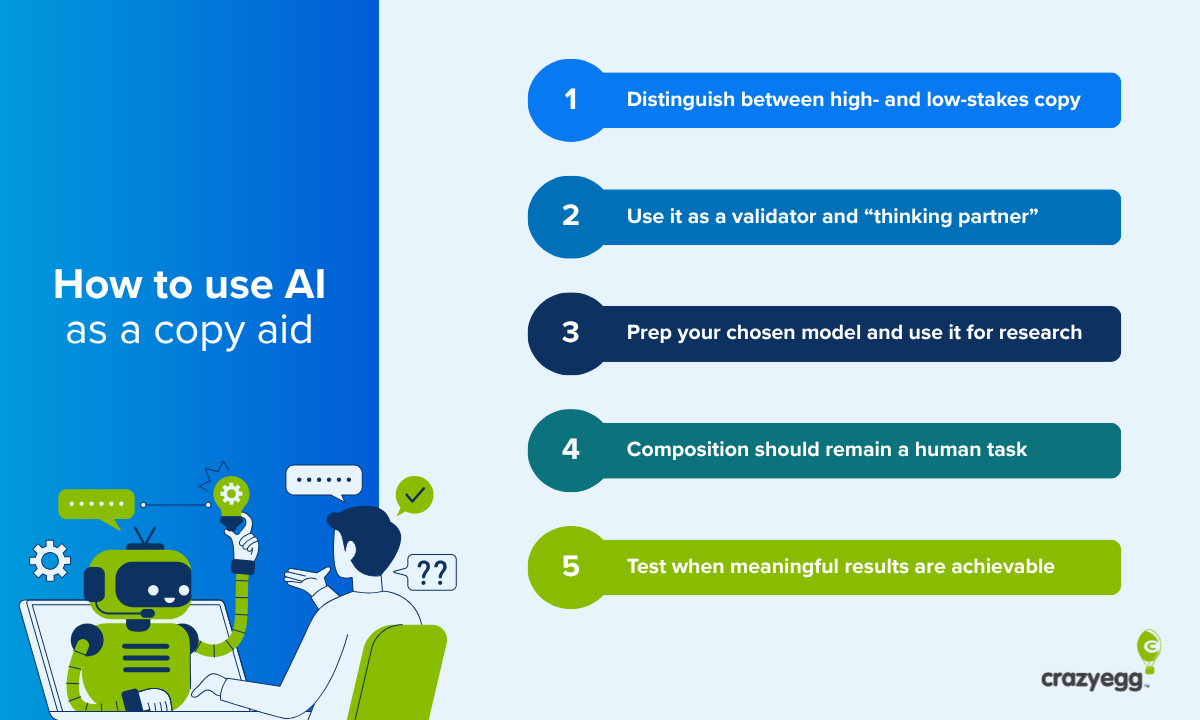
1. Distinguishing Between High and Low-Stakes Copy
Not all copy is created equal. A flyer for a local cafe and a high-stakes, direct-mail brochure for a financial newsletter require entirely different approaches. The experts agree that for revenue-critical copy—the kind that must convert on a cold audience—human intervention is not just recommended; it is mandatory. AI can handle the "tangential" copy, but the "A-list" work requires a human hand that understands the nuances of human desire.
2. The Power of "Thinking Partners"
Rather than asking AI to "write me a sales page," successful copywriters treat models as sounding boards. They use AI to critique drafts, identify potential logical fallacies, or brainstorm angles that a human might overlook. By using the tool to challenge their own assumptions, writers are strengthening their own output rather than letting the machine dictate the voice.
3. The "Garbage In, Garbage Out" Reality
Anita Siek, founder of Wordfetti, hit on a critical point: AI is an amplifier. If you feed it a weak brief, you will receive a weak result. Winning in this era isn’t about knowing the best prompts; it’s about having a deep, strategic understanding of human psychology that you can then "teach" to your AI tools.
Bob Bly: The Case for Skepticism in Direct Response
Bob Bly, author of The Copywriting Handbook and a legend in the industry, remains one of the most vocal critics of over-reliance on AI. His recent book, AI Apocalypse, serves as a cautionary tale for those who think automation can replace deep, original storytelling.
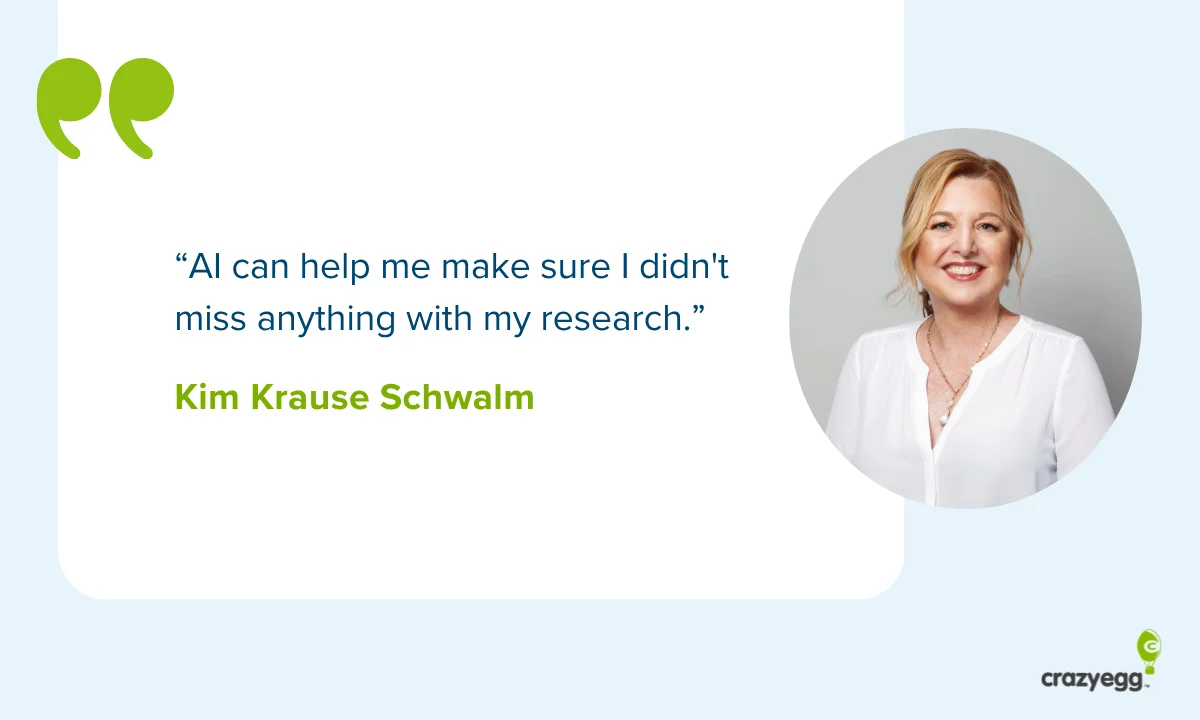
"AI cannot make original stories and experiences," Bly argues. "It can only regurgitate other stories that are not its own. Storytelling is such an important part of copywriting, and AI is axiomatically inferior to humans in that regard."
The "Meat on the Legs" Strategy
Despite his skepticism, Bly does use tools like ChatGPT to validate the "meat on the legs" of a big idea. If he is developing a 30-page financial promotion, he may ask the AI to list potential consequences of a geopolitical event (like the closing of the Strait of Hormuz) to ensure his research is exhaustive. He uses the tool to gather information, not to write the narrative.
Kim Krause Schwalm: Automating the Grunt Work
Kim Krause Schwalm, who built her career by consistently beating "unbeatable" controls, views AI as a powerful utility for productivity. Her workflow focuses on the "Prism" exercise—a method for profiling target prospects.
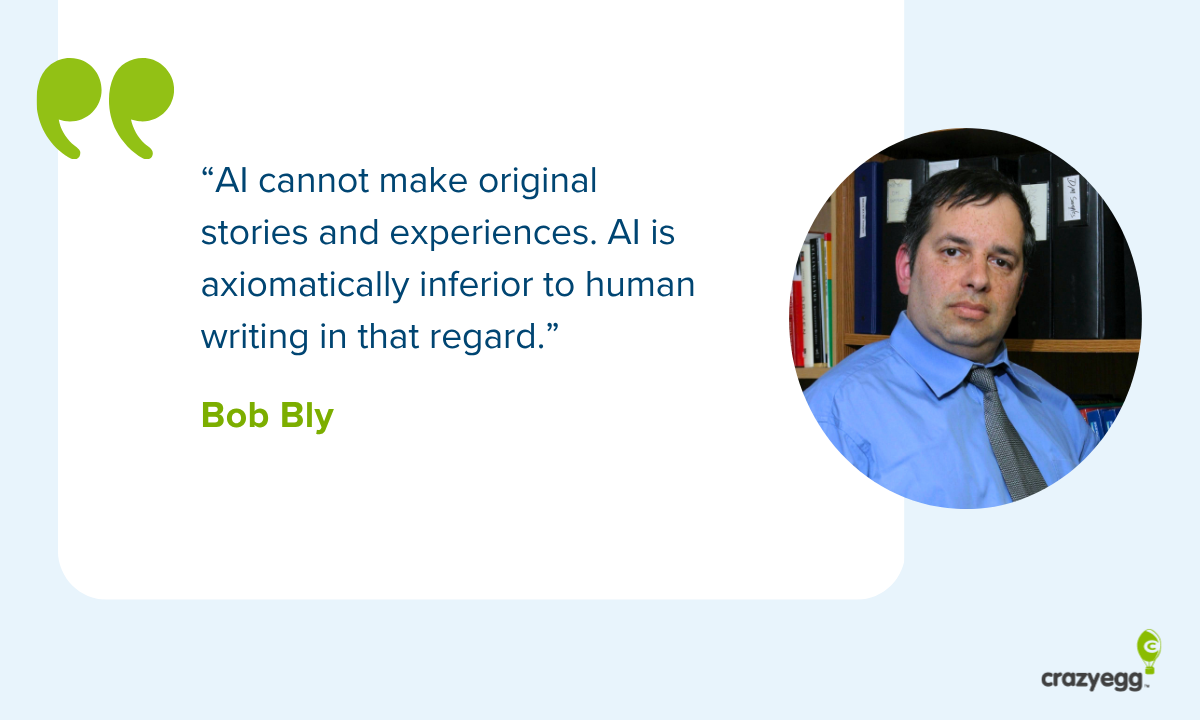
"I’ve always done avatar research manually," she explains. "It allows me to capture the actual language and emotional pain points of the prospect. But I also use AI with the same prompts to see what it returns. It helps me make sure I didn’t miss anything."
Schwalm is clear, however, that AI’s output is often "dry and clinical." For her, AI is a search assistant that helps her sharpen her manual research, ensuring that her final, human-written copy resonates with the emotional depth that only a person can provide.
David Deutsch: Protecting the Cognitive Muscle
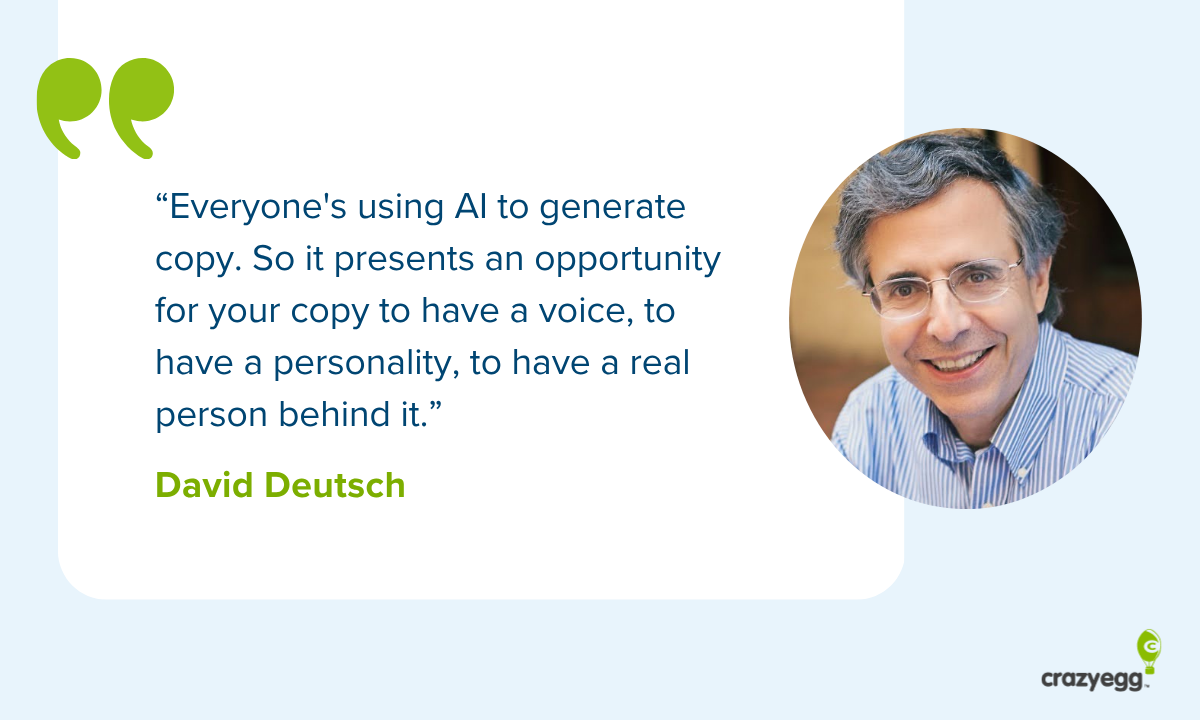
David Deutsch, a former Ogilvy & Mather writer who has generated over $1 billion in sales, focuses on the psychological toll of AI. He warns that over-reliance on technology is leading to a degradation in critical thinking.
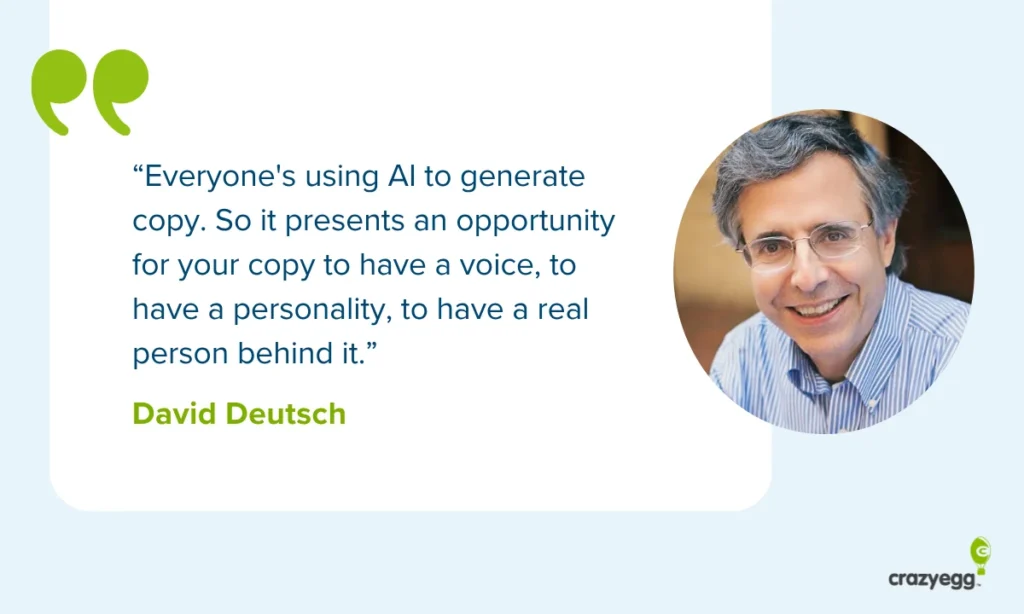
"Everyone is using AI to generate copy," Deutsch notes. "It presents an opportunity for your copy to have a voice, to have a personality, and to have a real person behind it."
The Four-Step System
For clients who require high-volume production, Deutsch utilizes a rigorous four-step process:
- Systematization: Creating frameworks (like AIDA or Jobs-to-be-Done).
- Deep Research: Analyzing Reddit and customer forums for authentic language.
- The Brief: Boiling that research down into a concise, human-authored brief.
- Testing: Using AI to generate dozens of variants for A/B testing.
In this model, the AI isn’t the writer; it’s the engine that powers a high-speed, iterative testing framework.
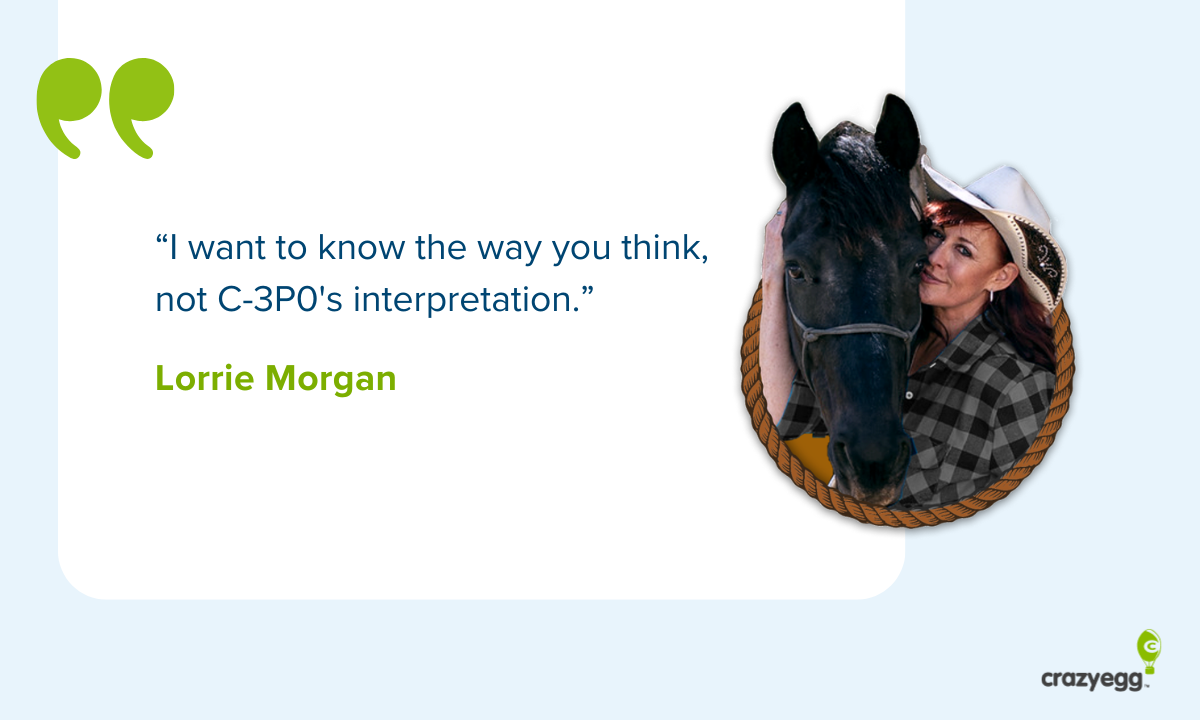
Lorrie Morgan: Avoiding the "C-3PO" Effect
Lorrie Morgan, mentored by icons like Gary Halbert and John Carlton, is perhaps the most concerned about the "homogenization" of content. She warns that AI has a "frictionless optimism" that is fundamentally un-human.
"AI never has a bad day," Morgan says. "It never gets frustrated, loses a client, or doubts itself. That frictionless optimism is exactly what makes it feel inhuman. Readers trust writers who have actually been through something."
She highlights that savvy audiences are developing "algorithm aversion." When a reader smells a piece of AI-generated content, they tune out. For Morgan, the goal is to let AI assist with outlines, but the "hands-on" work of writing must remain firmly human.
Anita Siek: The Future is Behavioral
Anita Siek represents the new generation of copywriters who treat AI as a proprietary asset. By building her own "FETTIBot"—an AI trained on nine years of her specific agency’s intellectual property—she has bridged the gap between machine speed and human strategy.
"At Wordfetti, we don’t just use public models," Siek says. "We’ve taught our AI our specific frameworks and strategies. It knows how to ask the right questions to support our copywriters."
For Siek, the winners of the AI era will be those who combine "tool know-how" with a deep understanding of behavioral psychology. AI cannot "feel" a customer’s resistance, but it can be trained to recognize the patterns that effective human copywriters have been using for decades.
Implications: The Road Ahead
The consensus among these five masters is clear: AI will not replace the copywriter, but the copywriter who understands the limits of AI will replace the one who doesn’t.
The "Hybrid" Future
The evidence points toward a hybrid workflow. The "low-stakes" copy—the filler, the social media scheduling, and the basic data synthesis—will increasingly be automated. However, the high-conversion, high-empathy, and high-impact "big idea" copy will remain a human sanctuary.
Competitive Advantage
The real competitive advantage in the coming years will be "Humanity." As the internet becomes flooded with synthetic, homogenized AI slop, content that features a distinct voice, personal experience, and deep emotional resonance will become increasingly rare—and therefore, more valuable.
Final Takeaway
If you are a marketer or a business leader, stop asking your AI to "write." Instead, ask it to:
- Critique your current arguments.
- Brainstorm potential counter-arguments you haven’t considered.
- Organize your research into a structured brief.
- Generate variations for testing, provided you have a human-led strategy to evaluate the results.
The technology is powerful, but it remains a tool. As Lorrie Morgan put it, you have to be willing to "get your hands dirty." The moment you stop doing the heavy lifting, you stop being a writer and start being a mere prompter—and that is a dangerous place to be in a market that rewards originality.
