

The Martech Paradox: Why Billions in Tech Investment Have Left Marketers Rich in Data but Poor in Action
Executive Summary: The Illusion of Digital Transformation
For the past decade, corporate boardrooms have operated under a shared article of faith: that massive capital expenditure on marketing technology (martech) would inevitably yield hyper-personalized customer experiences, flawless attribution, and automated efficiency. Chief Marketing Officers (CMOs) have aggressively accumulated enterprise software, transforming their departments into some of the largest technology buyers in the modern enterprise.
Yet, a landmark study from operations and analytics firm eClerx reveals a stark, uncomfortable reality: the multi-billion-dollar promise of martech remains largely unfulfilled.
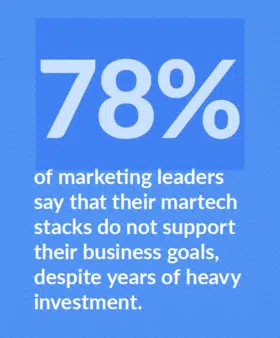
Despite years of relentless investment in customer data platforms (CDPs), advanced analytics suites, identity resolution graphs, and artificial intelligence, the vast majority of marketing leaders believe their technology is falling flat. According to eClerx’s findings, an overwhelming 78% of marketing leaders state that their martech stacks do not support their core business goals. Furthermore, a mere 25% of organizations describe themselves as fully data-driven.
This disconnect highlights a systemic crisis within modern business operations. Marketing departments are drowning in data, dashboard metrics, and AI-generated suggestions, yet they remain structurally paralyzed when it comes to translating those insights into profitable business outcomes.

Chronology: How Marketing Built a Digital Tower of Babel
To understand how the enterprise arrived at this point of technological saturation and operational stagnation, it is necessary to trace the evolution of the marketing department over the last fifteen years.
[2010–2015: The SaaS Boom] ──> [2016–2020: The Data Consolidation Era] ──> [2021–Present: The AI & Real-Time Gold Rush]
       (Tool Proliferation)              (CDPs & Unified Customer Views)              (The Insight Tsunami / Activation Gap)
Phase 1: The SaaS Boom and Tool Proliferation (2010–2015)
Following the 2008 financial crisis, the software-as-a-service (SaaS) business model exploded. Specialized, point-solution tools emerged for email marketing, social media scheduling, search engine optimization, and website personalization. Eager to demonstrate modern capabilities, marketing teams bypassed traditional IT procurement to buy these tools directly. This led to a massive expansion of the marketing technology landscape—growing from roughly 150 vendors in 2011 to several thousand by mid-decade. However, these tools were purchased in silos, creating the first fragmented data repositories.
Phase 2: The Data Consolidation Era (2016–2020)
As organizations realized their data was trapped in disconnected software systems, the industry pivoted toward consolidation. This era saw the rise of the Customer Data Platform (CDP) and the promise of the "360-degree customer view." Enterprises spent millions attempting to integrate their customer relationship management (CRM) systems with web analytics, transactional databases, and third-party data brokers. Despite these investments, integration proved highly complex. Legacy databases, security protocols, and incompatible APIs left data partially unified at best.
Phase 3: The AI and Real-Time Analytics Gold Rush (2021–Present)
The rapid introduction of machine learning and generative AI tools supercharged data collection and content creation. Marketing teams suddenly possessed the power to generate thousands of creative variations and run real-time predictive models on customer churn, lifetime value, and channel performance.
This rapid technological evolution brought marketing departments to their current bottleneck: the "activation gap." The industry successfully solved the engineering challenge of collecting and processing data, but failed to adapt the human processes, organizational structures, and decision-making frameworks required to act on those insights.
Supporting Data: Inside the Numbers of the ‘Activation Gap’
The eClerx study exposes a deep divide between the technical capabilities organizations possess on paper and the daily reality of their marketing operations.
MARKETER CONFIDENCE & DATA UTILIZATION
┌──────────────────────────────────────────────────────────┐
│ Martech Stack Fails to Support Business Goals: 78%       │
├──────────────────────────────────────────────────────────┤
│ Decisions Made Using Only Partial Data: 75%              │
├──────────────────────────────────────────────────────────┤
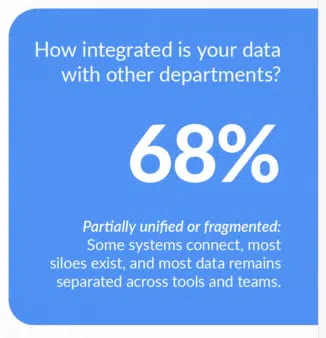
│ Fragmented/Siloed Customer Data Environments: 68%        │
├──────────────────────────────────────────────────────────┤
│ Lack High Confidence in Cross-Channel ROI: 47%           │
├──────────────────────────────────────────────────────────┤
│ Fully Data-Driven Organizations: 25%                     │
├──────────────────────────────────────────────────────────┤
│ Use Media Mix Modeling (MMM) for Real-Time Budgets: 24%  │
└──────────────────────────────────────────────────────────┘
The Data Trust Deficit
The survey reveals a striking lack of confidence among marketers regarding the information displayed on their dashboards:
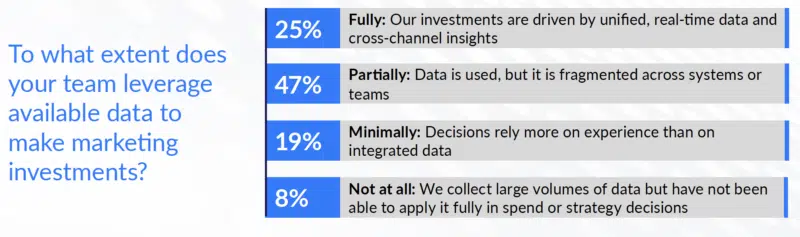
- 75% of respondents admit to making critical investment and campaign decisions using only partial or incomplete data.
- Only 25% of organizations describe their operations as fully data-driven. The remaining 75% rely on a mix of gut feeling, historical precedent, and incomplete analytics.
- 47% of marketing leaders report having only moderate confidence in their ability to measure true cross-channel return on investment (ROI).
- Just 24% of marketers leverage media mix modeling (MMM) to dynamically reallocate budgets based on live performance data.
These metrics suggest that while organizations have built sophisticated systems to gather intelligence, they have failed to build the internal trust necessary to rely on that intelligence for high-stakes business decisions.

The Persistence of Information Silos
Despite years of investing in data integration, information silos remain highly resilient within modern enterprises:
- 68% of respondents state that customer data remains partially unified or highly fragmented across marketing, sales, customer service, and product analytics environments.
- Nearly half (47%) of marketing leaders describe their overall martech stack as only "somewhat effective" specifically because data is siloed across different systems and internal teams.
These silos create severe practical challenges that directly impact the customer experience. In retail and consumer packaged goods (CPG), online and offline data environments are often completely disconnected. For example, a customer who browses a product online and subsequently purchases it in-store will often continue to see online retargeting ads for that exact item. To the marketing technology stack, this individual exists as two entirely different people.
Similarly, in high-tech and SaaS companies, product analytics (how users interact with software) and marketing analytics (how users find the website) frequently operate on disconnected platforms. Consequently, marketing teams are left unable to see the complete end-to-end customer journey.
Expert Analysis: Why Insights Fail to Become Action
The central finding of the eClerx report is that the primary bottleneck in modern marketing is no longer insight generation, but rather operational execution.
THE REAL-TIME BOTTLEENECK
┌─────────────────────────┐     ┌─────────────────────────┐     ┌─────────────────────────┐
│     Data Ingestion      │ ──> │   Insight Generation    │ ──> │  Operational Execution  │
│  (CDPs, Warehouses)     │     │      (AI Engines)       │     │  (Slow Approvals, Silos)│
│       [EFFICIENT]       │     │       [AUTOMATED]       │     │      [BOTTLE-NECK]      │
└─────────────────────────┘     └─────────────────────────┘     └─────────────────────────┘
According to eClerx, 86% of respondents identify fragmented data, inconsistent reporting, limited real-time visibility, or weak attribution frameworks as the primary barriers preventing them from improving marketing performance.
Industry analysts point out that this bottleneck is primarily organizational, not technical. Most mid-to-large-size enterprises already own some of the most sophisticated software tools ever built. The breakdown occurs in how companies are structured to use those tools.
Slow Approval Loops and Bureaucracy
Modern marketing tools can identify a shift in consumer behavior or ad performance within minutes. However, actually reacting to that shift—such as reallocating budget from a underperforming search campaign to a high-performing social campaign—frequently requires multiple rounds of manual approvals, cross-departmental meetings, and agency sign-offs. By the time a decision is authorized, the market opportunity has often passed.
Fragmented Ownership of the Tech Stack
In many corporations, the martech stack is divided among different owners. The IT department may own the data warehouse, the marketing operations team owns the email platform, and external agencies control the ad accounts. This fragmented ownership makes it extremely difficult to build the automated, closed-loop systems needed to trigger immediate marketing actions based on real-time customer behavior.

The Misalignment of KPI Incentives
Different departments are often measured on conflicting metrics. While the media buying team might be incentivized to maximize click-through rates, the sales team is focused on lead quality, and the product team is focused on user retention. Because these teams do not share a unified set of objectives, they struggle to agree on how to interpret and act upon the data their shared systems generate.
Implications: The Generative AI Threat and the Shift to Operational Design
The eClerx report carries a vital warning for marketing organizations currently rushing to integrate artificial intelligence into their operations.
Much of the current industry enthusiasm surrounding generative AI assumes that the primary challenge in marketing is a lack of content or analytical insights. However, if organizations are already struggling to act on the data they currently possess, introducing AI will likely worsen the problem.
                 Traditional Data Inputs
                           │
                           ▼
                  ┌─────────────────┐
                  │ Analytics Stack │
                  └────────┬────────┘
                           │  Produces: 10 Insights/Day
                           ▼
                  ┌─────────────────┐
                  │ Execution Bottleneck (Manual Approvals, Silos)
                  └────────┬────────┘
                           │  Can Only Act On: 2 Actions/Day
                           ▼
                      2 Campaigns

------------------------------------------------------------------

               AI-Powered Ingestion & Inputs
                           │
                           ▼
                  ┌─────────────────┐
                  │  AI Engine Stack │
                  └────────┬────────┘
                           │  Produces: 1,000 Insights/Day (Tsunami)
                           ▼
                  ┌─────────────────┐
                  │ Execution Bottleneck (Unchanged Operating Model)
                  └────────┬────────┘
                           │  Still Can Only Act On: 2 Actions/Day
                           ▼
                      2 Campaigns (With 998 Wasted Insights)
Without structural changes, AI will simply act as an "insight tsunami." It will flood disconnected, slow-moving organizational structures with thousands of automated recommendations, creative variations, and audience segments that the business is physically unable to execute or test. This explains why many organizations continue to buy new software tools while seeing only marginal, incremental improvements in their actual campaign performance.
The Transition to Operational Design
The ultimate takeaway from the eClerx study is that marketing maturity is no longer defined by the complexity of an organization’s technology stack. Instead, it is defined by the agility of its operational design.
The companies that succeed with data are not necessarily using different or more expensive software than their competitors. Rather, they are the ones that have successfully redesigned their operating models to connect data directly to execution, accountability, and business outcomes.
To bridge the activation gap, forward-thinking enterprises must shift their focus away from purchasing new software and toward redesigning their internal workflows:
- Streamlining Decision-Making Processes: Replacing slow, manual approval chains with clear, pre-authorized operational guidelines that allow execution teams to act on real-time data immediately.
- Breaking Down Departmental Silos: Unifying data ownership, marketing operations, and product analytics under a single, cross-functional leadership structure.
- Fostering Organizational Data Trust: Investing in data quality, robust attribution modeling, and governance frameworks so that teams feel confident relying on system insights for high-stakes business decisions.
The era of simply building the martech stack is over. The next competitive frontier in marketing will be won by those who can build the operational models to actually run them.
