
The Velocity Trap: Why AI Hasn’t Changed the Fundamentals of Enterprise Transformation
In the modern corporate boardrooms, a dangerous delusion has taken hold: the belief that the rapid ascent of generative AI has rendered the established rules of business strategy obsolete. Executives are being swept up in a whirlwind of machine-speed productivity, convinced that the sheer velocity of AI-driven output is synonymous with progress.
However, beneath the veneer of hyper-automation and high-tech jargon lies a stark reality: speed is not a substitute for direction. While artificial intelligence has undeniably accelerated the pace at which enterprises can operate, it has not rewritten the fundamental principles of organizational transformation. If anything, it has merely raised the stakes, ensuring that bad strategies fail faster and that the gap between the agile and the obsolete widens at an unprecedented rate.
The Illusion of Transformation
The current hype cycle would have us believe that the integration of Large Language Models (LLMs) and autonomous agents constitutes a "Year Zero" for corporate structure. This narrative suggests that because machines can now execute complex tasks in seconds, the arduous work of planning, alignment, and cultural change is no longer required.
This is a fallacy. While autonomous agents can process data, draft communications, and optimize workflows at speeds unimaginable just a few years ago, they do not possess the strategic intent required to lead an enterprise. For the CIO and the C-suite, the challenge remains unchanged: managing value, risk, and organizational alignment. The difference is that the feedback loop has tightened. Where an enterprise once had months to course-correct a failing initiative, they now have days, or even hours. AI has not invented a new playbook; it has put the old one under extreme pressure.
Chronology of a Digital Shift
To understand where we are, we must look at the evolution of enterprise transformation over the last decade.
- The Digitization Phase (2014–2018): Enterprise transformation was defined by the transition from legacy, on-premise systems to cloud-based infrastructure. The goal was scalability.
- The Data-Driven Phase (2019–2022): With cloud infrastructure in place, companies shifted focus to "Big Data." The imperative was to extract actionable insights from vast, siloed datasets.
- The Generative Acceleration (2023–2025): The introduction of accessible generative AI tools shifted the focus from insight to action. Organizations moved from analyzing reports to automating the creation of content, code, and customer interactions.
- The Current Reality (2026): We have entered the era of the "Autonomous Enterprise." Here, the question is no longer whether an enterprise can use AI, but whether it can govern that AI within a coherent strategic framework.
Supporting Data: The Efficiency Paradox
Forrester’s 2026 research into B2B brand, communications, and IT spending highlights a significant pivot in how enterprises view this technology. While 93% of B2B marketers still rely on agency support, the nature of that relationship is shifting. As internal AI-driven efficiencies grow, organizations are increasingly bringing execution-heavy tasks in-house, leaving agencies to focus on high-level strategy and specialized expertise.
The data suggests that while operational efficiency is skyrocketing, it is not necessarily leading to better outcomes unless paired with a "deliberate approach." In surveys regarding digital engagement and brand visibility, those companies that treated AI as a "magic button" saw their brand sentiment fluctuate wildly. Conversely, those that integrated AI into a long-term, human-led strategic roadmap saw consistent growth.
The lesson is clear: AI acts as a multiplier. If your strategy is sound, AI multiplies your success. If your strategy is flawed, AI accelerates your collapse.
The Seven Pillars of Transformation
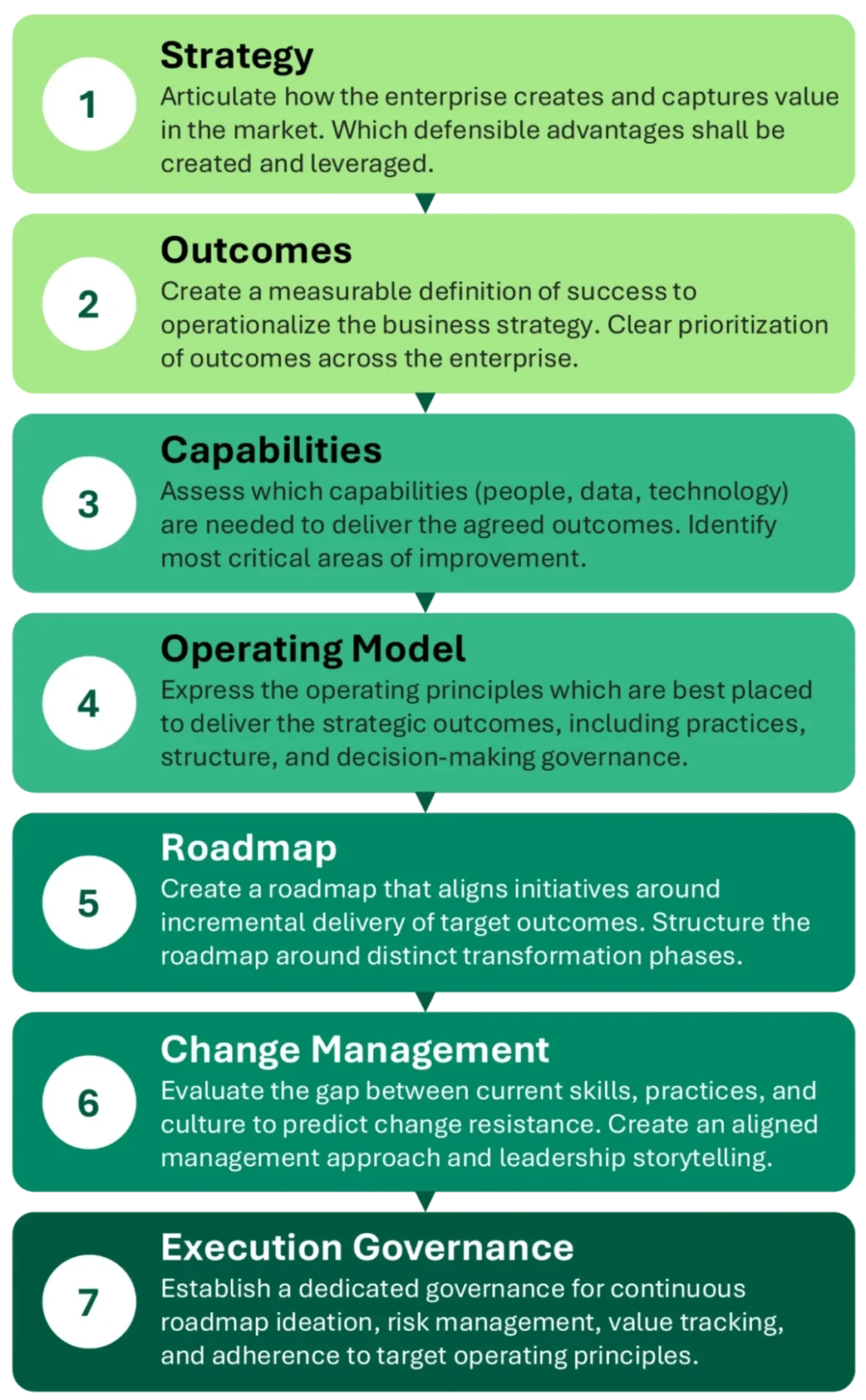
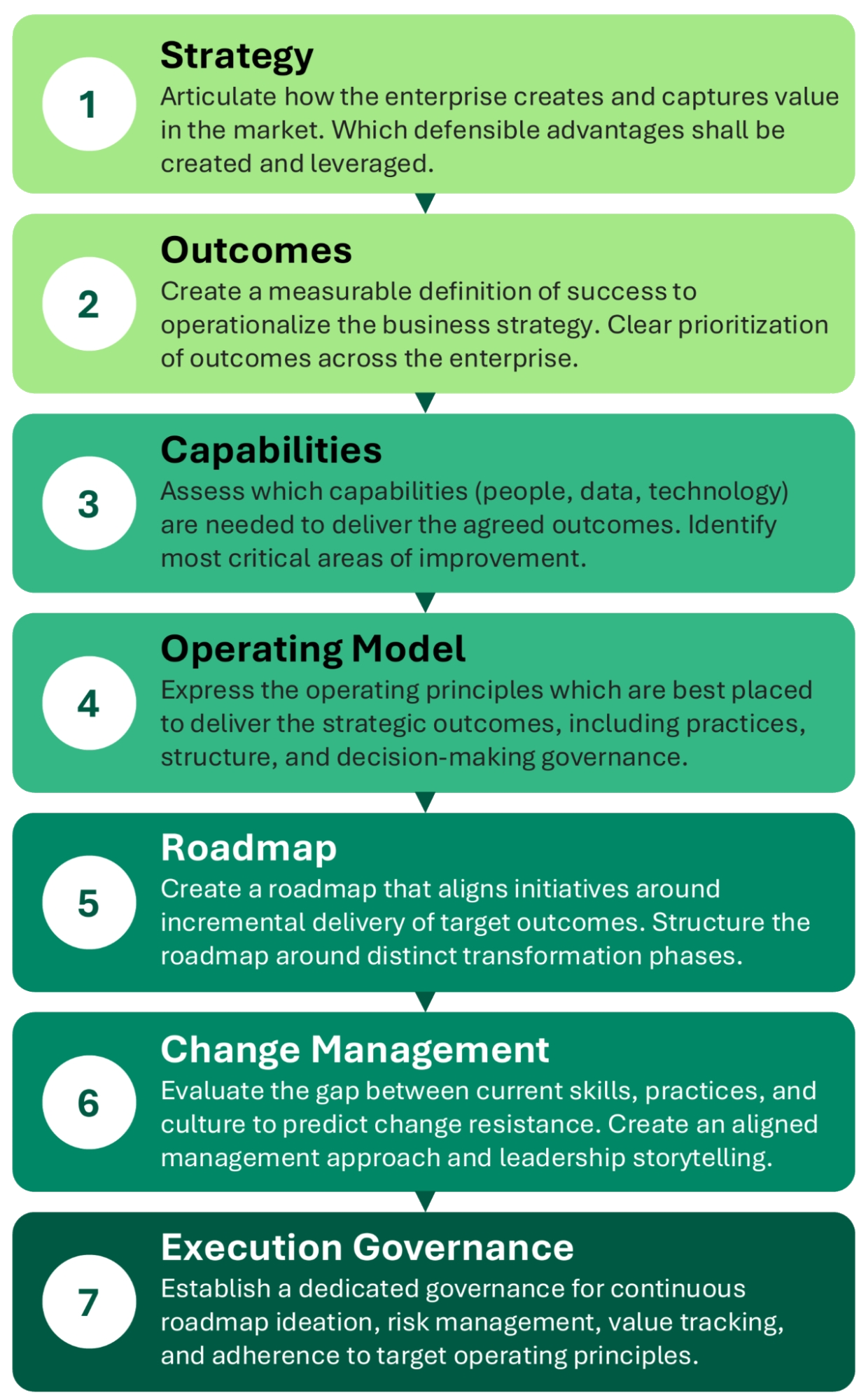
Successful transformation still relies on a rigorous, human-centric framework. Regardless of the sophistication of your AI stack, the "7 Essential Steps" remain the cornerstone of any successful enterprise-wide initiative:
- Define the Strategic North Star: Determine exactly where to play and why. AI cannot choose your market position for you.
- Outcome Mapping: Define what success looks like in measurable terms. If you cannot measure it, you cannot scale it.
- Capability Assessment: Conduct a cold-eyed audit of your current resources. Include your new AI tools in the repository, but ensure you have the human talent to govern them.
- Operating Model Design: Rethink how decisions are made. If your organization is too slow to decide, the speed of your AI tools will only create more "high-speed waste."
- Incremental Execution: Do not attempt a "Big Bang" deployment. Implement in cycles, learning and adjusting at each step.
- Cultural Alignment: Bring the organization with you. Resistance to change is the greatest barrier to transformation, and no amount of AI-generated content will convince a disengaged workforce.
- Continuous Feedback Loops: Establish a system to monitor not just the output of your AI, but the strategic relevance of that output.
Implications for Leadership: The "Ordinary" Advantage
If the playbook remains the same, why does the atmosphere feel so different? The implication for modern leadership is that the "margin for error" has been virtually eliminated.
In the past, a leader could hide a mediocre strategy behind a slow execution process. Today, autonomous agents will execute that mediocre strategy with such blistering speed that the flaws will be exposed to the entire organization—and the market—almost immediately.
The winners of the next five years will not be the companies that chase the latest AI headline. They will be the companies that do the "ordinary" things extraordinarily well. They will focus on:
- Operational Discipline: Using AI to remove friction, not just to add volume.
- Talent Augmentation: Ensuring that human employees are empowered to make higher-level decisions because AI has handled the administrative load.
- Strategic Clarity: Maintaining a firm grip on the business objectives, ensuring that technology serves the strategy, not the other way around.
The Verdict: More Speed, Fewer Excuses
As we navigate the second half of this decade, the excitement surrounding generative AI should be tempered by a commitment to foundational excellence. We are not living in a world where business rules have been rewritten; we are living in a world where the penalties for ignoring those rules have become more severe.
The most successful CIOs and CEOs of 2026 and beyond will be those who view AI as a sophisticated engine—one that requires a steady hand on the wheel. They will not be seduced by the siren song of "machine-speed" transformation that lacks a destination. Instead, they will focus on the boring, essential work of strategy, capability, and culture.
In the final analysis, the enterprise of the future is not defined by how fast it moves, but by the intentionality behind its motion. The technology has changed, the pace has quickened, and the tools have evolved. But the goal remains the same: to create sustainable value in an increasingly complex world. Those who succeed will do so because they stopped looking for shortcuts and started mastering the fundamentals. They will move faster, certainly—but they will do so with a clarity of purpose that their competitors lack, and with significantly fewer excuses for their performance.
