
The Transparency Shift: Microsoft’s Landmark Tax Disclosure Reveals Ireland’s Dominance
On June 30, 2026, Microsoft Corporation took a step into a new era of corporate accountability, publishing its inaugural country-by-country tax report in compliance with the European Union’s latest transparency mandates. The filing, which covers the fiscal year ending June 30, 2025, strips away the traditional veil of corporate secrecy, offering a granular view of how the tech giant distributes its revenue, profits, and tax obligations across the continent.
For the first time, the public can see the mechanics of a global tax strategy that has long been the subject of speculation. The data reveals a stark geographical divide: while Microsoft maintains a significant operational footprint across Europe, its financial engine is overwhelmingly centralized in Ireland.
The Core Facts: A Tale of Two Jurisdictions
The report, mandated by Chapter 10a of the EU’s Directive 2013/34/EU, provides a breakdown of financial metrics across 27 EU member states and five additional jurisdictions, including Panama and Turkey. The figures paint a compelling, if controversial, picture of Microsoft’s economic distribution.
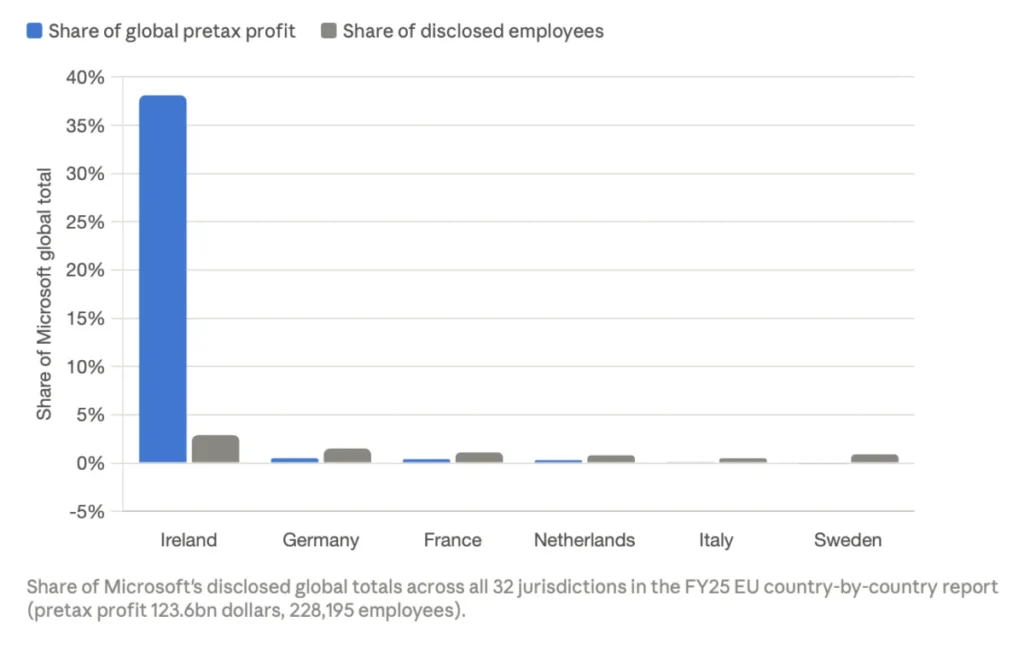
In Ireland, Microsoft reported a staggering $196 billion in revenue and $47.08 billion in pretax profit for the 2025 fiscal year. To put this in perspective, that single jurisdiction accounted for approximately 38% of the company’s entire worldwide pretax profit, despite the country hosting fewer than 3% of Microsoft’s global workforce—roughly 6,654 employees.
Contrast this with Germany, Europe’s largest economy. Despite employing 3,471 people—more than half the Irish headcount—Germany generated only $11.7 billion in revenue and $661 million in pretax profit. This massive disparity between profit allocation and headcount distribution highlights the concentration of intellectual property and centralized operations within the Irish corporate ecosystem, a structure that has invited significant regulatory scrutiny for decades.
A Chronology of Disclosure
The path to this transparency report began years ago with the OECD’s "Base Erosion and Profit Shifting" (BEPS) framework, which required private disclosures to tax authorities. However, the EU’s decision to move this data into the public domain marks a paradigm shift.
- 1982–1985: Microsoft establishes its European presence, opening offices in the UK, followed by Germany, France, and eventually Ireland.
- 2021–2023: The EU formalizes the directive requiring public country-by-country reporting for large multinationals.
- June 30, 2026: Microsoft officially releases its first public disclosure, accompanied by a strategic blog post from Jeff Bullwinkel, Vice President and Deputy General Counsel for Microsoft EMEA.
- July 3, 2026: The New York Times publishes a high-profile analysis of the report, triggering widespread public discourse regarding the efficacy of international corporate tax structures.
Analyzing the Supporting Data: Beyond the Headline Numbers
The filing does more than just highlight the Ireland-Germany gap; it provides a comprehensive look at Microsoft’s global tax footprint. The report lists 32 distinct lines of data—27 EU member states, plus Panama, Russia, Trinidad and Tobago, Turkey, and Vietnam—with an additional aggregate line for the "rest of the world."
The "Rest of World" Aggregate
The most significant figure in the report is the aggregate for all jurisdictions not explicitly listed. This line represents $279.2 billion in revenue and $74.6 billion in pretax profit across 198,843 employees. Because this figure includes the United States, it underscores the massive scale of Microsoft’s global operations, dwarfing any individual European country in the table.
Cash Tax vs. Accrued Tax
One of the most complex aspects of the filing is the distinction between income tax accrued (the amount owed for the year) and income tax paid on a cash basis (the actual outflow of funds). The report clarifies that these two numbers rarely align due to timing differences and historical tax credits.
France serves as a primary example of this complexity, reporting negative $96.4 million in cash tax paid. Bullwinkel clarified that this was not an avoidance strategy but rather the result of a one-time refund for taxes overpaid in previous years. He noted that over the previous three years, Microsoft had paid $374 million in taxes in France, demonstrating that a single year’s snapshot can be misleading.
The Anomaly of Sweden
Sweden presents a unique case in the reporting. Despite recording an $81.4 million pretax loss for the year, the country saw $143.7 million in income tax accrued and $288.8 million in cash tax paid. This is largely attributed to accumulated earnings—a reflection of historical performance rather than the immediate fiscal year’s activity.

Official Responses and Strategic Framing
Microsoft’s leadership clearly anticipated the shock value of these numbers. Jeff Bullwinkel’s blog post was published simultaneously with the report, serving as a preemptive strike against accusations of tax evasion.
"We have provided this kind of information directly to tax authorities for several years," Bullwinkel wrote. "It is now published to support transparency commitments, and we believe it is important to proactively address any questions these disclosures may raise, recognizing that numbers on a spreadsheet rarely tell the full story."
Bullwinkel emphasized that Microsoft is a massive taxpayer, noting that it paid $28.7 billion in corporate income taxes globally over the past year—ranking it second among all corporations worldwide according to S&P data. Within the EU, he stated the company paid $6.3 billion in income tax for fiscal year 2025. By shifting the conversation from "tax per country" to "total global contribution," Microsoft attempted to reframe the narrative from one of jurisdictional maneuvering to one of broad economic investment.
The Regulatory Backdrop: A New Standard
The directive forcing this disclosure is part of a wider trend of aggressive EU regulatory oversight. From the Digital Services Act (DSA) to the AI Act, European authorities are demanding more visibility into the operational realities of American Big Tech.
The filing explicitly notes that it was not prepared under the same instructions as the confidential reports submitted to tax authorities. This creates an interesting dichotomy: the public is now seeing a version of the data that is meant to be digestible, while tax authorities continue to work with highly technical, proprietary documentation.
However, the risk for companies like Microsoft is that these disclosures serve as a "litmus test" for public sentiment. As other American multinationals are required to file similar reports, the comparative data will become a roadmap for regulators and activists to pinpoint discrepancies in profit-shifting, potentially leading to a new wave of tax reform or legal challenges across the bloc.
Implications for the Digital Economy
For Marketers and Advertisers
While a tax filing may seem like a matter for accountants and lawyers, the implications for the marketing industry are profound. The entities named in Section 3 of the report—such as Microsoft Ireland Operations Limited—are the very entities that underpin the company’s advertising, cloud, and AI infrastructure.
For brands that rely on Microsoft Advertising or LinkedIn for their programmatic spend, the stability and jurisdictional health of these entities are paramount. If Ireland’s tax status or its regulatory environment undergoes significant change due to these new disclosures, it could indirectly impact the operational costs and compliance risks for global advertisers.
The Wider Regulatory Environment
Beyond tax, Microsoft is operating in a landscape where its data privacy practices are under constant scrutiny. With regulators like the Irish Data Protection Commission (DPC) facing pressure for enforcement consistency, the fact that Microsoft’s financial heart is in the same jurisdiction as its regulatory oversight creates a complex web of influence. As companies face increasingly granular disclosure requirements, marketers must now consider "jurisdictional exposure" as part of their vendor due diligence.
Conclusion: A New Baseline for Transparency
Microsoft’s disclosure is a watershed moment for corporate transparency. By laying bare the concentration of its profits in Ireland, the company has provided a window into the reality of modern multinational operation. While the numbers confirm that profit is not distributed evenly across the European footprint, Microsoft’s proactive communication strategy suggests that the company is prepared to defend its tax position on a global stage.
As the EU’s transparency mandates continue to take effect, this report will serve as a template for how large, data-driven organizations communicate their value to the public. For investors, regulators, and the marketing industry alike, the era of "black box" corporate finance is effectively over. The data is now in the public record—and it is likely to remain a focal point of debate for years to come.
