
The Social Video Revolution in Latin American News: 2026 Strategy Guide
Social media platforms have firmly cemented themselves as the primary battleground where Latin American (LATAM) news is discovered, debated, and shared at scale. According to the Reuters Institute Digital News Report 2025, roughly 58% to 64% of respondents across Argentina, Chile, Colombia, Mexico, and Peru rely on social media as a primary source for news content.
While some legacy publishers have successfully synchronized their social video strategies with this consumer shift, many others are falling behind agile, social-first creators. As competition intensifies, understanding how audiences actually consume and engage with news on social platforms has become a non-negotiable operational advantage for media organizations.
Drawing from extensive 2025 performance data provided by Tubular Labs and Chartbeat, this report examines the state of social video in LATAM, forecasting key trends for 2026 and offering a data-backed blueprint for newsrooms aiming to capture audience share on YouTube and TikTok.

Main Facts: The New Geography of LATAM News Consumption
The modern Latin American news consumer does not wait for the evening broadcast or purchase morning papers; they scroll, swipe, and tap. The data reveals staggering scale across the region:
- Massive Digital Volume: Across all video categories and social platforms, LATAM social video content generated a phenomenal 4.05 trillion views between January and July 2025.
- The News & Politics Share: Content categorized under News & Politics and posted specifically by professional media companies accounted for 27.1 billion views across 293,000 uploads.
- The Opportunity Gap: Despite these billions of views, News & Politics content made up a mere 0.67% of total uploads in the region. This stark imbalance highlights a massive whitespace opportunity for legacy publishers and digital-native newsrooms to expand their footprints and capture audiences migrating away from traditional broadcast and print.
Chronology and Evolution: How Social Video Overtook Traditional Broadcast
The migration of news audiences to digital platforms in Latin America has accelerated over the past several years, shifting from a supplemental distribution strategy to the core engine of audience acquisition.
Early 2020s: The Pandemic Pivot
During the global health crises of the early decade, LATAM audiences turned en masse to mobile devices for real-time updates. Publishers reacted by experimenting with basic digital uploads—often simply dumping full-length, landscape television broadcasts onto YouTube and Facebook. While viewership existed, engagement rates were low because the formats clashed with mobile-first viewing habits.
2023–2024: The Short-Form Explosion
The mainstream adoption of TikTok and the rollout of YouTube Shorts changed the calculus. Creators and independent journalists proved that complex political and social issues could be broken down into vertical, 30-second clips. Legacy publishers, however, lagged behind, clinging to mid-length uploads (1 to 5 minutes) that consistently underperformed in terms of engagement per video.
2025–2026: The Data-Driven Era
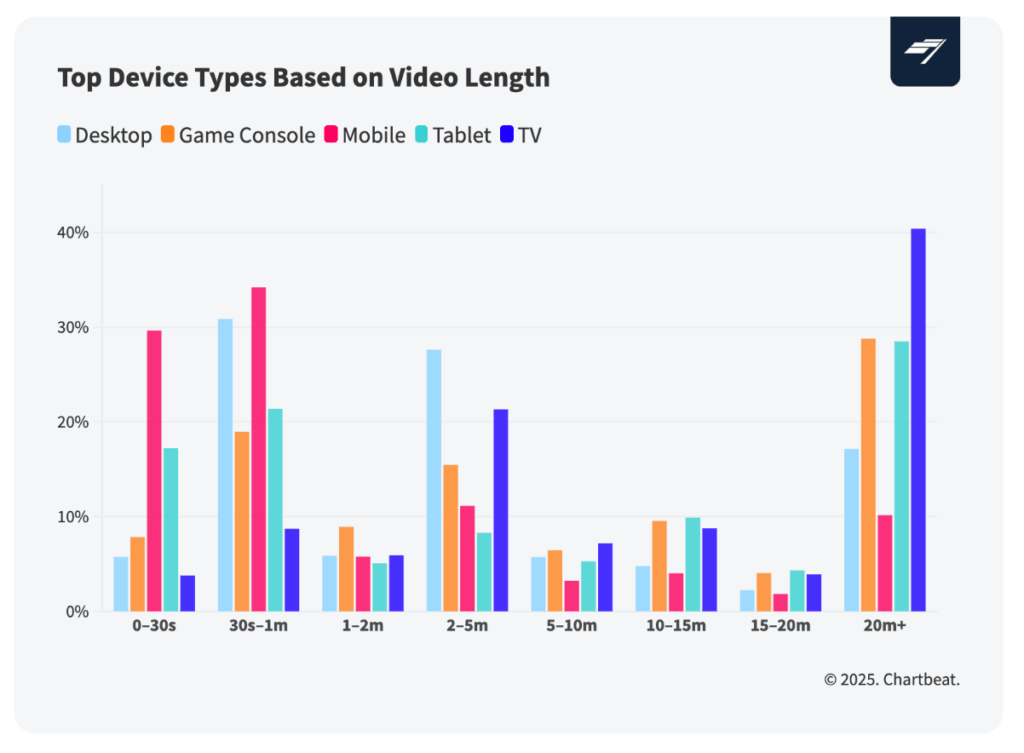
By 2025, data analytics from platforms like Tubular Labs and Chartbeat began to demystify audience behavior. Publishers realized that device preference dictated content length: while living-room TVs and connected devices favored long-form deep dives exceeding 20 minutes, the vast majority of consumers were interacting via mobile devices demanding rapid, digestible bites of news. Entering 2026, the mandate for LATAM newsrooms is clear: pivot from assumption-based publishing to data-backed, platform-specific content strategies.
Supporting Data: Deep Dive into YouTube and TikTok Metrics
To compete effectively, digital strategists must look past vanity metrics and examine underlying platform behaviors.
YouTube Trends in LATAM
YouTube remains a foundational pillar for regional distribution, but its consumption patterns defy conventional broadcasting logic.
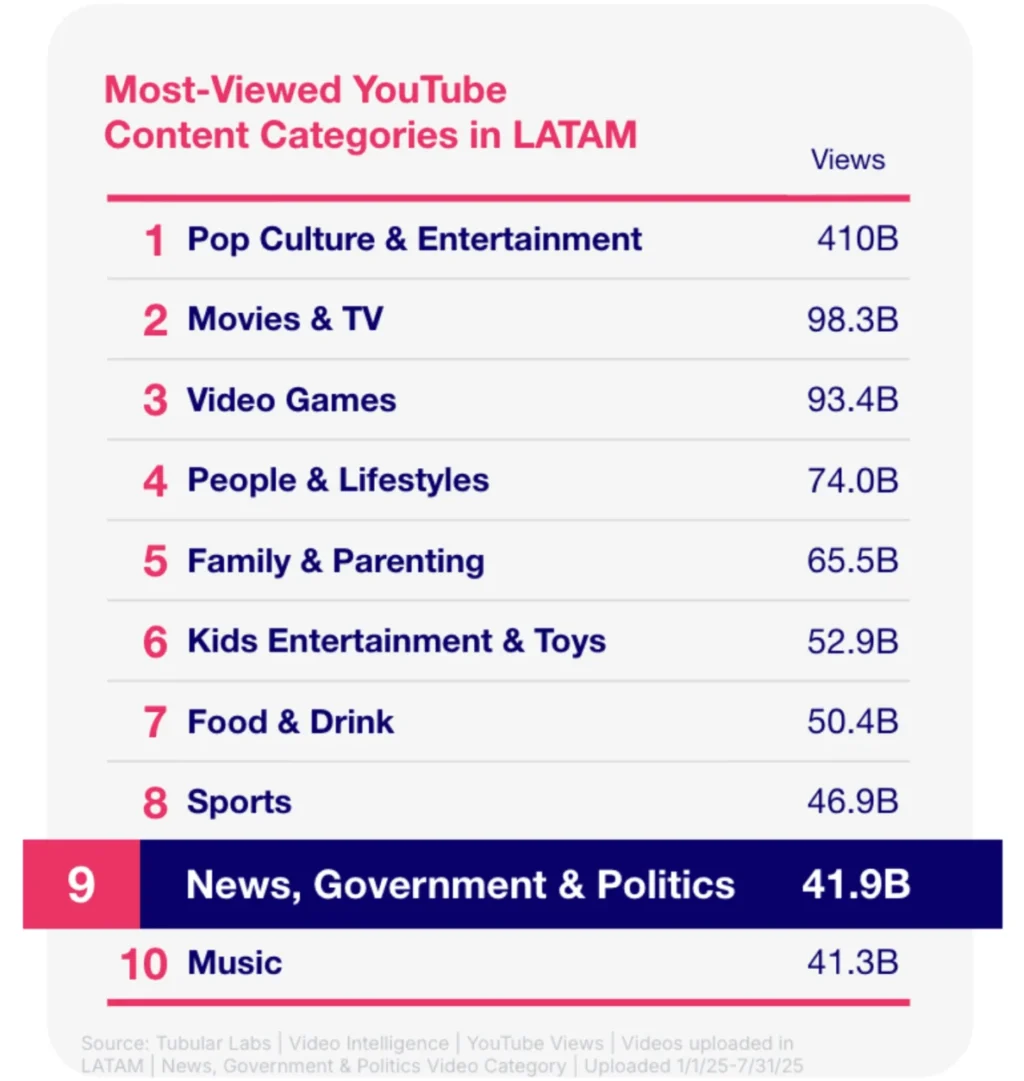
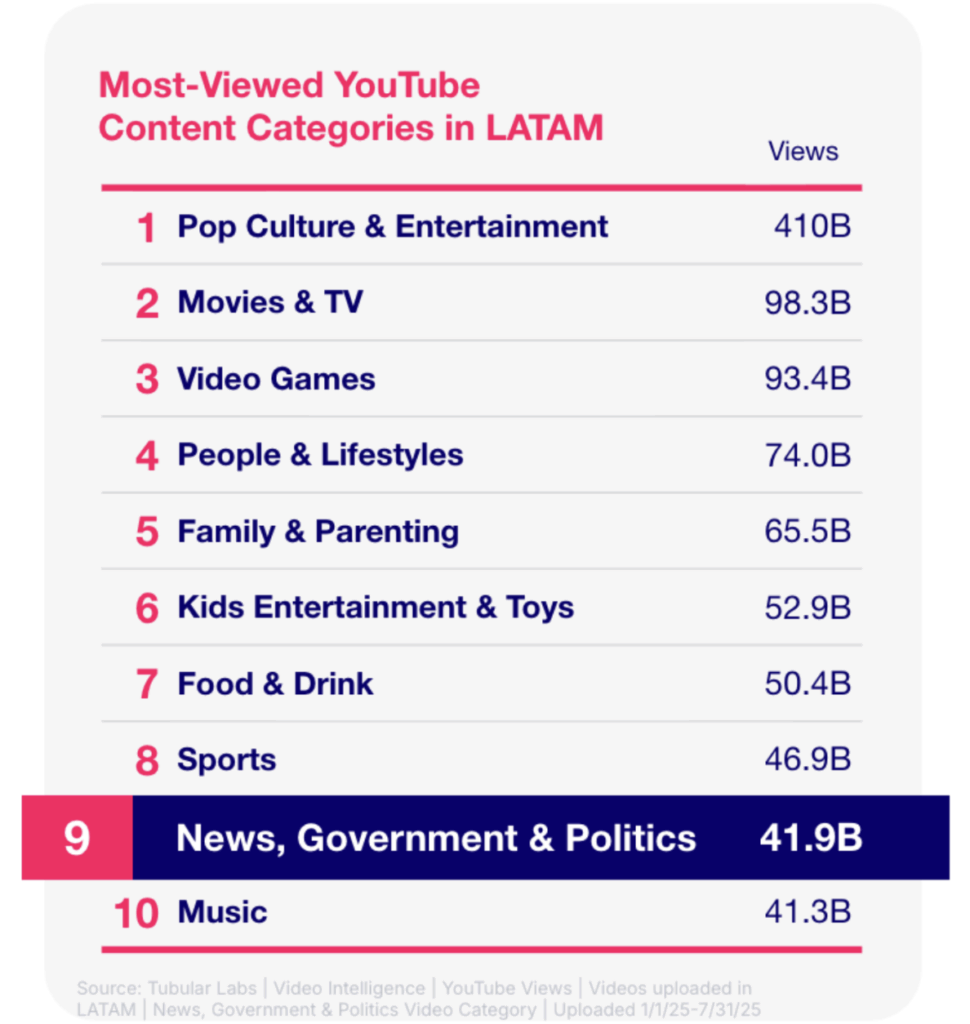
- High Category Ranking: News, Government & Politics ranked as the #9 most-viewed category on YouTube in LATAM, pulling in 41.9 billion views from publishers, influencers, and brands combined. Remarkably, this placed the category ahead of Music, despite significantly fewer uploads.
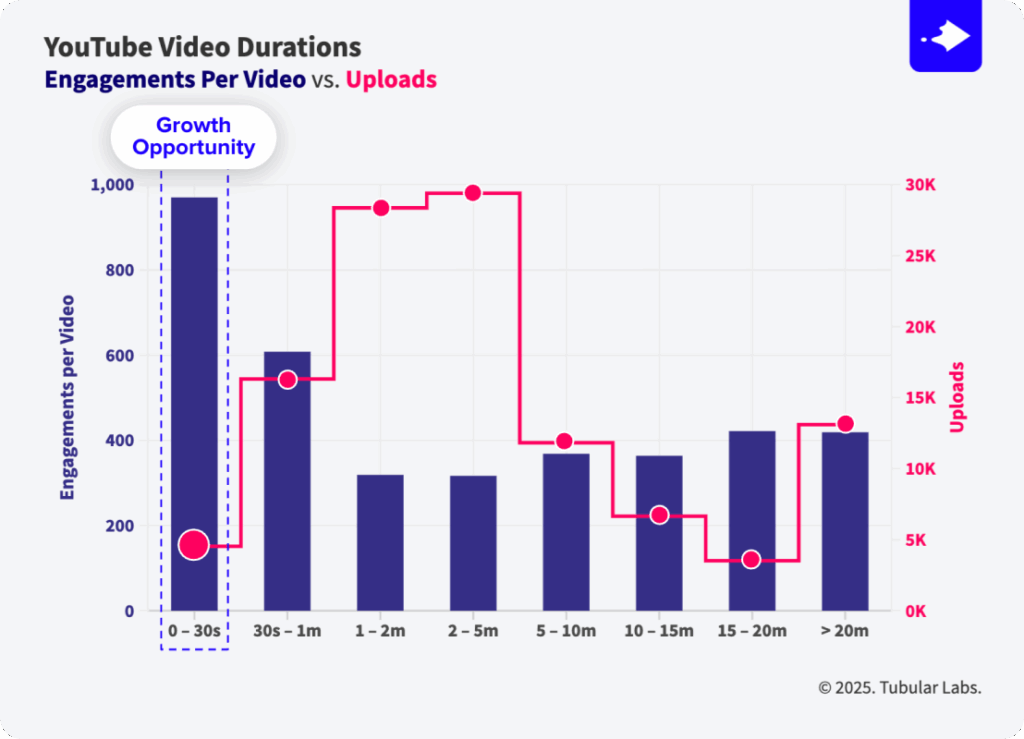
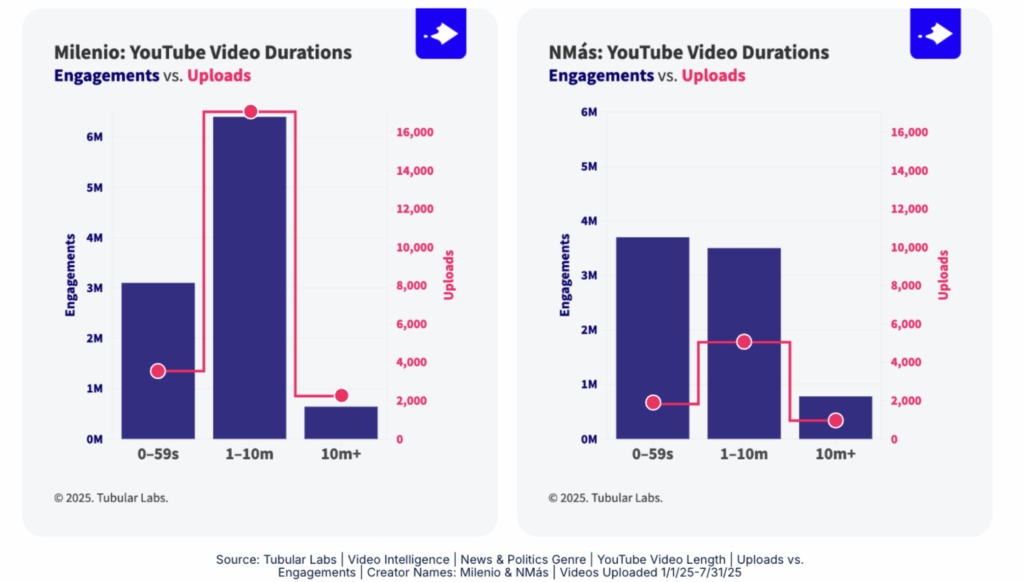
- The Video Duration Trap: Data reveals a glaring mismatch in publishing habits. YouTube videos under 30 seconds delivered the highest engagement per video, yet the vast majority of publisher uploads ranged from 1 to 5 minutes—a duration that consistently yielded the lowest engagement per video. Publishers are actively ignoring their most effective growth tool by failing to embrace sub-30-second clips.
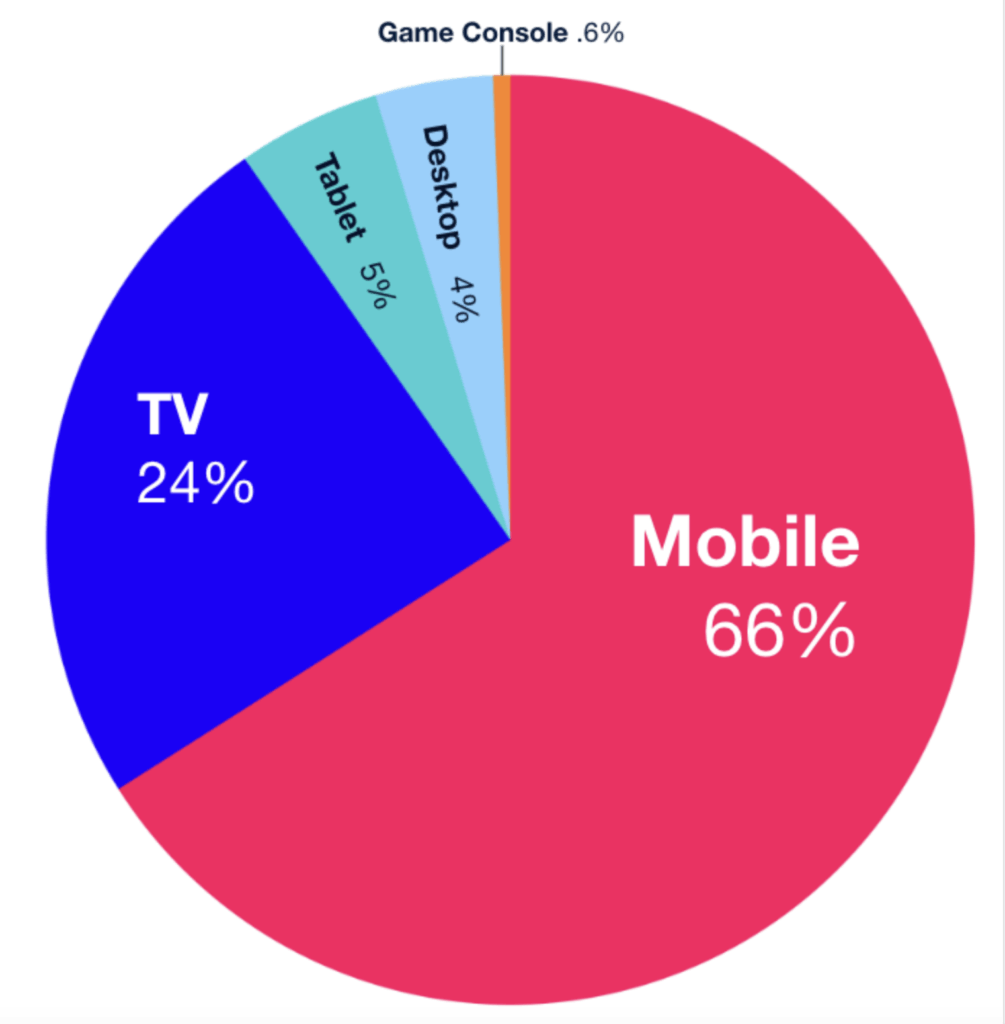
- Mobile Dominance: Mobile devices account for 66% of YouTube views for LATAM News & Politics publishers, compared to just 24% on televisions.
- The Power of Shorts: Leading publishers are already reaping the rewards of vertical video. For instance, Milenio’s YouTube Shorts made up just 15% of their total uploads but drove a staggering 31% of their total cross-platform engagements. Similarly, NMás posted 2.8 times more mid-length videos, yet earned nearly half of their total engagements exclusively from Shorts.
- Temporal Advantage: Analytics show that videos uploaded on Sundays earned the highest overall engagement, underscoring the need for automated scheduling systems to capture weekend news consumers outside standard business hours.
TikTok’s Role as a Growth Engine
If YouTube provides stability, TikTok functions as an explosive growth engine for news dissemination in Latin America.
- Interaction Share: TikTok drives 71% of all cross-platform social interactions with LATAM news media, despite representing a smaller share of overall uploads compared to older networks.
- Category Standing: News, Government & Politics ranked as the #6 most-viewed TikTok category, accumulating 92.0 billion views.
- Explosive Growth: Among the top 10 LATAM news publishers on TikTok, viewership surged by 55% year-over-year, proving an insatiable appetite for fast-paced, platform-native reporting.
- Case Study in Efficiency: Major outlets like C5N found that TikTok content accounted for only 25% of their cross-platform uploads but drove a remarkable 71% of their total engagements.
- Topic-Specific Audience Fragmentation: LATAM audiences look to different platforms for distinct topics. Data indicates that topics like immigration or women’s rights perform exceptionally well when cross-posted on Instagram and TikTok, whereas subjects like law enforcement and crime find higher engagement on Facebook.
Official Responses and Industry Perspectives
Industry leaders and analytics experts emphasize that survival in the LATAM media market depends on structural adaptation rather than incremental adjustments.
Media strategists note that legacy newsrooms have historically treated social media as a "fire-and-forget" distribution channel—a digital dustbin for broadcast clips. Modern audience analytics prove that this approach alienates digital-native demographics.
Data partners at Chartbeat and Tubular Labs stress that publishers must align their editorial workflows with real consumer habits. Because mobile users and living-room television viewers consume news in fundamentally different ways—with mobile users demanding brief, vertical summaries and TV audiences settling in for long-form investigative pieces—newsrooms must build flexible, multi-format production lines. Rather than filming a single piece of content and forcing it onto every platform, successful publishers are now slicing long-form reports into modular vertical assets tailored to individual platform algorithms.
Implications for LATAM News Publishers in 2026
The transition of social platforms into primary news sources carries profound operational, financial, and editorial implications for Latin American media organizations.
1. Operational Restructuring
Newsrooms must move away from siloed broadcast and digital teams. Reporters must be trained to capture vertical video in the field, and editing desks must prioritize short-form turnaround alongside traditional article writing. The data shows that the volume of News & Politics uploads is relatively low (0.67% of total content), leaving plenty of room for agile publishers to scale up production without instantly oversaturating the market.
2. Monetization and Audience Trust
As programmatic advertising yields on traditional text websites face ongoing pressures, building robust, engaged communities on YouTube and TikTok opens up alternative revenue streams—ranging from platform-native monetization programs to sponsored social integrations and direct reader funneling. However, publishers must balance speed and short-form brevity with rigorous journalistic standards to maintain audience trust in an era of digital misinformation.
3. Strategic Recommendations
To win in 2026, LATAM news publishers should immediately implement the following data-backed steps:
- Embrace Short-Form Video: Dedicate resources to producing vertical videos under 30 seconds for YouTube Shorts and TikTok.
- Repurpose Intelligently: Break down lengthy investigative reports and studio interviews into bite-sized, high-impact clips.
- Optimize Scheduling: Utilize automated publishing tools to capture high-engagement windows, particularly on weekends.
- Tailor Content to Platforms: Match news topics to the specific behavioral preferences of each network’s user base.
By aligning content strategies with actual audience behavior rather than legacy assumptions, LATAM publishers can secure their editorial influence and commercial viability for years to come.
