
The New Newsroom: Decoding Algorithmic Success in the Age of Digital Journalism
In the contemporary media landscape, news publishers are engaged in a multifaceted struggle for relevance. The competition is no longer merely against other legacy or digital-native outlets; it is a battle against the invisible hand of algorithmic curation. Today’s success in the News & Politics vertical is dictated by a rigid set of factors: timing, format precision, and content relevance.
New data from Tubular Intelligence, spanning November 2025 through February 2026, reveals that the "one-size-fits-all" approach to digital news is effectively dead. Across APAC, LATAM, EMEA, and North America, audience behavior is highly nuanced, and the divide between a viral hit and a forgotten post is increasingly determined by how well a publisher aligns their strategy with the underlying mechanics of social video platforms.
The Algorithmic Imperative: Why Strategy Must Trump Output
For decades, the standard operating procedure for newsrooms was "more is better." However, the current data suggests that publishers who prioritize volume over tactical distribution are often optimizing for nothing more than noise.
The latest analysis of global engagement patterns indicates that algorithms are increasingly favoring "format-fit" content. Whether it is the specific duration of a clip on YouTube or the precise time of day an Instagram post is published, the margin for error is shrinking. For news organizations, this means that the editorial mandate must shift from simply reporting the news to engineering the delivery of that news to meet specific platform consumption habits.
Optimal Video Length: The "Extremes" Strategy in APAC
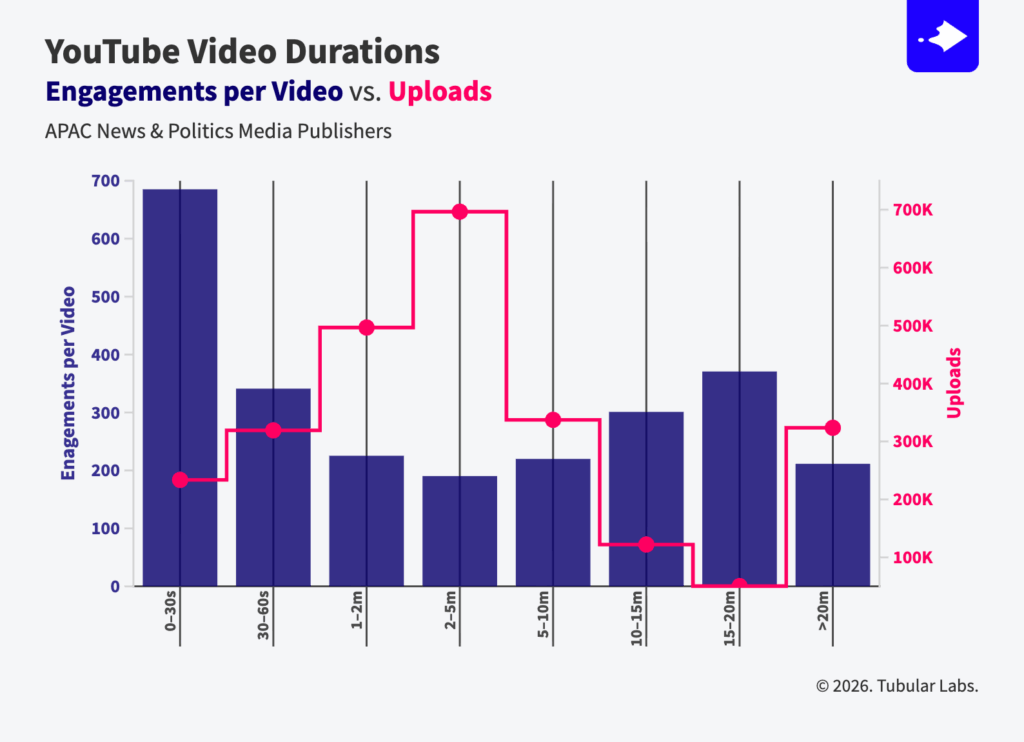
One of the most striking findings in the Q1 2026 data involves the "Goldilocks" problem of video duration. In the APAC region, for instance, there is a clear bifurcation in audience preference.
Data shows that audiences in this region engage most heavily with two distinct formats: ultra-short updates (0–30 seconds) and deep-dive long-form explainers (15–20 minutes). Conversely, mid-length videos—ranging from 2 to 5 minutes—dominate the total volume of uploads, yet they consistently underperform in terms of engagement-per-video.

The Efficiency Trap
The takeaway for newsrooms is sobering: many publishers are spending significant resources producing mid-length content that fails to capture the audience’s attention. By relying on this "middle-ground" strategy, these organizations are sacrificing potential impact for the sake of output. The data suggests that publishers should pivot toward "quick-hit" clips that satisfy the desire for immediate updates, while simultaneously investing in high-quality, long-form journalism that justifies a deeper time commitment from the viewer.
Chronology of Consumption: The LATAM Timing Mismatch
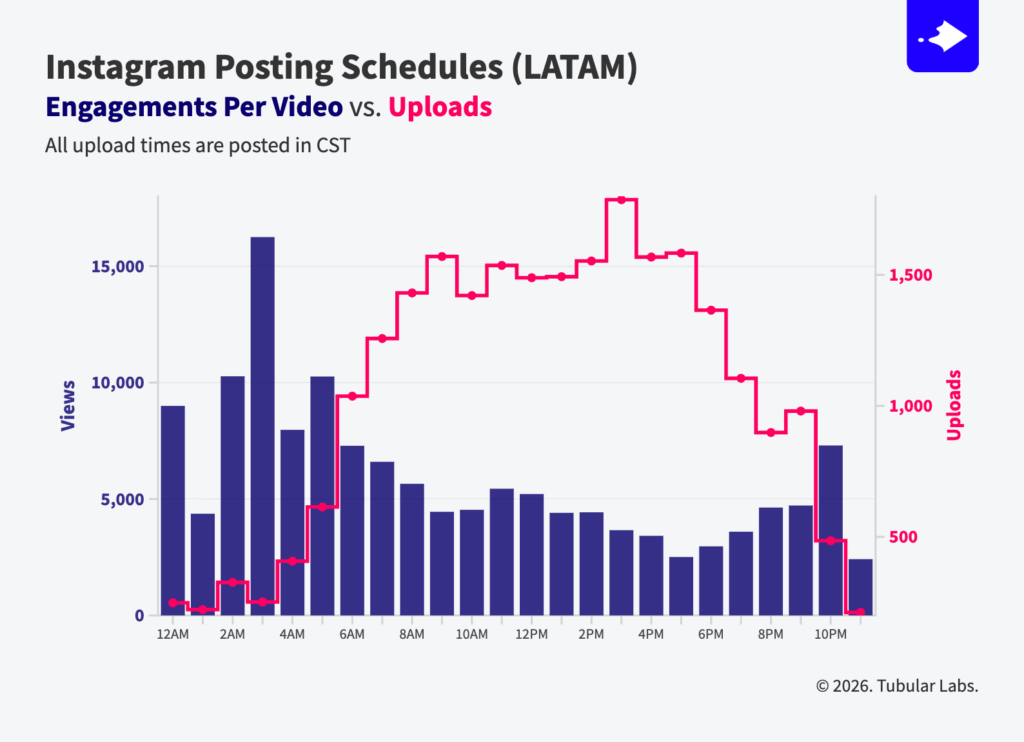
The disconnect between publisher behavior and audience activity is perhaps most visible in the LATAM market. An analysis of Instagram publishing schedules reveals a significant "timing mismatch" that is currently costing publishers valuable engagement.
The 3:00 AM Opportunity
While the majority of news content in LATAM is uploaded during the afternoon "peak" hours of 3:00 PM to 4:00 PM CST, the data indicates that engagement actually peaks in the early morning, specifically between 3:00 AM and 3:59 AM CST.
This presents a strategic arbitrage opportunity. Publishers who shift their distribution schedules to align with these off-peak hours can capture a more captive, early-rising audience while simultaneously avoiding the oversaturated noise of the mid-afternoon news cycle. By testing early-morning releases, newsrooms can potentially boost their visibility and secure higher engagement rates with less effort.
Hashtag Strategy and Brand Authority in EMEA
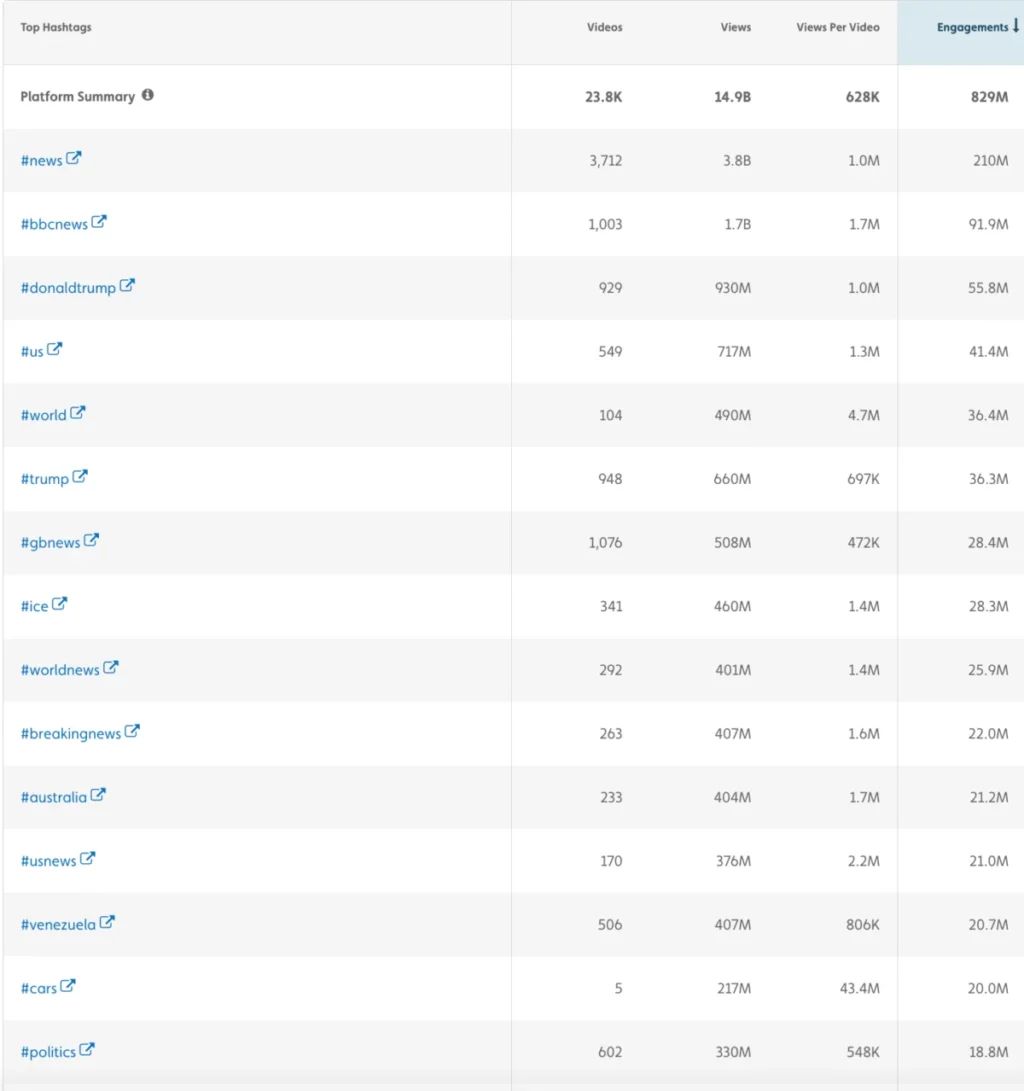
In the EMEA region, the use of hashtags has evolved from a simple organizational tool into a sophisticated mechanism for search engine optimization (SEO) and brand positioning. The most-viewed hashtags on Instagram for News & Politics reflect a trifecta of content strategies:
- Global Flashpoints: Trending tags like #trump, #ICE, and #venezuela demonstrate that audiences are looking for real-time updates on high-stakes geopolitical shifts.
- Branded Authority: The persistence of tags like #bbcnews confirms that users continue to seek out established, trusted sources amidst the sea of decentralized content.
- Cross-Border Discoverability: By pairing country-specific tags with global political topics, publishers are successfully broadening their reach beyond domestic borders, helping international audiences track events with local context.
This multifaceted use of hashtags suggests that publishers are using them not just for categorization, but to assert their authority and increase discoverability in a crowded global marketplace.
The Paradox of Engagement: Serious News and Viral Humor
Perhaps the most counterintuitive finding comes from the US market, where the most popular videos on platforms like TikTok highlight a fascinating divide between "views" and "engagement."
Case Study 1: Breaking News vs. Human Interest
The most-viewed content—such as reports on the car accident involving Anthony Joshua—tends to follow traditional journalistic lines. These breaking news stories, which garnered 180 million views in 30 days, prove that audiences still turn to established newsrooms for high-profile, factual reporting.
Case Study 2: The Engagement Surge
However, the most engaging content—defined by 63.5 million engagements in a single week—often stems from unexpected sources. A prime example is the viral response to a protest interview where a man’s comments on gun ownership were not met with the serious political debate one might expect, but rather with a wave of online mockery and humor.
The implication here is clear: while breaking news drives reach, "social" content drives interaction. On platforms like TikTok, the audience is looking for an emotional or cultural reaction. Publishers who can bridge the gap between hard-hitting news and the cultural zeitgeist—even through subtle, unexpected angles—are the ones who see the highest levels of community participation.
Official Perspectives and Industry Implications
Industry analysts at Tubular Labs emphasize that these patterns are not mere trends but are fundamental shifts in how the public consumes information. "The data clearly indicates that performance is no longer a matter of ‘what’ you cover, but ‘how,’ ‘when,’ and ‘in what format’ you deliver it," says a spokesperson.
The implications for the industry are profound:
- Operational Shifts: Newsrooms must transition from traditional, broadcast-heavy workflows to data-informed, platform-specific content cycles.
- Resource Allocation: With data showing that mid-length content is underperforming, editorial boards must re-evaluate their production quotas and reallocate resources toward the formats that yield the highest ROI (Return on Impact).
- Strategic Agility: The "LATAM timing" example demonstrates that the most successful publishers will be those who use data to identify gaps in the market—often in time slots that competitors have ignored.
Conclusion: Toward a Smarter Newsroom
As we move deeper into 2026, the mandate for news publishers is increasingly clear: the era of "publish-and-pray" is over. Success in the digital age requires a disciplined approach to platform-specific data.
Whether it is adjusting video lengths to fit the APAC preference for the extremes of short or long-form, capturing the early-morning engagement windows in LATAM, or leveraging hashtags in EMEA to build global authority, the path forward is data-driven. The opportunity for publishers is not to publish more content, but to publish smarter—aligning every piece of journalism with the specific, measurable, and evolving behaviors of their global audience.
For those willing to pivot, the rewards are clear: deeper engagement, stronger brand authority, and a more resilient newsroom in an increasingly fragmented digital world.
