
The Great Plateau: Has the Marketing Technology Industry Finally Reached "Peak Martech"?
For fifteen years, the annual release of the Marketing Technology Landscape has been the industry’s most anticipated—and often most overwhelming—tradition. Year after year, the narrative remained consistent: a relentless, upward trajectory of logos, categories, and complexity. It was a digital "Jurassic Park," where the ecosystem grew with such ferocity that it defied the predictions of skeptics and analysts alike.
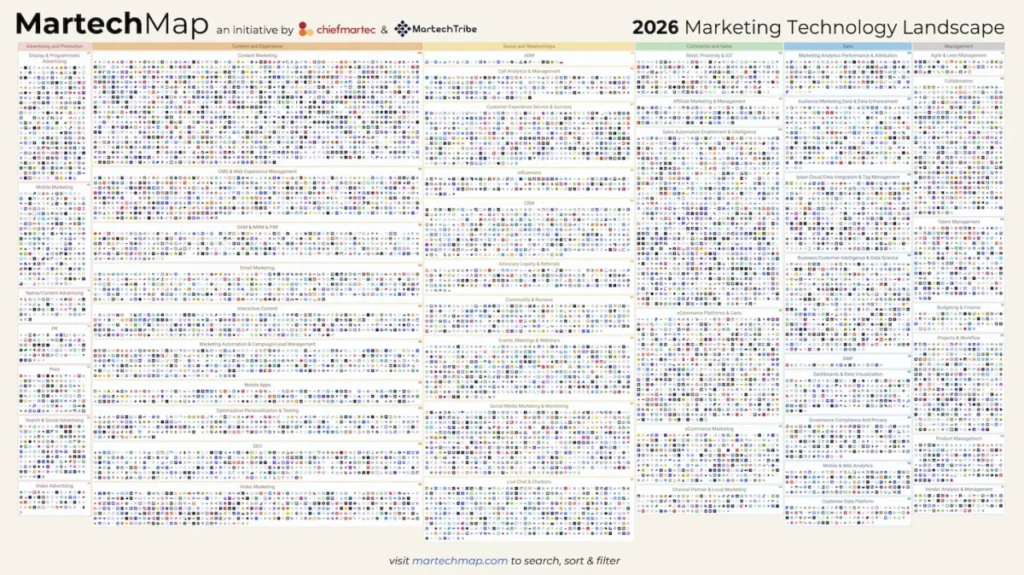
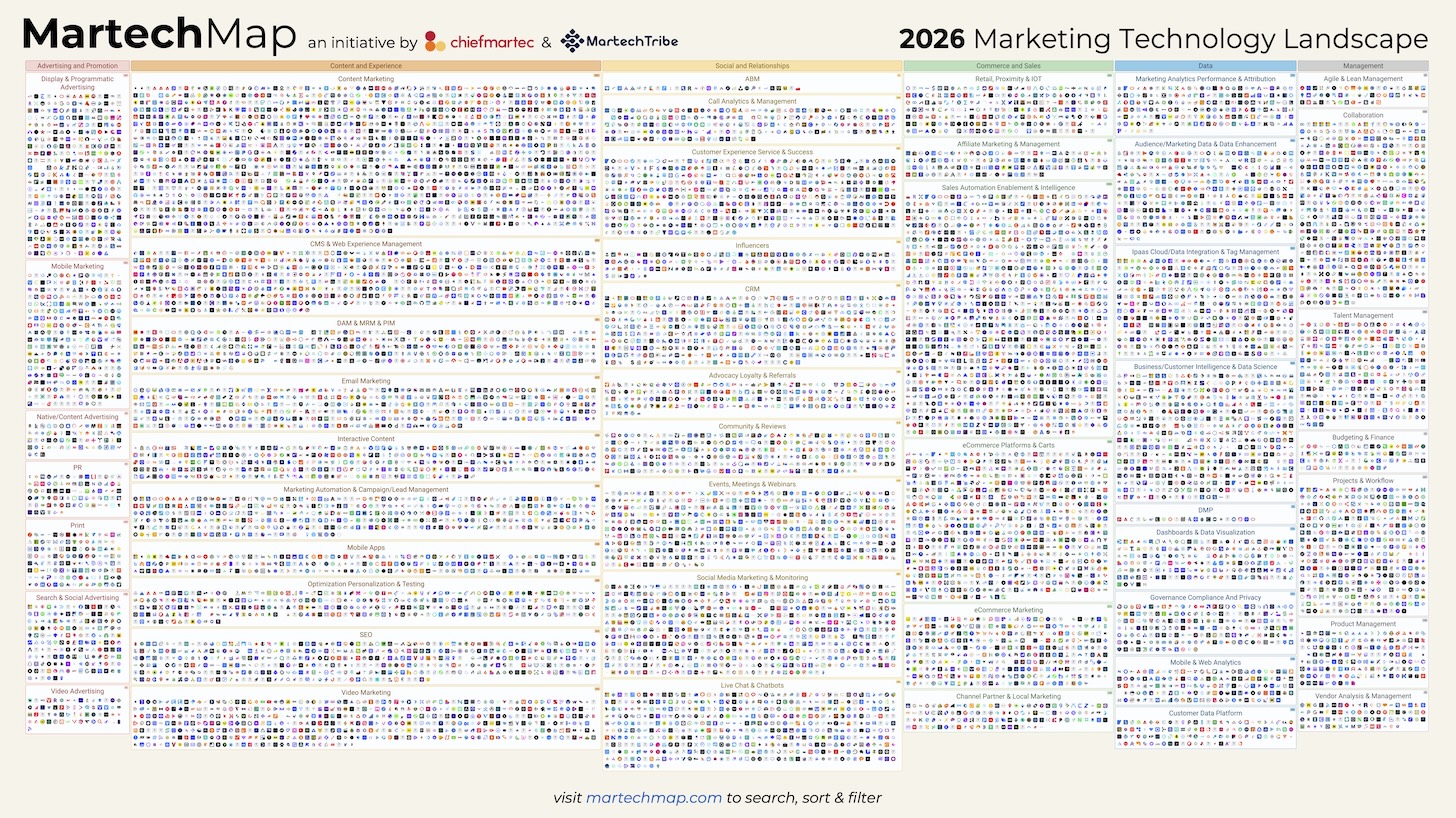
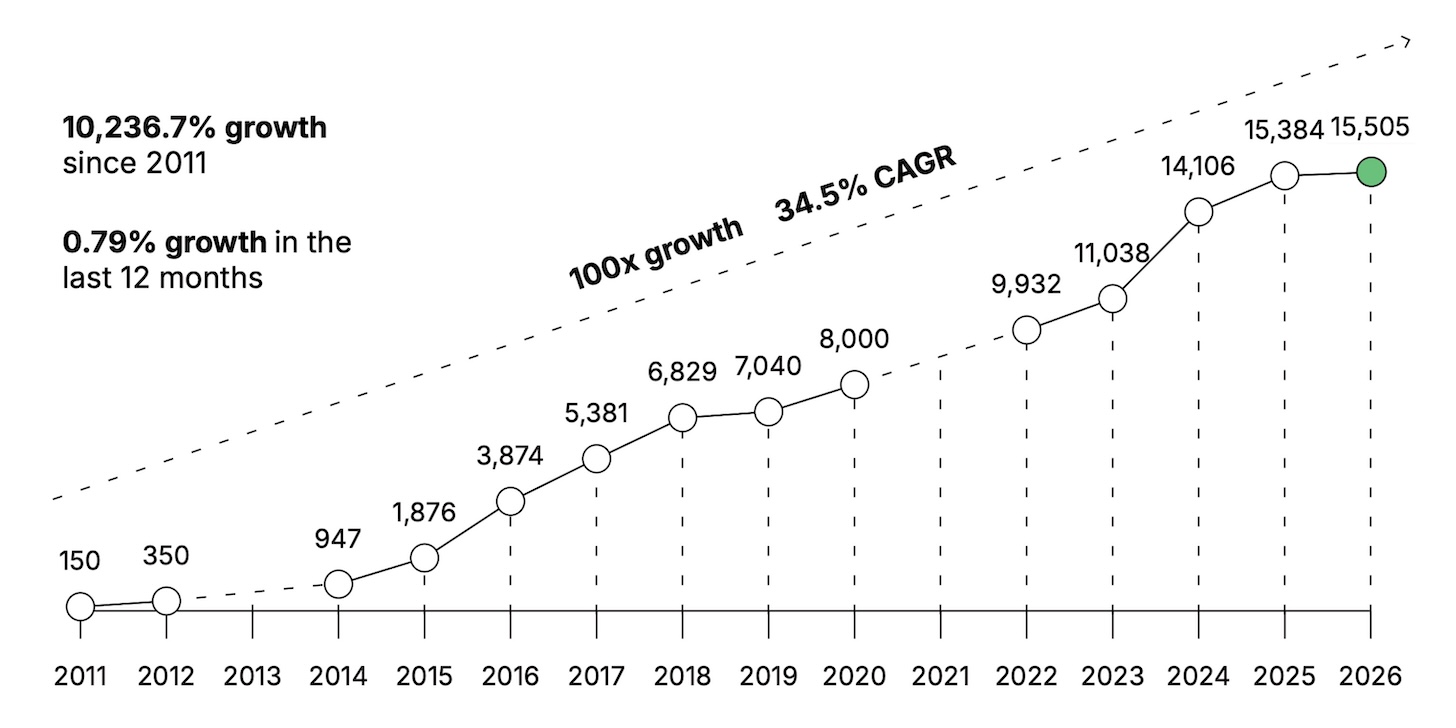
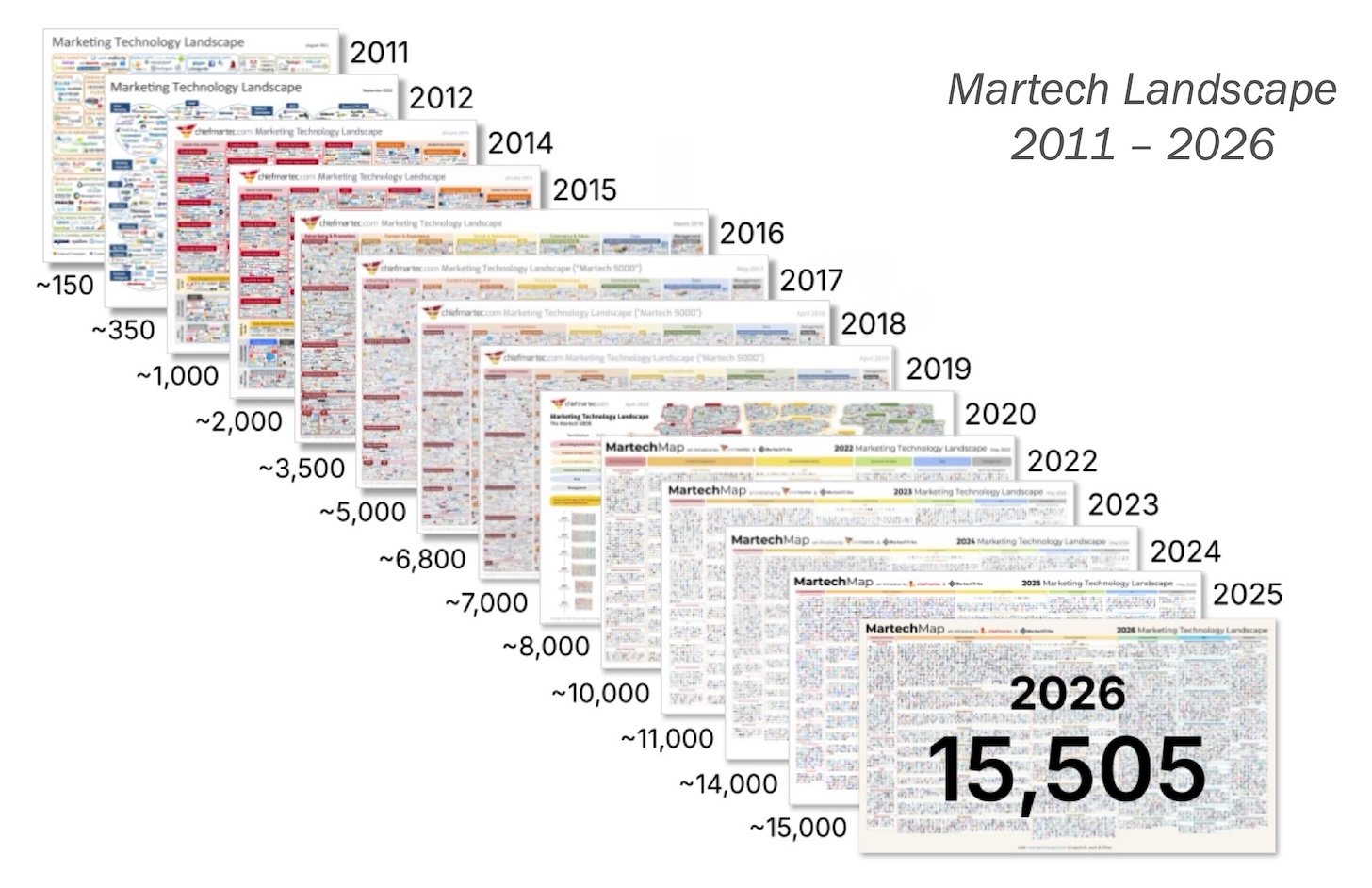
However, the 2026 edition of the landscape, released this month, tells a fundamentally different story. For the first time in over a decade, the growth of the martech ecosystem has effectively ground to a halt. With 15,505 products now cataloged, the industry has seen a net growth of only 0.79% since last year—a stark contrast to the explosive, exponential expansion that defined the previous fifteen years.
The Main Facts: A Market in Equilibrium
The 2026 data confirms what many industry veterans have whispered about in boardrooms: the era of unchecked, runaway expansion is over. After growing from a modest 150 products in 2011 to over 15,000 today, the market has finally hit what many are calling "Peak Martech."
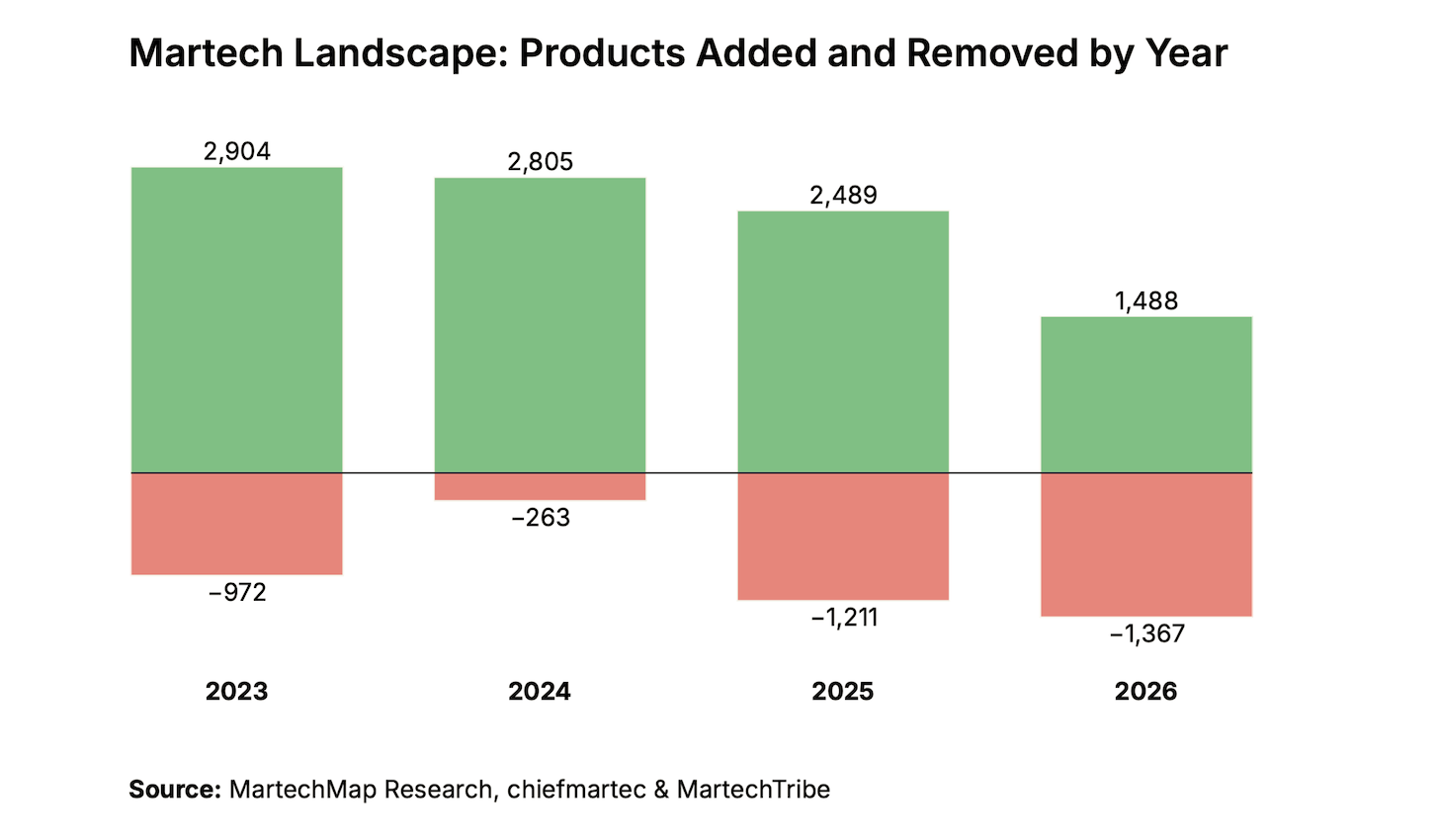
The headline figures are sobering. While the total number of products grew from 15,384 to 15,505, this represents a net increase of only 121 entries. To the casual observer, this might suggest a stagnant market, but beneath the surface, a fierce, high-stakes churn is underway. The "flat" headline masks a dynamic environment where 1,488 new products were introduced, while 1,367 were unceremoniously removed.
This near-perfect balance between creation and destruction suggests that the martech ecosystem has reached a state of mature equilibrium. The "gold rush" era—where a new tool could be launched with a clever landing page and a modest budget—is being replaced by a period of ruthless consolidation and rationalization.
A Chronology of Expansion and Consolidation
To understand the current plateau, one must look at the historical arc of the landscape. Between 2011 and 2025, the industry was governed by the "more is better" philosophy. Every year brought more categories, more niche solutions, and more "existential dread" for the CMOs and IT directors tasked with managing these increasingly fragmented stacks.
2011–2020: The Era of Proliferation
During this decade, the barrier to entry for SaaS development was at an all-time low. Cloud infrastructure, combined with the rapid adoption of digital marketing, created a perfect storm for innovation. Every functional gap in a marketing team’s workflow was viewed as a business opportunity.
2021–2024: The AI Gold Rush
The introduction of generative AI accelerated this trend momentarily, as thousands of "AI wrappers"—thin layers built atop existing LLMs—flooded the market. These entrants inflated the landscape, masking the underlying trend of consolidation that was already beginning to take root among more established players.
2025–2026: The Great Correction
The 2026 landscape marks the end of the AI-fueled expansion. The data shows a 40% decline in new entrants compared to the previous year, while exits increased by 13%. This shift indicates that the market has stopped tolerating "me-too" products. Investors are tightening their purse strings, and corporate buyers are aggressively auditing their stacks to eliminate redundant or underperforming tools.
Supporting Data: Why the "Middle" is Squeezed
The churn statistics provide a compelling look into the health of the industry. The most significant wave of departures—accounting for 51.7% of this year’s exits—consisted of companies from the 2010–2019 SaaS generation. These were not all failed "AI wrappers," but rather established businesses that had achieved a level of traction but failed to reach "inevitability."
The Vulnerability of the Mid-Market
The data suggests a structural squeeze affecting companies in the $1M–$10M revenue range.
- 45.5% of removed products fell within the $1M–$10M revenue bracket.
- 41.2% of exits were organizations with 1–10 employees.
- 38.7% of exits were organizations with 11–50 employees.
This cohort is being squeezed from two directions. From above, massive incumbents are "bundling" AI features directly into their enterprise platforms, rendering niche point solutions unnecessary. From below, agile, AI-native startups are delivering superior results with significantly lower overhead. For the mid-tier martech provider, the cost of customer acquisition (CAC) has become unsustainable, and their feature sets have been commoditized.
The Resurgence of Mature Categories
While the overall landscape is flat, the internal composition is shifting. The most explosive growth is occurring not in "shiny new" categories, but in the bedrock of digital infrastructure:
- CMS & Web Experience Management: Grew by 21.4% (from 504 to 612 products).
- Ecommerce Platforms: Grew by 19.9% (from 547 to 656 products).
- Mobile & Web Analytics: Grew by 11.3%.
This growth is fundamentally driven by the "Agentic Web." For twenty years, websites were designed for two primary audiences: humans and search crawlers. Today, a third audience has emerged: machines. AI search assistants, procurement agents, and "answer engines" now consume website data to make decisions for their human users. Companies are upgrading their CMS and ecommerce platforms to ensure their data is "machine-readable" and optimized for these autonomous agents.
Implications for the Future: Context is King
The shift toward AI-mediated interactions has profound implications for marketing strategy. As more of the customer journey moves into the realm of agents, the role of the marketer is evolving from "creator of pages" to "architect of context."
The Rise of Context Engineering
The quality of an AI agent’s output depends entirely on the context it is fed. Marketers are now prioritizing "context engineering"—the practice of structuring product data, customer history, brand guidelines, and pricing policies so that agents can act as effective, intelligent concierges. The future website will likely feel less like a static repository of pages and more like a collaborative environment where an AI guide helps a customer navigate complex purchase decisions.
The Return to Connectivity
Categories such as iPaaS (Integration Platform as a Service) and Governance & Privacy grew by 8.0% and 7.1%, respectively. This confirms that as AI agents begin to orchestrate actions across multiple systems, the "connective tissue" of the martech stack becomes the most valuable asset. Businesses are no longer just looking for features; they are looking for interoperability and the ability to apply guardrails across a complex, automated ecosystem.
Conclusion: A Mature, More Intentional Market
The 2026 Martech Landscape is not a sign of a dying industry; it is a sign of a maturing one. We have moved past the "Wild West" phase of growth, where the sheer number of logos was the primary metric of success. We are entering an era of optimization, integration, and AI-driven utility.
As the industry reaches this plateau, the winners will not be those who add the most features, but those who best serve the new machine-first reality. For the 15,505 products that remain, the challenge has shifted from "How do we get noticed?" to "How do we remain indispensable?"
The State of Martech 2026 report, which offers a deep dive into these 70+ AI use cases and the shifting landscape, serves as a vital compass for this new era. As the market reaches this equilibrium, one thing is certain: while the number of players may have stabilized, the intensity of the competition has only just begun to rise. The "still waters" of the 2026 landscape truly do run deep.
