
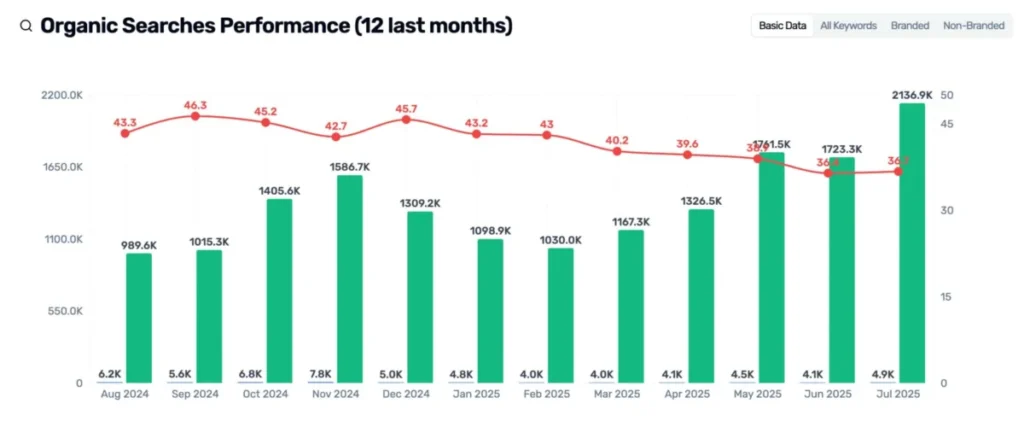
The New Currency of Search: Why Branded Keywords Are the Backbone of AI-Era Visibility
This article was originally published on the GrowthRocks blog by their Chief Strategist.
In the digital marketing landscape, not all search terms are created equal. For years, SEO practitioners have obsessively tracked rankings, clicks, and impressions, often blurring the lines between "organic discovery" and "brand recognition." However, as the search engine results page (SERP) undergoes a fundamental transformation fueled by Artificial Intelligence, the distinction between branded and non-branded keywords has become the most critical metric for any growth-oriented business.
Main Facts: The Great Divide in Search Intent
To understand your digital footprint, you must split your keyword data into two distinct buckets:
- Branded Keywords: These include your company name, product names, executive names, or any variation thereof. They represent "high-intent" users—people who already know who you are, have been influenced by your PR, social media, or word-of-mouth, and are specifically looking for your solution.
- Non-Branded Keywords: These are generic, category-level terms (e.g., "best CRM software," "affordable cloud hosting"). This is where the true SEO battle is fought. These keywords capture demand from users at the early stages of the buyer’s journey who are looking for solutions rather than specific providers.
The fundamental truth is that while non-branded keywords win you discovery, branded keywords signal that your brand is gaining traction. They are the "missing link" between SEO performance and overall brand impact.
The Google Curiosity Index: Measuring Brand Gravity
Before analyzing keyword data, one must understand the Google Curiosity Index. While not an official Google metric, this concept—pioneered by GrowthRocks—tracks how often people search for your brand name over time.
The Curiosity Index serves as the ultimate barometer for your offline and non-SEO marketing efforts. Have your PR campaigns been effective? Did that industry conference move the needle? Is your social media content resonating? The Curiosity Index captures the ripple effect of these activities on your digital presence, providing a holistic view of your brand’s health that traditional rank tracking fails to capture.
Attribution: Who Owns the Results?
Accountability is the bedrock of growth. In many organizations, SEO teams inadvertently take credit for branded search traffic, which distorts the reality of their performance. If your brand is growing because of a massive PR blitz, that shouldn’t be counted as a "win" for an SEO content strategy.
- Brand, PR, and Communications Teams: These departments are responsible for driving branded searches. Their KPI is brand awareness and "Curiosity."
- SEO Teams: These teams are responsible for driving net new traffic from non-branded, intent-based keywords. Their KPI is market penetration and capturing "cold" demand.
By separating these metrics, leadership teams can stop attributing the natural growth of a brand’s fame to the technical optimizations of the website. It ensures that SEO efforts are judged on their ability to capture new audiences, not just harvest the existing ones.
Branded Keywords in the Post-AI Era: A New Paradigm
If you believe that SEO is purely about technical site structure, you are missing the seismic shift caused by Large Language Models (LLMs) like Google’s AI Overviews, Perplexity, and ChatGPT.
Recent research from Ahrefs highlights a startling trend: Brand signals are now the strongest predictors of inclusion in AI-generated summaries. While traditional SEO relies on backlinks and domain authority, AI models prioritize "familiarity."
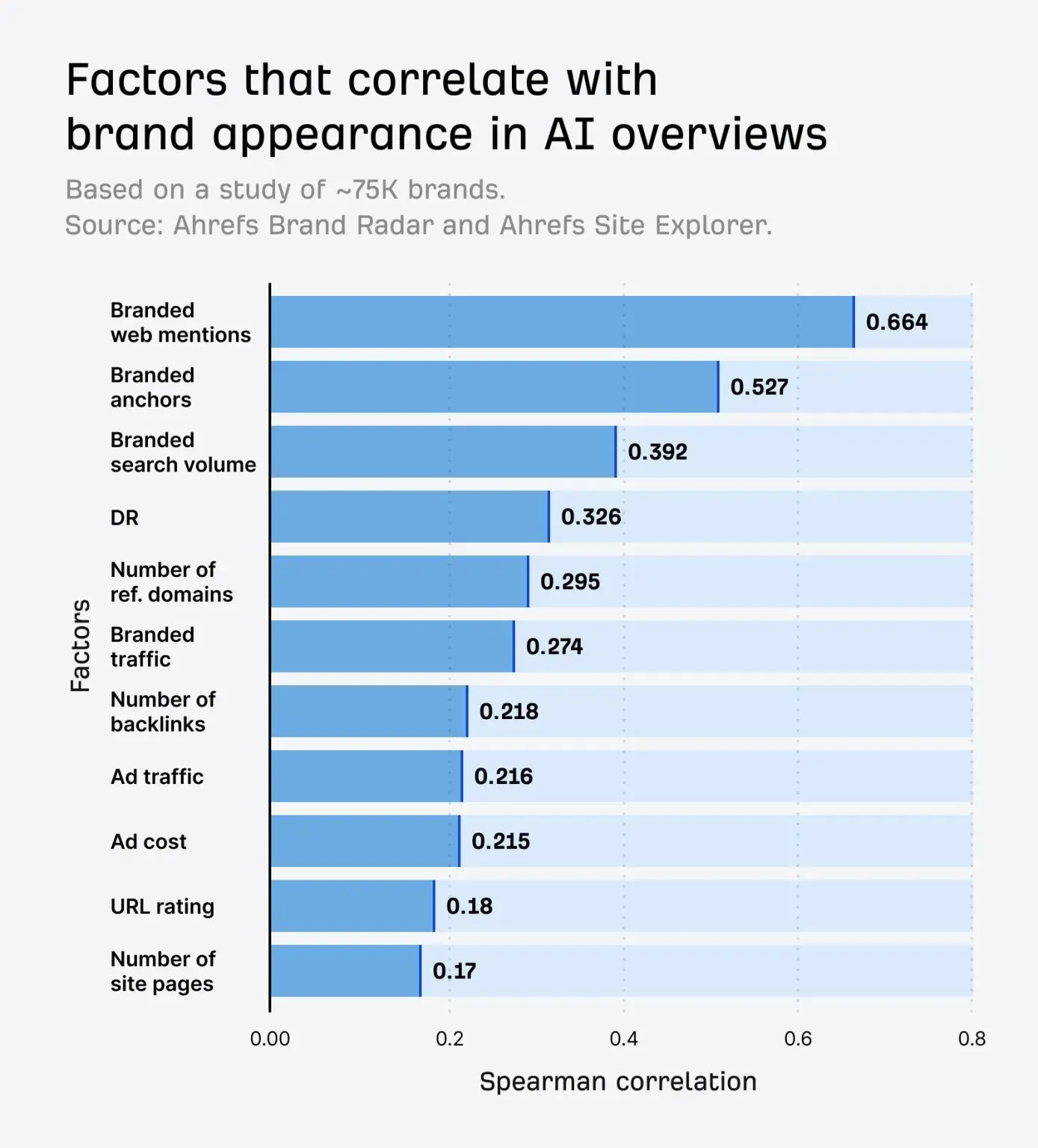
Why AI Favors the Known
AI models act like sophisticated curators, not just indexers. They gravitate toward entities that have:
- High Search Volume: A proxy for popularity and trust.
- Consistent Context: A brand that is consistently mentioned alongside specific topics creates a strong "semantic map" in the model’s training data.
- Positive Brand Sentiment: As these models learn from human interactions, they prioritize entities that users trust.
In the AI-dominated future, branded keywords are a shortcut to becoming an "AI-cited" authority. It is no longer about "gaming the system"; it is about giving the algorithm exactly what it is trained to trust: proven, well-known, and consistent entities. If you are not a recognized name, you are invisible to the AI that now provides the answers to your customers.
The Domain Name Connection
There is a profound semantic tie between branded keywords and your domain name. Many users bypass the URL bar entirely, typing your company name directly into Google. This is "brand interest masquerading as SEO traffic."
Pro Tip: Check your Google Search Console (GSC) for queries where your brand is the primary search term. If you see a massive spike in branded traffic without a corresponding increase in marketing spend, you have achieved "Brand Gravity."
Chronology: The Evolution of Search Strategy
- Pre-2015: The "Keyword Stuffing" era. SEO was about technical manipulation and backlink quantity.
- 2015–2023: The "User Intent" era. Content became king, and SEO teams focused on matching search queries with helpful, long-form content.
- 2024–Present: The "Entity & Authority" era. AI models now filter the internet based on established reputation. Branded search volume has replaced backlink quantity as the primary indicator of a site’s "trustworthiness."
Supporting Data: Why Volume and Volatility Matter
Tracking the volume and volatility of branded search provides three key insights:
- Market Penetration: Are more people learning about you over time?
- Campaign Efficacy: Did your last product launch actually create "buzz" that translated into search intent?
- Sentiment Monitoring: Sudden, unexpected volatility in branded search can be an early warning sign of a PR crisis or a competitor’s aggressive marketing campaign.
Implications for Modern Marketing Teams
The shift toward AI-driven search necessitates a change in how we report results. If your SEO reporting dashboard doesn’t segment branded vs. non-branded traffic, you are flying blind.
- Stop mixing the data: If your branded traffic is growing, celebrate it as a win for your marketing and PR teams, but don’t let it mask a decline in non-branded SEO performance.
- Invest in "Brand Signals": To win in the AI era, you must increase your brand’s footprint outside of search. PR, podcasts, influencer partnerships, and speaking engagements are now SEO activities.
- Automate your segmentation: Because Google Search Console does not natively segment these, use custom tools—such as the GrowthRocks OS or custom Data Studio templates—to visualize the split automatically.
The Future of SEO: From Rankings to "Brand Gravity"
The ultimate goal of a modern marketing strategy is no longer just to rank at the top of a list of ten blue links. It is to become a "default" in the minds of your customers.
When a user skips the "search" phase and types your name directly into the search bar, you have successfully moved from SEO to Brand Gravity.
Your SEO strategy should not just be about being found; it should be about being remembered. In the age of AI, where algorithms act as the gatekeepers of information, those who are remembered are the ones who get cited. The brands that invest in building their "Curiosity Index" today will be the ones that own the AI-generated search results of tomorrow.
Remember: SEO brings them to your door, but it is your brand that convinces them to walk inside. Stop counting clicks, and start measuring the gravity of your brand.
