
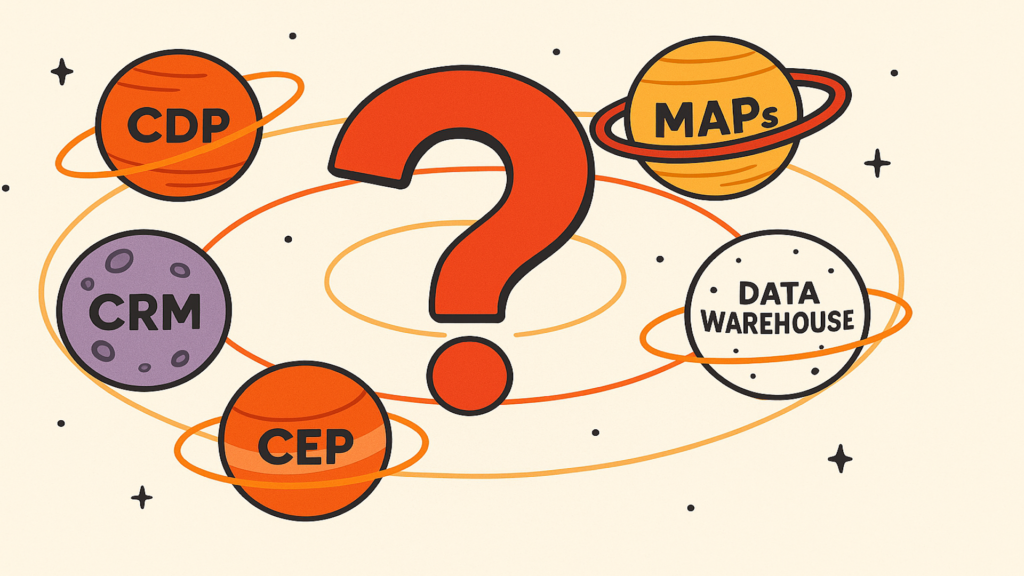
The Martech Trap: Why AI and Shiny Tools Are Breaking Modern Marketing Strategy
In the modern enterprise, the weekly inbox ritual has become predictable. A new software demonstration arrives with the promise of fixing a growth metric you never knew was broken. Whether it is an AI-powered writing assistant, a predictive lead-scoring layer, or an agentic workflow automation tool meant to run your conversion funnel while you sleep, marketing teams are routinely saying "yes" to too many inputs.
In doing so, these organizations have inverted a fundamental operational truth: tools should be a downstream decision, not an upstream one.
Too many marketing departments reverse that order. They acquire enterprise capabilities and shiny software first, then scramble to build a cohesive strategy around them. The result is predictable: more noise, more fragmented dashboards, a proliferation of competing data silos, and ultimately, less clarity about what is actually driving revenue.
Main Facts: The Anatomy of Martech Overload
At its core, the modern marketing technology stack has expanded beyond human management capabilities. Industry data indicates that the average mid-to-large enterprise utilizes dozens—sometimes hundreds—of discrete software tools. Yet, instead of creating operational synergy, this software sprawl introduces critical vulnerabilities:
- Data Fragmentation: Multiple overlapping analytics platforms rarely triangulate the truth; instead, they generate conflicting versions of reality, allowing teams to cherry-pick metrics that support pre-existing beliefs.
- Data Drift: Every additional system introduces a new dataset that fails to reconcile with legacy tools, requiring teams to manually massage data before executive leadership meetings.
- Strategic Ambiguity: Buying software to solve a vague problem ("We need better growth") invariably results in expensive infrastructure that obscures operational bottlenecks rather than clearing them.
When a marketing team hits a growth plateau, the reflexive reaction is often, "What tool do we need to fix it?" However, industry veterans argue that the starting point must be defining the operational objective and identifying precisely what is creating friction. A software purchase only becomes valuable once the exact problem has been diagnosed.
Chronology: The Evolution from Passive Tools to Autonomous AI
To understand how marketing operations reached this crossroads, it helps to examine the chronological shift in software capabilities:
Phase 1: The Era of Passive Software (Pre-2020)
Traditional marketing technology additions were fundamentally passive. An enterprise might purchase an email service provider, a CRM module, or a basic web analytics tracker. These systems sat dormant until a human operator deliberately logged in, executed a query, or built a campaign. If a tool went unused, it simply represented dead overhead; it did not actively disrupt the underlying business logic.
Phase 2: The Proliferation of Multi-Dashboard Ecosystems (2020–2023)
As cloud architectures matured, point solutions multiplied. Marketing stacks fractured into specialized tools for attribution, social listening, content optimization, and customer data platforms (CDPs). Organizations began buying software reactively, resulting in bloated tech stacks where teams spent more time reconciling data between platforms than executing campaigns.
Phase 3: The Autonomous AI Revolution (Present Day)
The introduction of enterprise artificial intelligence fundamentally changed the risk profile of software acquisition. Unlike passive legacy tools, AI platforms actively score leads, generate outbound copy, dynamically route inquiries, adjust programmatic bids, and orchestrate workflows with minimal human oversight.
AI does not just sit in the background—it moves quickly, projects high confidence, and possesses the dangerous capacity to be profoundly wrong at scale.
Supporting Data & The Danger of AI-First Procurement
The integration of artificial intelligence into enterprise stacks has magnified the cost of poor procurement ordering. When organizations deploy AI without a foundational strategy, the results are catastrophic for operational efficiency.
1. Lead Scoring Without Strategic Definition
Implementing a predictive lead-scoring model without a strict, cross-departmental definition of an ideal customer profile (ICP) does not provide clarity. It simply generates a numerical score, attaches a veneer of mathematical certainty to it, and potentially automates downstream sales actions based on a fundamentally flawed premise.
2. Generative Content Without a Positioning Strategy
Similarly, deploying generative AI writing tools without a rigorous brand positioning strategy does not produce differentiated messaging. Instead, it generates polished, grammatically correct copy that says nothing distinctive because there is no proprietary point of view behind the prompt.
The Core Verdict: AI does not fix strategic ambiguity. It executes strategic ambiguity faster, wrapping flawed operational premises in enough polish to look credible until the quarterly pipeline numbers reveal the truth.
Official Perspectives and Operational Frameworks: The Strategic Audit
To combat tool-driven sprawl, disciplined marketing leaders are redefining how software audits are conducted. Rather than treating an audit as a general housekeeping exercise to justify new budgets, organizations are running structured SWOT analyses against their strategic requirements.
Strengths: Identifying Load-Bearing Systems
Which tools are truly essential to the strategy you have defined? Clean data capture, consistent user adoption, and reliable cross-system integration matter far more than how impressive a platform looked during a vendor sales demo. Organizations must retain the systems that work, even if they lack the excitement of newer market entrants.
Weaknesses: Uncovering Workarounds
Where does the current technology stack fail to answer the strategic questions leadership is asking? The best indicator of stack failure is the workaround: the shadow spreadsheet someone maintains because the primary dashboard cannot be trusted, or the manual data export nobody has automated. Every workaround represents a critical question your infrastructure cannot answer.
Opportunities: Filling Strategic Gaps
Where does the overarching business strategy require a capability the organization genuinely lacks? This is the only scenario where a software purchase is justified. Notice the sequence: the strategy identifies the capability gap first, and the tool search follows as a downstream necessity.
Threats: Compounding Complexity
What happens to operational clarity as more systems are added? Without strict governance, ownership blurs, data contradicts itself, and system complexity compounds exponentially.
Practical Implementation: Shifting the Language of Procurement
To prevent unnecessary software acquisition, marketing leaders must fundamentally alter how proposals are framed within the enterprise. Vague requests must be replaced by precise operational diagnoses.
- Reject: "We need to buy an AI content generation tool."
- Adopt: "Our sales cycle stalls during the technical evaluation phase because we lack a scalable way to produce persona-specific comparison documentation for our target accounts."
- Reject: "We should add predictive lead-scoring software to our stack."
- Adopt: "Sales and marketing teams fundamentally disagree on lead qualification criteria, and that misalignment is directly suppressing pipeline velocity."
Disciplined organizations evaluate their software stack against strict strategic criteria on a scheduled cadence. They retire tools that no longer serve a measurable business objective, require a clearly defined owner and success metric before approving any purchase, and establish mandatory reevaluation dates upfront.
If a software platform cannot be explicitly tied back to a strategic business outcome after a trial period, it is operational noise—regardless of how compelling the initial vendor demonstration was.
Implications for Enterprise Leadership
The relentless push by software vendors for "AI-first" enterprise transformation ignores the foundational realities of business growth. For chief marketing officers and technology leaders, the path forward requires structural discipline:
- Enforce Governance: Establish a cross-functional governance board that evaluates technology requests through the lens of existing strategic bottlenecks rather than feature novelty.
- Audit for Deletion: Treat software subtraction with the same rigor as software addition. Removing redundant or confusing dashboards often yields immediate clarity gains compared to buying yet another integration layer.
- Prioritize Human Insight: Ensure that AI systems are constrained by strict guardrails, human-in-the-loop validation, and unambiguous operational definitions.
Ultimately, technology should serve as an amplifier of human strategy, not a substitute for it. By ensuring that strategy always precedes software selection, enterprises can eliminate costly digital noise, protect their data integrity, and build marketing engines designed for sustainable, measurable growth.
