
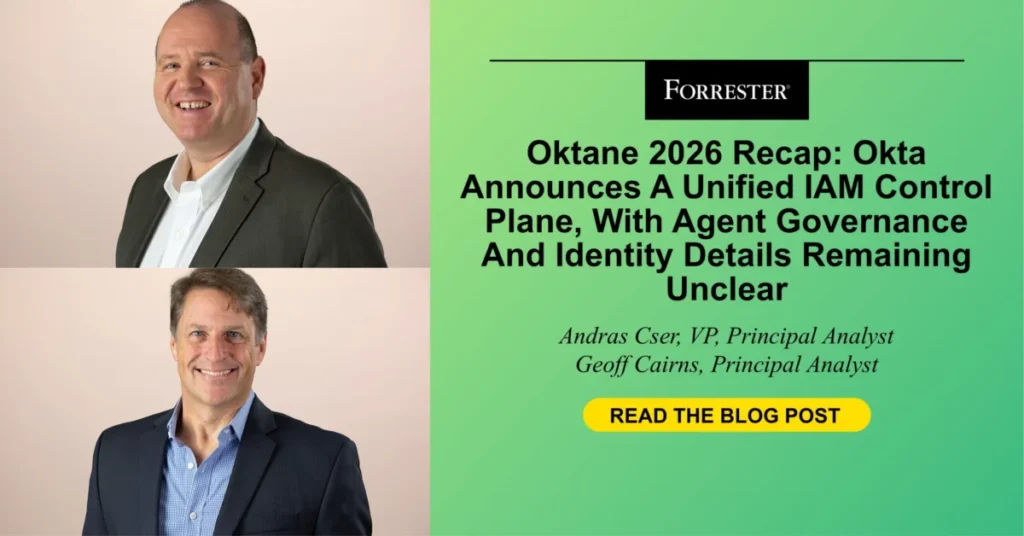
Securing the Autonomous Frontier: Inside Okta’s Bold Vision for AI Agent Identity at Oktane 2024
LAS VEGAS — As enterprise artificial intelligence transitions from static chatbots to autonomous, goal-oriented agents capable of executing complex workflows, a massive security blind spot has emerged. Who—or what—is authenticating these digital workers? How do systems ensure an AI agent acts within its authorized boundaries when interacting with other agents, databases, and third-party APIs?
At the annual Oktane conference in Las Vegas, identity and access management (IAM) giant Okta stepped forward to answer these pressing questions. Unveiling an ambitious, sweeping strategy to transform its platform into a universal control plane for AI agents, Okta signaled its intent to lead the charge in the nascent field of AI security. The announcements, threaded through keynotes and breakout sessions, focused heavily on agent identity, runtime authorization, agent-to-agent interactions, and unprecedented ecosystem collaboration.
However, as industry analysts and enterprise leaders dissect the roadmap, it is clear that while Okta’s vision is visionary, the path to universal agent security is fraught with technical hurdles, structural fragmentation, and unresolved economic models.
Main Facts: The Blueprint for a New Identity Paradigm
The core of Okta’s announcement centers on unifying human, nonhuman identity (NDI), and agentic identity management into a single, comprehensive control plane. Traditional IAM models, built around human users who log in with credentials, maintain sessions, and perform manual actions, are ill-equipped for the hyper-dynamic, autonomous nature of AI agents.
According to Okta, agent authentication and session management must function fundamentally differently than human workflows. Dynamic AI agent authorization—driven by real-time intent and situational context—took center stage during the product demonstrations.
To achieve this scale, Okta recognized that no single vendor can monopolize or unilaterally secure the agent ecosystem. This realization spurred the launch of the Blueprint Alliance, a newly formed coalition of technology vendors specializing in various facets of enterprise security and AI infrastructure. The Blueprint Alliance is designed as a multivendor, open IAM architecture for AI agents, encompassing four critical pillars:
- Agent governance
- Identity management
- Runtime authorization
- Interoperability components
By laying the groundwork for an open-standards framework, Okta aims to prevent the fragmentation that has historically plagued early-stage enterprise technology markets, inviting competitors and collaborators alike to build interoperable identity infrastructures.
Chronology: How Oktane Unfolded the AI Strategy
The trajectory of Okta’s AI security pivot became clear over a meticulously orchestrated multi-day event in Las Vegas, highlighting a clear timeline of strategic shifts:
- Day One Keynote: Okta CEO Todd McKinnon took the stage to deliver the opening address, anchoring his message in the necessity of open standards and industry-wide collaboration. McKinnon acknowledged that scaling AI safely requires "coopetition," setting the philosophical tone for the conference.
- The Blueprint Alliance Reveal: Following the keynote, Okta officially announced the Blueprint Alliance, bringing together a diverse array of cross-industry technology partners to establish foundational norms for agent governance and identity management.
- Technical Deep Dives and Specifications: Mid-week sessions detailed Okta’s active collaboration with Anthropic and other ecosystem stakeholders. Together, they advanced the Cross App Access extension and enterprise-managed access specifications—now integrated into the MCP (Model Context Protocol) authorization extensions. These are built on OAuth 2.1, though they await formal ratification by an official standards body.
- Real-World Validation: In the final stretch of the conference, Okta hosted panels featuring cybersecurity and IAM leaders from major North American financial institutions. These practitioners shared real-world accounts of navigating the complexities of implementing IAM for AI agents within highly regulated environments.
Supporting Data and Technical Architecture
To understand the weight of Okta’s announcements, one must examine the underlying mechanics of modern identity protocols and where Okta fits within the broader technology stack.
The convergence of human and machine identities has long been a holy grail in cybersecurity. Nonhuman identities—such as service accounts, API keys, and serverless functions—have rapidly outpaced human identities in volume within enterprise environments. AI agents represent the next exponential leap in this trend, capable of spawning sub-agents, executing autonomous multi-step financial transactions, and querying proprietary corporate data lakes without human oversight.
Okta’s integration with Anthropic’s MCP authorization extensions marks a vital step toward standardizing how agents request and receive permissions across disparate applications. By utilizing extensions derived from OAuth 2.1, developers can theoretically pass trust context securely between an AI model, an agent provider, and a downstream service provider.
Furthermore, Okta is branching into Cloud Infrastructure Entitlement Management (CIEM) by introducing AWS admin identity analysis paired with access request management. This allows security teams to audit and restrict the blast radius of administrative permissions granted to automated workloads in the cloud.
Official Responses and Industry Perspectives
Reaction from the broader cybersecurity and analyst community has been a mixture of cautious optimism and rigorous scrutiny.
During the conference keynotes, executive leadership emphasized that the success of Okta’s strategy depends entirely on industry-wide convergence. "No vendor can govern and secure the agent ecosystem alone," McKinnon stated repeatedly, urging competitors to adopt open protocols rather than locking customers into proprietary silos.
Financial sector panelists at Oktane echoed these sentiments, noting that their institutions are already deploying custom-built AI agents to handle customer service, fraud detection, and portfolio analysis. For these organizations, the lack of standardized agent identity frameworks represents an unacceptable operational risk. They welcomed Okta’s push toward centralized visibility, noting that auditing an AI agent’s "chain of thought" and intent is just as critical as logging its network traffic.
However, independent analysts have pointed out significant gaps in Okta’s current execution timeline, injecting a dose of realism into the corporate enthusiasm.
Implications: Challenges and Future Opportunities
While the vision presented at Oktane is undeniably forward-thinking, enterprise architects and Okta stakeholders must weigh several critical challenges and emerging opportunities as this strategy rolls out over the coming years.
The Challenges Ahead
- The SPIFFE Gap: The Secure Production Identity Framework for Everyone (SPIFFE) has rapidly emerged as the de facto industry standard for managing nonhuman identities in cloud-native environments. Currently, Okta lacks a full SPIFFE agent identity implementation—unlike specialized competitors such as Aembit or Teleport. While Okta has added SPIFFE-based authentication support to its roadmap, it is not scheduled to land until Q4 2026, leaving a notable window of vulnerability.
- Universal Know-Your-Agent (KYA) Standards: Much like KYC (Know Your Customer) regulations in banking, the industry desperately needs KYA frameworks to verify the origin, training provenance, and behavioral boundaries of third-party AI agents. As of Oktane, Okta has not disclosed plans for a universal KYA framework.
- Platform Fragmentation: Okta currently operates two distinct stacks: Okta for workforce IAM and Auth0 for customer IAM (CIAM). These platforms maintain different session management and AI agent management capabilities. Maintaining two separate architectures increases Okta’s internal product development costs and places a financial burden on enterprises striving to build a unified, interoperable workforce and CIAM infrastructure.
- Unclear Fine-Grained Authorization: Okta’s strategy for integrating its existing fine-grained authorization (FGA) solutions into the new AI agent framework remains ambiguous. Enterprises need clarity on how granular, attribute-based access controls will be enforced at runtime when an agent requests access to sensitive corporate records.
- Monetization Uncertainties: Traditional IAM pricing models rely heavily on Monthly Active Users (MAUs). In an agentic future where millions of ephemeral AI sub-agents spin up and spin down in seconds to perform micro-tasks, MAU pricing is obsolete. Okta has yet to finalize its pricing model for IAM for AI agents, though industry consensus points toward a transaction-based or consumption-based pricing structure.
The Opportunities
Despite these hurdles, Okta is uniquely positioned to capture massive market share if it executes its roadmap effectively.
- Intent Discovery and Authorization: Okta has a golden opportunity to pioneer the foundations of intent discovery and runtime authorization decision-making—domains where mature industry standards are virtually nonexistent today.
- Vendor-Agnostic Reference Architectures: By leveraging the momentum of the Blueprint Alliance, Okta can lead the creation of vendor-agnostic reference architectures, helping global clients harmonize human, nonhuman, and agentic AI identities under a single roof.
- Establishing Trust Chains: Successfully bridging human-to-agent trust (via OAuth 2.0) and agent-to-service provider trust will dramatically accelerate safe enterprise AI adoption. If enterprises trust that Okta can securely leash their autonomous agents, the friction holding back enterprise generative AI deployments will largely dissolve.
Conclusion
Okta’s Oktane conference made one thing abundantly clear: the perimeter of enterprise security has expanded beyond human employees and static servers to include autonomous, thinking digital agents. By introducing the Blueprint Alliance, pushing into MCP authorization extensions, and laying plans for a unified identity control plane, Okta has staked its claim as a primary architect of the AI security era.
Yet, bridging the gap between an ambitious vision and a bulletproof reality will require navigating complex standard battles, closing technical gaps like SPIFFE integration, and solving the thorny puzzle of agent pricing. For enterprise leaders navigating the chaotic transition to an agent-driven workforce, Okta’s roadmap provides a compelling glimpse into the future—and a stern reminder that securing the AI frontier has only just begun.
