
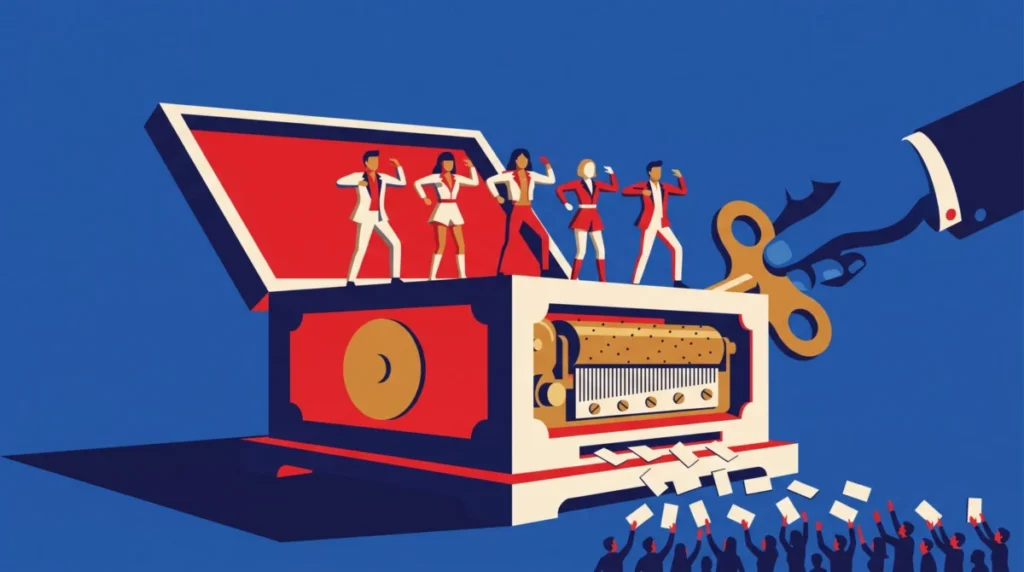
The Industrial Engine of Global Pop: Decoding the K-Pop Phenomenon
K-pop is more than a musical genre; it is a meticulously engineered cultural export that has redefined the relationship between entertainment agencies, performers, and global audiences. Originating from South Korea, this production system—defined by rigorous training, vertically integrated management, and hyper-engaged fan communities—has transformed Seoul into a global powerhouse of the recorded music industry. By 2025, South Korea ranked as the seventh-largest music market in the world, with album exports exceeding $301.74 million, marking a transition from a regional curiosity to a dominant force in international media.
The Architecture of the Idol System
At the heart of K-pop lies the "idol system," a structured pipeline formalized between 1997 and 2010. This ecosystem is dominated by four industry giants—SM Entertainment, YG Entertainment, JYP Entertainment, and HYBE—which operate as comprehensive management hubs.
The process begins years before a public debut. Young trainees are recruited and subjected to intense, structured programmes covering vocal performance, dance, multiple languages, and media etiquette. Once a group is ready for the market, they are bound by exclusive, long-term contracts that assign management rights, creative direction, and commercial negotiation power entirely to the agency.
The rigidity of these contracts has become a subject of intense legal scrutiny. A landmark case in 2025 involving the group NewJeans highlighted the tension between agency control and performer agency. When the HYBE subsidiary ADOR sought a court injunction to prevent NewJeans members from signing independent advertising deals, citing potential brand dilution, the Seoul Central District Court ultimately ruled in favor of the agency, affirming that existing contracts remained binding through 2029.
Chronology: From Local Roots to Global Hegemony
The evolution of K-pop is a century-long narrative punctuated by key technological and cultural shifts:
- 1907–1991: The dawn of commercial recording in Korea. For decades, the industry remained largely insulated from global trends.
- 1992–1996: The "Seo Taiji and Boys" era marked a watershed moment, shifting the focus to a teenage demographic and leading to the abolition of the prior review system for sound recordings.
- 1997–2010: The systematization of the trainee programme. The "Idol System" becomes the industry standard.
- 2012: The "Gangnam Style" inflection point. Psy’s viral hit became the first YouTube video to cross one billion views, forcing a global rethink of how digital virality is measured.
- 2016–2020: The rise of global supergroups like BLACKPINK and BTS, who began dominating the Billboard charts and collaborating with Western songwriters.
- 2024–2026: The maturation of the genre. Rose’s "APT." (with Bruno Mars) topped global charts as a non-English language hit, and the soundtrack for the film KPop Demon Hunters outperformed Western pop stars on streaming platforms, signaling the genre’s total integration into mainstream global entertainment.
Supporting Data: The Economics of Fandom
K-pop’s commercial success is driven by a unique model that treats fans as a paying community rather than a passive audience. This is best exemplified by the "comeback" cycle. Artists release mini or full albums supported by a barrage of music videos, television appearances, and world tours.
Physical sales remain a critical revenue stream, bolstered by the "photocard" phenomenon. By shipping albums in multiple versions—each containing randomized, collectible cards of individual members—agencies incentivize bulk purchasing. The results are stark: in 2025, South Korean acts occupied 12 of the IFPI’s 20 best-selling album slots, with Stray Kids’ Karma alone moving 3.49 million units.
Digital engagement is equally concentrated. HYBE’s Weverse platform, which hosts artist communities, live streams, and e-commerce, reached 11.2 million monthly active users in late 2025. Crucially, about 90% of the artists on Weverse are signed to labels outside of HYBE, illustrating the company’s evolution into a digital infrastructure provider.
Official Responses and Regulatory Challenges
The explosive growth of K-pop has not been without friction. Regulatory bodies have increasingly focused on the fairness of the industry’s business practices.
In August 2024, the Korea Fair Trade Commission (KFTC) issued fines against Weverse Company, SM, YG, and JYP for their online purchase policies, following a multi-year investigation into whether the bundling of photocards with albums constituted unfair "tie-in" sales. While the fines were modest, the message was clear: the government is watching.
Furthermore, environmental advocacy groups like Kpop4planet have successfully pressured the industry regarding the massive plastic waste generated by the mass-purchasing of physical albums. Agencies are now forced to navigate a landscape where social responsibility is increasingly linked to brand equity.
Implications for Media and Advertising
For media planners and marketers, K-pop serves as the ultimate "stress test" for modern attention measurement. The genre’s ability to drive sustained engagement across platforms—often bypassing traditional Western gatekeepers—has disrupted established industry metrics.
The YouTube-Billboard Schism
A major shift occurred on January 16, 2026, when YouTube ceased providing data to Billboard for its charts. Lyor Cohen, YouTube’s global head of music, criticized Billboard’s formula for prioritizing subscription-based streams over ad-supported ones. This move significantly altered the chart landscape in the US, as K-pop’s massive ad-supported YouTube audience no longer translates into the same chart weight it once did.
The Netflix Effect
The success of the animated film KPop Demon Hunters demonstrated that the "K-pop sound" is no longer tied strictly to Korean agencies. The film’s soundtrack, featuring the track "Golden," held the top spot on global YouTube charts for weeks, often outperforming major US artists. This indicates that K-pop has transitioned from a specific "origin-based" label to a globally recognized production aesthetic.
Brand Reputation and Endorsements
Endorsements remain a primary revenue driver. The Korean Business Research Institute publishes a monthly "brand reputation index" based on big data—measuring participation, media coverage, and community sentiment for over 1,700 idols. Unlike traditional sales data, this index tracks the "conversation volume," providing brands with a predictive tool for influencer marketing that goes far beyond simple view counts.
A Future of Complexity
Despite the record-breaking successes of 2026—including BTS’s highly anticipated return with the album Arirang and the historic Oscar win for the KPop Demon Hunters soundtrack—the industry faces significant challenges.
Operating margins have tightened. HYBE’s 2025 financial reports revealed that while revenue climbed by 17.5% to 2.65 trillion won, operating profit plummeted by 72.9% to 49.9 billion won. This contraction highlights the high cost of talent development and the financial risks inherent in maintaining a global idol machine during periods when core members are inactive.
As the industry moves forward, it faces a fundamental identity crisis: what is "K-pop" when the songs are written by Western songwriters, performed by multinational groups, and produced by non-Korean entities? The lines are blurring. While Hallyu (the Korean Wave) continues to export food, beauty, and film, K-pop has transcended its origins. It is no longer just a musical category; it is a global template for how to manufacture, monetize, and maintain the attention of the digital consumer.
For the marketing world, the lesson is unequivocal: the future of mass-market entertainment lies not in reaching the largest number of people, but in cultivating the most committed ones. As long as fans continue to see their participation—from subway ads to album collections—as a form of cultural advocacy, the K-pop engine will remain the most potent force in the global music industry.
