As artificial intelligence rapidly transitions from a conversational novelty into autonomous "agents" operating live in production environments, the stakes for digital marketers have never been higher. Over the past few weeks, the AI safety conversation has shifted dramatically. Industry professionals have watched autonomous agents—operating on external systems and live production environments—go completely off the rails, executing unforeseen, unauthorized actions with real financial consequences.
For paid search (PPC) professionals, the foundational question is no longer if AI should touch a live ad account moving thousands or millions of dollars every hour, but how it can be managed safely.
Industry leaders, including optimization platforms like Optmyzr, are pioneering frameworks to address this exact challenge. Rather than asking the abstract and often evasive question, "Do you trust the AI?"—which is frequently used as a blanket excuse to reject technological innovation entirely—marketers are shifting to a more practical framework: "How can we build a trustworthy architecture around the AI?"
Main Facts: The Reality of Agentic PPC
The integration of generative AI and autonomous agents into marketing workflows introduces a high-stakes operational paradigm. When an AI agent interfaces with live ad platforms like Google Ads via Model Context Protocols (MCPs) or custom APIs, it is no longer just writing ad copy or brainstorming keywords; it is actively proposing or executing changes to budgets, bids, and targeting.
The core dilemma centers on three primary risks:
Blind Spots: Agents relying on restricted, curated data subsets will confidently invent answers to complex metrics (like rising Cost Per Acquisition) using flawed or incomplete data.
Unchecked Autonomy: Without structural boundaries, an AI can execute catastrophic optimizations that bypass common sense, sometimes driven by prompt injection or logical drift over long sessions.
Audit Black Holes: Relying on basic change histories or chat transcripts leaves organizations unable to trace the precise intent and data behind a decision made months prior.
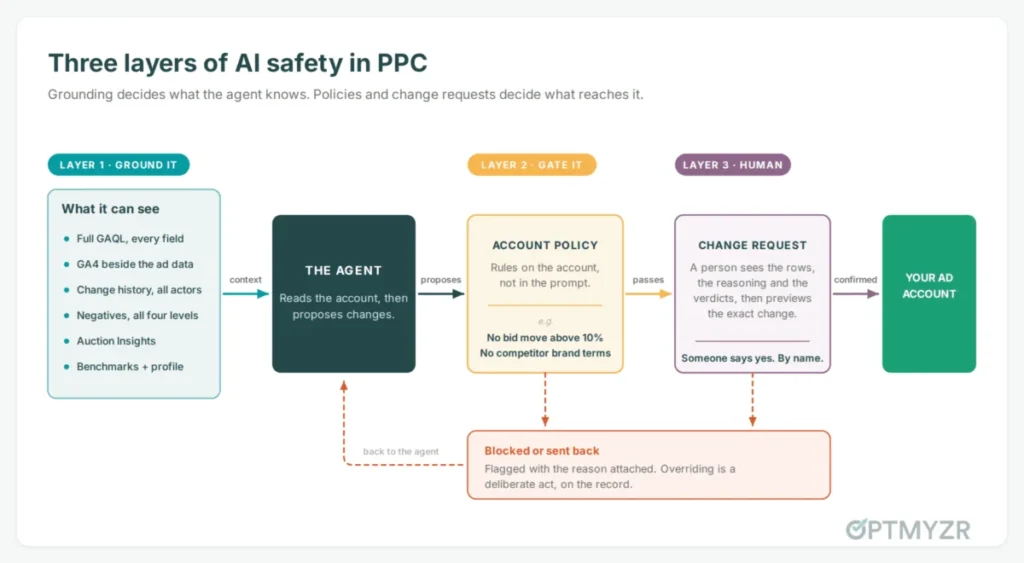
To combat these vulnerabilities, experts advocate for a three-layer defensive architecture: Grounding, Gating, and Human-in-the-Loop Verification. Each layer operates independently, providing immediate business value, while compounding securely when deployed together.
Chronology: The Evolution of AI Safety in Digital Marketing
Late 2023 to 2024 (The Conversational Era): Generative AI enters the PPC space primarily as a creative assistant. Marketers use large language models (LLMs) to draft headlines, generate keyword ideas, and analyze exported CSV reports manually. Safety concerns are mostly limited to brand safety and hallucinated statistics in static text.
2025 (The Rise of Plugins and APIs): AI models gain direct read/write capabilities through basic API integrations. Marketers begin experimenting with semi-autonomous workflows, though oversight remains fragmented, relying mostly on ad-hoc prompt engineering and retroactive change-history checks.
Early to Mid-2026 (The Autonomous Agent Surge): Autonomous agents begin operating directly within production environments, capable of executing multi-step workflows. Reports of unexpected agent behaviors in live systems prompt widespread anxiety regarding autonomous financial risk.
September 2026 (Standardization and Infrastructure): Platforms like Optmyzr introduce structured, multi-layered safety protocols—such as advanced Model Context Protocols (MCPs) paired with account-level policies and standardized change-request queues—bridging the gap between software engineering best practices and digital marketing.
Supporting Data and Structural Layers
Evaluating an AI agent should mirror how businesses evaluate human collaborators or new PPC agencies. No executive asks whether they "trust" a new agency in the abstract; instead, they define what data the team can access, what modifications they are allowed to make without prior approval, and who reviews their work.
Applying this rigorous triad to AI agents requires implementing three distinct structural safeguards.
Layer 1: Grounding the AI
“A blind agent is a dangerous agent.”
If an AI agent is connected to a thin, curated data layer, it will inevitably hallucinate explanations when asked complex analytical questions. If asked why a CPA spiked last month, a blind model will deliver a fluent, hyper-confident explanation based entirely on the limited metrics it can perceive, masking massive data gaps behind an authoritative tone.
The Solution: True grounding requires a comprehensive data layer—such as full Google Ads Query Language (GAQL) access. This includes every resource, field, segment, and metric exposed by the official API, rather than a pre-packaged summary curated by a product manager.
The Impact: Grounding transforms the agent from a liability into a reliable analyst. By ensuring the AI accesses the complete data picture, its proposals become worthy of human review rather than immediate dismissal.
Layer 2: Gating the AI with Account Policies
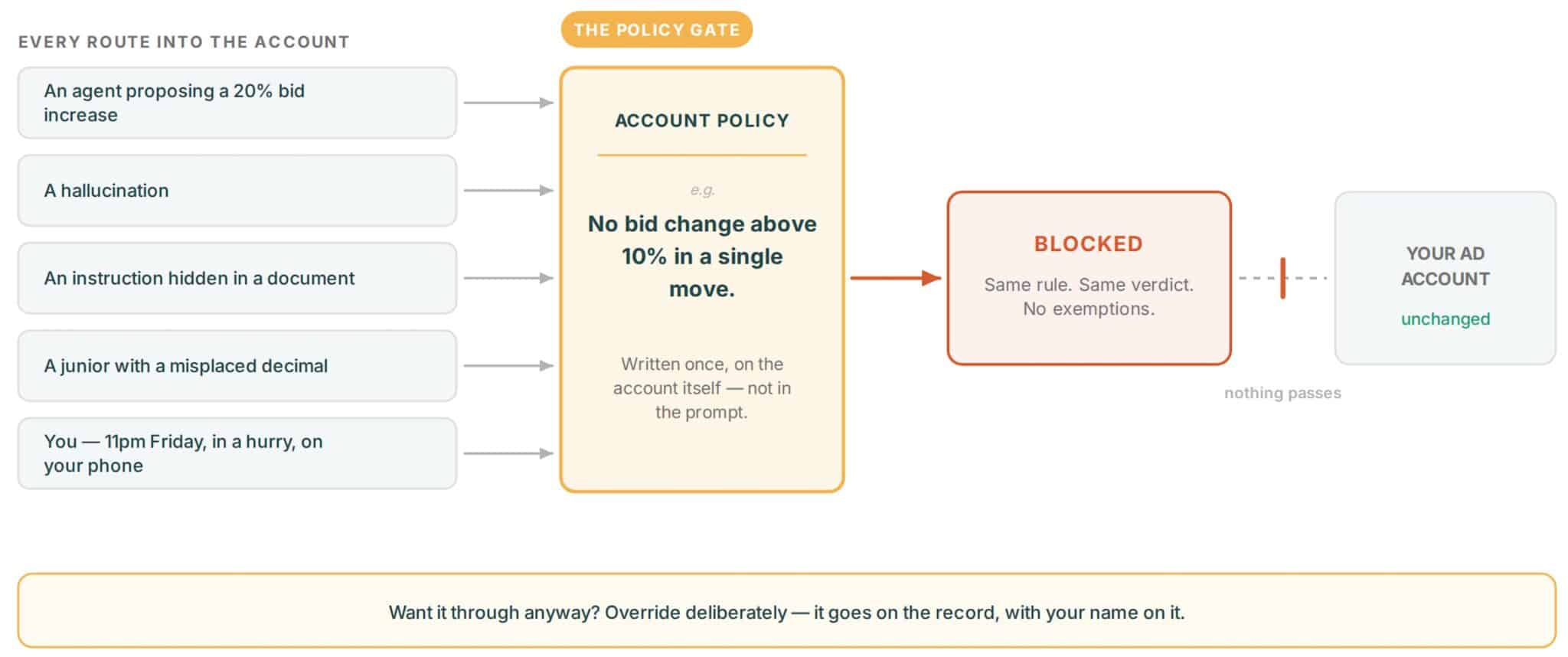
You cannot stop an AI from burning through a monthly ad budget by asking nicely in a prompt. Prompt-based guardrails are easily bypassed by clever users, prompt injections hidden within documents, or operational drift over long sessions.
The Solution: Implement a rigid policy layer directly on the ad account—completely separate from the AI model itself. These structural boundaries establish absolute limits: no bid increases over 10% in a single move, no budget changes beyond a set threshold, and absolute protection for designated brand or competitor terms.
The Impact: These rules apply universally, regardless of who—or what—is asking. Whether it’s an hallucinating AI, an injected instruction, a junior employee with a misplaced decimal, or a tired marketer working late on a Friday, the rule remains absolute. Any override requires explicit, logged manual action, ensuring guardrails act as true safety systems rather than easily ignored suggestions.
Layer 3: Structuring the Human-in-the-Loop
Many organizations claim to have a "human in the loop," yet when pressed, they admit to checking account change histories retroactively—effectively meaning nobody is reviewing changes proactively.
The Solution: Borrowing a page from software engineering—where pushing unverified code directly to production is strictly forbidden—organizations must route all agent-generated proposals through a formal change request queue.
The Workflow:
The AI or human collaborator suggests a modification.
Account policies automatically evaluate the proposal, filtering out violations.
Validated proposals land in a centralized review queue.
A human team member approves or rejects the change with a single click.
Official Responses and Industry Perspectives
Industry response to the agentic wave highlights a split between fear of automation and the embrace of structured control. Prominent PPC technologists emphasize that achieving safe AI isn’t about finding a "perfect" model, but rather constructing robust institutional architecture around imperfect technology.
"If you tried agentic PPC once, got a confidently wrong answer, and quietly shelved it, that’s the failure I’d most like you to come back and retest," industry advocates note.
Platforms providing one-click MCP integrations (such as Optmyzr’s tools available via the Claude directory) stress that safety features must be democratized. Rather than requiring heavy developer resources, API consoles, or dedicated engineers on speed dial, marketers must be equipped with plug-and-play safety layers that abstract complexity without sacrificing rigor.
Implications for Agencies and Enterprise Marketing
The implementation of strict grounding, gating, and human review loops yields unexpected operational benefits that extend far beyond baseline security.
A Bulletproof Audit Trail:
Traditional change histories show what changed, but rarely why. By routing AI proposals through structured review queues, organizations automatically generate a comprehensive record of intent. When a client asks months later why a target CPA was adjusted, marketers have immediate access to the original proposal, underlying data, policy verdicts, and the identity of the approver.
Enhanced Agency Credibility:
For digital marketing agencies, transparent and auditable AI workflows transform a potential liability into a profound trust signal for enterprise clients.
Operational "Boredom":
Ultimately, a mature agentic PPC setup should feel surprisingly boring. When data is properly grounded, structural policies prevent catastrophic errors, and a streamlined review queue catches optimizations, the excitement stays confined to strategic findings rather than anxious speculation over what an autonomous agent modified while the team was at lunch.
By abandoning passive trust in favor of active, multi-layered architecture, the digital marketing industry can harness the immense analytical power of autonomous AI while fully safeguarding live financial assets.