
The Great Migration: How the 2026 Digital News Report Signals a Structural Collapse of Publisher Dominance
The global media landscape is undergoing a transformation that is no longer merely an evolution; it is a structural displacement. According to the 2026 Digital News Report, published on June 15 by the Reuters Institute for the Study of Journalism (RISJ) at the University of Oxford, the era of the "publisher-owned destination" is rapidly drawing to a close.
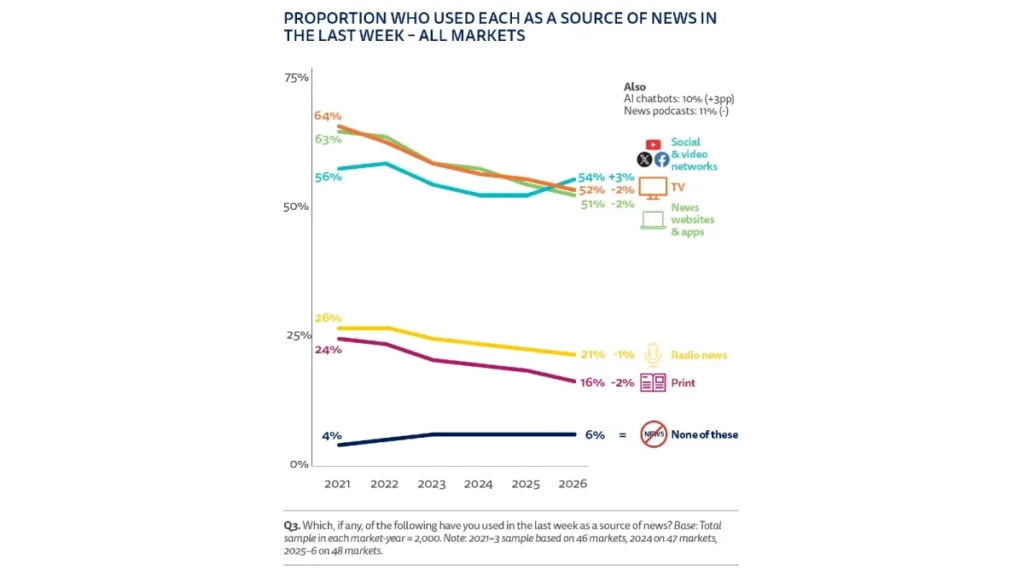
For the first time in the report’s fourteen-year history, the data confirms a bleak reality for traditional news organizations: audiences are not just drifting; they are permanently migrating toward social media, algorithmic video feeds, and generative AI chatbots. In 30 of the 48 countries surveyed, social media and video networks have officially overtaken news publishers’ own websites and apps as the primary gateway to information. This is not a temporary fluctuation—it is a fundamental shift in the architecture of the internet, leaving publishers to grapple with a future where their content is increasingly divorced from their platforms.
The Chronology of Decline: A Decade of Disruption
To understand the current crisis, one must look at the trajectory tracked by the RISJ since 2012.
- 2012–2018: The Social Awakening. Publishers initially embraced social platforms as distribution channels, believing they could lure users back to their "owned and operated" properties.
- 2019–2022: The Algorithmic Pivot. As Facebook and Google tightened their grip on referral traffic, the decline of the homepage began in earnest. Publishers pivoted to "video-first" strategies, yet failed to account for the fact that these platforms prioritized engagement over traffic.
- 2023–2025: The Search Collapse. The introduction of generative AI in search tools began to erode the "Search" pillar of news traffic. Referral traffic from Google to news publishers plummeted by 50% in just two years.
- 2026: The "Post-Publisher" Reality. The current report marks a tipping point. With publisher sites seeing a 5 percentage point drop in users in just one year, the industry is entering a phase where the "destination" website is becoming a secondary, or even tertiary, touchpoint.
Supporting Data: The Erosion of the Direct Relationship
The RISJ report, powered by a YouGov survey of nearly 100,000 respondents, presents a statistical portrait of a dying habit. The retention metrics are particularly damning.
The Generational Divide
While television news has long been viewed as a legacy medium, news websites are now suffering from a similar affliction, particularly among the 18–34 demographic. The report notes that this age group is abandoning publisher platforms faster than they are dropping TV news. In the 18–24 cohort, reliance on news websites as a primary source has dropped 6 percentage points since 2021.
The AI Paradox
The rise of AI chatbots—such as ChatGPT and Gemini—as a news source has hit the 10% threshold globally, with usage doubling in markets like South Korea and Spain. However, the "utility" of these tools for publishers is nearly zero. While users flock to AI to summarize, translate, or interrogate news, they do not click through to the source. The click-through rate for AI tools sits at a meager 4%, compared to 19% for search and 17% for social media. When users do click, it is merely to verify a fact, not to consume the journalism.
The Video Consumption Shift
Perhaps the most ironic finding is that while news consumption in video format is at an all-time high (77% of global respondents consume online news video weekly), it is not happening on the websites of the journalists who produce it. YouTube has become the primary destination for "intentional" news searching, while Instagram and TikTok capture the "incidental" news consumer. The investment by publishers into in-house video players has largely failed to build audience loyalty.
Official Perspectives: Expert Analysis
The report’s lead researchers have been vocal about the implications of these findings.
Richard Fletcher, RISJ’s Director of Research, highlights the distinction between "adoption" and "retention." He notes that while news sites still enjoy a 71% adoption rate, they are hemorrhaging users at the retention stage. "The decline in publisher website use is not a failure to attract new eyes," Fletcher notes, "but a failure to keep the ones we have."
Amy Ross Arguedas, a senior researcher at RISJ, points to a fundamental change in the "job" that news performs for the user. Audiences are no longer looking for a "daily read." Instead, they are using chatbots and creators to interpret complex, high-stress topics. "We are seeing a move toward an ‘interpretive’ model," Arguedas explains. "Users want follow-up questions answered, they want summaries, and they want linguistic translation. They are using AI to interrogate reality, not just to receive a feed of headlines."
Nic Newman, a senior research associate, adds that the rise of "independent creators" has created a hybrid ecosystem. While creators fill the gaps left by traditional newsrooms, they rarely replace them. Even in high-adoption markets like Kenya or the U.S., these creators function as a "supplement" rather than a foundational news source, leaving a vacuum in the ecosystem that neither legacy media nor independent influencers are currently equipped to fill.
Implications for the Advertising Ecosystem
The shift documented in the 2026 report is not just a cultural problem; it is a financial catastrophe for the existing digital advertising model.
The Shrinking Contextual Inventory
For years, the gold standard for advertisers has been "brand-safe" contextual advertising—placing ads next to high-quality journalism. However, as the audience for these sites shrinks and fragments, the scale required for programmatic advertising is evaporating. Advertisers are left with two uncomfortable choices: either pay a premium for a smaller, aging audience that remains on publisher sites, or follow the mass market to the "black box" of social media feeds and AI chatbots where they have less control over ad placement and context.
The Death of Referral Dependency
The decline in search traffic, which fell from 51% to 27% in two years, suggests that the "search engine optimization" (SEO) era of news is effectively over. Publishers are being forced to pivot to subscription-based models or diversify into events and licensing, as seen with industry leaders like Condé Nast. Yet, as the report notes, this model requires massive brand equity. Smaller publishers, lacking the resources to pivot, face an existential threat as their primary source of discovery—search—is cannibalized by AI summaries that do not provide a path back to the publisher.
Political Polarization and Ad Spend
The report also uncovers a troubling link between platform-based news consumption and public sentiment. Users who rely on social media as their primary news source report significantly lower satisfaction with coverage of major global events (e.g., climate change, the Ukraine conflict, and immigration). For advertisers, this means that the platforms currently capturing the largest share of eyeballs are also the ones where the news environment is viewed most negatively. This "brand safety" nightmare is likely to complicate future media buying strategies.
Conclusion: A New Frontier
The 2026 Digital News Report does not offer a roadmap for recovery; it offers a roadmap for survival in a post-publisher world. The data is clear: the habit of visiting a news website is fading, and the structural reliance on third-party platforms is deepening.
As we look toward the remainder of the decade, the divide between publishers who can monetize direct relationships—through subscriptions, newsletters, and community engagement—and those who remain dependent on the fickle algorithms of YouTube, TikTok, and AI interfaces will only widen. The "migration" is complete. The question that remains is whether the institutions that produce the world’s journalism can build a new home in the ruins of the old one, or if they will be relegated to the status of content suppliers for the platforms that have finally eclipsed them.
