
The Great Disruption: Why Andrew Yang’s Vision for an AI-First Economy is More Urgent Than Ever
Every leader navigating the modern corporate landscape faces a singular, haunting challenge: How do we maintain institutional stability when the underlying technology is evolving faster than our policies, our economic frameworks, and our social contracts?
As the velocity of Artificial Intelligence (AI) accelerates, the chasm between technological capability and human readiness has become the defining issue of our time. Standing at the center of this dialogue is Andrew Yang—entrepreneur, former presidential candidate, and bestselling author—who has spent the better part of a decade acting as a canary in the coal mine for the American workforce.
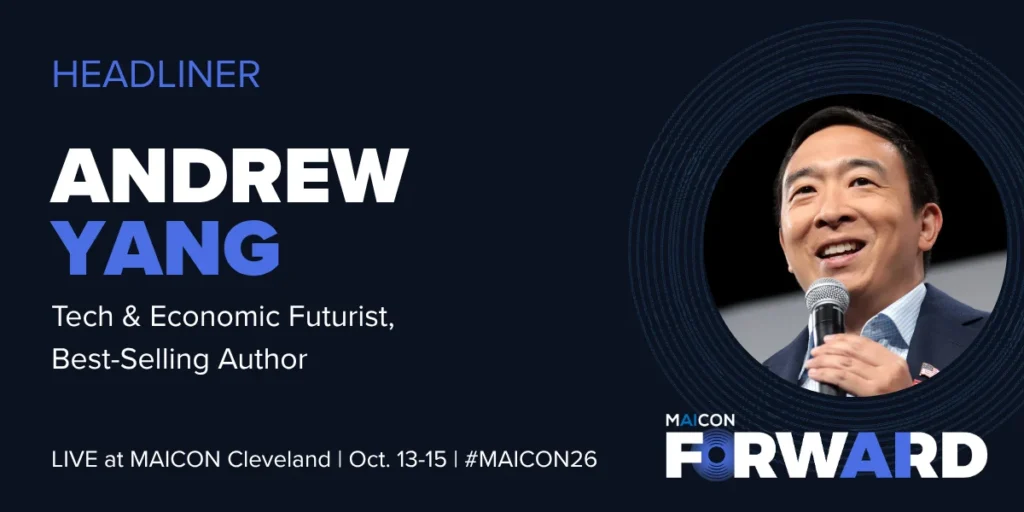
As the keynote speaker for the Marketing Artificial Intelligence Conference (MAICON) 2026, Yang brings a perspective honed by years of intense public scrutiny and rigorous policy debate. His appearance marks a pivotal moment for the conference, shifting the focus from technical implementation to the broader, existential questions of how society and industry can survive—and thrive—in the age of automation.
The Man Who Saw It Coming: A Chronology of Foresight
To understand the weight of Andrew Yang’s message at MAICON 2026, one must look back at the trajectory of his career. Long before generative AI became a household term, Yang was signaling the arrival of the "Fourth Industrial Revolution."
2018–2020: The Presidential Clarion Call
When Yang launched his 2020 presidential campaign, his platform was viewed by many political pundits as eccentric. His core argument—that AI and automation were on the verge of fundamentally dismantling the American workforce—was met with skepticism. At the time, the economy was robust, and the specter of "job displacement" felt like a distant, sci-fi hypothetical.
Yang persisted, famously championing Universal Basic Income (UBI) as a necessary floor for an economy in flux. He argued that as machines began to outperform humans in cognitive and creative tasks, the traditional link between labor and survival would snap.
2021–2024: The Reality Sets In
The skepticism of 2020 evaporated by 2024. As large language models (LLMs) and generative tools entered the mainstream, the economic disruption Yang predicted began to manifest in real-time. In his 2024 blog post, "AI and the Rest of Us," Yang highlighted a sobering anecdote: a business owner who had recently laid off 15 graphic designers, replacing their entire output with AI-generated assets.
What was once a theoretical argument about the future had become a tactical reality for businesses. The creative, administrative, and analytical sectors—long thought to be "safe" from automation—were suddenly on the front lines.
2025–2026: The New Era of Policy and Strategy
Following his TED Talk in 2025, where he reiterated the urgency of structural economic reform, Yang pivoted from electoral politics to building independent coalitions. Through the Forward Party and his continued advocacy, he has transitioned into the role of an essential bridge-builder, connecting the technologists driving AI development with the policymakers who are struggling to regulate its impact.
Supporting Data: The Anatomy of Workplace Displacement
The urgency of Yang’s message is backed by shifting economic indicators that suggest the disruption of the workforce is not a future event, but a current process.
- The Shift in Creative Labor: Data from the last 24 months indicates that entry-level roles in marketing, copywriting, and design are seeing the most immediate "AI-integration." Companies are increasingly opting for "AI-augmented" workflows that reduce headcount by 30% to 50% for standard production tasks.
- The Productivity Paradox: While AI tools significantly boost individual output, the macro-economic benefits have yet to manifest as widespread wage growth. Instead, we are seeing a "hollowing out" of middle-management roles that were traditionally responsible for oversight and administrative coordination.
- Institutional Lag: Current federal and state policies remain largely focused on 20th-century labor protections. According to recent economic forums, less than 15% of current legislative proposals in Washington effectively address the long-term displacement risks posed by autonomous systems.
Official Responses and the Philosophical Divide
The conversation surrounding AI is currently split into two distinct camps: the "Techno-Optimists" and the "Human-Centered Pragmatists," the latter of which Yang leads.
The Techno-Optimist Perspective
Many in Silicon Valley argue that AI will create more jobs than it destroys, citing the historical precedent of the Industrial Revolution. Their official stance is that increased efficiency will drive down costs, stimulate consumer demand, and eventually result in new industries that we cannot currently conceive.
The Human-Centered Response
Yang and his contemporaries argue that while the long-term outlook may be positive, the "transition period" will be catastrophic if not managed with intentional policy. They point out that in previous industrial revolutions, the transition took generations; the AI revolution is unfolding in years.
![Andrew Yang: How AI Can Build a Future that Works for Everyone [MAICON 2026]](https://www.marketingaiinstitute.com/hubfs/Andrew%20Yang.png)
In response to the rapid adoption of AI, leaders across the globe are beginning to experiment with "human-centric" governance. This includes:
- Upskilling Initiatives: Corporate mandates to retrain workers displaced by automation.
- AI Taxes: Discussions regarding taxing machine productivity to fund social safety nets.
- Algorithmic Transparency: Mandating that organizations disclose when AI is being used to make decisions regarding employment or performance management.
Implications for Modern Leadership
For the attendees of MAICON 2026, the implications of Yang’s framework are immediate. Leaders are no longer just choosing software vendors; they are architects of their company’s future social impact.
1. Workforce Planning
Strategic leaders must move away from viewing AI as a cost-cutting tool and toward viewing it as a catalyst for human-machine collaboration. This requires a fundamental rethink of job descriptions and hiring criteria. Are you hiring for task execution, or are you hiring for the human-centric skills (empathy, ethics, creative synthesis) that AI cannot replicate?
2. Risk Management
The legal and ethical risks of AI adoption are growing. From algorithmic bias in hiring to the potential for intellectual property lawsuits, companies that blindly integrate AI without a governance framework are setting themselves up for institutional failure.
3. Long-Term Positioning
The most successful organizations of the next decade will be those that provide the most value to their human stakeholders. Yang argues that the "human-centered economy" will reward companies that prioritize their workforce, as a disaffected or displaced labor force will eventually lead to a collapse in the very consumer base these businesses rely on.
What to Expect at MAICON 2026
At MAICON 2026, Yang’s keynote, titled "The Human-Centered Economy: Building a Future That Works for Everyone," will serve as a roadmap for navigating this volatile landscape. Rather than focusing on the technical mechanics of AI, Yang will challenge leaders to:
- Redefine Value: How do we measure the success of an organization when traditional metrics like "hours worked" become obsolete?
- Bridge the Gap: How can individual businesses advocate for, and implement, policies that protect their workers during the AI transition?
- Foster Innovation: How to harness the creative potential of AI without sacrificing the human spark that drives brand loyalty and innovation.
Yang’s appearance is not just a keynote; it is a call to action. He brings a rare, grounded ability to synthesize complex economic theory into actionable strategy. Whether you are a CEO, a marketing director, or a technologist, his insights offer a framework for making decisions that are not only profitable but sustainable in a world where the rules of the game are being rewritten in real-time.
Join the Conversation
The era of passive observation is over. As we move further into 2026, the decisions made today regarding AI integration, ethical oversight, and workforce development will define the next century of business.
Andrew Yang headlines a powerhouse roster of over 50 industry leaders at MAICON 2026. This conference is designed for those who refuse to be reactive. It is for the leaders who recognize that the speed of technology is a challenge to be met with wisdom, strategy, and a commitment to the human element of the economy.
Are you prepared for the shift?
Join us at MAICON 2026 to hear from Andrew Yang and the brightest minds in the industry. Learn how to turn the current technological disruption into a foundation for a more prosperous and equitable future.
For more information on registration options and to view the full speaker lineup, visit the official MAICON 2026 portal. The future isn’t coming—it’s already here. Ensure you are ready to lead it.
