
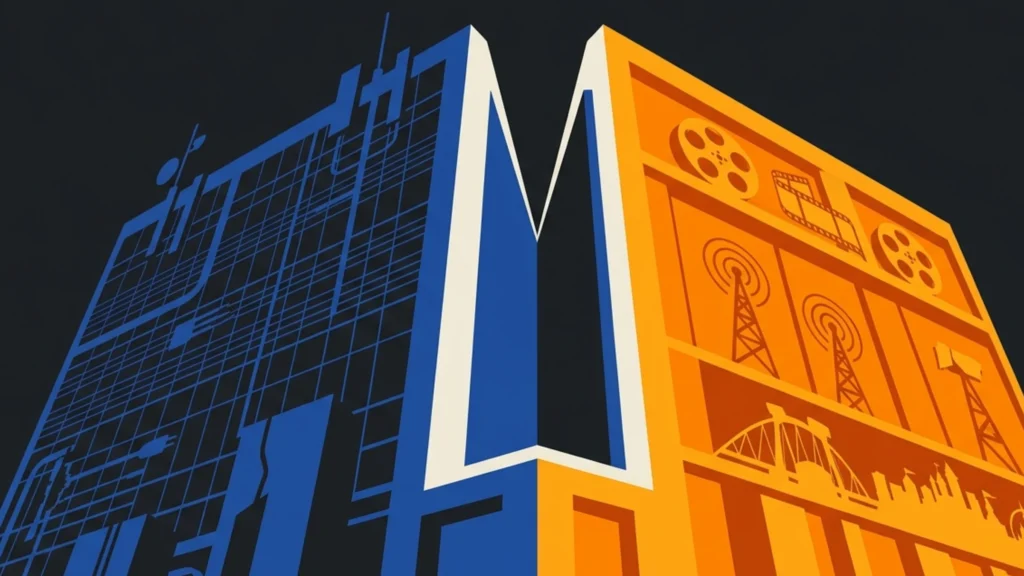
The Great Decoupling: Comcast Announces Historic Split of Media and Connectivity Empires
In a seismic shift that reshapes the global media and telecommunications landscape, Comcast Corporation announced on June 29, 2026, its intention to execute a landmark corporate divorce. The Philadelphia-based giant plans to cleave its massive operations into two independent, publicly traded entities: a pure-play connectivity and technology company, and a global media and entertainment powerhouse.
This tax-free spin-off, which is expected to conclude within 12 months, represents the most significant structural reorganization in the company’s history. It effectively separates the "pipes"—the broadband and wireless infrastructure that form the backbone of Comcast’s revenue—from the "content"—the vast array of studios, networks, theme parks, and streaming platforms that define the NBCUniversal and Sky brands.
The Two New Entities
The Connectivity Powerhouse (The Retained Entity)
The company remaining under the Comcast name will maintain its status as the nation’s largest converged network operator. This entity will focus exclusively on its broadband, mobile, and enterprise technology segments. Its reach is formidable, serving more than 65 million homes and businesses across 40 U.S. states.
The retained Comcast will command the Xfinity brand, including Xfinity Mobile and Comcast Business. Strategically, the company is positioning itself to capture a larger share of the $200 billion wireless market, which Comcast management notes is growing at a rate 2.5 times faster than the broadband segment. By shedding its media weight, the new Comcast aims to operate with a sharper, more agile focus on technological innovation, network infrastructure, and enterprise services.
NBCUniversal (The Spun-Off Entity)
The new NBCUniversal will be a juggernaut of global entertainment, absorbing the European pay-television giant Sky. Its portfolio is staggering in scale:
- Broadcast and Cable: NBC, Telemundo, Bravo, and MSNBC.
- Studios and Production: Universal Film and Television Studios, DreamWorks Animation, Illumination, and Focus Features.
- Theme Parks: Universal Destinations & Experiences, including sites in Hollywood, Japan, Beijing, Singapore, and the soon-to-open Epic Universe in Orlando.
- International Distribution: Sky’s extensive footprint across the UK, Ireland, Germany, Austria, Switzerland, and Italy.
- Streaming: Peacock, which has seen rapid growth, reporting 41 million paid subscribers as of early 2025.
The entity will also hold an enviable collection of sports rights, including the Olympics, NBA, Sunday Night Football, Premier League, and Formula 1, positioning it as a dominant player in both live event broadcasting and global digital distribution.
Chronology: A Rapid Path to Restructuring
The announcement on June 29, 2026, is not an isolated event but rather the second major corporate restructuring for Comcast in less than a year.
- December 2025: The Comcast Board approves the separation of its cable television network portfolio into an independent entity, Versant Media Group.
- January 2, 2026: The Versant Media spin-off officially closes.
- January 5, 2026: Versant Media Group begins trading on the Nasdaq under the ticker VSNT.
- June 29, 2026: Comcast announces the much larger, more complex spin-off of NBCUniversal and Sky.
- Next 12 Months: The company enters a transition period marked by regulatory reviews, the filing of Form 10 registration statements with the SEC, and the finalization of capital structures for both new entities.
Supporting Data and Financial Strategy
The financial architecture of the split is designed to be tax-efficient for shareholders. Comcast intends to distribute shares of the new NBCUniversal on a pro-rata basis, allowing existing shareholders to retain equity in both businesses. To deleverage, Comcast plans to retain a stake of up to 19.9% in NBCUniversal for up to one year post-spin, which it intends to monetize to pay down debt.
Notably, the company has announced a suspension of its share repurchase program for the duration of the separation. Both companies are being engineered to maintain investment-grade balance sheets, though specific debt allocations and dividend policies will be disclosed in the coming months. Goldman Sachs & Co. LLC and PJT Partners are serving as financial advisors, while Davis Polk & Wardwell LLP provides legal counsel.
Leadership Transitions
The separation brings a significant reshuffling of the executive suite. Brian L. Roberts, the long-time Chairman and Co-CEO of Comcast, will maintain an oversight role in both companies, providing continuity during the transition.
- Mike Cavanagh, currently Co-CEO, will step into the role of Chief Executive Officer of the newly independent NBCUniversal.
- Michael Angelakis, a former CFO of Comcast, will return to lead the retained connectivity business as its CEO. He will serve as a Strategic Advisor during the interim period.
"The transaction we are announcing will unlock a more entrepreneurial management approach and open up a multitude of new opportunities for each business," Roberts stated. Angelakis echoed this sentiment, emphasizing that the separation provides a "powerful foundation" for the future by allowing each firm to focus on its distinct core competencies.
Strategic Implications: The Advertising Technology Conundrum
One of the most complex aspects of the split involves the fate of the company’s advertising technology infrastructure. Currently, Comcast’s unified infrastructure powers a significant portion of the global premium streaming ad market.
The Question of FreeWheel and Universal Ads
FreeWheel, a leading video ad server that services giants like DIRECTV, Paramount, and Warner Bros. Discovery, currently operates as a subsidiary of Comcast Corporation. Similarly, "Universal Ads"—the cross-publisher platform used for the 2026 Milan Cortina Olympics—acts as a neutral intermediary for various media companies.
Industry analysts are watching closely to see which entity will control these assets. If FreeWheel or Universal Ads fall under the purview of the new NBCUniversal, competitors may hesitate to use their services, fearing a conflict of interest. If they remain with the connectivity business, they could operate as a neutral, third-party technology provider. The ultimate decision will ripple through the entire programmatic advertising ecosystem.
The Sky-ITV Factor
The implications extend to Europe, where Sky is in the process of acquiring ITV’s broadcast and streaming unit. Should the spin-off proceed while this acquisition closes, the new NBCUniversal would command a massive, consolidated share of the UK television advertising market. This raises potential regulatory scrutiny regarding media concentration in the European theatre.
Why Now? The Rationale for Separation
Comcast’s investor presentation highlights five key drivers for this move:
- Scaled Leadership: Creating two entities that can dominate their respective sectors without the friction of disparate business models.
- Optimized Capital Allocation: Allowing broadband/mobile and media/entertainment to pursue investment strategies tailored to their specific lifecycles.
- Balanced Sheets: Establishing independent credit profiles and financial policies.
- Incentive Alignment: Creating clearer performance metrics and compensation structures for leadership teams.
- Investor Base: Allowing institutional investors to choose between a steady, cash-generative connectivity play or a high-growth, cyclical entertainment play.
Beyond these points, the move acknowledges the harsh realities of the current media environment. Linear television is facing sustained pressure from streaming, and advertising budgets are migrating toward programmatic, data-driven environments. By splitting the businesses, Comcast is essentially admitting that the "synergies" once promised by vertical integration—the idea that content and distribution are better together—are less valuable in the current market than the agility provided by independence.
Conclusion: A New Era
As Comcast prepares for this transition, the industry is left to grapple with a new reality. The 2026 split is not just a corporate maneuver; it is a fundamental reassessment of how media and technology should be structured in the digital age. By the summer of 2027, the telecommunications landscape will look fundamentally different, with a "new" Comcast focused on the infrastructure of the future and an "independent" NBCUniversal tasked with conquering the global streaming and content wars. For investors, employees, and competitors alike, the next 12 months will be a defining chapter in the history of global media.
